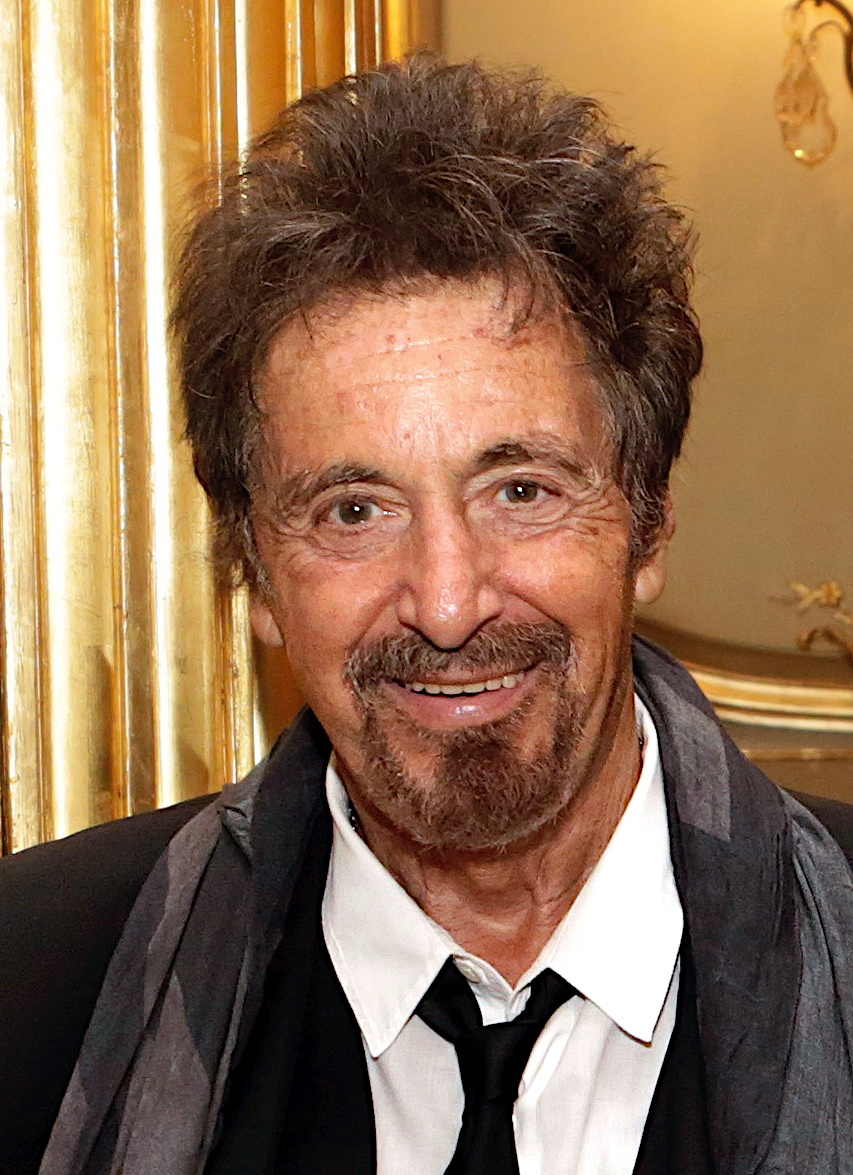
Before he was Michael Corleone, before he was Tony Montana, before he was Serpico or Scarface or the blind colonel who tangoed his way through a hotel ballroom, Al Pacino was a boy in the South Bronx with no money, a broken family, and a need to make himself felt in the world that he had not yet found a way to satisfy. The ferocity that would eventually generate some of the most iconic characters in the history of American cinema had to come from somewhere, and it came from there: from the tenements and the streets and the particular anger of a child who understood that the world had arranged itself against people like him and who decided, with a certainty that most people never find at any age, that he would not accept the arrangement. Acting was not his escape from the South Bronx. It was his way of using the South Bronx, of converting its rawness and its rage into something that other people could receive and be changed by.
Quick Facts
- Full name
- Alfredo James Pacino
- Born
- 25 April 1940, Manhattan, New York City, USA
- Nationality
- American
- Known for
- "The Godfather" (1972), "Scarface" (1983), "Scent of a Woman" (1992), "Heat" (1995)
- Awards
- Academy Award for Best Actor (1993), Tony Award, two Emmy Awards, a Golden Globe Award, BAFTA Award
The South Bronx and a Childhood Built on Absence
Alfredo James Pacino was born on 25 April 1940 in East Harlem, Manhattan, the son of Salvatore Pacino and Rose Gerard, both of Sicilian descent. When he was two years old, his parents divorced. His father moved to California. His mother, who was 22 years old and had no financial resources, moved with Al to the South Bronx to live with her parents, Kate and James Gerard. It was Kate and James who effectively raised him, as his mother struggled with depression through much of his childhood. His grandfather James became the most consistent male presence in his early life, a storyteller who loved theatre and who took young Al to films as often as he could manage.
The South Bronx in the 1940s and 1950s was poor in a way that required constant management. The Gerard household was not unhappy but it was economically precarious, and Pacino grew up understanding poverty not as a romantic condition but as a practical constraint that limited what was available to him and that would limit him permanently unless he found a way out. School was not obviously that way. He was a dreamy and distracted student who entertained his classmates by performing impressions and playing characters but who showed no serious academic engagement with the curriculum. He was, however, consumed from an early age by movies and by the theatre, which he had encountered partly through his grandfather’s enthusiasm and partly through the sheer luck of growing up in a city that had theatre available to those who sought it out.
He dropped out of High School of Performing Arts, which he had entered with high hopes, and spent several years in his teens and early twenties living in profound poverty. He worked a series of menial jobs, including messenger, building superintendent’s assistant, and postal worker, in order to survive while he tried to pursue acting. There were periods when he could not afford a place to live and stayed with friends or in cheap rooming houses. There were periods when he was hungry. The distance between those years and the career they preceded is one of the more extraordinary distances in American cultural biography.
The Actors Studio and the Formation of a Method
Pacino’s formal training began at the HB Studio in Greenwich Village, where he studied with Charles Laughton’s former associate, and it intensified when he was accepted, in his mid-twenties, into the Actors Studio, the legendary institution founded in 1947 by Elia Kazan, Cheryl Crawford, and Robert Lewis and which had produced Marlon Brando, James Dean, Paul Newman, and a generation of actors who transformed American screen performance.
At the Actors Studio he worked with Lee Strasberg, the director and acting teacher who had developed and systematised the method approach derived from Konstantin Stanislavski’s theories of emotional recall and psychological realism. Strasberg was a demanding and sometimes brutal teacher who pushed students to access genuine emotion rather than simulate it, to use their own experiences as raw material for character construction. For Pacino, whose life had already supplied considerable raw material in the form of poverty, abandonment, and grief, the method was not an imposition but a framework for organising what he already possessed.
His early stage work off-Broadway brought him to the attention of critics who recognised that something unusual was happening. He appeared in “The Indian Wants the Bronx” (1966), written by Israel Horovitz and directed by James Hammerstein, playing a street thug in a tense two-hander that required sustained aggression and psychological intensity. The production won an Obie Award and established Pacino’s reputation in New York theatrical circles as someone who was operating at a different level from most of his contemporaries. He won his own Obie for the performance.
He followed this with “Does a Tiger Wear a Necktie?” (1969), which brought him to Broadway and earned him a Tony Award for Best Featured Actor in a Play. He was 29 years old. The Tony signalled to the New York theatre world that a major talent had fully arrived. It also signalled to the film industry, which had begun paying attention, that Pacino was ready for something larger.
The Godfather and the Making of a Legend
In 1971, Francis Ford Coppola was preparing to make “The Godfather,” based on Mario Puzo’s bestselling novel about the Corleone crime family. The studio, Paramount Pictures, wanted established stars for the major roles. Paramount’s executives initially resisted Marlon Brando for the title role and resisted Al Pacino for the role of Michael Corleone, the youngest son who undergoes the film’s central transformation from war hero with legitimate prospects to cold and ruthless mafia boss. Pacino was not yet a film star. He was a stage actor with an Obie and a Tony. Coppola fought for both Brando and Pacino. He eventually prevailed.
The decision was one of the most consequential casting choices in cinema history. Pacino’s Michael Corleone is one of the defining performances of American film. The character requires the actor to convey, across the film’s nearly three hours, the step-by-step logic of a moral disintegration, to make the audience understand how a man who begins the film as the family member least likely to become a criminal becomes the most dangerous person in the room by its conclusion. Pacino accomplished this by playing Michael’s intelligence and his love for his family alongside his coldness, by never making the transformation feel sudden or unjustified, by building it scene by scene with a discipline that belied his age and his relatively limited film experience.
“The Godfather” was released in March 1972. It became one of the highest-grossing films in history at that point, earning over $245 million worldwide against a budget of approximately $6 million. It won the Academy Award for Best Picture, Best Actor for Marlon Brando, and Best Adapted Screenplay for Coppola and Puzo. Pacino was nominated for Best Supporting Actor, a categorisation that seemed strange given that he was arguably the central figure of the film’s emotional arc. The nomination itself was a recognition that something historic had happened in the performance.
Serpico, Dog Day Afternoon, and the Decade of Risk
In 1973, the year after “The Godfather,” Sidney Lumet cast Pacino as Frank Serpico, a New York City police officer who blew the whistle on widespread corruption in the NYPD in the late 1960s and early 1970s. The Serpico role was almost entirely opposite to Michael Corleone: Serpico was a genuine idealist, a man who refused to corrupt himself even as everyone around him was corrupted, who paid for his idealism with his career, his social world, and eventually his physical safety. Pacino played the role with a vulnerability and a genuine moral anguish that showed how wide his range actually was. The film was directed with Lumet’s characteristic clarity and restraint and grossed over $29 million. Pacino received his second Academy Award nomination for Best Actor.
In 1974, he appeared in Coppola’s “The Godfather Part II,” reprising the role of Michael Corleone in a film that intercut the present-day Michael with flashbacks to his father Vito’s youth in Sicily and New York, played by Robert De Niro. “The Godfather Part II” is widely regarded as one of the finest sequels ever made, and Pacino’s performance in it is often considered even more fully realised than his work in the original. The film won six Academy Awards including Best Picture. Pacino received his third nomination for Best Actor.
In 1975, Lumet directed him again in “Dog Day Afternoon,” based on the true story of Sonny Wortzik, a man who robbed a Brooklyn bank in 1972 to fund his partner’s gender reassignment surgery, and whose bungled robbery became a media circus. The role required Pacino to play comic panic alongside genuine tenderness and desperation, and to make the audience simultaneously laugh at and feel for a character whose decisions made no practical sense but whose motivations made complete human sense. The film grossed over $50 million. He received his fourth nomination for Best Actor.
These three films across three years, “Serpico,” “The Godfather Part II,” and “Dog Day Afternoon,” established Pacino as the most important American film actor of the 1970s, a figure who could be trusted to bring full commitment and intelligence to whatever he took on and who was helping to define what American screen acting meant in the post-studio era.
“The camera can film my face but until it captures my soul, you don’t have a movie.”
Scarface, the 1980s, and the Question of Excess
In 1983, Brian De Palma directed “Scarface,” a film written by Oliver Stone that reimagined Howard Hawks’s 1932 gangster film in the context of the Cuban exile community in Miami during the cocaine boom of the late 1970s and early 1980s. Pacino played Tony Montana, a Cuban refugee who arrives in Miami with nothing and rises through the drug trade to immense wealth and power before his own paranoia and cocaine addiction destroy everything he has built. The role required him to play excess in every dimension, physical, verbal, emotional, material, and his performance was, and remains, a matter of genuine critical debate.
The film was initially controversial. Critics were divided about whether it was a morally coherent work or a glorification of violence and excess. Some found Pacino’s performance overwhelming, his accent and his volatility too much. Others found it a towering piece of theatrical energy that served De Palma’s baroque design perfectly. The film was not a conventional critical success on its release, though it grossed over $65 million worldwide. In the years following, its reputation reversed dramatically. It became a cultural touchstone, one of the most quoted films in American popular culture, with Montana’s speeches permeating hip-hop culture and popular consciousness in ways that no one predicted in 1983. The performance, whatever its critics said, achieved a kind of cultural permanence that quieter choices rarely reach.
The 1980s were a more uneven decade for Pacino than the 1970s had been. He made choices that did not always work: “Revolution” (1985), directed by Hugh Hudson, was a critical and commercial disaster. He took a break from film for several years. He returned to the stage, which had always been home for him in a way that Hollywood, despite everything, was not. He appeared in a production of David Mamet’s “American Buffalo” and in a critically acclaimed stage version of “Richard III.” The stage work reminded him and his audience what he could do when stripped of every film support.
Scent of a Woman and the Long-Awaited Oscar
He returned to film with force in the early 1990s. In 1989, he appeared in Brian De Palma’s “Scarface” follow-up in spirit, “Carlito’s Way” (which came in 1993), and in 1990 he appeared in Francis Ford Coppola’s “The Godfather Part III,” a third chapter to the saga that was received with far less enthusiasm than its predecessors but in which Pacino’s performance remained committed and controlled.
In 1991, he appeared opposite Michelle Pfeiffer in “Frankie and Johnny,” directed by Garry Marshall, a quieter and more emotionally open performance than most of his recent work.
The performance that finally brought him the Academy Award he had been nominated for repeatedly came in 1992 with Martin Brest’s “Scent of a Woman.” He played Lieutenant Colonel Frank Slade, a blind, alcoholic, retired Army officer who is being babysat for a Thanksgiving weekend by a prep school student (Chris O’Donnell) while the student deals with his own crisis of moral courage. The film gave Pacino the licence to be theatrical, but it also required him to find the genuine grief and the genuine dignity beneath Slade’s performative misanthropy. The tango sequence, in which Slade dances with a young woman in a hotel ballroom, is one of the most technically demanding things he had ever filmed. The film grossed over $134 million worldwide. He won the Academy Award for Best Actor at his eighth nomination, a record number of nominations before a win at that time.
Heat, The Merchant of Venice, and Continued Authority
In 1995, Michael Mann directed “Heat,” a crime epic in which Pacino played LAPD detective Vincent Hanna opposite Robert De Niro as master thief Neil McCauley. The film is memorable for many reasons, but the most discussed element is the coffee shop scene in which Hanna and McCauley sit across a table for the first time, two men who know they are destined to destroy each other having a brief, lucid conversation about their respective natures. Pacino and De Niro had technically appeared in the same film before, in “The Godfather Part II,” but had never shared a scene. The coffee shop scene was the first time they appeared on screen together, and it was worth the wait.
“Heat” grossed over $187 million worldwide and is widely regarded as one of the finest crime films of the 1990s. Pacino’s performance as Hanna is in the large-scale register that his critics found problematic in “Scarface,” but in Mann’s context it served the film’s operatic ambitions perfectly.
In 2004, he appeared as Shylock in a film adaptation of “The Merchant of Venice,” directed by Michael Radford, that brought Shakespeare to a wider audience without dumbing down the text. His Shylock was human and pitiable and dangerous, and the performance confirmed that his stage training remained the bedrock of everything he did on camera.
He appeared in Michael Mann’s “The Insider” (1999) as television producer Lowell Bergman, a factual drama about the CBS News story on tobacco industry whistleblower Jeffrey Wigand. The performance was among his most restrained and was a reminder that the loud version of Pacino was a choice rather than a limitation. He appeared in Steven Soderbergh’s “Ocean’s Thirteen” (2007), in a delightful villain turn that he played with evident enjoyment.
Later Years and Enduring Influence
Into the 2010s and 2020s, Pacino continued to work prolifically in film and television, taking on a broader range of material than the prestige drama that had defined his peak years. He appeared in “You Don’t Know Jack” (2010), an HBO television film about Jack Kevorkian in which he was extraordinary and for which he won an Emmy Award. He appeared in Martin Scorsese’s “The Irishman” (2019) as Teamsters Union president Jimmy Hoffa, a role in which he was electric and which represented a late-career reunion with Scorsese, De Niro, and the Italian-American gangster world that had originally made his name.
In 2023, he became a father again at the age of 83, with his girlfriend Noor Alfallah, welcoming a son named Roman. The news reminded the public that Pacino had always been, underneath the enormous career, a man who lived at full intensity in every dimension of his life.
Legacy
Al Pacino changed what American film acting permitted. Before him, and before the generation of method-trained actors who reshaped American cinema in the late 1960s and 1970s, American film performance operated within certain conventions of composure and control that derived from the studio era. Pacino, with his theatrical training and his Bronx rawness and his willingness to go further than anyone expected, helped dismantle those conventions and replace them with something that made room for full psychological exposure.
The specific characters he created, Michael Corleone, Serpico, Sonny Wortzik, Tony Montana, Lieutenant Colonel Slade, Vincent Hanna, these figures are part of the shared imaginative vocabulary of American culture in a way that goes beyond cinema. His eight nominations for the Academy Award before winning represent a strange and instructive story about the relationship between extreme talent and institutional recognition. That he won eventually matters less than what the nominations themselves recorded: that across eight different roles, across more than two decades, the Academy recognised that it was in the presence of something exceptional and kept saying so.
Key Facts
- Al Pacino received eight Academy Award nominations before winning for “Scent of a Woman” (1992), a record for the number of nominations before a first win in an acting category at that time.
- His portrayal of Michael Corleone in “The Godfather” trilogy is consistently cited in critics’ polls as one of the greatest performances in cinema history.
- He trained at the Actors Studio in New York under Lee Strasberg and won a Tony Award for Best Featured Actor before he was 30 years old.
- “Scarface” (1983) was a moderate commercial success on release but became one of the most quoted and referenced films in American popular culture over the following four decades.
- He appeared alongside Robert De Niro in “Heat” (1995) in the first scene the two actors shared together on screen, despite having technically appeared in the same film in “The Godfather Part II” (1974).