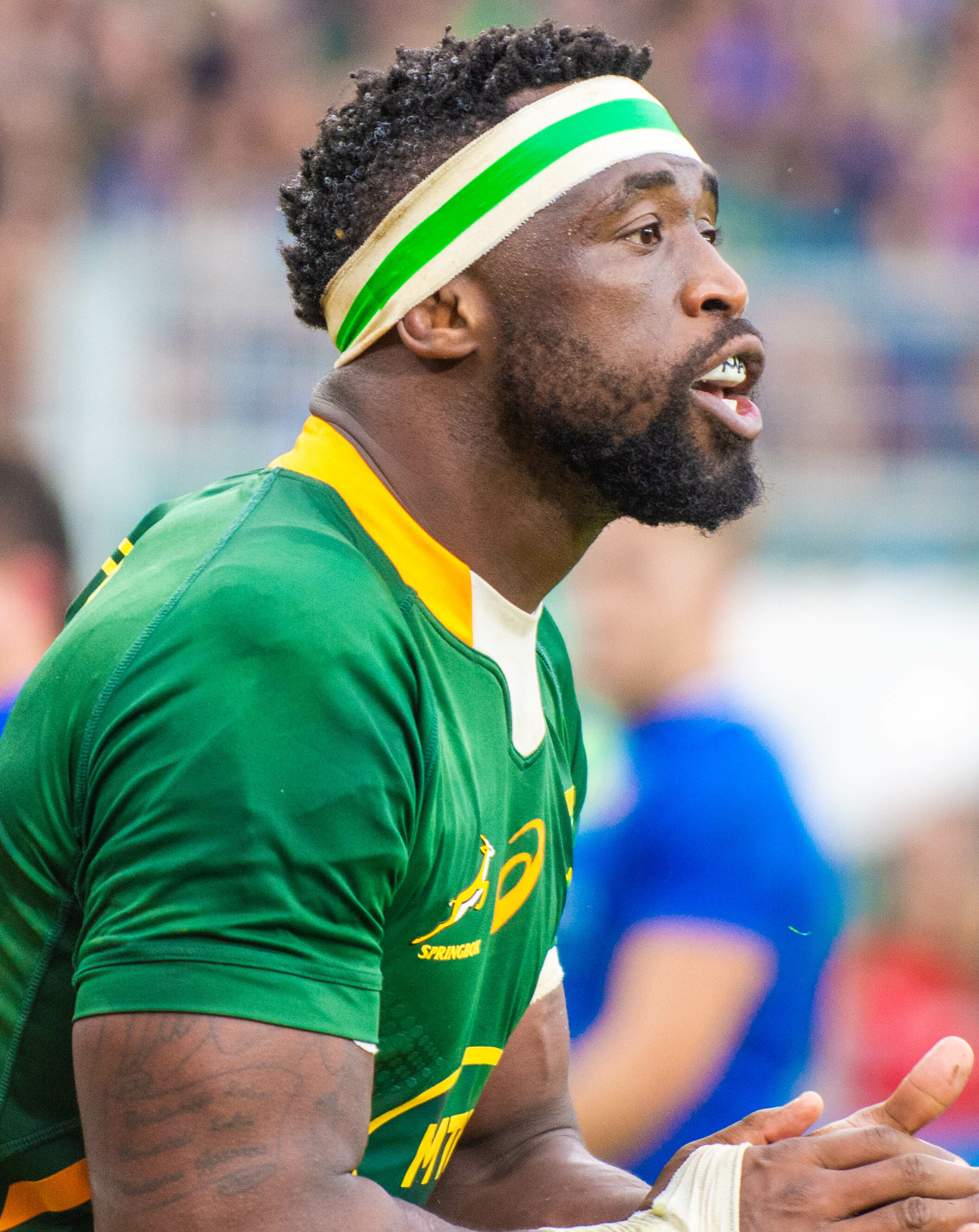
On the evening of 2 November 2019, in a packed stadium in Yokohama, Japan, a man who had grown up sleeping on the floor of a small house in a South African township lifted the Webb Ellis Cup above his head. Siya Kolisi, the captain of the Springboks, had just led his country to a Rugby World Cup title. For a nation still carrying the wounds of its past, the image carried a weight far beyond sport. A Black man wearing the green and gold, the same jersey once reserved almost entirely for white players under apartheid, stood as the leader of a united team. Millions wept. Millions cheered. And a boy from Zwide, who had once gone to bed with nothing in his stomach, became the face of what his country hoped it could be.
This is the story of how he got there.
Quick Facts
- Full name
- Siyamthanda "Siya" Kolisi
- Born
- 16 June 1991, Zwide, Port Elizabeth, South Africa
- Sport
- Rugby union (flanker)
- Known for
- First Black captain of the Springboks; 2019 and 2023 World Cup winner
- Position
- Loose forward / flanker
Early Life
Siyamthanda Kolisi was born on 16 June 1991 in Zwide, a township on the edge of Port Elizabeth (now known as Gqeberha) in South Africa’s Eastern Cape. His name, Siyamthanda, means “we love him” in isiXhosa. He arrived in a world defined by hardship. His mother, Phakama, was only a teenager when she gave birth to him, and his father, Fezakele, was still very young too. Neither could raise a child on their own in the crowded, cash-strapped reality of township life.
So the job of raising Siya fell largely to his grandmother, Nolulamile. She became the anchor of his childhood. Money was almost always short. Kolisi has spoken openly, many times, about going to bed hungry, about days when there was no food in the house, and about learning to stretch the little the family had. There were nights when a single bread roll or a bit of sugar water had to serve as a meal. He slept on cushions on the floor. When he needed something to eat before a rugby match as a boy, it was not always there.
The township of Zwide was a place of tin roofs, dusty streets, and communities holding one another up through struggle. It was also a place where violence, poverty, and alcohol could pull young people off course. Kolisi has said that had rugby not found him, he could easily have gone down a very different road.
Tragedy shadowed his early years. His grandmother, the woman who had done the most to raise him, died in his arms when he was still a boy. Then, when he was a teenager, his mother Phakama passed away as well. He was still a child himself, carrying grief that most adults would struggle to bear. In interviews he has described losing the two most important women in his life within a few short years, and how those losses shaped the driven, emotional man he became.
Amid all this, one thing gave him joy and structure: rugby. He first started playing as a small boy on the fields of Zwide, often barefoot, using whatever ball he could find. He joined a local club, the African Bombers, where the coaches noticed almost at once that this thin, quick, fearless child had something unusual. He tackled bigger boys without hesitation. He read the game. He wanted the ball. Rugby, in a township more often associated with soccer, became his escape and his purpose.
A Scholarship and a Way Out
The turning point came at a youth tournament. As a boy of around twelve, Kolisi was playing in an Eastern Province age-group competition when scouts and coaches from far wealthier schools were watching. His talent was impossible to miss. A place at Grey Junior School, and later Grey High School in Port Elizabeth, one of the most prestigious and rugby-obsessed schools in the country, was offered to him on a scholarship.
That scholarship changed the entire direction of his life. Grey was a world away from Zwide. It had manicured fields, proper equipment, coaching, meals, and boys who had grown up with advantages Kolisi had never known. He arrived barely able to speak English, having grown up speaking isiXhosa, and he has spoken about the loneliness and culture shock of those first years, of feeling like an outsider, of missing home. But he adapted. He learned the language. He grew, physically and as a player, and he began to dominate.
At Grey, Kolisi was no longer just a talented township kid. He was a genuine prospect, the kind of player who moves through the ranks of South African schoolboy and provincial rugby with the sense that he is going somewhere. He represented Eastern Province at youth level and caught the eye of the country’s rugby system. The scholarship had opened a door, and Kolisi ran through it.
He has always been careful to acknowledge what that opportunity meant, and how many boys just like him never got one. It is a large part of why, years later, he would build a foundation aimed at giving others the kind of chance he received.
Rising Through the Ranks
After school, Kolisi moved into the professional system centred in Cape Town. He joined Western Province and then the Stormers, the Super Rugby franchise based at Newlands. He worked his way up through the age grades and into senior rugby, establishing himself as a hard-working, intelligent loose forward: a flanker who could tackle relentlessly, win turnovers at the breakdown, and carry the ball with power.
His performances for Western Province and the Stormers made him one of the most promising young forwards in South Africa. He was named in national development and Under-20 setups, and it was only a matter of time before the senior call came. In June 2013, Siya Kolisi made his debut for the Springboks, coming on against Scotland. Pulling on the green and gold jersey was, for a boy from Zwide, a moment that few in his community could have imagined when he was scrapping for food as a child.
Over the following years Kolisi became a regular in the Springbok squad. He was not always a guaranteed starter early on, and South African rugby had a deep pool of loose forwards, but his consistency, leadership, and work rate kept pushing him forward. He captained the Stormers, developing the calm, leading-by-example style that would later define him at national level. Teammates and coaches spoke of a player who set the tone through effort rather than words, who made his tackles, hit rucks, and asked nothing of others that he did not first demand of himself. By the time a new era of Springbok rugby dawned in 2018, Kolisi had become one of the most respected figures in the squad.
His journey to that point was not a straight line. There were injuries, form dips, and the ordinary grind of professional sport, where reputations are made and lost on small margins. Kolisi weathered all of it. He also carried the constant awareness that he represented far more than himself when he ran onto a field. For many supporters watching from townships across the country, he was living proof that the highest level of the game was open to them too, and he never treated that responsibility lightly.
Captain and World Cup Glory
In 2018, the newly appointed Springbok coach Rassie Erasmus made a decision that would resonate around the world. He named Siya Kolisi as the captain of South Africa. Kolisi became the first Black player to captain the Springboks in a Test match, a milestone in a country whose rugby history is inseparable from the history of apartheid.
For most of the twentieth century, the Springboks were a symbol of white South Africa. Under apartheid, the national team was almost exclusively white, and rugby itself was bound up in the politics of racial division. When Nelson Mandela handed the World Cup trophy to captain Francois Pienaar in 1995, wearing a Springbok jersey, it became one of the most famous images of reconciliation in modern history. But the captaincy itself had never been held by a Black man. Kolisi changing that, in 2018, was heavy with meaning. He led the team out for the first time as captain in June 2018 against England.
Kolisi has always been thoughtful about the symbolism, careful not to reduce himself only to it, but honest about its power. He knew that children in townships like Zwide were watching, and that they could now see someone who looked like them, who came from where they came from, leading the country.
The 2019 Rugby World Cup in Japan became the stage for the story’s most dramatic chapter. South Africa lost their opening pool match to New Zealand but recovered, growing stronger with every game. They ground their way through the knockout rounds, beating Japan and then Wales in a tense semifinal. On 2 November 2019, in the final in Yokohama, they faced England. The Springboks were physically dominant, controlling the game and powering to a 32 to 12 victory. Their wingers, Makazole Mapimpi and Cheslin Kolbe, both scored tries in the second half, and the forward pack overwhelmed England.
When Kolisi lifted the trophy, the image travelled the globe. In his post-match words, he spoke about what the team represented for a divided nation, and about hope.
“We can achieve anything if we work together as one.”
That sentiment, delivered by a boy who had once had nothing, captured why the win mattered so much beyond the scoreboard.
Back-to-Back and a National Symbol
If 2019 made Kolisi a national hero, 2023 confirmed him as one of the greatest captains in the sport’s history. Four years later, at the Rugby World Cup in France, South Africa set out to defend their title, and they did so in extraordinary, nerve-shredding fashion.
The Springboks’ path through the 2023 knockout stage was one of the tightest in World Cup history. They beat host nation France 29 to 28 in a breathtaking quarterfinal, then edged England 16 to 15 in the semifinal, and finally faced their old rivals New Zealand in the final at the Stade de France on 28 October 2023. In a brutal, low-scoring contest played largely against fourteen New Zealand players after an early red card, South Africa held on to win 12 to 11. Every one of their three knockout matches had been decided by a single point.
Kolisi, who had battled back from a serious knee injury earlier in 2023 to even make the tournament, lifted the Webb Ellis Cup for a second time. South Africa became the first team to win the Rugby World Cup four times, and the first to win back-to-back titles since New Zealand. And Kolisi became the first captain to lift the trophy twice as a winning skipper in that back-to-back manner for the Springboks.
By now he was far more than a rugby player. He was a unifying figure across a country that does not agree on very much. When a Black captain from a township lifts a trophy once linked to exclusion, and does it twice, the symbolism deepens into something like national mythology. Kolisi has always tried to use that platform responsibly, speaking about unity without pretending South Africa’s problems are solved, and reminding people that the team’s diversity is its strength rather than a slogan.
Family and Foundation
Away from the field, Kolisi’s life has been shaped by family and by a determination to give back. He married Rachel Smith, and together they had two children, Nicholas and Keziah. In a decision that speaks to his values, Kolisi also took in his younger half-siblings, Liyema and Liphelo, raising them as part of his own family so that they would not grow up in the hardship he had known. He has spoken about the responsibility he feels toward the family he came from and the family he built.
In 2020, Siya and Rachel Kolisi founded the Kolisi Foundation. Launched during the difficult early period of the COVID-19 pandemic, the foundation initially focused on food relief for struggling communities, distributing meals and essentials to families facing hunger, the very hardship Kolisi had lived through as a child. Over time its work broadened to focus on three main areas: food security, education and sport, and the fight against gender-based violence, a crisis that has hit South Africa especially hard.
Kolisi has been an outspoken advocate on gender-based violence, using his profile to draw attention to an issue that many public figures avoid. He has spoken about the importance of men taking responsibility and changing the culture that allows abuse to continue. Through the foundation he has channelled resources into shelters, survivor support, and awareness campaigns.
His personal life has not been without difficulty or public attention. In 2024, Siya and Rachel Kolisi announced that they had separated after several years of marriage, a private matter that drew wide coverage given their public profile. Through it, Kolisi has continued his charitable and sporting commitments. On the club front, he spent a season with Racing 92 in France in 2023 to 2024 before returning to South African rugby to play for the Sharks, keeping his career going at the top level.
Career Timeline
- 16 June 1991: Born in Zwide township, Port Elizabeth, South Africa.
- Early 2000s: Spotted at a youth tournament and offered a scholarship to Grey Junior and later Grey High School in Port Elizabeth.
- 2011 to 2012: Rises through Western Province and the Stormers in South Africa’s professional system.
- June 2013: Makes his Springbok debut against Scotland.
- 2018: Named the first Black captain of the Springboks by coach Rassie Erasmus; leads the team out for the first time against England in June.
- 2 November 2019: Captains South Africa to victory over England (32 to 12) in the Rugby World Cup final in Yokohama, Japan.
- 2020: Co-founds the Kolisi Foundation with wife Rachel, beginning with COVID-19 food relief.
- 2023 to 2024: Joins French club Racing 92 for a season before returning to play for the Sharks in South Africa.
- 28 October 2023: Captains South Africa to a 12 to 11 win over New Zealand in the Rugby World Cup final at the Stade de France, securing back-to-back titles.
Lesser-Known Facts
- His name means “we love him”: Siyamthanda is an isiXhosa name, and Kolisi grew up speaking isiXhosa, learning English only later when he moved to Grey High School.
- He went hungry as a child: Kolisi has spoken repeatedly about days without food in Zwide, sleeping on cushions on the floor, and how rugby gave him a path out of poverty.
- A scholarship changed everything: His talent was spotted at a youth tournament as a boy, earning him a place at the prestigious Grey High School, which transformed his prospects entirely.
- He raised his half-siblings: Kolisi took in his younger half-siblings, Liyema and Liphelo, raising them as part of his own household so they would not endure the hardship he had faced.
- First Black Springbok Test captain: When he was named captain in 2018, he broke a barrier in a national team whose history was deeply entangled with apartheid.
- Two World Cups against the odds: He fought back from a serious knee injury in 2023 to captain the Springboks to their second consecutive world title, with all three knockout matches won by a single point.
Frequently Asked Questions
Who is Siya Kolisi? Siya Kolisi is a South African rugby union player, a flanker and loose forward, who became the first Black captain of the Springboks, South Africa’s national team. Born in 1991 in the township of Zwide, he rose from deep poverty to lead his country to two Rugby World Cup titles.
Why is Siya Kolisi significant? His significance goes far beyond his skill on the field. As the first Black man to captain the Springboks in a Test match, in a country whose rugby history is bound up with apartheid and racial division, he became a powerful symbol of unity and possibility. Leading a diverse team to World Cup glory turned him into a national hero.
How many World Cups has he won? Kolisi has won two Rugby World Cups as captain of South Africa: the 2019 tournament in Japan and the 2023 tournament in France, making the Springboks back-to-back champions.
Where did he grow up? He grew up in Zwide, a township on the outskirts of Port Elizabeth (now Gqeberha) in the Eastern Cape of South Africa. He was raised largely by his grandmother in conditions of severe poverty, often going without food.
What is the Kolisi Foundation? The Kolisi Foundation is a charitable organisation he co-founded with his then-wife Rachel in 2020. It began by distributing food during the COVID-19 pandemic and grew to focus on food security, education and sport, and the fight against gender-based violence in South Africa.
Legacy
Siya Kolisi’s legacy is still being written, but its outline is already clear. On the field, he is one of the most successful captains in the history of rugby, a two-time World Cup winner who led his team through some of the finest margins the sport has ever seen. Off the field, his meaning is even larger. He is proof that a child born into hunger and hardship, who lost his mother and grandmother young and slept on the floor of a township house, can rise to lead his nation and lift the sport’s greatest prize, not once but twice.
For young people across Africa, and especially in the townships of South Africa, Kolisi’s story offers something rare and precious: evidence that where you start does not have to decide where you finish. He has never hidden his roots or pretended the journey was easy. Instead he has used his platform to feed the hungry, to speak against violence, and to insist that unity is not a slogan but a choice a nation makes every day.
When history remembers the Springboks of this era, it will remember the trophies. But it may remember even more the image of a boy from Zwide, holding the World Cup aloft, showing a divided country and a watching continent what is possible when people decide to stand together. That is Siya Kolisi’s true legacy, and it will outlast any scoreline.