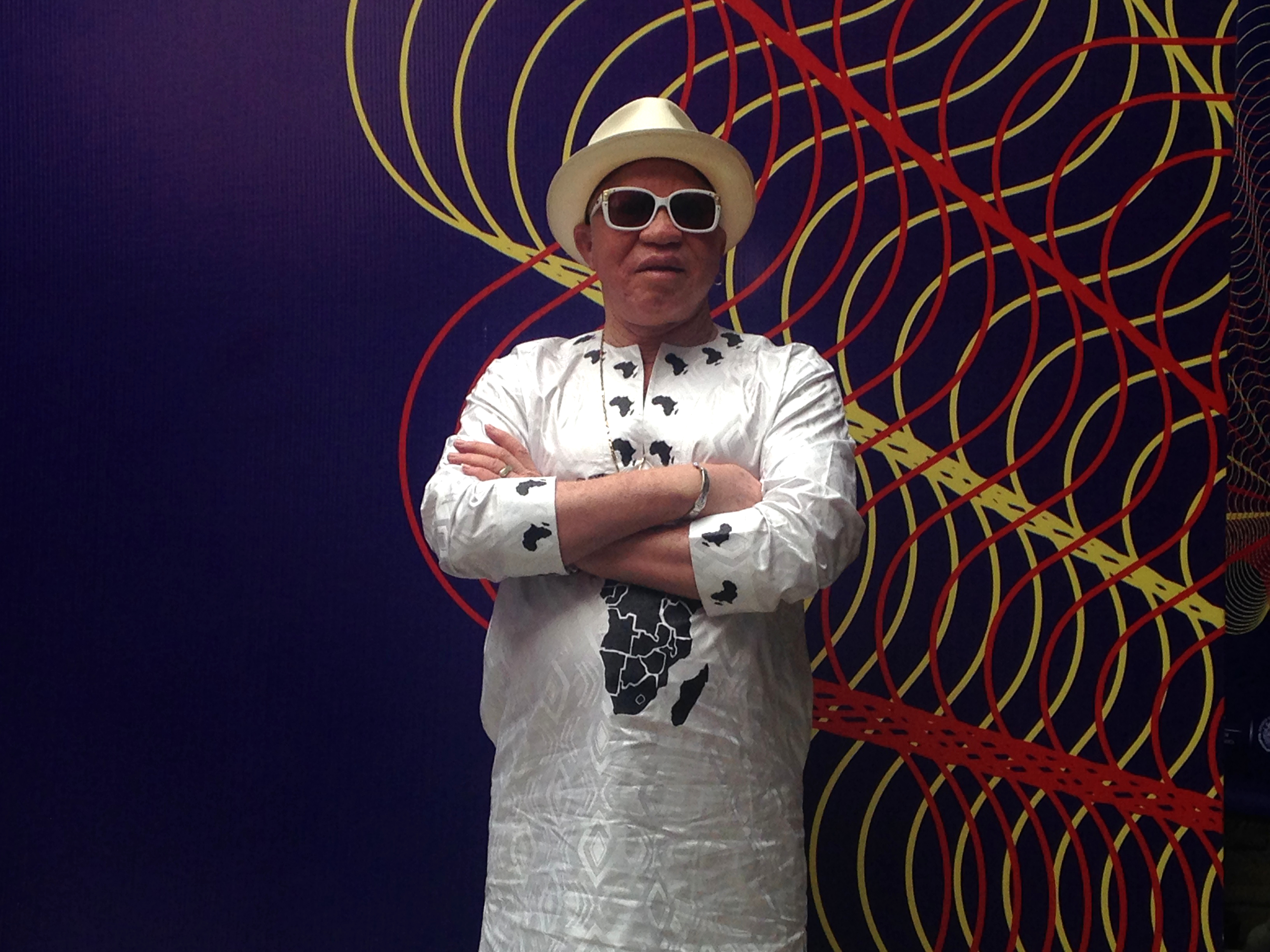
In the village of Djoliba, on the banks of the Niger River in Mali, a boy was born who carried two burdens that seemed impossible to reconcile. He was born with albinism, a condition that in his community was treated not as a matter of genetics but as an omen, a sign of misfortune, sometimes even a mark of the supernatural. And he was born a Keita, a direct descendant of Sundiata Keita, the thirteenth century warrior king who founded the Mali Empire. One inheritance made him an outcast. The other made him a prince. That a person could be both, rejected and royal at the same time, defined the strange and difficult path that Salif Keita would walk toward becoming one of the most celebrated voices Africa has ever produced.
The world would eventually call him “The Golden Voice of Africa.” But before the acclaim, before the sold out concerts in Paris and New York, before the Grammy nominations and the collaborations with musicians from across continents, there was a child who was stared at, whispered about, and told in more ways than one that he did not belong. This is the story of how he sang his way past every barrier that stood in front of him, and how he later turned around to hold the door open for others who carry the same difference he does.
Quick Facts
- Full name
- Salif Keita
- Born
- 25 August 1949, Djoliba, Mali
- Genre
- Afropop, Mande music, world music
- Known for
- "The Golden Voice of Africa"; advocate for people with albinism
- Lineage
- Descendant of Sundiata Keita, founder of the Mali Empire
Early Life: A Prince Marked as an Outsider
Salif Keita was born on 25 August 1949 in Djoliba, a small farming village roughly an hour’s drive south of Bamako, the Malian capital. His birth carried a weight that most newborns never have to bear. He arrived with albinism, an inherited condition that reduces or removes the pigment in the skin, hair, and eyes. In much of West Africa at the time, and in too many places still today, albinism was surrounded by fear and superstition rather than understanding. A pale child born to dark skinned parents was often read as a bad sign, a source of shame, or the product of some curse.
The rejection Salif experienced was not distant or abstract. It reached into his own home and community. He has spoken over the years about being ostracised, about the way people recoiled from him, and about the pain of feeling unwanted by those who should have offered protection. His own father is said to have struggled to accept him at first, and the wider community treated him as an object of suspicion. For a child, the cruelty of being singled out for something entirely beyond his control left scars that would surface again and again in his music and his later activism.
What made his situation even more complicated was his bloodline. The Keita name is one of the most storied in West African history. Salif descends from Sundiata Keita, the legendary figure who unified the Mande peoples and founded the Mali Empire in the thirteenth century, an empire that at its height was one of the largest and wealthiest in the world. To be a Keita was to be nobility, a member of the ruling caste whose ancestors were kings.
Here lay a deep contradiction that shaped his youth. In traditional Mande society, music and the telling of history were not the work of nobles. They were the sacred domain of a hereditary caste of musicians and oral historians known as griots, or jeli. The griots preserved genealogies, sang the praises of rulers, and carried the memory of the people from one generation to the next. For someone of noble Keita blood to take up singing as a profession was seen as improper, even scandalous. A prince was meant to be praised by griots, not to become one himself. So when the young Salif began to feel drawn toward music, he was defying not only the stigma of his albinism but also the rigid social code of his own aristocratic lineage. His pursuit of song was doubly controversial.
There is a bitter irony worth pausing on. The very family status that should have shielded him instead added another layer of disapproval to his ambitions. Rejected for his skin and constrained by his rank, he found himself boxed in on all sides. Music, the one thing that gave him a sense of purpose and belonging, was also the thing his heritage forbade.
Leaving Home for Music
By his late teens, the pressures of village life had become too much. Salif left Djoliba and made his way to Bamako, the bustling capital where a young man might disappear into the crowd and reinvent himself. He arrived with little, and the early years in the city were hard. He is often described as having sung in the streets and markets during this period, surviving on the coins and attention his voice could earn. It was an unglamorous beginning, but it was also a proving ground. In those difficult days he discovered that his voice, high, piercing, and full of raw emotion, could stop people in their tracks.
His talent did not go unnoticed for long. In 1970, Salif joined the Rail Band, one of the most important ensembles in Malian music history. The group was sponsored by the national railway company and was based at the Buffet Hotel de la Gare in Bamako, a hub where travelers and locals gathered. The Rail Band blended traditional Mande melodies with the modern sounds sweeping across the continent, including Cuban rhythms, jazz, and electric instrumentation. Singing with the Rail Band gave Salif a platform and a professional apprenticeship, and it placed him alongside other rising talents, including the celebrated singer Mory Kante, who would also become a star in his own right.
After a few years, Salif made a move that reflected both ambition and the restless churn of Mali’s music scene. He left the Rail Band and joined a rival outfit, Les Ambassadeurs, which was based at the Motel de Bamako. With Les Ambassadeurs he continued to sharpen his craft and expand his reputation as a singer of extraordinary power and range. The group produced music that traveled well beyond Mali’s borders, and Salif’s voice became its defining feature. As political and economic conditions shifted in the region, the band relocated for a time, eventually working out of Abidjan in Ivory Coast, where they recorded and gained a wider West African following under the name Les Ambassadeurs Internationaux. It was during this era that one of his most enduring early songs, “Mandjou,” a tribute steeped in the history and pride of the Mande people, cemented his standing as a major artist.
By the end of the 1970s, Salif Keita had transformed himself from a rejected village boy into one of West Africa’s most respected vocalists. But the continent, for all its love of his music, was only the first stage. A larger world was waiting.
International Career: Soro and the Move to Paris
In the mid 1980s, Salif Keita made the decision that would carry his music to a global audience. He moved to Paris, then a magnet for African musicians seeking wider recognition, better recording facilities, and access to the international “world music” market that was beginning to take shape. Paris had a large West African community and a growing appetite among European listeners for sounds from beyond their borders. For an artist of Salif’s ambition, it was the logical place to make his next leap.
That leap came in 1987 with the release of his solo album Soro. The record was a landmark. It fused the deep traditions of Mande music, its modal melodies, its call and response structures, its griot storytelling, with lush modern production, synthesizers, layered arrangements, and a polished studio sound. The result was something that felt both ancient and utterly contemporary. Soro announced Salif Keita to the world as a singular artist, and it is widely regarded as one of the defining African albums of its era. Critics embraced it, and it opened doors across Europe and North America. Almost overnight, the boy who had sung in the markets of Bamako was being written about in the international press as a major force in global music.

What set Salif apart was not only the beauty of his voice but the way he refused to be confined to a single tradition. Over the following years he continued to experiment, working with musicians and producers from many backgrounds and drawing on jazz, rock, flamenco, and electronic textures without ever abandoning the Mande core of his sound. Albums such as Ko-Yan (1989) and Amen (1991), the latter featuring contributions from renowned figures including the guitarist Carlos Santana and produced with the involvement of jazz keyboardist Joe Zawinul, showed an artist determined to keep reaching outward. He toured widely, performing on stages across Europe, the Americas, and Africa, and his reputation as a live performer of tremendous intensity grew alongside his recorded output.
Through it all, the nickname followed him: the Golden Voice of Africa. It was a fitting description not just of the shining, almost incandescent quality of his singing but of the sense that here was a voice that carried the weight and pride of an entire continent.
A Voice for the Marginalised
As the years passed, Salif Keita’s music increasingly circled back to his roots. After a period living and working abroad, he eventually returned to Mali and built a recording studio there, planting his creative life once again in the soil that had first rejected him. This homecoming was reflected in his art. In 2002 he released Moffou, an album widely praised as a return to a more acoustic, intimate, and traditionally grounded sound. Named after a simple flute used by farmers in the fields, Moffou stripped away some of the heavy production of his earlier international records and let the warmth of Mande music breathe. Many listeners and critics consider it one of the finest albums of his career, and it introduced his voice to a new generation.
The acclaim of this later period brought formal recognition from the wider industry. Salif’s work earned Grammy Award nominations, including recognition in the world music categories, a mark of how thoroughly he had crossed from regional star to global elder statesman of African music. His 2009 album La Difference, whose very title pointed toward the theme of difference and acceptance that ran through his life, won honors and drew particular attention for its openness about his experience of albinism. The album was, in part, a plea for tolerance, using his own story to speak on behalf of anyone who has been treated as an outsider.
His music had always carried social meaning, but in these years the connection between his songs and his lived experience became explicit. The rejection of his childhood, the pride of his heritage, and the longing for a more just and understanding world all flowed together in his work. He was no longer only singing about the Mande past. He was singing for the present and the future, for the marginalised everywhere, and above all for people who shared his condition.
“I want people to understand that an albino is a human being like any other. We are not ghosts, we are not cursed. We are people, and we deserve respect.”
Advocacy for Albinism
Perhaps no part of Salif Keita’s life is more important than the work he has done on behalf of people living with albinism. Having survived a childhood defined by rejection, he understood better than almost anyone the daily reality of prejudice, isolation, and fear that so many with the condition endure. Rather than leaving that pain behind once fame had lifted him out of it, he chose to confront it directly.
In parts of Africa, people with albinism face dangers that go far beyond social exclusion. In some regions they have been the targets of horrific violence, hunted and attacked because of grotesque and false beliefs that their body parts hold magical powers. Children and adults with albinism have been maimed and killed, and families have lived in terror. It is one of the cruelest superstitions on the continent, and it has claimed real lives. Salif Keita has used his fame, his voice, and his resources to fight against it.
He established the Salif Keita Global Foundation, an organization dedicated to supporting people with albinism, raising awareness of the condition, combating the discrimination and violence they face, and providing help with the practical challenges they encounter, including the serious risk of skin cancer that comes with a lack of pigment under the harsh African sun. Through the foundation and through his public advocacy, he has pushed governments, communities, and the wider world to see people with albinism as fully human, deserving of dignity, protection, and equal treatment.
His activism has taken many forms, from benefit concerts to public statements condemning attacks, to using his platform to demand that authorities do more to protect vulnerable people. When violence against people with albinism made headlines, Salif was among the most prominent voices calling for justice and change. For him, this was never an abstract cause. It was personal, drawn directly from the wounds of his own early life, and it gave his later career a moral weight that few artists ever attain.
Career Timeline
- 1949: Salif Keita is born on 25 August in Djoliba, Mali, a descendant of Sundiata Keita, founder of the Mali Empire.
- Late 1960s: As a young man he leaves his village for Bamako, singing in streets and markets to survive while pursuing music against social expectations.
- 1970: He joins the Rail Band, one of Mali’s most influential ensembles, based at the Buffet Hotel de la Gare in Bamako.
- Mid 1970s: He leaves the Rail Band for the rival group Les Ambassadeurs, further building his reputation across West Africa, later performing as Les Ambassadeurs Internationaux from Abidjan.
- Mid 1980s: Seeking a global audience, he relocates to Paris, a center of the emerging world music scene.
- 1987: He releases the acclaimed solo album Soro, which brings him international fame and establishes him as a major world music artist.
- 1991: He releases Amen, an ambitious album featuring collaborations with international musicians including Carlos Santana.
- 2002: He releases Moffou, a celebrated return to a more acoustic, traditional sound, widely ranked among his best work.
- 2009: He releases La Difference, an album addressing his albinism and calling for tolerance, and he continues his advocacy through the Salif Keita Global Foundation.
Lesser-Known Facts
- His albinism shaped his entire life and art. Born with the condition into a community steeped in superstition, he was ostracised as a child, an experience of rejection that later became the driving force behind both his most personal songs and his humanitarian work.
- He broke a powerful cultural taboo simply by singing. In traditional Mande society, music was the hereditary role of the griot caste, not the nobility. As a member of the aristocratic Keita line, his choice to become a professional singer was seen as improper, making his career controversial from the start.
- He is descended from an emperor. His ancestor Sundiata Keita founded the Mali Empire in the thirteenth century, one of the great African civilizations, giving Salif a royal lineage that stretches back roughly 700 years.
- The Rail Band was his launching pad. The ensemble he joined in 1970 was sponsored by Mali’s national railway and became a legendary training ground for the country’s greatest musicians, including fellow star Mory Kante.
- His nickname captures both sound and symbolism. Called the Golden Voice of Africa, the title reflects the shining, radiant quality of his singing as well as his role as a musical ambassador for the entire continent.
- He turned his pain into a foundation. Through the Salif Keita Global Foundation he has campaigned against the persecution of people with albinism and worked to provide them with protection, awareness, and practical support.
Frequently Asked Questions
Who is Salif Keita? Salif Keita is a Malian singer and songwriter, born in 1949, who became one of the most celebrated musicians in African history. Known as the Golden Voice of Africa, he rose from a childhood of rejection to international stardom and has spent much of his life advocating for people living with albinism.
Why is he called the Golden Voice of Africa? The nickname reflects both the brilliant, radiant quality of his singing voice and his stature as one of the continent’s greatest and most internationally recognized artists. He is seen as a musical ambassador who carried Mande and African music to the world.
Why was his music career controversial? He faced controversy on two fronts. He was born with albinism, which carried heavy social stigma, and he came from the noble Keita lineage. In traditional Mande culture, singing was the role of the hereditary griot caste rather than the nobility, so a prince becoming a professional musician broke a deeply held taboo.
What is he known for advocating? He is a leading advocate for people living with albinism. Through his public voice and the Salif Keita Global Foundation, he campaigns against the discrimination and violence they face in parts of Africa and works to promote awareness, dignity, and practical support such as protection from skin cancer.
Where is he from? He was born in the village of Djoliba in Mali, near the capital Bamako, and he is a descendant of Sundiata Keita, the founder of the ancient Mali Empire.
Legacy
Salif Keita’s legacy rests on the rare combination of a once in a generation voice and a life lived with unflinching honesty. As a musician, he helped define what African music could be on the global stage, proving that the modal melodies and griot traditions of the Mande world could stand alongside any sound on earth without apology or dilution. Albums like Soro and Moffou remain touchstones, studied and loved by musicians and listeners far beyond Mali, and his influence echoes through the work of countless African artists who followed the path he cleared.
But his greatest legacy may lie beyond the concert hall. Here was a man told from birth that he was cursed, unwanted, and out of place, and who answered that rejection not with bitterness alone but with a voice that demanded to be heard and, later, with a mission to spare others the pain he had known. In fighting for people with albinism, he transformed his private suffering into a public cause, and in doing so he changed how many people across Africa and the world think about difference, dignity, and belonging.
He remains a living symbol of a simple, powerful truth: that the thing that sets a person apart can become the very source of their greatness. The prince who was cast out became the Golden Voice of Africa, and the boy who was told he did not belong sang until the whole world had no choice but to listen.