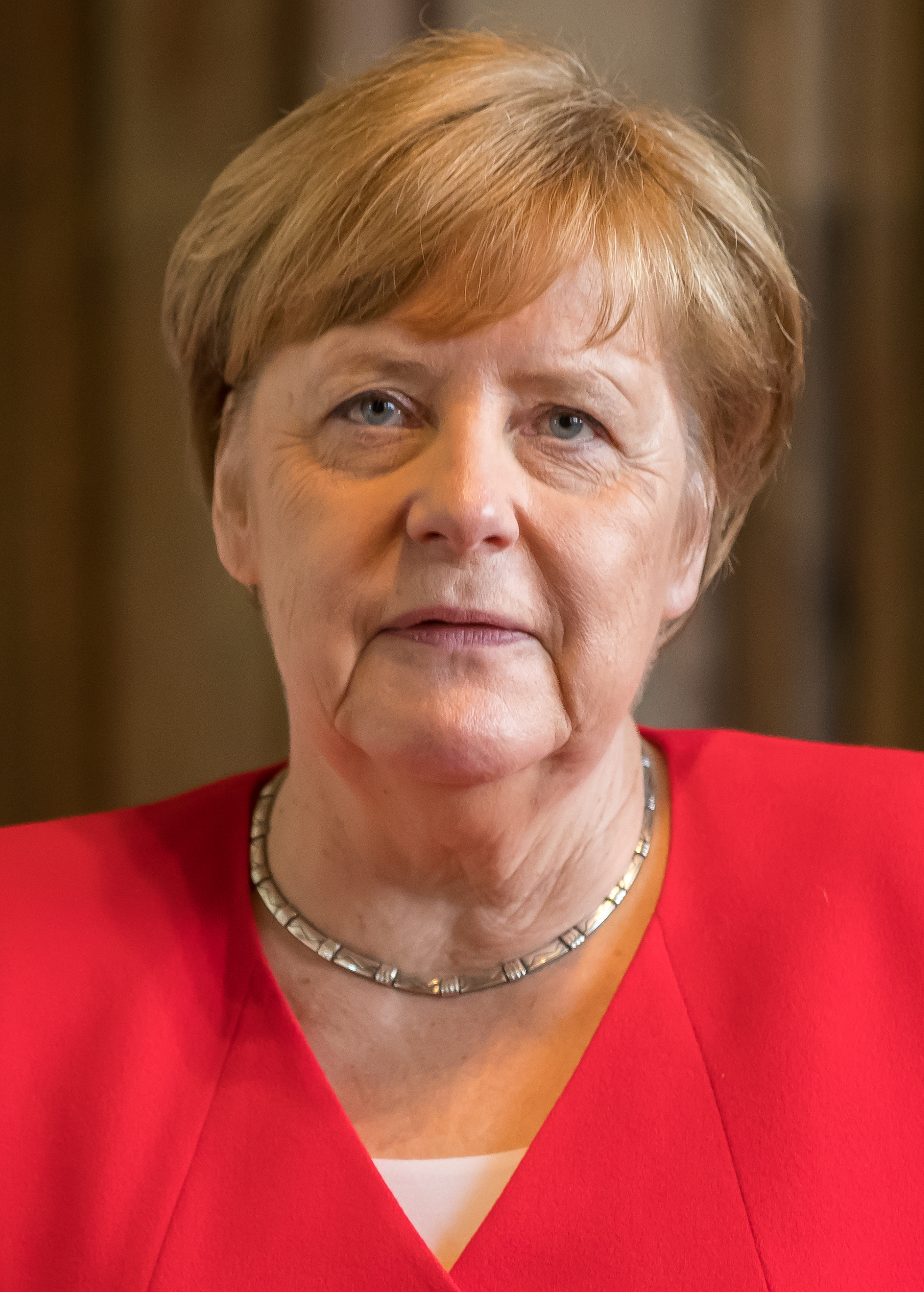
There is a gesture that Angela Merkel made famous without ever intending to. She would sit or stand with her fingertips touching, thumbs up, forming a rough diamond shape over her abdomen. Politicians and observers called it the Merkel-Raute, the Merkel diamond. It appeared in cartoons, on protest signs, at sporting events where fans formed it with their hands in stadiums to show their approval. The gesture itself is entirely neutral, a posture of quiet concentration, and that is precisely what made it so characteristic of its owner. In an era of theatrical politics, of leaders who performed emotion, projected dominance, and filled every available second of airtime with noise, Angela Merkel became the most powerful politician in Europe by being, almost demonstratively, calm.
Quick Facts
- Full name
- Angela Dorothea Merkel (born Kasner)
- Born
- 17 July 1954, Hamburg, West Germany
- Died
- Living
- Known for
- Chancellor of Germany (2005 to 2021); leader of the Christian Democratic Union; Europe's most influential political figure during the global financial crisis and refugee crisis
- Key achievement
- Served four consecutive terms as German Chancellor, navigating the eurozone crisis, the 2015 refugee crisis, and Brexit while maintaining Germany's position as Europe's central political and economic power
Hamburg and Templin: A Childhood Across Two Germanys
Angela Dorothea Kasner was born on 17 July 1954 in Hamburg, in what was then West Germany. Her father, Horst Kasner, was a Lutheran pastor who made a decision that shaped his family’s entire trajectory: in 1954, a few weeks after Angela’s birth, he moved his family to Quitzow, a small town in the German Democratic Republic, the Communist East. The move was unusual and somewhat controversial. Most people in those years were trying to get out of the East; Horst Kasner was going in. He believed he had a pastoral calling to serve a congregation in a state that the Lutheran church was still trying to establish its relationship with.
The family eventually settled in Templin, a small town north of Berlin in the state of Brandenburg, where Horst Kasner built a pastoral training centre called the Waldhof. Angela grew up in a house that was, by the standards of East Germany, exceptionally comfortable and intellectually lively. Her father was a man of genuine learning and a certain political flexibility that allowed him to navigate the requirements of the East German state without becoming its enthusiast. The family had access to West German television. Books were plentiful. Guests of various kinds came through the Waldhof, including Western visitors whose presence gave the children a slightly less constricted view of the world than most of their contemporaries enjoyed.
She was not a dissenter in her school years. She participated in the Free German Youth, the state socialist youth organisation, as virtually all East German schoolchildren did. She was talented at languages, learning Russian to a high level and winning national competitions in it, and she was exceptionally gifted in mathematics and the natural sciences. These gifts were recognised and encouraged by her teachers, and she was, by her own later description, a child who found the structure of science more congenial than the ambiguities of politics or personal expression.
The East Germany in which she grew up was not the worst version of Soviet-style Communism. It was also not a free society. The Stasi, the state security service, maintained informants in every workplace and social environment, and the surveillance was sufficiently thorough that most East Germans developed a second nature of self-monitoring, of knowing what could be said to whom, and keeping certain thoughts for private moments. Whether and to what extent Merkel was shaped by this environment of constrained speech became a subject of some speculation when she entered West German politics, with observers sometimes attributing her caution and her reticence to the habits formed in a state where unguarded speech carried real risks.
Physics and a Different Kind of Precision
She studied physics at Karl Marx University in Leipzig from 1973 to 1978, and the choice was characteristic in several ways. Physics was a discipline in which ideological conformity mattered less than in the humanities and social sciences. You could not make a dialectical materialist argument about quantum mechanics; the particles either behaved as the equations predicted or they did not. For a young woman of intelligence and ambition growing up in a state where the humanities were saturated with political requirements, the natural sciences offered a kind of refuge of pure reasoning.
She was a serious student, disciplined and methodical in her approach to problems. She graduated with a degree in physics and then completed a doctorate at the Academy of Sciences in East Berlin, where she worked on quantum chemistry, publishing her doctoral dissertation in 1978 on the decay rates of hydrocarbon ions in reaction mechanisms. The work was competent and solid without being transformative, the kind of doctoral research that builds the painstaking technical foundation for a scientific career rather than the kind that announces a future Nobel Prize winner. But the habits of mind it instilled, breaking complex systems into their components, testing hypotheses rigorously, accepting the evidence even when it contradicted the preferred theory, would later prove to be among the most valuable tools she brought to politics.
She married in 1977, a fellow physics student named Ulrich Merkel. The marriage did not last; they divorced in 1982. She kept his surname. She later married Joachim Sauer, a quantum chemistry professor, in 1998, and the marriage has been a lasting one, though Sauer has maintained a careful and consistent distance from the public dimensions of his wife’s political life.
She was working as a researcher at the Central Institute for Physical Chemistry of the Academy of Sciences in East Berlin in November 1989 when the Berlin Wall came down. Her account of that evening is one she returned to in interviews over the years: she had been to a sauna with friends, as she typically did on Thursday evenings, and by the time she emerged and heard the news, the crowds were already surging at the checkpoints. She crossed into West Berlin, had a beer with some strangers in someone’s apartment, and then came home to sleep because she had work the next morning. The anecdote is quintessentially Merkel, underplaying a historical moment that would have tempted most people to rhetorical extravagance, and getting home in time to be functional the next day.
Entry into Politics: The Post-Reunification Moment
The fall of the Wall and German reunification in 1990 created an enormous opening in German political life. The parties of West Germany were extending themselves into the East, absorbing East German political organisations, and in the process creating careers for a new generation of East German politicians who could claim both the credibility of having lived under Communism and the democratic legitimacy of the new unified system.
Merkel joined the newly formed Democratic Awakening party in December 1989, one of the East German political groupings that emerged in the brief, extraordinary window between the fall of the Wall and the formal reunification of Germany. Democratic Awakening subsequently merged into the East German branch of the Christian Democratic Union, West Germany’s major centre-right party, and Merkel, who had no prior political career and no established base of support, became a CDU politician.
What she had, which was not nothing, was intelligence, a talent for navigating bureaucratic systems, and the backing of Lothar de Maiziere, the last prime minister of the GDR before reunification, who noticed her abilities and brought her into his circle. When Chancellor Helmut Kohl formed his first all-German government after the October 1990 elections, Merkel was appointed Minister for Women and Youth, partly because of her competence and partly because Kohl wanted to be seen to include younger women and East Germans in his cabinet.
Kohl famously, and subsequently embarrassingly, referred to her as “das Madchen,” the girl, a patronising diminutive that conveyed how little he expected from her. What she did with the opportunity was watch, learn, and build the political relationships and the understanding of how German federal politics actually worked that would eventually allow her to step from relative obscurity to the leadership of her party.
The Rise: From Kohl’s Girl to Party Leader
Merkel moved from the Ministry for Women and Youth to the Environment Ministry in 1994, a more substantial portfolio that gave her responsibility for Germany’s participation in the early international climate negotiations and for managing the complex environmental legacy of the heavily polluted former East Germany. She attended the first Conference of the Parties to the UN Framework Convention on Climate Change in Berlin in 1995 and demonstrated in those negotiations a mastery of technical detail and a capacity for patient multilateral diplomacy that would become hallmarks of her later work.
The CDU’s 1998 election defeat, which ended the Kohl era after sixteen years, created the conditions for Merkel’s ascent. Kohl was then engulfed by a party financing scandal in 1999, and Merkel, who had by then risen to become CDU secretary general, wrote a newspaper article calling on the party to separate itself from Kohl and move forward. It was a politically calculated but also genuinely courageous act: Kohl had been her patron, and the article ended that relationship. But it also positioned her as someone who could be trusted to put the party’s interests above personal loyalty.
She won the CDU leadership in 2000. The party that she inherited was demoralised, financially compromised, and operating in the shadow of its founding father’s disgrace. She rebuilt it with the same methodical patience she brought to everything, travelling the country, building relationships, establishing her authority through sheer persistent competence rather than through charisma in the conventional sense.
She ran for chancellor in 2005 against the incumbent Social Democrat Gerhard Schroeder. The campaign was not an easy one. The CDU was expected to win by a comfortable margin, but in the final weeks Schroeder’s aggressive campaign style closed the gap, and the result on election night, 18 September 2005, was one of the closest in German postwar history. The CDU/CSU won 35.2 percent to the SPD’s 34.2 percent: a razor’s edge victory that forced a grand coalition between the two major parties. Merkel became chancellor in November 2005, the first woman and the first East German to hold the office.
The Governing Style: Sixteen Years of Muddling Through Brilliance
Merkel’s approach to governing confounded people who expected either the ideological conviction of a traditional conservative or the bold transformative ambition associated with historic leadership. She was, in the description of many who worked with her, a tactical politician of extraordinary skill operating within a broadly centrist framework, one who would occupy the political centre ground rather than try to shift it, who would manage crises rather than ideologically reframe them, and who would reach decisions through a process of exhaustive information-gathering that sometimes maddened colleagues who wanted faster action.
The global financial crisis of 2008 and 2009 was the first major test. Merkel’s government responded with a combination of fiscal stimulus, bank rescue measures, and labour market policies (the Kurzarbeit short-time work scheme, which paid workers to stay employed at reduced hours rather than be laid off) that kept Germany’s unemployment from spiking as sharply as in most other major economies. Germany emerged from the crisis in better shape than most of its European partners, and Merkel’s reputation as a sound steward of economic stability was consolidated.
The eurozone sovereign debt crisis of 2010 to 2015 was more complicated, and her handling of it more contested. Greece, Ireland, Portugal, Spain, and Cyprus required international financial support to avoid default on their sovereign debts, and Germany, as the eurozone’s largest and strongest economy, was the central actor in shaping the terms of the bailout programmes. Merkel pushed for conditions: fiscal austerity, structural reforms, and intrusive international oversight of the debtor countries’ budgets. Her critics in the affected countries and among left-leaning economists argued that the conditions were unnecessarily harsh and that they prolonged the recession in southern Europe by choking off public spending during a demand shortfall. Her supporters argued that the conditions were necessary to maintain the discipline that made the euro a credible currency.
“For me, Europe is not a question of economics. It is a question of war and peace.”
This statement, made in a 2011 speech to the Bundestag, captured the core of Merkel’s European conviction: that European integration was ultimately not an economic project but a peace project, born from the catastrophe of two world wars and sustained by the recognition that the nation-states of Europe could not reliably prevent their conflicts from becoming global disasters without the structures of shared governance and mutual interdependence that the EU represented.
The Refugee Crisis: The Decision That Defined Her
In the summer of 2015, the Syrian civil war and the conflicts in Afghanistan, Iraq, and Eritrea produced the largest movement of people toward Europe since the Second World War. By September, images of refugees stranded at Budapest’s Keleti railway station, and of the body of a three-year-old Syrian boy named Alan Kurdi washed ashore on a Turkish beach, produced a moment of moral and political intensity in Germany that was impossible to ignore.
On the night of 4 to 5 September 2015, Merkel made the decision to open Germany’s borders to the refugees stranded in Hungary and Austria. Over the following months, more than a million people, the majority from Syria, Afghanistan, and Iraq, entered Germany. It was the most consequential and the most disputed decision of her chancellorship.
She justified it in characteristically simple terms: “Wir schaffen das.” We can do this. The phrase became both a rallying cry for the volunteers who flooded into German train stations and refugee reception centres with food, clothing, language lessons, and practical help, and a target for her political opponents, who argued that she had made a unilateral decision that destabilised Europe, overwhelmed German administrative capacity, and provided electoral fuel for the far-right Alternative for Germany party, which had been a minor political force before 2015 and became a significant parliamentary presence after it.
The refugee decision was both right and costly in ways that continue to shape German politics. The integration of the refugees who came in 2015 has been a long and imperfect process, with significant successes and significant failures. The political consequences for Merkel’s party were real: the CDU’s vote share declined in subsequent elections, and the rise of the AfD as a parliamentary force is partly attributable to the 2015 decision, though the AfD’s roots run deeper than a single policy choice.
Later Years: Brexit, Trump, and the Twilight of an Era
The last years of Merkel’s chancellorship were shaped by two developments that she could not control. Brexit, the United Kingdom’s decision to leave the European Union, which was confirmed by the June 2016 referendum, disrupted the European order that Merkel had spent sixteen years working within and required years of tedious negotiation to manage the terms of departure. And the election of Donald Trump as US president in November 2016 disrupted the transatlantic relationship that had been the bedrock of German foreign and security policy since 1945.
Merkel managed both challenges with her characteristic combination of patience and firmness. On Brexit, she maintained the EU’s negotiating unity and protected the integrity of the single market while avoiding the kind of punitive language that some European politicians used. On Trump, she was notably direct in ways that were unusual for her: after a G7 summit in 2018, she issued a statement that “the times in which we could completely rely on others have passed to some extent” and that Europeans needed to take their destiny into their own hands. The statement was widely read as a response to Trump’s unreliability and was more publicly critical of a US president than anything a German chancellor had said since the relationship was rebuilt after 1945.
She announced in October 2018 that she would not stand again as CDU party leader and would not seek a fifth term as chancellor. She served out the remainder of her term in a kind of extended epilogue, managing the early stages of the COVID-19 pandemic with a public communication style that many observers found more reassuring and credible than that of leaders in many other countries. She addressed the German public in March 2020, calling the pandemic the greatest challenge since World War Two and appealing for solidarity and personal responsibility with a directness and gravity that reminded people that behind the bureaucratic pragmatism there was a person of genuine moral seriousness.
She left office on 8 December 2021, when Olaf Scholz of the SPD was sworn in as her successor. She had been chancellor for 5,860 days, just over sixteen years, and had served alongside four French presidents, four British prime ministers, and four American presidents. She has since maintained a public profile of conspicuous modesty, declining most of the international speaking circuits and advisory roles that typically follow former heads of government, and appearing publicly only occasionally and on her own terms.
Legacy
Angela Merkel’s legacy is the subject of ongoing and often fierce debate in Germany and across Europe, which is itself a measure of how consequential her leadership was. She governed Germany during a period of extraordinary turbulence, through two major economic crises, a refugee emergency of unprecedented modern scale, the Brexit disruption, and the first stirrings of what would become a profound challenge to the liberal international order. That Germany emerged from these sixteen years with its economy broadly intact, its democratic institutions functioning, its international position strong, and its European commitments maintained is not entirely her work, but she deserves substantial credit for it.
The criticisms are also real. Germany’s underinvestment in public infrastructure and digital modernisation during her chancellorship left real deficits. Her energy policy, which pursued the simultaneous phaseout of both nuclear power and coal while maintaining Germany’s dependence on Russian natural gas, proved catastrophically miscalculated when Russia invaded Ukraine in 2022. The question of what Germany paid, in terms of deferred investment, structural economic reform, and strategic energy vulnerability, for the stability of the Merkel years is one that German society is actively working through.
What is not seriously disputed is the stature of the person. A physicist from Communist East Germany who learned politics the way she had learned science, by patient observation and disciplined analysis, Angela Merkel became the most powerful European leader of her generation and held that position for longer than anyone expected. She did it without drama, without a defining ideology, and without any apparent interest in how she would be remembered. That combination of effectiveness and ego-freedom is rarer in politics than almost any other quality, and it is perhaps the most distinctive thing about her.
Key Facts
- Merkel was Germany’s first female chancellor, first East German chancellor, and at the time of her first election in 2005, one of the youngest people to hold the office at 51 years old.
- She holds a doctorate in quantum chemistry from the Academy of Sciences in East Berlin, awarded in 1978 for research on the decay rates of hydrocarbon ions.
- During the 2015 refugee crisis, Germany received over a million asylum seekers in a single year, more than any other European country, under Merkel’s “Wir schaffen das” policy.
- She served under five popes, four US presidents, four French presidents, and four UK prime ministers during her sixteen-year chancellorship.
- In 2015 and again in subsequent years, Forbes magazine ranked Merkel as the most powerful woman in the world, a distinction she held for a decade.