On a summer evening in Canada in 2014, a young Nigerian forward stood on the pitch as the flashbulbs went off around her. She had just been named the best player at a global tournament, and she had also finished as its leading scorer. For most of the watching world, Asisat Oshoala was a fresh discovery, a name to remember. But for the young woman herself, that moment carried the weight of everything she had fought through to reach it: the closed doors at home, the relatives who told her football was no place for a girl, the years of practising in Lagos when the only encouragement she received came from inside her own head.
Today Asisat Oshoala is widely regarded as the greatest African women’s footballer of her generation, and by many measures the greatest ever. She has lifted the UEFA Women’s Champions League, collected a stack of Spanish league titles, won the Africa Women Cup of Nations with Nigeria, and been crowned African Women’s Footballer of the Year a record six times. This is the story of how a girl from Lagos who was told to give up the game she loved instead conquered it.
Quick Facts
- Full name
- Asisat Lamina Oshoala
- Born
- 9 October 1994, Lagos, Nigeria
- Sport
- Football (forward)
- Known for
- Six-time African Women's Footballer of the Year; Barcelona star
- Nickname
- "Super Falcon"
Early Life
Asisat Lamina Oshoala was born on 9 October 1994 in Lagos, Nigeria’s teeming commercial capital. She grew up in a bustling urban environment where football was everywhere, spilling out of narrow streets, played on rough patches of open ground, and celebrated in living rooms whenever the men’s national team, the Super Eagles, took the field. From a very young age, Oshoala was drawn to the game. While other children her age were steered toward more conventional pursuits, she gravitated toward the ball, spending hours honing her touch, her balance, and the fearless directness that would later define her play.
That passion, however, ran headlong into the expectations placed on girls in her community. Football was widely regarded as a boy’s game, an activity unsuited to a young woman, and Oshoala’s family did not initially support her ambitions. Relatives worried about her future and her reputation, and there was real pressure on her to abandon the sport and focus on more acceptable paths. In interviews over the years, Oshoala has spoken candidly about the resistance she faced at home, describing how difficult it was to pursue her dream without the backing of the people closest to her.
Rather than crush her ambition, the opposition seemed to sharpen it. Oshoala kept playing, often in the face of disapproval, convinced that football was not a phase but her calling. She played in local competitions and street games, gradually building a reputation as a forward with pace, power, and an instinct for goals. The determination she developed in those early years, the refusal to be told what a girl could or could not do, became the bedrock of her character. It is a theme that recurs across her whole life, and one that has made her an inspiration far beyond the touchlines.
By her mid-teens, Oshoala’s talent was undeniable. She had turned a childhood obsession into a genuine athletic gift, and she was ready to test herself at a higher level. The girl who had been told football was not for her was about to prove, on the biggest stages in the world, exactly how wrong that judgement had been.
The Lagos of Oshoala’s childhood was, and remains, one of Africa’s great footballing cities, a place where the men’s Super Eagles are followed with an almost religious devotion and where children learn to play on whatever surface is available. For a girl, though, the culture cut both ways. The passion for the game was all around her, yet the assumption that it belonged to boys was equally pervasive. Oshoala absorbed the first and rejected the second. She learned to read the game by watching, to improvise on cramped and uneven pitches, and to compete against opponents who were often bigger and stronger. Those conditions bred the qualities that would later serve her so well in Europe: physical resilience, a low centre of gravity, quick feet in tight spaces, and an appetite for the fight. The very environment that told her she did not belong was also, unknowingly, forging one of the finest forwards Africa would ever produce.
Rising Star
The breakthrough arrived in the summer of 2014. Nigeria qualified for the FIFA Under-20 Women’s World Cup held in Canada, and Oshoala travelled as part of the young national side. What followed was one of the most memorable individual tournaments in the history of youth women’s football.
Oshoala was electric throughout the competition. Playing with an aggression and a clinical edge that belied her years, she tore through defences and scored freely, carrying Nigeria all the way to the final. Though the team finished as runners-up, Oshoala herself finished on top of the individual honours. She was awarded the Golden Boot as the tournament’s top scorer, and the Golden Ball as its best overall player. Winning both awards in the same tournament is a rare distinction, and it announced her to the global game in the most emphatic way possible.
The double triumph transformed her prospects overnight. Scouts and clubs from around the world took notice of the powerful Nigerian forward who could score all kinds of goals and terrorise experienced defenders. For a young woman who had grown up being told football was not her place, the recognition was profound validation. She was no longer a hopeful from the streets of Lagos; she was one of the most exciting young talents on the planet.
That same year, Oshoala was named the BBC Women’s Footballer of the Year, becoming the first player from Africa to receive the honour. It was a landmark moment that underlined just how far and how fast she had risen. Being chosen ahead of established international stars, and being the first from her continent to claim the award, sent a powerful message about the depth of talent in African women’s football and about Oshoala’s own place at the front of it.
The 2014 breakthrough also carried a deeper significance back home. In Nigeria, where women’s football had long struggled for attention and investment despite the Super Falcons’ dominance of the African game, a young forward being celebrated on the world stage offered vivid proof of what was possible. Girls who had been discouraged from playing suddenly had a contemporary hero, someone who had walked a similar road and refused to turn back. The stage was set for a career in the elite leagues of Europe, and Oshoala was ready to seize it.
Europe and England
Following her breakout, Oshoala made the move to European football, the destination for the world’s leading players. Her first major stop was in England, where she joined Liverpool in the FA Women’s Super League. The transition to the physical, fast-paced English game demanded adaptation, but Oshoala brought her signature blend of strength and finishing to Merseyside, testing herself against some of the best defenders in the women’s game.
Her time in England soon took her to Arsenal, one of the most storied clubs in women’s football. At Arsenal she continued to develop, adding trophies and experience to her growing résumé and cementing her status as a forward capable of thriving in top competition. The English chapter of her career was a crucial stage in her development, exposing her to elite coaching, professional structures, and the relentless standards of the European club game.
Playing in England also raised her profile internationally. She was now a regular presence in one of the world’s most-watched women’s leagues, and her performances continued to draw attention. Yet Oshoala was never a player content to settle. Ambitious and always looking to grow, she was open to new challenges, and the next stage of her journey would take her far from Europe before eventually bringing her to the club where she would achieve her greatest glories.
China and Barcelona
In a move that surprised some observers, Oshoala left Europe for China, joining Dalian Quanjian in the Chinese Women’s Super League. The Chinese league was investing heavily in the women’s game at the time, and Oshoala flourished there, scoring prolifically and adding another dimension to her career. Her spell in China demonstrated her adaptability, her willingness to embrace unfamiliar environments, and her consistent ability to find the net wherever she played.
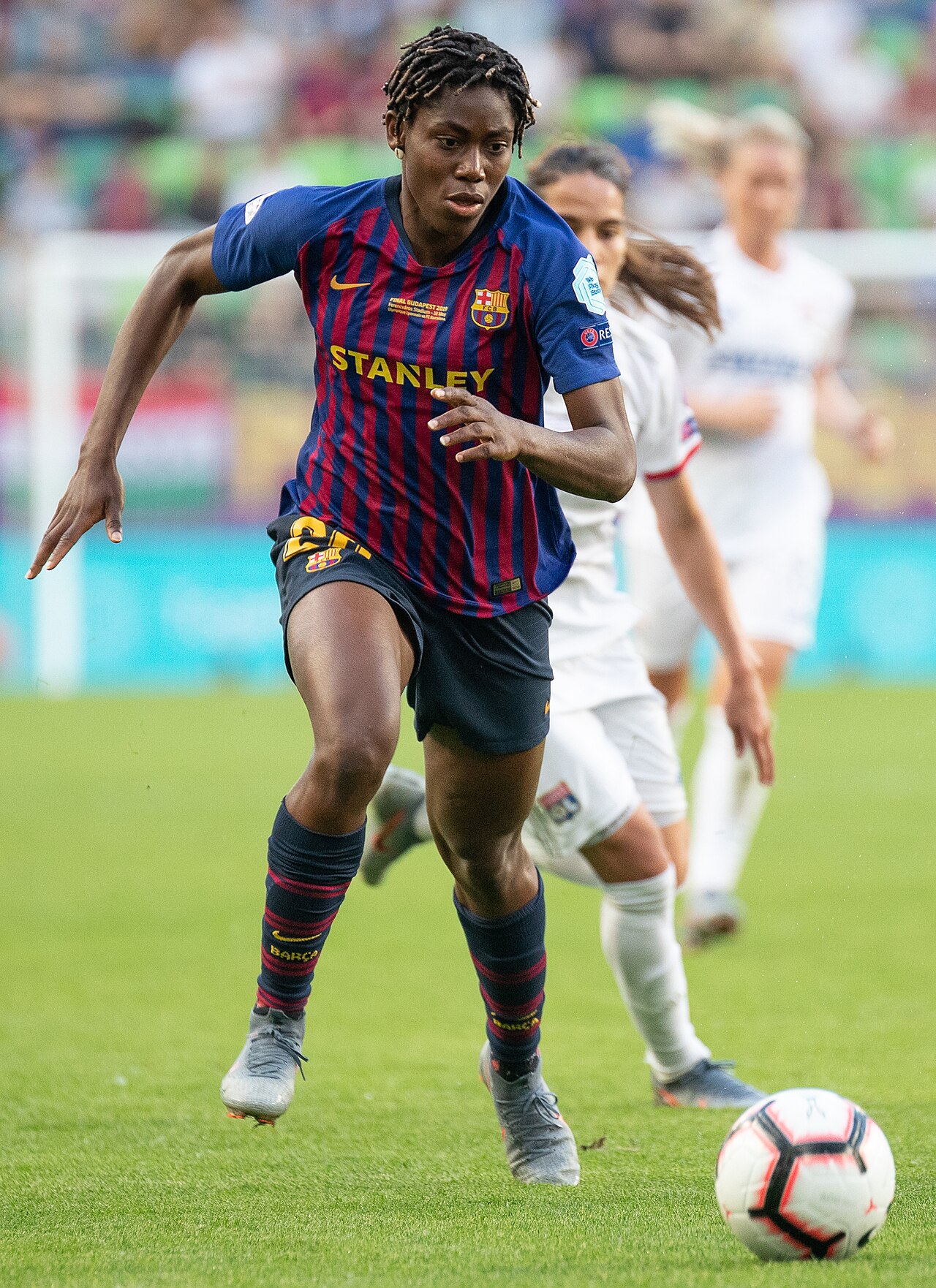
The defining move of her club career came when she joined FC Barcelona. At the Catalan giants, Oshoala became a central figure in one of the most dominant teams in the history of women’s football. Barcelona’s women’s side, known as Barca Femeni, established themselves as the pre-eminent force in Europe, and Oshoala was one of the stars driving that success.
The crowning achievement arrived when Barcelona won the UEFA Women’s Champions League, the most prestigious club trophy in the sport. Oshoala thereby became a European champion at club level, a rare and coveted honour, and one that placed her among the elite of the global game. Alongside continental glory, she collected multiple Spanish league titles, winning the Primera Division repeatedly as Barcelona dominated the domestic scene, along with Spanish cup competitions.
At Barcelona, Oshoala was celebrated not only for her goals but for her big-game temperament and her role in a squad packed with world-class talent. She proved she could excel in a team of superstars, holding her own alongside players who regularly featured in the running for the world’s top individual awards. Her years in Catalonia turned her from a brilliant individual into a serial winner, and secured her place as one of the most decorated African footballers, male or female, of the modern era.
Her style suited the Barcelona blueprint perfectly. In a team built on possession, quick combinations, and relentless pressure, Oshoala provided the cutting edge, the pace to stretch defences and the power to finish the chances the system created. She became known for her ability to come off the bench and change games as well as to start and dominate them, a versatility that made her invaluable across a long and demanding campaign of domestic and European fixtures. Playing week in and week out at that level, in front of the record-breaking crowds that Barcelona’s women’s team attracted, elevated her game and kept her at the peak of world football for years. For a Nigerian audience, the sight of one of their own thriving at Europe’s most celebrated club was a source of enormous pride.
Nigeria and the Super Falcons
For all her club success across three continents, Oshoala has remained deeply committed to her country. As a member of the Nigerian women’s national team, the Super Falcons, she has been a talismanic figure for well over a decade, leading the line for the most successful national team in African women’s football.
Oshoala has been central to Nigeria’s continued dominance of the Africa Women Cup of Nations, the continent’s flagship international competition. The Super Falcons are by far the most decorated side in the tournament’s history, and Oshoala has contributed to multiple title triumphs, often as the team’s most dangerous attacking threat. Wearing the green and white of Nigeria, she has repeatedly delivered on the biggest African stage, cementing her bond with fans back home.
On the global stage, Oshoala has represented Nigeria at the FIFA Women’s World Cup, carrying the hopes of a football-mad nation against the best sides in the world. Her goals and performances at the World Cup have made her one of the most recognisable African players in the tournament’s history, and she has consistently shown up when it mattered most for her country.
“I always dreamt of being a professional footballer. I never gave up on my dream, no matter the obstacles.”
That determination, forged in the face of family resistance and societal doubt, has defined her international career just as it did her rise. For countless young Nigerian girls, seeing Oshoala lead the Super Falcons is proof that the doors once closed to them can be forced open.
Records and Recognition
Perhaps the clearest measure of Oshoala’s greatness is her record haul of individual honours. She has been named African Women’s Footballer of the Year a record six times, a tally no other player has matched. Across her repeated triumphs in the award, she has stood alone as the dominant figure in African women’s football, year after year outshining her contemporaries.
That run of individual recognition, spread across nearly a decade, speaks to a rare consistency at the very top of the game. It is one thing to enjoy a single standout season; it is another to be judged the best on an entire continent time and again over many years, through moves between clubs and countries, through changes of coach and team-mate. Oshoala’s ability to sustain her excellence is what separates her from her peers.
Combined with her BBC Women’s Footballer of the Year award, her Under-20 World Cup double, her Champions League winner’s medal, and her Spanish league titles, this body of work makes a compelling case that Oshoala is the greatest African women’s footballer of all time. She is routinely spoken of in those terms by pundits, former players, and fans alike, and few who have watched her career would argue otherwise.
Beyond Football
Oshoala’s impact extends well beyond her performances on the pitch. Mindful of the obstacles she faced as a girl who wanted to play, she has used her platform to open doors for others. She established a foundation and academy dedicated to supporting young girls in football, providing opportunities, facilities, and encouragement to the next generation of players in Nigeria.
The Asisat Oshoala Foundation reflects the values that shaped her own journey. Where she once encountered resistance and a lack of support, she has worked to build the opposite for young girls: an environment in which their talent is nurtured rather than dismissed, and their dreams are taken seriously. Through her academy work, she has sought to give girls the structure and belief that were so often missing from her own early years.
Oshoala has also become a prominent advocate for the women’s game and for the empowerment of girls through sport. She speaks openly about the barriers women face in football and in society, using her own experience to challenge the attitudes that once told her she did not belong. In doing so, she has become a role model whose influence stretches far beyond the results columns, an ambassador for a game she has helped to transform.
Career Timeline
- 9 October 1994: Born in Lagos, Nigeria.
- 2014: Stars at the FIFA Under-20 Women’s World Cup in Canada, winning the Golden Ball as best player and the Golden Boot as top scorer as Nigeria reach the final.
- 2014: Named BBC Women’s Footballer of the Year, the first African player to win the award.
- 2015: Joins Liverpool in England’s FA Women’s Super League, beginning her European club career.
- 2016: Moves to Arsenal, another leading English club, continuing her development in top-flight football.
- 2017: Signs for Dalian Quanjian in the Chinese Women’s Super League, where she scores prolifically.
- 2019: Joins FC Barcelona, becoming a key forward for one of the dominant forces in European women’s football.
- 2021: Wins the UEFA Women’s Champions League with Barcelona, alongside multiple Spanish league titles during her spell at the club.
- Across her career: Named African Women’s Footballer of the Year a record six times, and a repeated winner of the Africa Women Cup of Nations with Nigeria’s Super Falcons.
Lesser-Known Facts
- Her family initially opposed her playing football. Oshoala grew up facing resistance at home because football was seen as unsuitable for a girl, and she had to defy that disapproval to pursue the game.
- She achieved a rare individual double in 2014. At the FIFA Under-20 Women’s World Cup, she won both the Golden Ball (best player) and the Golden Boot (top scorer) in the same tournament, a combination few players ever manage.
- She broke new ground for Africa. In 2014 she became the first African footballer to be named BBC Women’s Footballer of the Year.
- She is a Champions League winner. Oshoala won the UEFA Women’s Champions League with FC Barcelona, one of the highest honours in club football.
- She founded her own academy. Through the Asisat Oshoala Foundation, she supports and develops young girls in football, aiming to give them the encouragement she lacked as a child.
- Her six African Player of the Year awards are a record. No other footballer has been named African Women’s Footballer of the Year as many times as she has.
Frequently Asked Questions
Who is Asisat Oshoala? Asisat Oshoala is a Nigerian professional footballer, a forward widely regarded as the greatest African women’s player of her generation. Born in Lagos in 1994, she rose from local football to global stardom, starring for clubs in England, China, and Spain, and leading Nigeria’s Super Falcons on the international stage.
How many times has she won African Player of the Year? Oshoala has been named African Women’s Footballer of the Year a record six times, more than any other player in the award’s history.
Which clubs has she played for? Her senior club career has included Liverpool and Arsenal in England, Dalian Quanjian in China, and FC Barcelona in Spain, where she achieved her greatest club success.
Did she face opposition to playing football? Yes. As a girl growing up in Lagos, Oshoala faced resistance from her family, who initially opposed her playing football because it was seen as unsuitable for a girl. Her determination to overcome that opposition became a defining part of her story.
What has she won with Barcelona? With FC Barcelona, Oshoala won the UEFA Women’s Champions League as well as multiple Spanish league titles and domestic cup honours, establishing herself as a star of one of Europe’s dominant teams.
Legacy
Asisat Oshoala’s legacy is written in trophies and records, but its deepest impact lies in what she represents. She is living proof that talent and determination can overcome even the most entrenched resistance. The girl from Lagos who was told football was not for her went on to conquer the sport at the highest level, from a youth World Cup in Canada to Champions League glory in Europe, and to be crowned the best in Africa six times over.
For the millions of Nigerians who follow her, and for young girls across the continent who dream of playing, Oshoala is more than a footballer. She is a symbol of possibility, a woman who forced open doors that others tried to keep shut, and who has spent her success building a wider path for those who follow. Her academy and her advocacy ensure that her influence will outlast her playing days, shaping the futures of girls who may never know just how hard their hero had to fight for the same chance.
When the history of African football is written, Asisat Oshoala will stand among its towering figures, the Nigerian queen of the women’s game, whose journey from the streets of Lagos to the summit of world football continues to inspire. Hers is a story of defiance, brilliance, and generosity, and it is far from over.