The house at 54 University Avenue in Rangoon, set back from the road behind rusted iron gates, facing the still water of Inya Lake, is not a large or imposing building. It is a colonial-era two-storey wooden structure, shabby in the way that neglected tropical buildings become, and it would attract no particular attention from a visitor unfamiliar with its history. But for twenty-one years, at various intervals between 1989 and 2010, this house was one of the most symbolically charged addresses in the world, because inside it, voluntarily confined, was the daughter of Burma’s independence hero, a woman who had been offered her freedom on the condition that she leave her country forever and had refused, who sat reading, meditating, playing Bach on a piano that had been given to her, and waiting for Myanmar to become what she believed it could be.
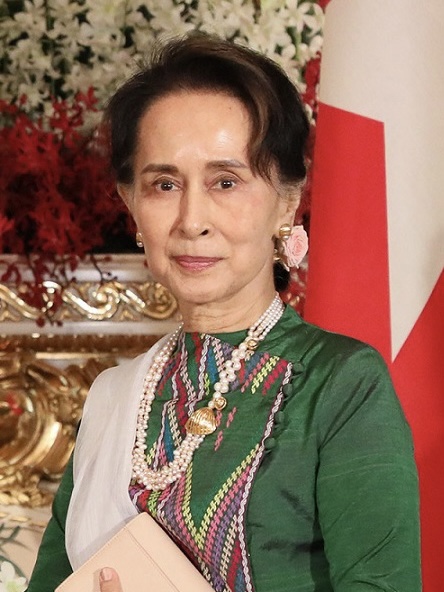
Quick Facts
- Full name
- Aung San Suu Kyi
- Born
- 19 June 1945, Rangoon, British Burma
- Died
- Living (imprisoned)
- Known for
- Leader of Myanmar's pro-democracy movement; Nobel Peace Prize laureate (1991); State Counsellor of Myanmar (2016 to 2021)
- Key achievement
- Led the National League for Democracy to a landslide victory in 1990 and again in 2015; endured over two decades of house arrest in defense of democratic principles
Rangoon and the Shadow of an Assassinated Father
Aung San Suu Kyi was born on 19 June 1945 in Rangoon, the capital of British Burma, the third child and only daughter of General Aung San and his wife Daw Khin Kyi. Her father was, by any measure, the defining figure of Burmese political history: the founder of the modern Burmese military, the leader who negotiated Burma’s independence from Britain, and the man whose assassination on 19 July 1947, just months before independence was achieved, made him a martyr whose image would hang in homes, offices, and temples across Burma for generations.
He was killed when Suu Kyi was two years old. She had no memories of him that were not constructed from photographs, stories, and the way other people deferred to his memory whenever her name was mentioned. Growing up as the daughter of Aung San was both a privilege and a form of pressure so constant it was almost invisible: her identity was inseparable from his, and the question of whether she would, in some way, continue his work was present in her life from childhood, even if she would not frame it that way until much later.
Her mother, Daw Khin Kyi, was a woman of considerable ability and determination who raised her children with a combination of Burmese traditional values, Buddhist discipline, and a fierce insistence on education. In 1960, Daw Khin Kyi was appointed Burma’s ambassador to India, and Suu Kyi, who was fifteen, went with her to New Delhi. The years in India, from 1960 to 1964, gave Suu Kyi a second education alongside her formal schooling: she was exposed to the legacy of Gandhi and Nehru, to the traditions of nonviolent resistance and moral politics that would later shape her own approach, and to the international culture of a diplomatic household that received visitors from across the world.
She absorbed Gandhi with particular intensity. His philosophy of ahimsa, nonviolent resistance, and his insistence that the means of political struggle must be consistent with the ends it sought to achieve, became foundational to her own thinking. She was also influenced by the Buddhist traditions of Myanmar, in which the concept of metta (loving kindness) and the cultivation of inner peace through meditation formed a way of engaging with the world that was both contemplative and morally demanding.
Oxford, London, and a Life Away from Burma
In 1964, she enrolled at St Hugh’s College, Oxford, to read politics, philosophy, and economics. Oxford in the mid-1960s was a lively intellectual environment, and Suu Kyi was an active participant in it, though she was remembered by contemporaries as reserved and thoughtful rather than aggressively political. She graduated in 1967 and then spent several years working in New York at the United Nations, where she worked in the budget committee under the Burmese diplomat U Thant, who would later serve as the UN’s Secretary General.
She met Michael Aris, a British scholar of Tibetan and Himalayan culture, at a party in London in 1972. Their courtship moved quickly, and they married in London on 1 January 1972. Before the marriage, she wrote him a letter that would later become famous, because in it she told him, with a clarity that suggested she had thought carefully about what she was asking: “I only ask one thing, that should my people need me, you would help me do my duty by them even though it might mean years of separation or even your death.” It was a remarkable thing to write to a man she was about to marry, and it proved prophetic in ways that neither of them could have fully anticipated.
They built a life together in Oxford, where Aris held a position at the university, and Suu Kyi pursued academic work while raising their two sons, Alexander (born 1973) and Kim (born 1977). She undertook research on Burmese literature and culture, worked on a biography of her father, and spent a period as a visiting scholar in Japan and India. She was, from the outside, a private person leading an academic life in a university town, connected to Burma through her scholarly work but not publicly engaged with Burmese politics.
Burma in these years was governed by General Ne Win, who had seized power in a coup in 1962 and had spent the following decades building one of Asia’s most isolationist and economically destructive military regimes. The military government, which called its ideology “the Burmese Way to Socialism,” had nationalised businesses, expelled foreign companies, and progressively dismantled the relatively open economy and society that Burma had had at independence. By the 1980s, Burma was one of the world’s poorest countries, designated by the UN as a “least developed nation,” despite possessing abundant natural resources.
1988: The Return and the Revolution
In April 1988, Suu Kyi flew to Rangoon because her mother had suffered a stroke. She arrived to find Burma in a state of gathering crisis. The National Unity Party government had recently announced the demonetisation of large-denomination banknotes without compensation, destroying the savings of millions of ordinary Burmese. Economic resentment combined with political frustration, and through the late spring and summer of 1988, demonstrations began to build across the country.
On 8 August 1988, a date chosen for its auspicious appearance (8-8-88), hundreds of thousands of people took to the streets across Burma in the largest political uprising since the independence movement. The military’s response was brutal: soldiers opened fire on crowds in Rangoon and other cities, killing an estimated 3,000 people in the crackdown that followed, though the actual number may have been much higher. The date is remembered in Myanmar as the 8888 Uprising.
Suu Kyi had not come to Burma to start a revolution. She had come to nurse her mother. But in the weeks of the uprising she was approached by student leaders, by monks, by veterans of the independence movement who knew her father’s legacy, and by ordinary citizens who saw in her the possibility of a national leader who could unite the opposition and give it a moral and political authority that the generals could not match. She had her father’s name. She had education and international experience. She had a Buddhist moral seriousness that resonated deeply with the culture of a country where almost everyone was a practising Buddhist. And she was willing.
She gave her first public speech on 26 August 1988, before a crowd of hundreds of thousands at the Shwedagon Pagoda in Rangoon, the most sacred Buddhist site in the country. She spoke with a composure that seemed almost miraculous given the circumstances, a composed clarity in front of the largest crowd she had ever addressed, calling for democracy, for national unity, and for non-violence. The crowd responded with a fervour that established, in a single afternoon, that she was not merely a symbol but a leader with genuine popular authority.
She co-founded the National League for Democracy in September 1988 and became its general secretary. The military, which had taken direct power in September 1988 under a new junta called the State Law and Order Restoration Council (SLORC), found itself confronting a movement whose leader it could not easily delegitimise. She was not a communist. She was not a foreign agent. She was the daughter of the man who had built the Burmese army, campaigning for exactly the kind of multi-party democracy that the military’s own announced schedule of transition had promised.
House Arrest and the Nobel Peace Prize
The military’s response was to place her under house arrest on 20 July 1989, under legislation that allowed for detention without charge or trial. The move was designed to silence her before the elections that the junta had promised. It had the opposite effect internationally. Her detention transformed her, in the eyes of the world, from a national political figure into a global symbol of nonviolent resistance to authoritarian rule.
The elections were held in May 1990 anyway, apparently in the expectation that the NLD, with its leader detained, would do poorly. The result was one of the most dramatic election outcomes in Asia’s modern history: the NLD won 392 of the 485 contested seats, with approximately 59 percent of the national vote. The junta, faced with this result, simply refused to transfer power, claiming that a constitutional convention needed to be convened first to draft a new constitution, a process that would take another eighteen years.
In 1991, the Nobel Committee awarded Aung San Suu Kyi the Nobel Peace Prize. She remained in house arrest and could not travel to Oslo to accept it. Her son Alexander, then eighteen, accepted on her behalf in a ceremony of considerable emotional power, reading a speech she had prepared. She later gave the prize money, approximately $1.3 million, to establish a health and education trust for the Burmese people.
Her house arrest was briefly lifted in 1995, re-imposed in 2000, briefly lifted again in 2002, and then re-imposed in 2003 after an incident in which a government-organised mob attacked her convoy. She remained under house arrest from 2003 to November 2010, during which period her husband Michael Aris was diagnosed with prostate cancer in 1997 and died in March 1999. The Burmese government refused to grant him a visa to visit his wife; Suu Kyi refused to leave Burma to be at his bedside, knowing that if she left she would not be permitted to return. He died in Oxford without seeing her again. She learned of his death in her house on University Avenue.
“The only real prison is fear, and the only real freedom is freedom from fear.”
The remark, which appeared in her 1991 essay collection “Freedom from Fear,” articulated the philosophy that sustained her through the years of isolation. Fear, she argued, was the tool by which authoritarian governments maintained control, and the willingness to face fear without surrendering to it was both a political act and a spiritual practice. Her capacity to embody this principle, to sit quietly in her house while the world argued about her fate, gave the words a weight that mere philosophical argument could not have achieved.
Release, Politics, and the Nobel’s Shadow
She was released from house arrest for the last time on 13 November 2010, a week after elections that the military had designed to entrench its power through a new constitution. The constitution allocated 25 percent of parliamentary seats to military appointees, which meant that the military had an automatic veto over any constitutional change requiring a 75 percent supermajority. It also contained a clause barring from the presidency anyone who had foreign family members, a provision transparently designed to exclude Suu Kyi, whose sons held British citizenship.
The following years were a period of managed transition in which the military, under President Thein Sein, opened political and economic space with sufficient care to earn international approval and investment while maintaining real control over the structures of power. Suu Kyi re-entered electoral politics, winning a by-election in 2012 for a parliamentary seat in Kawhmu. She travelled internationally for the first time in over two decades, visiting Thailand, Europe, and the United States, where she was received with the reverence due a living legend.
The NLD won the 2015 general election by a landslide, taking 255 of 330 contested seats in the lower house. The constitutional bar on her becoming president was circumvented by the creation of a new position, State Counsellor, which functioned as a de facto prime ministership. She governed Myanmar alongside the NLD’s presidential candidate, Htin Kyaw, from April 2016.
And then came the crisis that would define how history ultimately judges her. In August 2017, the Myanmar military launched what the UN would later describe as genocide against the Rohingya Muslim minority in Rakhine State. Soldiers burned villages, killed civilians, and conducted mass sexual violence. More than 700,000 Rohingya fled to Bangladesh in a matter of weeks, the largest and fastest refugee movement in the region in decades.
Suu Kyi’s response was one of near-total silence on the atrocities, followed by active defence of the military at the International Court of Justice in The Hague in December 2019. She denied that genocide had occurred, claimed the military’s operations were a legitimate counter-terrorism response to attacks by Rohingya militants, and refused to acknowledge the documented evidence of systematic atrocities. Several countries and institutions withdrew honours they had previously awarded her. The Nobel Committee, which does not revoke prizes, was silent.
The explanations offered for her position ranged from political calculation (she could not afford to alienate the military if she wanted to maintain any governing authority) to Buddhist nationalism (a minority position among Myanmar’s Buddhist majority holds that Islam poses a threat to Buddhist culture, and Suu Kyi may have been unwilling to defend a Muslim minority against this view) to a genuine belief in the military’s account of events that her admirers found difficult to accept. None of the explanations were satisfying, because none of them were consistent with the moral philosophy she had spent decades articulating.
The 2021 Coup and Imprisonment
On 1 February 2021, the Myanmar military launched a coup against the elected government, arresting Suu Kyi and other NLD leaders in the early morning hours, claiming without evidence that the November 2020 elections had been fraudulent. The coup was universally condemned by democratic governments and international organisations. Suu Kyi was charged with a series of crimes including corruption, violating COVID-19 protocols, illegal importation of walkie-talkies, and several other charges that international legal observers uniformly described as politically motivated.
She has since been sentenced to a total of twenty-seven years in prison by military courts operating in proceedings her lawyers were barred from discussing publicly. She is held in a military facility in Naypyidaw, the purpose-built capital, and has been largely cut off from communication with the outside world. Her health, she was seventy-six at the time of the coup, is a subject of concern to her supporters.
Legacy
The life of Aung San Suu Kyi does not offer the comfort of a straightforward moral tale. It is the story of a person of genuine courage and genuine moral seriousness who made, in the final years of her political career, choices that were in deep contradiction with the values she had spent her life representing. The woman who wrote about freedom from fear was unwilling to speak fearlessly about the suffering of people she deemed inconvenient to defend.
Her twenty-one years of house arrest remain a feat of moral endurance that most people would be unable to match. The sacrifice she made, her marriage, her children’s childhoods, her freedom, her husband’s dying days, was real and considerable. She did not have to stay in Burma; she chose to, and that choice was grounded in a genuine conviction about her obligation to her people. The Nobel Peace Prize was not given for nothing.
But history will also record that when she finally held the power she had waited so long for, she used it to protect a military committing atrocities against a minority people on her soil, and that she defended those atrocities before the highest court in the world. Whether the courage that sustained her through the years of house arrest and the complicity she displayed in office belong to the same person is a question that simplifies the moral complexity of a remarkable and deeply troubling life.
Key Facts
- Aung San Suu Kyi spent approximately 15 of the 21 years between 1989 and 2010 under house arrest at her family home in Rangoon, making her one of the longest-held political detainees in modern history.
- The National League for Democracy won 392 of 485 contested parliamentary seats in the 1990 elections, a result the military refused to honour for twenty-five years.
- She was awarded the Nobel Peace Prize in 1991, one of the few prizes ever given to a person held in detention; she did not travel to Oslo to collect it until June 2012, twenty-one years after the award.
- Her husband Michael Aris died of prostate cancer in Oxford in March 1999 without being allowed to visit Myanmar; Suu Kyi refused to leave the country to see him, knowing she would not be permitted to return.
- At the International Court of Justice in December 2019, she led Myanmar’s legal defence against charges of genocide related to the military’s 2017 campaign against the Rohingya people in Rakhine State.