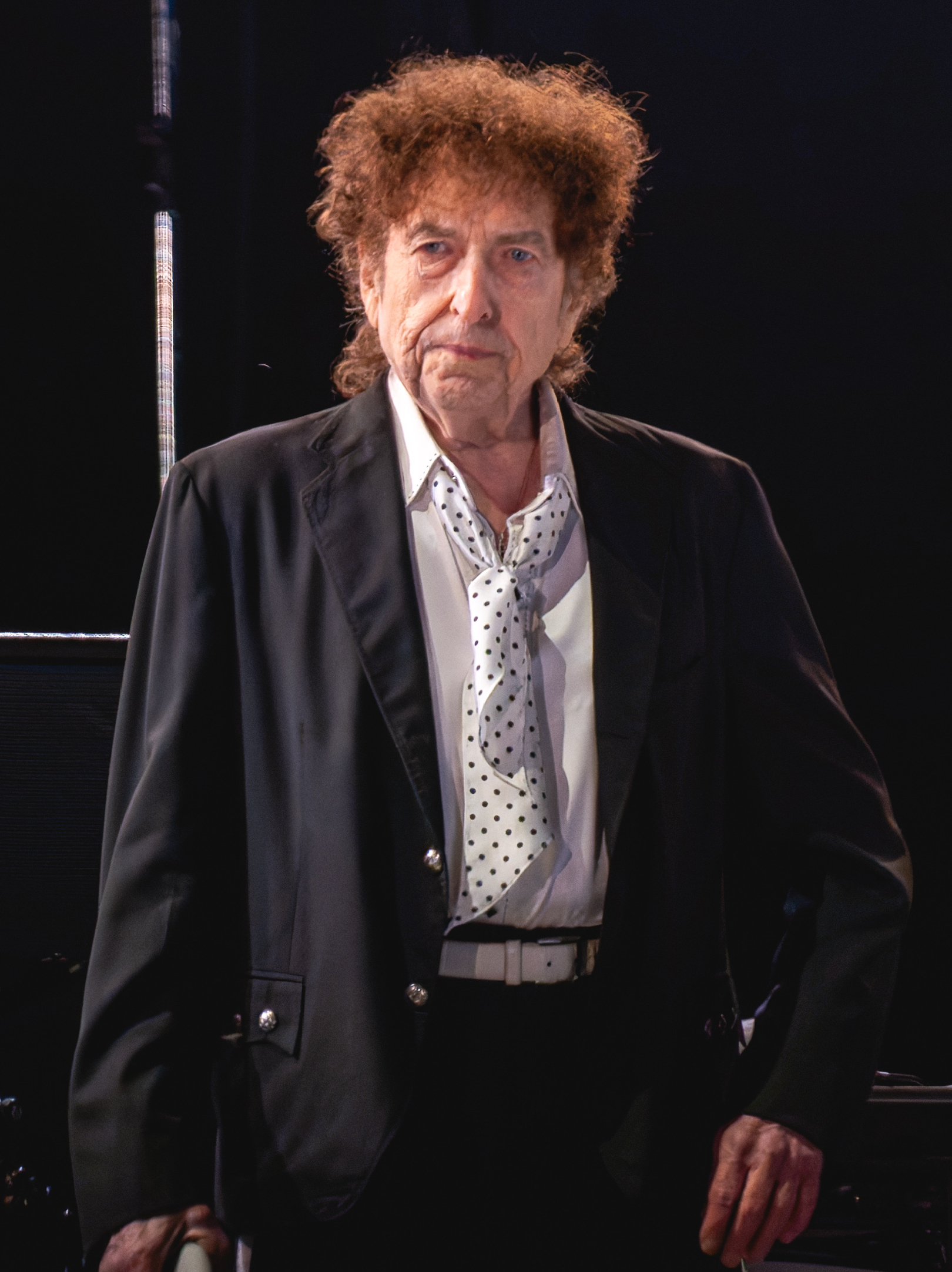
For more than sixty years, Bob Dylan has occupied a place in popular culture that no other songwriter has matched. He arrived in New York as a scruffy young folk singer with a borrowed name and a head full of Woody Guthrie, and within a few years he had rewritten the rules of what a popular song could contain. He gave the protest movement its anthems and then walked away from it. He plugged in an electric guitar and was booed as a traitor, only to be vindicated as a visionary. He has reinvented himself so many times that the only constant in his career has been change itself. In 2016 the Swedish Academy made him the first songwriter in history to win the Nobel Prize in Literature, a recognition that what he had been doing all along was a form of poetry. To understand how a boy from the Minnesota iron range became the most influential songwriter of the twentieth century, you have to follow the whole restless journey.
Quick Facts
- Full name
- Robert Allen Zimmerman
- Born
- 24 May 1941, Duluth, Minnesota, USA
- Genre
- Folk, rock, blues, country
- Known for
- One of the greatest songwriters of all time; Nobel Prize in Literature 2016
- Real name
- Born Robert Zimmerman; took the name Dylan
Early Life and Background
Robert Allen Zimmerman was born on 24 May 1941 in Duluth, Minnesota, and grew up in the mining town of Hibbing, on the cold iron range of the American north. His family was Jewish, the descendants of immigrants from Eastern Europe, and his father worked in the appliance business. Hibbing was a remote and unglamorous place, far from the cultural centres of the country, but it had radio, and through the airwaves at night the young Zimmerman heard the sounds that would shape him: the blues from the south, country from Nashville, and the first electric jolt of rock and roll.
As a teenager he formed bands and idolised performers like Little Richard and Elvis Presley, banging out rock and roll on the piano with more enthusiasm than polish. But it was folk music, with its storytelling tradition and its connection to American history, that captured him most deeply when he discovered it. He began to remake himself, adopting the name Bob Dylan, a change he would later surround with various and contradictory explanations. The reinvention was the point. The boy from Hibbing was constructing a new self, one with a mythology of his own making.
He enrolled at the University of Minnesota in Minneapolis in 1959, where he spent more time in the coffee houses of the local folk scene than in lecture halls. He immersed himself in the music of Woody Guthrie, the great Dust Bowl balladeer whose songs of working people and hard times became Dylan’s model. Before long he dropped out of university altogether and set his sights on New York City, where Guthrie lay ill in a hospital and where the folk revival was gathering force.
Greenwich Village and Folk Stardom
Dylan arrived in New York in January 1961 and made his way to Greenwich Village, the bohemian heart of the American folk movement. He played the coffee houses and clubs, absorbing everything around him, visiting his hero Woody Guthrie, and quickly establishing a reputation as a striking new talent with an old soul. He was signed to Columbia Records by the legendary talent scout John Hammond, and his self-titled debut album appeared in 1962. It was made up mostly of traditional folk and blues songs, with only a couple of his own compositions, and it sold modestly.
It was his second album, The Freewheelin’ Bob Dylan, released in 1963, that announced his arrival as a songwriter of extraordinary power. Filled with original material, it contained songs that became anthems of the civil rights and anti-war movements, songs whose questions about freedom, justice and war seemed to capture the conscience of a generation. Almost overnight Dylan became the most celebrated young songwriter in America, hailed as the voice of his generation, a label he would come to resent.
“All I can do is be me, whoever that is.”
He performed at the 1963 March on Washington where Martin Luther King Jr delivered his most famous speech, and his songs were taken up by other artists, most notably the trio Peter, Paul and Mary, who turned his compositions into major hits. His relationship with the folk singer Joan Baez, already a star, raised his profile further. For a brief period he was the golden boy of the protest movement, the poet who had given the struggle its soundtrack.
Going Electric
But Dylan had no intention of remaining anyone’s spokesman. By 1964 his songs were turning inward and outward at once, becoming more personal, more surreal, more poetic, and less obviously political. Then came the change that split his audience. In 1965 he released Bringing It All Back Home, an album that mixed acoustic folk with electric rock, and followed it with Highway 61 Revisited, a fully electric record powered by a wild, mercurial energy. The six-minute single that opened it shattered the conventions of what a hit song could be in both length and language.
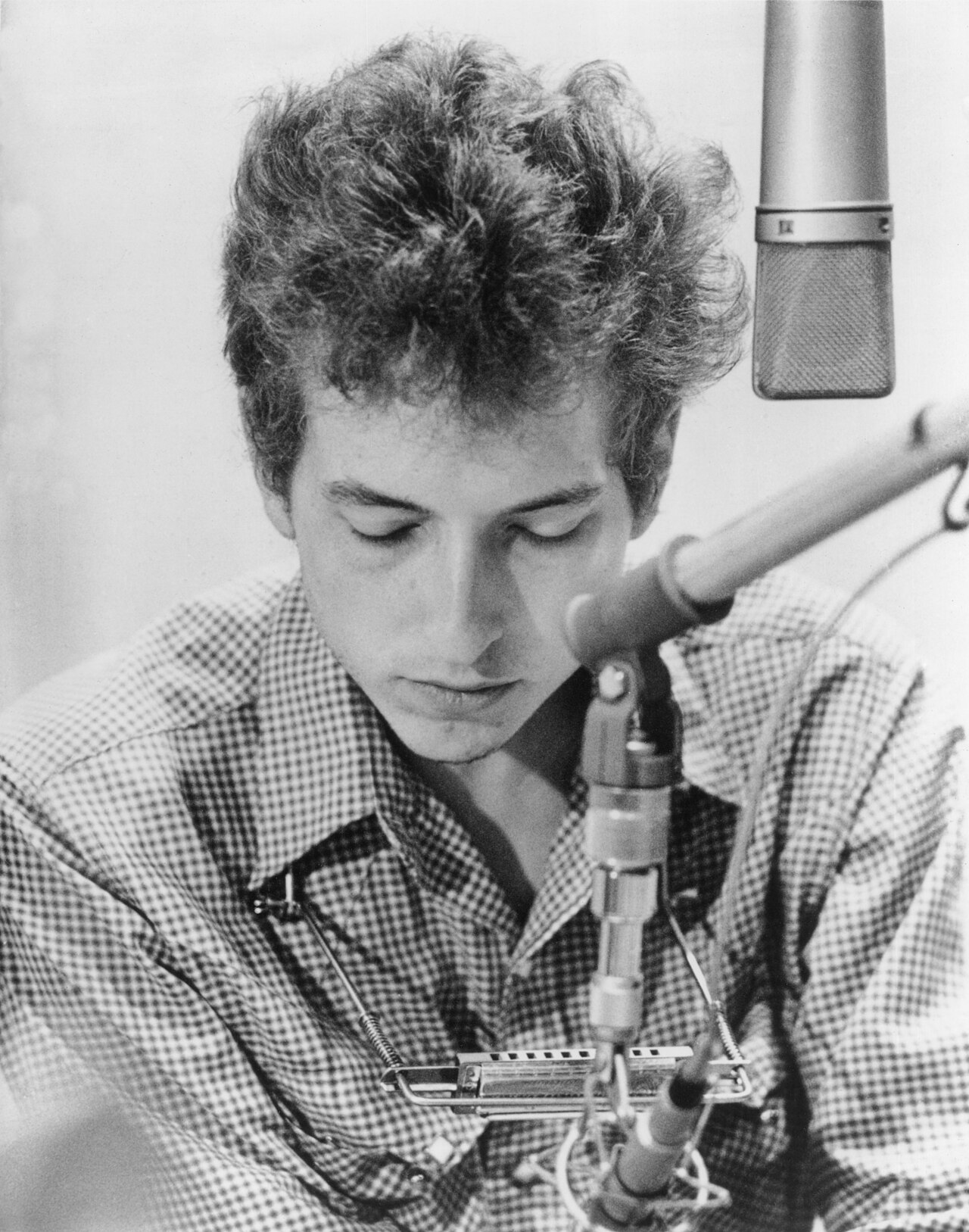
When he appeared at the Newport Folk Festival in July 1965 backed by an electric band, parts of the audience booed, feeling betrayed by the man they had anointed as the keeper of the folk flame. The hostility followed him on a world tour in 1965 and 1966, culminating in a famous concert in Manchester, England, where an audience member shouted an insult at him for abandoning folk purity. Dylan, unbowed, told his band to play louder. The 1966 double album Blonde on Blonde completed this astonishing run, a sprawling masterpiece of poetic rock that many consider among the greatest albums ever recorded.
Then, in the summer of 1966, a motorcycle accident near his home in Woodstock, New York, pulled him out of public view. The crash, the seriousness of which has been debated ever since, gave him an excuse to retreat from the relentless pressure of fame, to recover, and to be with his family. He had remade popular music twice in the space of a few years, and now he disappeared to think.
Reinvention After Reinvention
The pattern of Dylan’s career, established in those early years, would repeat for decades: just when audiences thought they understood him, he would change direction. After the accident he recorded informally with the musicians who became The Band, sessions later released as The Basement Tapes, and turned toward a quieter, more rootsy sound. In 1969 he confounded expectations again with Nashville Skyline, a gentle country record sung in a soft croon utterly unlike his earlier rasp.
The 1970s brought more turns. In 1975 he released Blood on the Tracks, a raw and intimate album widely regarded as one of his finest, its songs shaped by the breakdown of his marriage. He mounted the chaotic, carnival-like Rolling Thunder Revue tour. Then at the end of the decade he stunned everyone once more by converting to evangelical Christianity and releasing a series of gospel albums, alienating some fans even as he insisted on following his own path. Through every shift, the refusal to be pinned down remained his defining trait. He would not be the voice of a generation, the folk purist, the rock prophet, or anything else that others wanted him to be.
The Never Ending Tour and Later Career
In 1988 Dylan embarked on what came to be known as the Never Ending Tour, a relentless schedule of concerts that would see him perform around the world, year after year, for decades. He reworked his old songs almost beyond recognition in live performance, treating them as living things rather than museum pieces, frustrating some fans and delighting others.
His recorded output was uneven through the 1980s, but in 1997 he produced Time Out of Mind, a dark, weathered, beautiful album that won the Grammy Award for Album of the Year and announced a remarkable late-career renaissance. He followed it with a string of acclaimed records including Love and Theft and Modern Times, proving that his creative powers had not dimmed with age. He also published the first volume of a memoir, Chronicles, which was widely praised, and hosted an idiosyncratic radio show that revealed his deep love of American music in all its forms.
The Landmark Albums
To trace Dylan’s career is to trace a sequence of albums that each marked a turning point not only for him but for popular music as a whole. The Freewheelin’ Bob Dylan in 1963 established him as the conscience of his generation. The Times They Are a-Changin’ in 1964 sharpened that image with stark protest songs, before Another Side of Bob Dylan, released the same year, signalled his retreat from straightforward political messaging toward something more personal and ambiguous.
Then came the great electric trilogy. Bringing It All Back Home in early 1965 split the record between acoustic and electric sides. Highway 61 Revisited later that year went fully electric and produced some of his most celebrated work. Blonde on Blonde in 1966, recorded largely in Nashville with seasoned session musicians, achieved a richness and a sustained brilliance that critics have spent decades praising. After the seclusion that followed his motorcycle accident, John Wesley Harding in 1967 surprised listeners with its spare, restrained, almost biblical simplicity, a deliberate turn away from the dense imagery of the electric years.
The 1970s brought Blood on the Tracks in 1975, an album of such emotional depth that many regard it as the finest work of his career, and Desire later the same year, which included epic narrative songs and the fruits of his Rolling Thunder Revue period. Even his commercially uneven later decades produced remarkable records, and his late renaissance beginning with Time Out of Mind in 1997 showed an artist who had grown rather than faded. Taken together, this body of work constitutes one of the richest catalogues in the history of recorded music, a sustained achievement across more than half a century that has no real parallel.
The Craft of the Songwriter
What set Dylan apart from his contemporaries was the sheer scope of what he was willing to put into a song. Before him, popular songs were largely about romance, set to predictable structures and a limited vocabulary. Dylan broke those limits open. He drew on the King James Bible, on the French poets, on American folk and blues traditions, on the rhythms of everyday speech and the imagery of dreams. His songs could be tender love ballads, savage political indictments, surreal comic narratives, or meditations on mortality, sometimes all within a single album.
He worked quickly and instinctively, often capturing songs in a handful of takes and resisting the polished perfectionism of the studio. He valued spontaneity over precision, the feel of a moment over technical flawlessness, and this gave his recordings a rawness and immediacy that more meticulous artists could never replicate. His distinctive voice, nasal and weathered and far from conventionally beautiful, became one of the most recognisable and influential instruments in popular music precisely because it carried so much character and conviction. Singers who could hit notes Dylan never could nonetheless studied the way he phrased a line, the way he could make ordinary words land with extraordinary weight.
Beyond Music
Dylan’s restless creativity spilled well beyond songwriting. He acted in and directed films, including the sprawling, improvised Renaldo and Clara, and appeared in others such as the western Pat Garrett and Billy the Kid, for which he also wrote the soundtrack. He published Tarantula, an experimental book of prose poetry, early in his career, and decades later produced the acclaimed memoir Chronicles, which revealed a thoughtful and surprisingly candid writer.
In his later years he became a serious visual artist, exhibiting paintings, drawings and metalwork sculptures in galleries around the world. He hosted Theme Time Radio Hour, an eclectic and beloved radio programme in which he played records spanning the whole history of American popular music and shared his encyclopaedic knowledge with warmth and humour. Each of these pursuits reflected the same curiosity and refusal to stand still that defined his music. He was never content to be one thing, and he treated his own legend with a wry detachment that kept audiences guessing about where the real man ended and the myth began.
Influence on Other Artists
The list of musicians who have credited Bob Dylan as a decisive influence reads like a history of modern popular music. The Beatles, who met him in 1964, spoke of how he pushed them to write more thoughtful and personal lyrics, helping to transform them from a pop group into the most ambitious songwriters of their era. The Rolling Stones, Bruce Springsteen, Neil Young, Joni Mitchell, Patti Smith and countless others have pointed to him as the figure who showed them what was possible. Springsteen once said that Dylan freed the mind the way Elvis Presley had freed the body, capturing the sense that Dylan had expanded the very idea of what popular music could do.
His influence extended far beyond those who tried to imitate his style. By demonstrating that a songwriter could be a serious artist, that lyrics could carry the weight of literature, and that an audience would follow an artist who insisted on changing and growing, Dylan reshaped the expectations placed on every songwriter who came after him. The singer-songwriter movement of the late 1960s and 1970s, in which performers wrote and sang their own deeply personal material, owed its existence in large part to the path he had cleared. Hip-hop artists, decades later, would echo his conviction that words and wordplay could be the centre of a song rather than an afterthought. Few figures in any art form have cast so long a shadow over those who followed.
Personal Life
For all his fame, Dylan guarded his private life fiercely. He married Sara Lownds in 1965, and the couple had several children before divorcing in 1977, a painful separation that informed some of his most personal work. One of his sons, Jakob Dylan, became a successful musician in his own right as the frontman of the band The Wallflowers, carrying the family’s songwriting gift into another generation. Dylan largely kept his family out of the public eye, granting few interviews and revealing little, preferring to let his work speak while he remained an enigma.
The Nobel Prize and Legacy
In October 2016 the Swedish Academy awarded Bob Dylan the Nobel Prize in Literature, citing his creation of new poetic expressions within the great American song tradition. The decision provoked intense debate. Some argued that song lyrics were not literature and that the prize should go to a novelist or poet. Others celebrated the recognition of songwriting as a serious art form with roots reaching back to the ancient bards. Dylan himself responded with characteristic ambiguity, remaining silent for weeks before acknowledging the honour, and sending a lecture rather than attending the ceremony in person. It was a fitting response from a man who had spent his life refusing to do what was expected.
The scale of Dylan’s influence is almost impossible to overstate. He expanded the vocabulary of popular song, showing that it could carry the weight of poetry, politics, philosophy and the deepest personal emotion. The Beatles, the Rolling Stones and virtually every serious songwriter who followed acknowledged his impact on their work. He demonstrated that a popular artist could be an uncompromising one, that commercial success and artistic seriousness were not enemies, and that an artist had the right to change and grow rather than repeat a winning formula.
More than six decades after he stepped off a bus into the cold of a New York winter, Bob Dylan remains a singular figure, still touring, still recording, still refusing to be anything other than himself. He took the humble popular song and made it a vehicle for the full range of human experience, and in doing so he changed the culture permanently. The boy from Hibbing who invented a new name for himself ended up rewriting the story of modern music.
What endures, in the end, is not any single song or album but the example of an artist who trusted his own instincts above the demands of his audience, the expectations of critics, or the temptations of easy success. Dylan taught generations of musicians that the worst thing an artist can do is to stand still, to keep delivering the same thing because it once worked. His career is a long argument for restlessness, for curiosity, for the courage to disappoint the people who think they own you. In an industry built on repetition and formula, he built something closer to a life’s work in the truest sense, a continuous act of creation that has never stopped surprising the world.
Key Facts
- Bob Dylan was born Robert Zimmerman on 24 May 1941 in Duluth, Minnesota, and reinvented himself with a new name after immersing himself in folk music.
- His 1963 album The Freewheelin’ Bob Dylan made him the most celebrated songwriter of the protest era and earned him the label “the voice of a generation.”
- His turn to electric music in 1965, including the album Highway 61 Revisited and a famously booed performance at the Newport Folk Festival, transformed popular music.
- His late-career renaissance began with the Grammy-winning Time Out of Mind in 1997, proving his creative powers undimmed.
- In 2016 he became the first songwriter ever to win the Nobel Prize in Literature, recognising songwriting as a serious literary art.