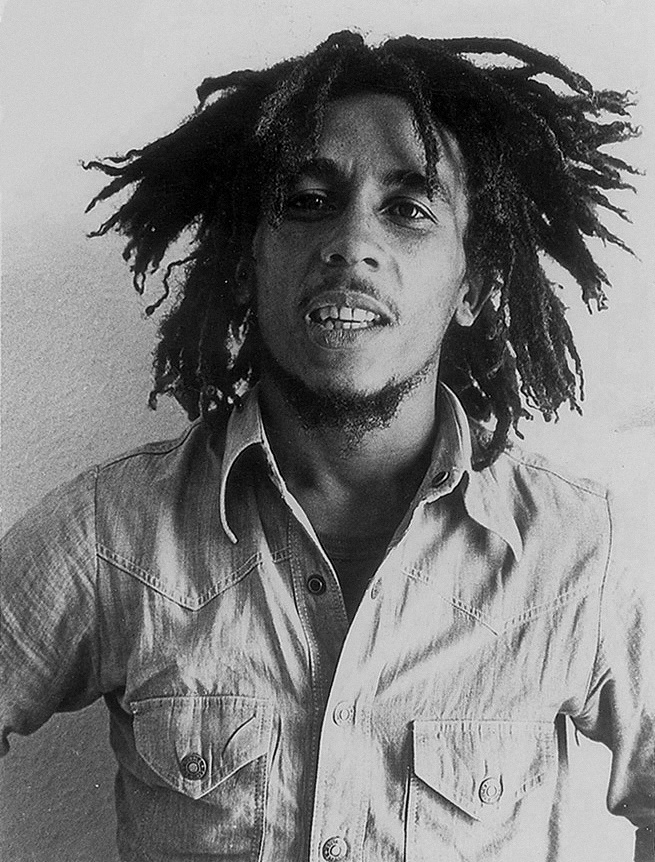
Some artists define a genre; a rare few come to embody an entire culture. Bob Marley belongs to the second group. Through a body of work made in barely two decades, he carried reggae out of the dancehalls of Kingston and into stadiums across the globe, transforming Jamaican music into a universal language of hope and defiance. To listeners on every continent he became something larger than a musician, a prophet of unity whose recordings still circulate like scripture set to a bassline. Decades after his death, his image remains one of the most reproduced in the world, and his message of love, justice and spiritual liberation continues to find new audiences with each passing generation.
Quick Facts
- Full name
- Robert Nesta Marley
- Born
- 6 February 1945, Nine Mile, Saint Ann, Jamaica
- Died
- 11 May 1981, Miami, USA (aged 36)
- Genres
- Reggae, ska, rocksteady
- Band
- Bob Marley and the Wailers
- Faith
- Rastafari
Early Life and Background
Robert Nesta Marley was born on 6 February 1945 in Nine Mile, a remote village in the parish of Saint Ann in the hills of northern Jamaica. His mother, Cedella Booker, was a young Black Jamaican woman, then still a teenager; his father, Norval Marley, was a white man of English descent who worked as an overseer and was considerably older. Norval married Cedella but was largely absent from his son’s life and died when the boy was still young. That mixed heritage left Marley caught between worlds, not fully embraced by either, and the experience of being treated as an outsider, taunted for the colour of his skin from both directions, sharpened the empathy that would later run through all of his music.
The early years in Nine Mile were rural and poor but rich in the traditions of the Jamaican countryside. As a child Marley was known for a seriousness and an intensity beyond his years, and some neighbours believed he had a gift for reading palms before he ever picked up a guitar. When he was a young teenager, his mother moved to Kingston in search of work and a better future, and the family settled in Trench Town, one of the poorest districts of the capital.
Trench Town and the Making of a Musician
Trench Town took its name from the drainage trench that ran through it, yet it pulsed with a creativity that belied its hardship. The district was a cradle of Jamaican popular music, alive with sound systems blasting records from rival operators, street-corner harmony groups, and the constant exchange of new rhythms. For a boy with a hunger to make something of himself, it was both a tough school and an inspiring one. Marley would later honour Trench Town repeatedly in his songs, treating the neighbourhood not as a place to escape but as a wellspring of identity and pride.
It was here that Marley met Neville Livingston, later known as Bunny Wailer, and the singer Peter Tosh. The three young men shared a passion for the American rhythm and blues and soul records that drifted across the radio waves, as well as for the homegrown sounds emerging from Jamaican studios. They studied vocal harmony under the guidance of the respected singer Joe Higgs, who held informal lessons in his yard and taught them not just how to sing but how to phrase, breathe and project. Out of those sessions a group began to take shape.
Forming the Wailers
In the early 1960s Marley, Tosh and Bunny Wailer formed the vocal group that would become the Wailers. They came of age as Jamaican music itself was evolving with astonishing speed, moving from the brisk, horn-driven rhythms of ska, through the cooler, slower grooves of rocksteady, and finally into reggae, with its deep, deliberate bass lines and its distinctive emphasis on the off-beat. The Wailers rode every one of those waves, recording prolifically for local producers and scoring hits in Jamaica even as they earned almost nothing from them, a common fate for artists in an industry that frequently exploited its talent.
The group’s early output ranged widely, from youthful tunes about romance and street life to records that engaged with the tensions of a newly independent Jamaica. Throughout, Marley was developing as a songwriter, learning to fuse melody with meaning and to write lyrics that worked simultaneously as personal expression and social commentary. The musicianship around him was deepening too, and the partnership with the brothers Aston “Family Man” Barrett and Carlton Barrett, who anchored the rhythm section, would give the later Wailers their unmistakable groove.
One good thing about music: when it hits you, you feel no pain.
Faith and the Embrace of Rastafari
The transformation of Marley from a talented singer into a singular artist owed much to his embrace of the Rastafari faith during the 1960s. Rastafari, which had grown among Jamaica’s poor, regarded the late Ethiopian emperor Haile Selassie I as a messianic figure and looked to Africa as a spiritual homeland from which Black people had been exiled. It gave Marley a rich symbolic vocabulary, one of Babylon and Zion, of bondage and redemption, of exile and return, that elevated his songwriting from observation to something closer to prophecy.
The faith reshaped his appearance and his way of living. He grew the dreadlocks that became part of his iconic image, adopted a diet rooted in natural foods, and approached his music as a form of spiritual service. The use of ganja, which many Rastafari regard as a sacrament aiding meditation, became associated with him in the public mind, though for Marley the deeper significance lay in the faith’s message of dignity, resistance to oppression, and the unity of all African peoples. That message would beat at the heart of his greatest work.
Breakthrough and Global Fame
The Wailers’ path to international recognition opened in the early 1970s when they signed with Island Records, the label founded by Chris Blackwell. Island gave their albums fuller production and, crucially, a route to the rock and pop audiences of Europe and North America who had never encountered reggae before. Where Jamaican records had typically been aimed at the singles market, the Wailers were now presented as serious album artists, complete with the kind of promotion previously reserved for rock bands. The gamble worked, and a string of albums across the decade introduced listeners around the world to reggae’s hypnotic pulse and to Marley’s magnetic presence.
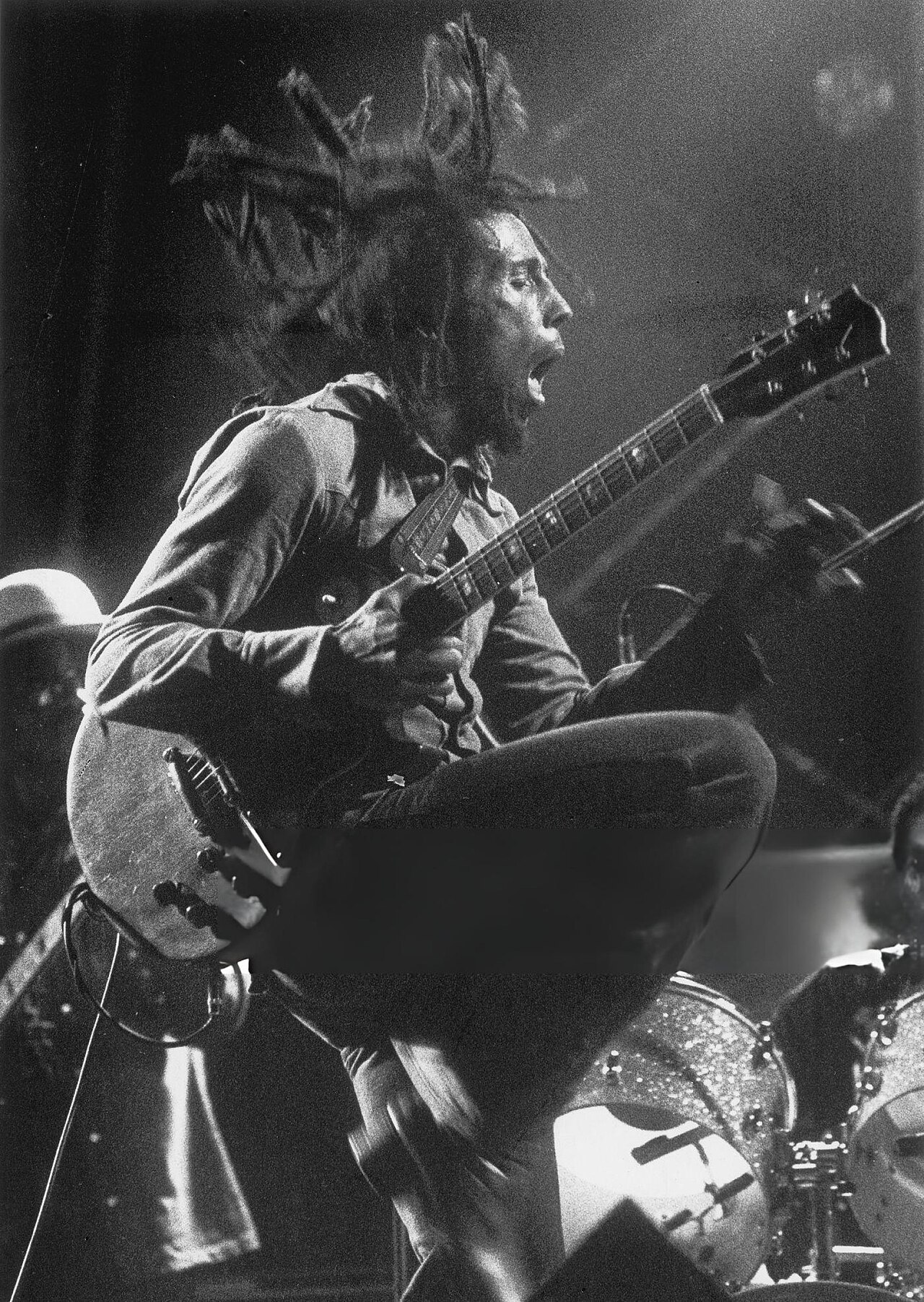
A turning point came when Peter Tosh and Bunny Wailer, each a formidable artist in his own right, departed to pursue solo careers. The group was reconfigured and renamed Bob Marley and the Wailers, with Marley firmly at the centre and a trio of female backing vocalists known as the I-Threes, which included his wife, Rita Marley, adding gospel-tinged depth. Through relentless international touring, Marley became one of the first global superstars to emerge from the developing world. In concert halls and festival fields across Europe, the Americas, Africa and beyond, audiences who shared neither his language nor his faith responded to the emotional truth in his voice and the irresistible momentum of the band.
The Sound of the Wailers
Much of the power of Marley’s recordings came from the band that surrounded him. The rhythm section of brothers Aston “Family Man” Barrett on bass and Carlton Barrett on drums gave the music its deep, rolling foundation, with the bass functioning almost as a lead instrument and the drums laying down the unhurried, off-beat pulse that is the signature of roots reggae. Around that core, keyboards, rhythm guitar and percussion built textures that felt at once spacious and hypnotic, leaving room for Marley’s voice and the harmonies of the I-Threes to carry the emotional weight.
That sound was not an accident but the product of countless hours in the studio, where Marley proved himself a meticulous craftsman as well as an inspired performer. He reworked songs repeatedly, refining arrangements and phrasing until they achieved the blend of immediacy and depth he sought. The collaboration with Island Records gave these recordings a polish that helped them reach rock audiences without sacrificing their essential character, and the live performances that followed turned the studio material into something even more electric, with Marley moving across the stage in a kind of trance, eyes closed, lost in the music he was channelling.
The Major Albums
Across the 1970s, Bob Marley and the Wailers produced a sequence of albums that together form one of the most influential catalogues in popular music. The records that opened the decade introduced international listeners to the group’s roots-reggae sound and to Marley’s gift for songs that were politically charged yet deeply melodic. Subsequent albums broadened both the sound and the message, weaving together themes of spiritual faith, romantic love, social protest and African liberation, and yielding many of the songs that would become global standards.
By the middle of the decade, the live recordings and studio albums had established the band as a genuine international act, and the second half of the 1970s brought work of remarkable ambition and consistency. These albums tackled exile, injustice and redemption while remaining eminently danceable, a balance few artists in any genre have struck so well. The compilation released after his death gathered many of these songs in one place and became a permanent fixture in record collections worldwide, the entry point through which millions first discovered him. Taken as a whole, the catalogue demonstrates how Marley expanded reggae’s expressive range without ever abandoning its foundations.
Music as a Message
What set Marley apart was the way he fused the personal and the political without ever letting either overwhelm the music. He sang of love and heartbreak with the same conviction he brought to songs about poverty, injustice and liberation, and he wrapped even his most pointed messages in melodies so warm and memorable that they slipped past the defences of listeners who might otherwise have resisted. His songs became anthems for civil-rights campaigners, anti-colonial movements and ordinary people who felt unheard, and he understood the responsibility that came with such reach.
That growing influence placed him at the centre of Jamaica’s volatile politics. In December 1976, just days before he was due to perform at a free concert intended to ease political tensions on the island, gunmen broke into his home and opened fire, wounding Marley, his wife and his manager. Badly shaken but undeterred, Marley performed at the concert anyway, reasoning that the people trying to make the world worse were not taking a day off, so neither would he. The image of a wounded artist singing for peace became part of his legend.
Two years later, at the One Love Peace Concert in Kingston, he produced one of the defining gestures of his career, bringing the leaders of Jamaica’s two bitterly opposed political parties onto the stage and joining their hands above his head in a plea for reconciliation. It was a moment of extraordinary moral authority, and it captured the role he had come to occupy: not merely an entertainer but a unifying figure whom warring factions were willing, however briefly, to heed.
Africa, Identity and Family
Marley’s pride in his African heritage deepened as his fame grew, and he came to see his music as part of a larger story of liberation across the African diaspora. That conviction reached a symbolic peak in 1980, when he was invited to perform at the official celebrations marking the independence of Zimbabwe, a country whose liberation struggle he had championed in song. To stand on that stage as a new African nation was born was, for Marley, a profound honour and a vindication of the themes he had sung about for years.
His personal life was as expansive as his public role. He married Rita Anderson in 1966, and though the marriage endured, his life included relationships that produced a large family of children. Several of them, most prominently Ziggy, Stephen, Damian, Cedella and Ky-Mani, would go on to carry his musical legacy into later generations, winning acclaim in their own right and keeping his catalogue and message alive. The Marley name became, in effect, a musical dynasty, an unusual continuation of an artistic legacy across generations.
The Man Behind the Music
Away from the stage, Marley was known for a restless energy and a deep love of football, which he played with genuine seriousness wherever he travelled, often organising matches with his band and crew between recording sessions and concerts. The sport was more than a pastime; he saw in it the same qualities he valued in music, namely discipline, teamwork and joy, and it was a football injury that would later be linked to the discovery of his illness. He was also known for his generosity, quietly supporting relatives, friends and members of his community, and for a charisma that drew people to him and made him a natural leader within the close-knit world of his band.
A few details help complete the portrait:
- He grew up between two worlds as the son of a young Black Jamaican mother and an older white father, an experience that shaped his lifelong message of unity.
- He honed his vocal harmonies in the yard of the singer Joe Higgs, a mentor to the young Wailers.
- He performed at a peace concert in 1976 just days after surviving an assassination attempt, appearing on stage despite his wounds.
- He played at the independence celebrations of Zimbabwe in 1980, a moment of deep personal significance.
- His children, including Ziggy, Stephen and Damian Marley, became acclaimed musicians who carried his legacy forward.
Illness and Death
In 1977 doctors discovered a malignant melanoma beneath a toenail on one of Marley’s feet, an injury he had initially attributed to a football mishap. The recommended treatment would have involved amputating the affected toe, a step Marley declined, in part because of beliefs associated with his faith and his identity as a performer. The cancer, left to advance, eventually spread to other parts of his body, including his lungs and brain.
Even as his health deteriorated, Marley continued to tour and record, driven by a sense of mission and a reluctance to stop. By 1980 the illness had progressed too far to ignore, and after collapsing while jogging in New York he sought treatment abroad. The disease could not be reversed. Returning across the Atlantic, he died on 11 May 1981 in Miami at the age of just thirty-six. He was given a state funeral in Jamaica, attended by enormous crowds and by political and cultural leaders alike, and was buried near his birthplace in Nine Mile.
Legacy
Bob Marley’s death did not diminish his presence; if anything, it magnified it. In the years that followed, his reputation grew from that of a celebrated reggae star into that of a global cultural icon, his name invoked alongside the handful of twentieth-century musicians whose influence transcended their own genre entirely. A posthumous greatest-hits collection became one of the best-selling albums in history, introducing his music to listeners who had not yet been born when he died and ensuring that his songs remained fixtures on radio playlists, in films and at gatherings of every kind around the world. Statues, museums, festivals and murals in his honour appeared from Kingston to cities across Africa, Europe and the Americas. He was inducted into the Rock and Roll Hall of Fame, received a posthumous Grammy Lifetime Achievement Award, and was repeatedly cited by later musicians across genres as a foundational influence.
Marley’s influence on later music is almost impossible to overstate. He did more than any other single figure to bring reggae to a global audience, opening doors for the Jamaican artists who followed and embedding the genre’s rhythms in the wider vocabulary of popular music. Echoes of his approach can be heard across rock, hip-hop, pop and the many strains of world music that drew on Caribbean sounds; his songs have been covered, sampled and reinterpreted countless times. Beyond the music itself, he helped popularise the visual and cultural language associated with Rastafari and with a certain ideal of conscious, socially engaged artistry, inspiring musicians to believe that commercial success and a serious message need not be at odds.
His political and cultural resonance has, if anything, deepened with time. Liberation movements adopted his songs as anthems, humanitarian campaigns invoked his words, and his name became shorthand for a particular blend of resistance and love. In 2001 he received a posthumous Grammy Lifetime Achievement Award, and his work has been recognised by halls of fame and cultural institutions around the world. The museum housed in his former Kingston home draws visitors from every continent, and “One Love,” the spirit of unity for which he is best remembered, has become a phrase associated with Jamaica itself.
More than four decades on, his face, framed by dreadlocks and lit by an unmistakable conviction, remains one of the most recognisable images on the planet, reproduced on posters, murals and clothing in every corner of the globe. But the deeper legacy lies in the message rather than the merchandise. Marley proved that music made on a small island nation could speak to the whole of humanity, that a song sung with enough conviction can outlast the powers it challenges, and that art rooted in a specific faith and place can nonetheless become a shared inheritance for the world. He turned reggae into a global force and, in doing so, gave voice to the dispossessed everywhere. He showed that an artist could be commercially successful and spiritually serious at once, that a message of peace could be delivered with irresistible groove, and that the particular struggles of one community could illuminate the universal longing for freedom and dignity. That is why his songs are still sung at protests and weddings, in stadiums and on street corners, by people who may know nothing of Trench Town or Rastafari but who feel, instinctively, that the music is speaking to them. That voice has not faded, and it shows no sign of doing so.