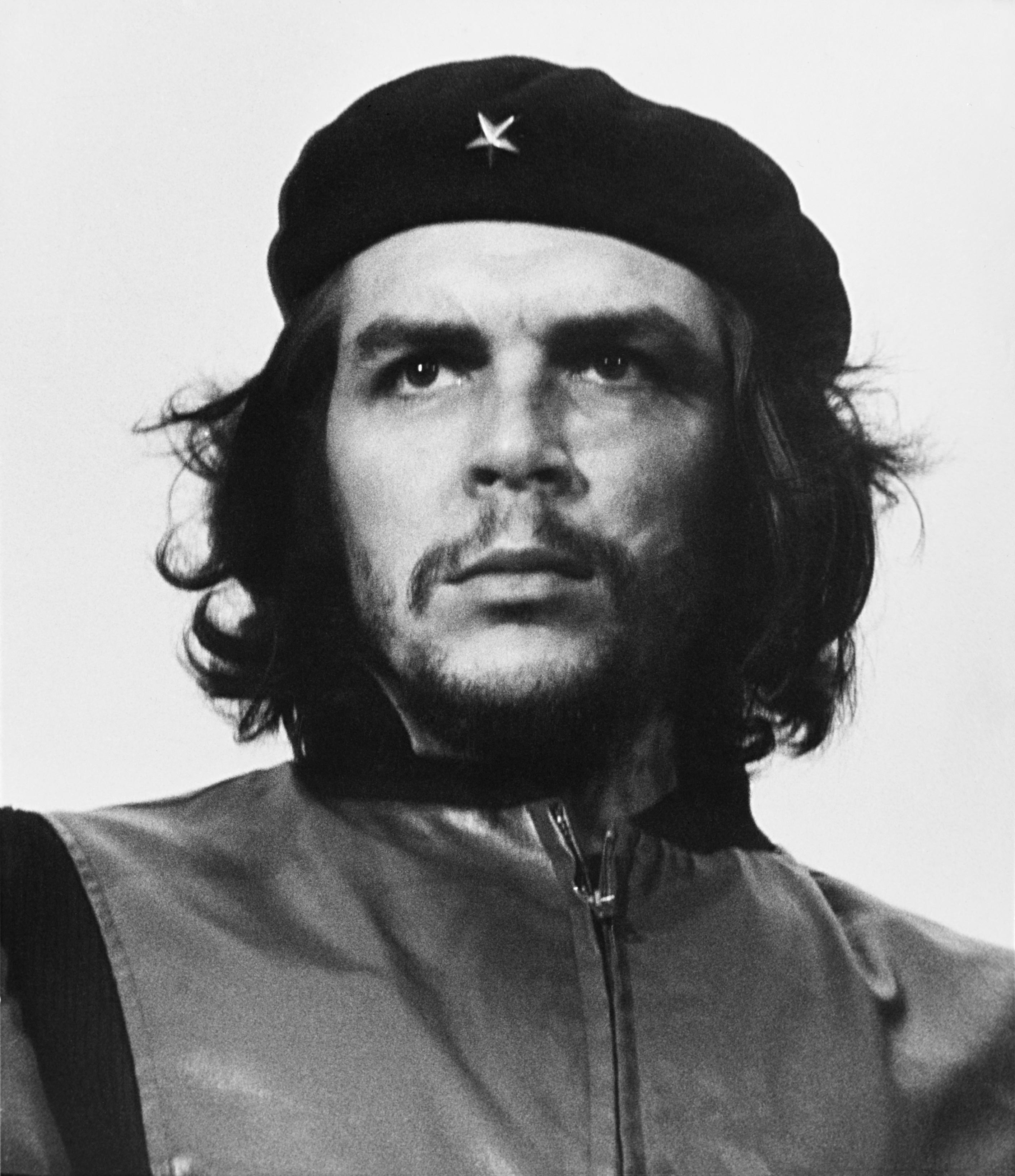
On 5 March 1960, at a memorial ceremony in Havana for the victims of the freighter La Coubre, which had exploded in the harbour two days earlier killing more than a hundred people, the Cuban photographer Alberto Korda raised his camera and captured an image that would become one of the most reproduced photographs in human history. In the image, a young man in a black beret stands slightly above the crowd, chin tilted upward, jaw set, eyes focused on some fixed point in the distance beyond the frame. The expression is impossible to read with confidence: it might be grief, or anger, or the particular concentrated stillness of someone who has made irrevocable decisions. The man was Ernesto Guevara de la Serna, a thirty-one-year-old Argentine physician who had abandoned his medical career to join a guerrilla revolution and had been, for the previous year, one of the commanders of the revolutionary government of Cuba. He had a nickname that had followed him since his early days in Argentina, rooted in his habit of punctuating his speech with the Argentine slang word “che,” roughly equivalent to “mate” or “hey.” The photograph by Korda was titled “Guerrillero Heroico,” the Heroic Guerrilla. It became the visual icon of an era.
Quick Facts
- Full name
- Ernesto Guevara de la Serna
- Born
- 14 June 1928, Rosario, Argentina
- Died
- 9 October 1967, La Higuera, Bolivia (aged 39)
- Known for
- Commander in the Cuban Revolution; minister in the Cuban government; revolutionary theorist; guerrilla leader in Bolivia
- Key achievement
- Commanded forces that captured Santa Clara in December 1958, the decisive battle of the Cuban Revolution; served as Cuba's minister of industry and president of the national bank
Rosario and a Childhood of Privilege and Illness
Ernesto Guevara de la Serna was born on 14 June 1928 in Rosario, the second-largest city in Argentina, to a family of the educated middle class with a lineage that included on his father’s side some genuine if faded aristocratic ancestry. His father, Ernesto Guevara Lynch, was a civil engineer and farmer of intermittent success; his mother, Celia de la Serna y Llosa, was a woman of education and left-liberal politics who would prove the more formative parental influence. She read widely, kept a household in which political discussion was normal, and held progressive views on women’s role in society that were ahead of her social milieu.
When Ernesto was two years old, he developed asthma that would be severe, chronic, and life-defining. The condition first manifested after he went swimming with his mother in a cold river in Cordoba province, and it never left him. From that point forward, the Guevara family organised much of its life around the child’s medical condition, eventually moving from Rosario to Alta Gracia in the Cordoba province mountains when Ernesto was four, because the drier mountain air was thought to be better for his lungs.
Alta Gracia was a small town in the Sierras that attracted a population of convalescing patients and their families, giving it a somewhat cosmopolitan character despite its small size. Among the community of expatriates who settled there in the 1930s were a number of Republicans who had fled Spain after Franco’s victory in the Civil War, and the young Guevara grew up knowing and listening to people who had been through a real political struggle and who brought with them a Spanish Republican left-wing politics that was an entirely normal part of the social world of Alta Gracia.
His asthma shaped him in ways that went beyond the physical. He could not always participate in the rough-and-tumble outdoor activities of normal Argentine boyhood, and the enforced idleness of asthma attacks, which could leave him bedridden for days, gave him time to read that other children did not have. His mother supplied him with a library that included world literature, history, and poetry. By his early teens he was reading Freud, Jung, Marx, and a wide range of socialist and anarchist political philosophy alongside Neruda, Verne, and Jack London. He kept notebooks of philosophical and literary quotations that he called his “philosophical” diary.
He was also, from early adolescence, a rugby player of genuine ability, a fact that sat oddly with his chronic illness but was characteristic of his relationship to physical challenge. He refused to let the asthma prevent him from doing what he wanted to do, and he pushed through attacks by sheer will, carrying an inhaler and simply continuing. The rugby sustained him socially and physically, and it reinforced a physical courage that seems to have been a constitutive part of his personality.
The family moved several times during his childhood, eventually settling in Buenos Aires where Ernesto enrolled in the medical school of the University of Buenos Aires in 1948. By the time he began medical training he was already politically formed: his reading, his family’s liberal political culture, the experience of knowing Spanish Republican exiles, and his own observation of the social conditions of rural Argentina had produced a young man of leftist convictions who combined genuine intellectual curiosity with a temperamental impatience with what he saw as the comfortable hypocrisy of the bourgeoisie he had grown up among.
The Motorcycle Diaries: Education on the Road
In January 1952, before completing his medical degree, Guevara set off on a journey across South America with his friend Alberto Granado, a biochemist who was twenty-nine to Guevara’s twenty-three. They travelled on a Norton 500cc motorcycle that they called La Poderosa (the Powerful One), which broke down irreparably near Temuco in southern Chile about a third of the way into the trip, after which they continued by whatever means were available: truck, boat, raft, and foot.
The journey took them from Argentina through Chile, Peru, Colombia, and Venezuela over a period of nine months, and Guevara kept a diary of remarkable quality throughout. He observed, with the attentiveness of a doctor and the moral seriousness of a young man who was thinking hard about what kind of person he intended to be, the conditions in which the majority of South Americans lived: the Atacama Desert miners working in conditions of medieval brutality for foreign mining companies, the Indian communities of Peru whose descendants of an ancient civilisation had been reduced to the margins of a society that had dispossessed them, the leper colony of San Pablo in the Peruvian Amazon where Guevara worked as a volunteer doctor and gave his graduation speech swimming to the lepers’ side of the colony rather than speaking from the healthy side.
He arrived in Venezuela in July 1952, took a plane to Miami (his first visit to the United States), and flew back to Argentina to finish his medical degree. He completed his studies in November 1953, qualifying as a physician. He never practised medicine as a profession. Within months he was back on the road in Latin America, this time with a more deliberate political purpose.
Guatemala and the Radicalisation
He arrived in Guatemala City in December 1953, drawn by the social experiment underway under President Jacobo Arbenz, who had won democratic elections in 1950 and was implementing a land reform programme that redistributed unused plantation land to landless indigenous farmers. The reform was specifically targeting the vast holdings of the United Fruit Company, the US corporation that owned enormous tracts of Guatemalan land and had deeply entrenched political influence in Washington, having placed several of its executives in key government positions during the Eisenhower administration.
Guatemala under Arbenz was a centre of Latin American left-wing political thought, attracting intellectuals, activists, and political refugees from across the hemisphere. Guevara threw himself into this environment, working as a doctor and engaging intensely in the political debates of the exile and activist community. He met Hilda Gadea, a Peruvian economist active in the APRA movement, who became his first wife, and through her he was introduced to a group of Cuban exiles who had survived the disastrous attack on the Moncada Barracks in July 1953. One of these exiles, Nico Lopez, gave him his first substantial account of the 26th of July Movement and its leader, Fidel Castro.
In June 1954, a CIA-organised military operation, Operation PBSUCCESS, overthrew the Arbenz government, installing in its place a right-wing military regime. The coup was swift and virtually bloodless because the Guatemalan army, whose loyalty Arbenz had never fully secured, simply stood aside. Guevara was in Guatemala City when it happened. He attempted to organise armed resistance, gathering what weapons he could find and urging the defenders of the government to fight. The defenders did not fight. Arbenz resigned and went into exile.
The experience was transformative. Guevara drew two conclusions from Guatemala that shaped the rest of his life. The first was that the United States would never allow a genuinely left-wing government in Latin America to consolidate itself through peaceful democratic means: the moment any government threatened American corporate interests, the CIA and the American military would be deployed to remove it. This conclusion was not unreasonable given the evidence available in 1954. The second conclusion was that a revolutionary movement that relied on the existing national army, rather than building its own armed force, was inherently vulnerable to the army’s switching sides. This conclusion shaped the strategic thinking of the Sierra Maestra campaign and all of Guevara’s subsequent guerrilla theory.
Mexico, Castro, and the Sierra Maestra
Guevara arrived in Mexico City in September 1954, having fled Guatemala after the coup. He worked as a physician at the General Hospital and renewed his connections with the Cuban exile community, including Antonio Lopez, who introduced him to Raul Castro in June 1955 and through Raul to Fidel a week later.
The meeting with Fidel Castro was one of those encounters whose significance both parties recognised immediately. Guevara had been looking for a revolutionary project worthy of his commitment; Castro had been looking for cadres of the calibre that the revolution he was planning would require. Guevara stayed up all night talking with Castro at their first meeting, and by the end of the conversation he had agreed to join the expedition that was being planned to Cuba. He joined not as a soldier, to which his medical training was irrelevant, but as the unit’s doctor. But he also trained as a fighter, and from the beginning it was clear that his role would not be confined to the medical.
He trained with the other eighty-one guerrillas at a farmhouse in Mexico under the former Spanish Republican military officer Alberto Bayo. He was consistently the outstanding student of the group. He participated in the nightmarish seven-day crossing on the Granma and landed in Cuba on 2 December 1956. In the subsequent battle and its chaotic aftermath, he was wounded in the neck, reached the Sierra Maestra with a group of survivors, and began the guerrilla campaign that would last two years.
In the Sierra Maestra he demonstrated a military talent that astonished even his comrades who had seen him train in Mexico. He was methodical in planning, absolutely calm under fire, and demanding toward both himself and those who served under him in a way that some found inspiring and others found brutal. He executed, during the guerrilla campaign, at least some individuals who were accused of being informants or traitors, and his willingness to order these executions without apparent hesitation was noted by those who served with him and later by biographers trying to understand the full character of the man.
He was promoted to Comandante, the highest rank in the guerrilla force, in July 1957, one of only two people to hold that rank (the other was Fidel Castro). He led his column eastward and northward through 1958 while the general campaign intensified, and in December 1958 he led the force that captured Santa Clara, the country’s third city, in a battle whose decisiveness prompted Batista to flee on 31 December 1958.
Cuba: Minister, Banker, and Wandering Revolutionary
The years between 1959 and 1965 were Guevara’s Cuban period, in which he served the revolutionary government in a range of positions while simultaneously writing the theoretical works that would make him one of the most widely read revolutionary thinkers of the twentieth century.
He served first as head of the La Cabana Fortress prison in Havana, where he oversaw the trials and executions of individuals accused of crimes under the Batista regime. The executions numbered in the hundreds over several months, a fact that became one of the central counts against him in the assessment of later critics who found his treatment of human rights abuses under Batista too summary and too brutal to square with his stated commitment to human dignity.
He served as president of Cuba’s National Bank from November 1959, signing currency notes with the single word “Che,” and as minister of industry from February 1961. In both roles he was energetic, analytical, and ultimately unsuccessful. His approach to economic management was idealistic in a way that reflected his theoretical commitment to the moral transformation of the individual worker through revolutionary consciousness but proved impractical in the face of Cuba’s economic realities, the American embargo, and the complexity of managing a national economy.
He travelled widely as Cuba’s international representative, delivering some of the most memorable speeches of the Cold War era, including an address to the UN General Assembly in December 1964 in which he explicitly attacked the United States for its support of apartheid South Africa and its policy in the Congo, and a speech to the Tricontinental Conference in Havana in 1966 in which he called for the creation of “two, three, many Vietnams” to stretch American imperial power to its limits.
“The true revolutionary is guided by a great feeling of love. It is impossible to think of a genuine revolutionary lacking this quality.”
The line, from his 1965 essay “Socialism and Man in Cuba,” captures something essential about Guevara’s self-understanding: that the revolutionary project was not merely political but moral and even spiritual, rooted in a love for humanity that was inseparable from the determination to change the conditions in which humanity lived.
In April 1965, he left Cuba. He had written a farewell letter to Castro formally resigning his Cuban citizenship and party membership, releasing Castro from any obligation to his former comrade so that Castro could deny any Cuban involvement in whatever Guevara did next. What he did next was go to the Congo, where he led a guerrilla operation in support of Laurent-Desire Kabila’s rebel forces in the eastern Congo from April to November 1965. The operation was a failure. Kabila’s forces lacked discipline and commitment. The Congolese fighters did not want to fight the way Guevara’s theory required. He left the Congo in November 1965 feeling, by the account of his Congo diary, that the experience had been a defeat.
Bolivia and the End
Guevara spent several months in Cuba in 1966, in hiding, preparing for his next campaign. He had chosen Bolivia, a landlocked Andean country with a desperately poor rural majority, as the terrain for a guerrilla campaign that he believed could ignite a continental revolution. Bolivia was also strategically positioned at the heart of South America, bordered by five countries; a successful revolutionary base there, in his theory, could spread the struggle outward in multiple directions simultaneously.
He arrived in Bolivia in November 1966 under a false identity, with a small group of Cuban comrades and a larger group of Bolivian recruits. The campaign began badly and grew steadily worse. The Bolivian Communist Party, whose support he had been promised, withdrew it after a political dispute. The Bolivian peasant communities in the region where he was operating, the Nancahuazu Valley in the south-east of the country, did not rally to the guerrillas. The Bolivian army, trained and assisted by US Special Forces advisers, was more capable and more motivated than he had expected.
The CIA tracked his location with methodical precision, using a network of informants and technical surveillance that proved more effective than any counter-insurgency operation the agency had previously mounted in Latin America. By October 1967, his column had been reduced to fewer than fifty fighters, exhausted, hungry, and running from a much larger force.
He was captured on 8 October 1967 near the village of La Higuera, wounded in the leg and no longer able to run. He was held overnight in a small schoolhouse in La Higuera. On 9 October 1967, following instructions from the Bolivian government and, by most accounts, from CIA officers present at the scene, a Bolivian army sergeant named Mario Teran shot Guevara in a series of bursts, delivering the final shots to his torso to simulate combat wounds. He was thirty-nine years old.
His hands were cut off for fingerprint identification, and photographs of his body were widely distributed as proof of his death. His remains were not officially located until 1997, when his skeleton was found in a mass grave near the Vallegrande airstrip, where his body had been brought after his death. He was reinterred in Cuba in October 1997 with full military honours.
Legacy
Ernesto Guevara’s legacy is one of the most contested in modern political history. To his admirers, he was the incarnation of the selfless revolutionary, a man who gave up comfort, career, family, and ultimately his life for the liberation of the poor, who could have remained in Havana as a minister and chose instead to go back into the jungle and the mountains where the revolution was most needed. To his critics, he was a brutal executioner who killed without sufficient legal process, a failed economic manager whose idealism produced poverty, and a romantic fool whose guerrilla theory worked in the specific conditions of the Sierra Maestra but nowhere else.
Both readings are partial. What is not seriously disputed is the quality of his courage, the depth of his intellectual engagement with the questions he had spent his life trying to answer, and the extraordinary reach of his image and his ideas across fifty years of history. The photograph by Korda has been reproduced on more surfaces, in more countries, than virtually any other photograph in history. That the face in it belongs to a doctor from Rosario who read Freud and Marx during asthma attacks and went looking for a revolution is itself a story that the world has found inexhaustible.
Key Facts
- Guevara’s famous motorcycle journey across South America in 1952 covered over 8,000 kilometres and took nine months; the diary he kept was published in 1993 and adapted into a film, “The Motorcycle Diaries,” in 2004.
- As Cuba’s national bank president from 1959 to 1961, he signed the country’s currency notes with only the word “Che,” dismissing the formal title as evidence of bourgeois attachment to the trappings of office.
- He led the column that captured Santa Clara in December 1958, the decisive battle of the Cuban Revolution; the battle is commemorated by a large mausoleum in the city that holds his remains and those of other guerrillas killed in Bolivia.
- His guerrilla manual, “Guerrilla Warfare,” published in 1961, was studied by revolutionary movements and by counter-insurgency military planners on opposite sides of the Cold War, including by the US Army at West Point.
- He was captured and executed in Bolivia on 8 and 9 October 1967; the instructions for his execution are believed to have come from senior CIA officer Felix Rodriguez, who was present at La Higuera, and from the Bolivian government of Rene Barrientos.