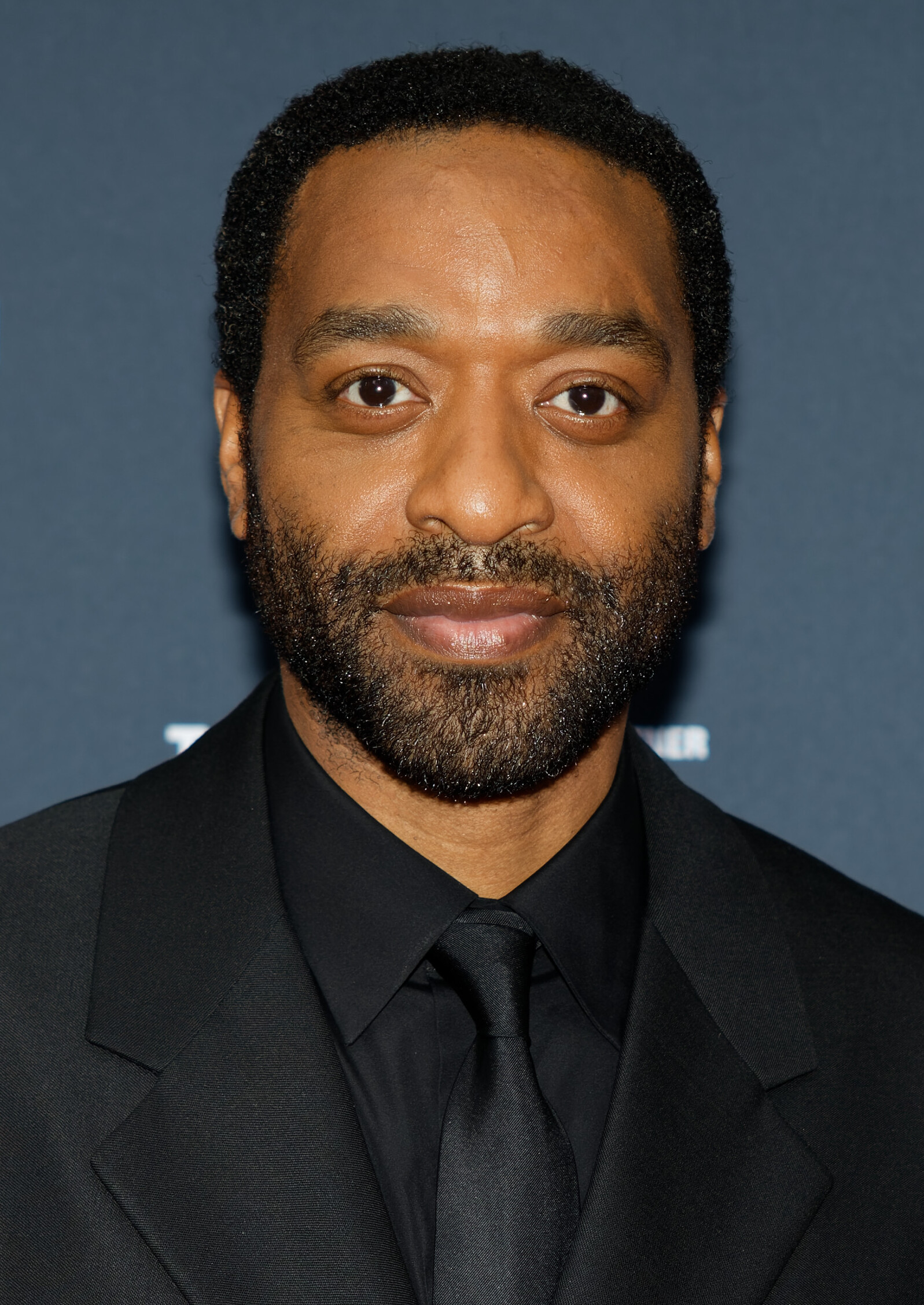
There is a quality in Chiwetel Ejiofor’s work that is difficult to name precisely but impossible to miss. It is a quality of absolute presence, of a person who is listening as intently as he is speaking, of a mind that is working even when the character is silent. Directors who have worked with him frequently mention that he gives them something unexpected in every take, not something disruptive or uncontrolled but something new, a detail, a hesitation, a look that opens the moment in a direction the script had not anticipated. Steve McQueen, who directed him in “12 Years a Slave,” has said that he would watch Ejiofor’s face between takes and find the expression there as interesting as anything happening during the shot. That quality, the sense that the interior life is always running, always processing, is what makes him one of the most distinctive screen presences working in contemporary cinema. Understanding how it developed requires going back to Forest Gate in east London, to a Igbo-Nigerian family with deep roots in education and medicine, and to a series of formative experiences that shaped a particular kind of intelligence and a particular kind of courage.
Quick Facts
- Full name
- Chiwetel Umeadi Ejiofor
- Born
- 10 July 1977, Forest Gate, London, England
- Nationality
- British
- Known for
- "Dirty Pretty Things" (2002), "Kinky Boots" (2005), "Children of Men" (2006), "12 Years a Slave" (2013), "Doctor Strange" (2016)
- Awards
- Academy Award nomination for Best Actor (2014), BAFTA Award for Best Actor, Screen Actors Guild Award, OBE (2008)
Forest Gate and a Nigerian Heritage
Chiwetel Umeadi Ejiofor was born on 10 July 1977 in Forest Gate, a district in the London Borough of Newham in east London. His parents, Arinze and Obiajulu Ejiofor, were both Nigerian of Igbo descent. His father was a doctor and his mother a pharmacist, and the family represented the generation of educated Nigerian professionals who came to Britain in the post-independence decades, bringing with them a set of values that combined professional aspiration with a strong sense of cultural identity. Chiwetel grew up in a household where education was central, where medicine and science were the default vocabulary of achievement, and where Nigerian culture, including the Igbo language, was maintained alongside the English context of daily life in London.
The family lived in Forest Gate and then moved to Islington. His father was a member of the Roman Catholic church, and religion was part of the household’s fabric. The Igbo community in London was a social world with its own networks, events, and expectations, and Chiwetel grew up inside those networks while also navigating the mainstream English world of his schooling and neighbourhood. The bicultural experience, familiar to the children of Nigerian immigrants throughout the United Kingdom, is one that he has discussed in various interviews as formative and sometimes complicated: the question of identity, of where you belong and what you represent when you belong in multiple places simultaneously.
When he was eleven years old, his family was involved in a serious car accident. His father was killed. The loss was devastating for the entire family, and Chiwetel, who was eleven and the eldest child, found himself in a household reshaped entirely by grief. He has spoken about this period carefully in interviews, acknowledging the difficulty without dwelling in it, noting that the loss was one of the experiences that drove him toward acting, toward the sustained imaginative engagement with human experience that performance requires.
He attended Dulwich College, a distinguished independent school in south London, where he developed as a student and as a performer. His drama teacher recognised his exceptional talent early and encouraged it seriously. He appeared in school productions and demonstrated, from his early teens, the quality that would later distinguish him professionally: the ability to be completely present in a character without the audience being able to see the mechanism of the performance.
The London Academy of Music and Dramatic Art
After Dulwich College, he gained a place at the London Academy of Music and Dramatic Art (LAMDA), one of Britain’s foremost drama schools. He was accepted into the programme at 19, and the training confirmed and systematised what he had been developing organically through school performance. LAMDA’s curriculum included classical text work, voice and movement training, and the sustained discipline of learning how to work in an ensemble, and Ejiofor brought to all of it the intellectual seriousness and the emotional openness that would characterise his professional work.
He did not complete the full LAMDA programme, because before his course was finished he was cast in a major professional production. Steven Spielberg needed a young actor to play the teenage Meili in “Amistad” (1997), his film about the 1839 slave ship revolt. Ejiofor was cast directly from drama school. The experience of working with Spielberg at nineteen, alongside Djimon Hounsou, Morgan Freeman, Anthony Hopkins, and an ensemble of experienced professionals, was an immersion course in professional filmmaking that no drama school curriculum could replicate. He handled it with a poise that surprised those who did not yet know what he was capable of.
He returned to stage work after “Amistad” and continued to build his credentials in British theatre. He worked at the National Theatre and at the Royal Shakespeare Company, appearing in productions that gave him extensive experience with classical text. His Othello at the Donmar Warehouse, directed by Michael Grandage, received extraordinary critical notices and established him as a major classical actor, not simply a promising screen talent. The Donmar Othello toured internationally and confirmed that he could carry one of the most demanding roles in the Shakespeare canon with complete authority.
Dirty Pretty Things and the Rise to Film Prominence
The film that established him for the broader public in Britain and internationally was Stephen Frears’s “Dirty Pretty Things” (2002), in which he played Okwe, a Nigerian doctor working illegally in London as a taxi driver and hotel porter after having fled unspecified horrors in Nigeria. The film examined the lives of undocumented immigrants in London with a mixture of thriller mechanics and social realism that was characteristic of Frears’s best work. Audrey Tautou played his co-lead.
Ejiofor’s Okwe was a revelation: a man carrying enormous grief and guilt and fear who maintained a surface of professional competence and personal dignity because the alternative was collapse. The performance was enormously controlled and yet visibly alive, a portrait of a particular kind of immigrant experience, the educated professional reduced to invisibility by the accident of his legal status, that had rarely been shown on a British screen with that specificity. The film grossed approximately $14 million internationally, a substantial figure for a film of its type, and the critical response was dominated by discussion of Ejiofor’s performance. He was named Best Actor by the British Independent Film Awards.
In 2004 he appeared in Antoine Fuqua’s “Chasing Liberty” in a small role and in Craig Gillespie’s “Lars and the Real Girl” in a supporting role. He appeared in Spike Lee’s “She Hate Me” in 2004 and began to establish himself in American cinema as a presence who could operate across a wide range of tonal registers.
In 2005, he appeared alongside Joel Edgerton and Nick Frost in Lasse Hallström’s “Kinky Boots,” playing Lola, a drag performer whose relationship with a struggling shoe factory owner becomes the engine of a feel-good comedy-drama. The role required Ejiofor to perform in high heels, to sing, and to embody a character whose flamboyance and vulnerability were both genuine and in the open. It was a radical departure from the quiet containment of “Dirty Pretty Things” and demonstrated that the range he had shown on stage was available on film as well. “Kinky Boots” was warmly received and grossed over $14 million internationally.
Alfonso Cuarón and Children of Men
In 2006, Alfonso Cuarón’s “Children of Men” cast Ejiofor as Nigel, an art curator protecting the last remnants of civilisation’s cultural heritage in a near-future Britain where human fertility has collapsed and society is disintegrating. The film is a masterpiece of speculative cinema, and Ejiofor’s role was supporting rather than central, but his presence was crucial to the moral architecture of the film’s argument about what is worth preserving when everything is being lost. Clive Owen played the film’s central character and Julianne Moore appeared in a significant early role. The film grossed over $69 million worldwide and was nominated for three Academy Awards.
He appeared in “Talk to Me” (2007), Don Cheadle’s film about Washington D.C. radio personality Petey Greene, in a role as Dewey Hughes, the programme director who recognised and championed Greene’s talent. The film was a period piece set in the 1960s and 1970s and required Ejiofor to inhabit the specific world of Black professional life in Washington during the civil rights era with precision and care. He received the Los Angeles Film Critics Association Award for Best Supporting Actor.
In 2007, he appeared in Ridley Scott’s “American Gangster” alongside Denzel Washington and Russell Crowe, playing Nicky Barnes, a Harlem drug lord whose relationship with Washington’s Frank Lucas drives part of the film’s narrative. The film grossed over $266 million worldwide. In 2012, he appeared in David O. Russell’s “The Words,” and began preparing for the role that would define his career’s public recognition.
“I’m always looking for the moment where a character reveals themselves, not through what they say but through what they’re unable to say.”
12 Years a Slave and the Academy Award Nomination
Steve McQueen’s “12 Years a Slave” (2013), based on Solomon Northup’s 1853 memoir, told the story of a free Black man in Saratoga Springs, New York, who was kidnapped in 1841 and sold into slavery in Louisiana, where he remained enslaved for twelve years before being freed through the intervention of a Canadian friend. The film was one of the most anticipated and discussed films of its year, given McQueen’s reputation as a filmmaker of exceptional seriousness and the moral and historical weight of the subject matter.
Ejiofor played Solomon Northup, and the role required him to carry almost every scene in a film of more than two hours, to convey the full arc of a man’s experience of a system designed to destroy not just his freedom but his sense of himself as a person with history, family, and dignity. He played Solomon’s arrival in the slave state of Louisiana, his terrible education in the specific rules and brutalities of the institution, his strategic decisions about what to suppress and what to resist, and his survival over twelve years with an unflinching precision that made the audience understand slavery as a human experience rather than a historical abstraction.
The performance was physically demanding and psychologically exhausting in ways that Ejiofor has discussed carefully, acknowledging the particular challenge of inhabiting experiences of suffering and dehumanisation without either sensationalising them or retreating into emotional protection. He remained completely present throughout a film that required him to witness and participate in scenes of extreme violence and degradation, and the result was a performance that the Academy recognised with a nomination for Best Actor and that critics in every major market identified as one of the finest pieces of screen acting they had seen.
“12 Years a Slave” won the Academy Award for Best Picture, the BAFTA for Best Film, and the Golden Globe for Best Drama Film. It grossed over $187 million worldwide against a budget of approximately $20 million. Ejiofor did not win the Academy Award (Matthew McConaughey won for “Dallas Buyers Club” that year) but his nomination was a recognition of a performance that will be part of cinema’s historical record for as long as the medium exists.
Doctor Strange, Salt and Fire, and the Range of a Complete Actor
After the recognition that followed “12 Years a Slave,” Ejiofor’s choices demonstrated the same breadth that had characterised his earlier career. He appeared in Scott Derrickson’s “Doctor Strange” (2016) as Baron Mordo, a supporting character in Marvel’s introduction of the Sorcerer Supreme played by Benedict Cumberbatch. The role placed him in one of the most commercially successful franchise films of that year, which grossed over $677 million worldwide, and required him to play a character whose allegiances were ambiguous and whose arc was designed to continue across multiple films.
He appeared in Werner Herzog’s “Salt and Fire” (2016), a deliberately austere film about an environmental scientist and a corporate executive whose confrontation at a Bolivian salt flat becomes a meditation on responsibility and nature. Herzog’s film was not a commercial production and was not intended as one; it was the kind of difficult, uncommercial work that Ejiofor has consistently taken on alongside larger projects, maintaining the range and the willingness to serve art cinema that his career has always shown.
He appeared in Joel Edgerton’s “Loving” (2016), playing American civil rights attorney Bernie Cohen who argued the landmark interracial marriage case Loving v. Virginia before the Supreme Court. He appeared in the film adaptation of Roald Dahl’s “The BFG” (2016), directed by Spielberg in a reunion with the director who had given Ejiofor his first major film role. He took the role of Scar in Jon Favreau’s photorealistic computer-generated remake of “The Lion King” (2019), voicing the villain in a film that grossed over $1.6 billion worldwide.
In 2020, he appeared in the remake of “The Witches,” directed by Robert Zemeckis, playing the Grand High Witch’s servant. He continued to work in theatre, appearing in productions that kept him connected to the live performance traditions that had formed him. He wrote and directed his own film project in Nigeria, “The Boy Who Harnessed the Wind” (2019), based on William Kamkwamba’s memoir about a young Malawian who built a wind turbine to save his village from famine. The film was shot in Malawi and represented a direct statement about the stories Ejiofor wanted to tell and the parts of the world he wanted cinema to see.
Heritage, Identity, and Advocacy
Throughout his career, Ejiofor has been direct about the importance of his Nigerian heritage to his sense of identity and to his understanding of his work. He speaks Igbo, has maintained connections to Nigeria, and has been part of discussions in both British and Nigerian cultural contexts about what representation means and what it costs when it is absent. He was appointed an Officer of the Order of the British Empire (OBE) in 2008 for services to drama, recognition that came relatively early in his career and reflected the sustained quality and significance of what he had already achieved.
He has been a visible participant in discussions about diversity in British and Hollywood filmmaking, about the specific experiences of British-Nigerian and British-African actors navigating industries that have historically been slow to offer complexity to Black characters or to trust Black actors with the full weight of major productions. His career is itself an argument in that discussion: a demonstration that given the material and the space, a talent of his quality produces work of extraordinary value.
Directing, Writing, and Life Beyond Performance
The directorial debut that Ejiofor made with “The Boy Who Harnessed the Wind” (2019) was a statement about the kind of filmmaker he intended to be, not someone who made a first film in order to demonstrate his credentials and then returned to acting, but someone who had been developing this project for years and saw it as a natural extension of his storytelling commitments. The film told the story of William Kamkwamba, a Malawian teenager who in 2002, during a severe drought and famine that threatened his village, taught himself from library books to build a wind turbine that could power a water pump and save the harvest. Kamkwamba had no formal engineering training. He had a library and stubbornness and a desperate need to solve a problem. The story was, for Ejiofor, a story about Africa as a place of ingenuity rather than a place of helplessness, and the film’s insistence on that reframing was both a creative choice and a political one.
He wrote the screenplay as well as directing, and he appeared in the film as Kamkwamba’s father, a performance that required him to portray a man whose own limitations and fears become obstacles to his son’s solution. The casting of himself as the flawed father rather than the heroic son was a deliberate choice, a statement about humility and about the ensemble of perspectives that the story required. The film was produced for Netflix and premiered at the Sundance Film Festival in 2019, where it was warmly received. It starred Maxwell Simba as the young Kamkwamba and was shot on location in Malawi with a predominantly African cast and crew.
The film’s reception among critics and African audiences demonstrated that there was an appetite for the kind of African storytelling that Ejiofor had set out to provide, stories grounded in the specific realities and textures of African life, told with craft and emotional intelligence rather than with the distancing devices of the outsider. The directorial debut positioned him as a filmmaker whose ambitions extended to Africa in a way that his acting career, necessarily shaped by the priorities of the industries that hired him, had not been able to fully express.
Legacy
Chiwetel Ejiofor’s career is still in progress, and the body of work he has accumulated across thirty years makes clear that it will continue to grow in significance. He is one of the finest actors of his generation working in English, a performer whose range extends from Shakespeare to Marvel, from Nigerian social realism to Werner Herzog’s austere meditations, from period drama to contemporary thriller. He brings to all of it the same quality: a fully inhabited presence, a sense that the character is being discovered rather than performed, and an intelligence that the audience can feel even when it cannot name it.
His emergence from the British-Nigerian community in east London, his training in classical British theatre, and his navigation of both British and Hollywood filmmaking make him a figure who belongs to multiple traditions and reduces to none of them. He is, in the fullest sense, a product of the specific cultural intersection that produced him, and the work is richer for it.
Key Facts
- Chiwetel Ejiofor was cast in Steven Spielberg’s “Amistad” (1997) directly from his drama school training at LAMDA, making his major film debut at the age of nineteen.
- His performance as Solomon Northup in “12 Years a Slave” (2013) earned him Academy Award, BAFTA, Screen Actors Guild, and Golden Globe nominations, among the most complete citation records in a single year for any actor.
- He wrote and directed “The Boy Who Harnessed the Wind” (2019), shot in Malawi, a film that represented his most direct engagement with African storytelling and that he had been developing for several years.
- He was appointed an OBE in 2008 for services to drama, one of the younger British actors to receive the honour, at the age of 30.
- His Othello at the Donmar Warehouse, directed by Michael Grandage, is cited by theatre critics as one of the finest productions of that play in the early twenty-first century.