Few careers in the history of sport have been built as deliberately and maintained as ferociously as that of Cristiano Ronaldo. Where other great footballers are remembered for moments of inspiration, Ronaldo is remembered equally for what happened between those moments: the hours in the gym when everyone else had gone home, the dietary discipline that made him, at thirty-seven, as lean and powerful as men a decade younger, the obsessive attention to the technical details of his own performance. He has scored more international goals than any man in football history. He has won five Ballon d’Or awards and five UEFA Champions League titles. He has played at the highest level on three separate continents. The story of how he got there begins not on a glamorous stage but on a small Atlantic island where poverty was the rule and football was the escape.
Quick Facts
- Full name
- Cristiano Ronaldo dos Santos Aveiro
- Born
- 5 February 1985, Funchal, Madeira, Portugal
- Nationality
- Portuguese
- Sport
- Association football (forward)
- Major titles
- 5x Ballon d'Or; 5x UEFA Champions League; 5x Serie A; 3x Premier League; 2x La Liga; UEFA Euro 2016; UEFA Nations League 2019
Madeira: Where It Began
Cristiano Ronaldo dos Santos Aveiro was born on 5 February 1985, in Funchal, the capital of the Portuguese island of Madeira. He was the fourth and youngest child of Maria Dolores dos Santos and José Dinis Aveiro. His father was a municipal gardener who also worked as a kit man for Andorinha, the local football club; his mother was a cook. The family lived in a cramped house on a steep hillside in the Quinta do Falcao district, and money was consistently short. His father struggled with alcoholism throughout Ronaldo’s childhood, a source of pain the footballer has spoken about with unusual candour in later years, and José Dinis Aveiro died in 2005 without seeing the full scale of what his youngest son would become.
The island shaped Ronaldo in ways he still acknowledges. Madeira is remote, geographically isolated from the Portuguese mainland, and the communities there have a reputation for toughness and self-reliance. Ronaldo grew up understanding that no one from outside was going to hand him anything. His early football was played in the streets and on small pitches, and his skill was apparent from almost the moment he could walk. He joined Andorinha at age eight, then moved to Nacional, the bigger Madeiran club, two years later.
His single-mindedness was evident from childhood. Teammates from his youth years have described a boy who stayed long after training had ended, practising free kicks and dribbles until the light was gone. He did not simply want to be good. He wanted to be better than anyone had ever been, a goal that at that point in his life was not arrogance but faith, the faith of a child who understood that talent alone was not enough and that only total commitment would bridge the gap between where he was and where he intended to be.
Sporting CP and the Move to Lisbon
At twelve, Ronaldo was offered a trial at Sporting CP, the Lisbon-based club that remains one of Portugal’s two dominant football institutions. The trial was a success, and Ronaldo was accepted into the youth academy, moving from Madeira to Lisbon at an age when most children are still beginning secondary school. The move was devastating personally: he was homesick, he cried, and he was separated from everything familiar. He also had to deal with his accent, which marked him immediately as an outsider from the islands, and with the inevitable teasing that followed.
What he did with that adversity became the defining theme of his career. He threw himself into the academy programme with total focus. By fourteen he had been diagnosed with a heart condition that required surgery, a racing heart that threatened to end his football career before it began. The surgery was performed, successfully, and Ronaldo returned to training within weeks. His response to the diagnosis was characteristic: he did not allow it to diminish his ambition. He simply added it to the list of things he had overcome.
By seventeen he was playing regularly in Sporting CP’s first team, the youngest player in the club’s history to do so at that point. His performances in the autumn of 2002 announced him to the wider world. His dribbling was electric and sometimes undisciplined, his willingness to run at defenders unceasing, his desire to be on the ball in every important moment total. English scouts began making notes.
Manchester United: The Education of a Superstar
On 12 August 2003, Sporting CP played a pre-season friendly against Manchester United at the Estadio Jose Alvalade. Ronaldo, still seventeen, gave a performance of such precocious brilliance that United’s players reportedly lobbied manager Sir Alex Ferguson on the bus back to the hotel to sign him. Ferguson had already been considering the move; the game settled it. Within days, Ronaldo was a Manchester United player, for a fee of twelve million pounds, wearing the number 7 shirt previously carried by Eric Cantona, David Beckham, and George Best.
His first years at United were a negotiation between his explosive talent and the tactical demands of English football. He was frequently brilliant and occasionally infuriating, a player who dribbled into dead ends, threw himself to the ground seeking free kicks, and celebrated his own achievements with a self-regard that sections of the English press and public found grating. Ferguson managed him with a combination of firm authority and protective warmth, recognising in Ronaldo something he had seen in very few players: a young man for whom the desire to improve was not a virtue imposed by coaching but a compulsion that lived inside him.
The transformation from exciting wide player to complete forward accelerated dramatically after the 2006 World Cup. Portugal reached the semi-finals, and Ronaldo played brilliantly until a controversial moment during England’s quarter-final against Portugal in which he appeared to wink at the bench after Wayne Rooney’s red card, a gesture that generated enormous controversy in England and tested his relationship with his United teammates. He returned to Manchester in the aftermath and worked across the summer in a manner that his colleagues described as single-minded to the point of obsession.
The 2007 to 2008 season was the result of all that work compressed into nine months. He scored 42 goals in all competitions, won the Premier League title, the FA Cup, and the UEFA Champions League. He was named PFA Players’ Player of the Year, FWA Footballer of the Year, and, in November 2008, won his first Ballon d’Or. He was twenty-three years old.
The Move to Real Madrid
In the summer of 2009, Ronaldo moved to Real Madrid for what was then a world record transfer fee of eighty million pounds. The move had been anticipated for at least a year, and the announcement produced scenes at the Bernabeu that resembled a state occasion rather than a footballer’s unveiling. Eighty thousand fans attended the official presentation at the stadium.
At Madrid, Ronaldo entered into the most sustained period of individual scoring in the history of top-level football. From 2009 to 2018, he averaged more than fifty goals per season in all competitions. He scored 450 goals in 438 appearances for the club, winning four Champions League titles, two La Liga titles, two Copa del Rey trophies, and four additional Ballon d’Or awards. In the 2011 to 2012 La Liga season, he scored 50 league goals, a record for the division. In the 2014 to 2015 Champions League, he became the first player to score in every round, finishing as top scorer with ten goals.
His relationship with his great rival, Lionel Messi, who played for Barcelona during the same period, generated the most sustained debate in football about individual genius versus individual excellence. Messi was intrinsically gifted in ways that seemed almost effortless; Ronaldo was relentlessly constructed, a monument to what sustained application could do. The debate was never resolved, which is precisely what made it fascinating. Both men pushed the other to heights they might not have reached alone.
“Talent without working hard is nothing.”
Personal Life, Image, and the CR7 Brand
Away from the football pitch, Ronaldo built a commercial enterprise around his image that few athletes in any sport have matched. The CR7 brand, covering clothing, hotels (he opened a chain of Pestana CR7 hotels beginning in 2016, including properties in Lisbon, Madeira, New York, and Madrid), fragrances, and a museum dedicated to his career in his home island of Madeira, turned his name into a global commercial property worth hundreds of millions.
His personal life attracted consistent tabloid attention. He had his first son, Cristiano Ronaldo Jr., in 2010, through a surrogate mother whose identity he has never publicly disclosed, a decision he has repeatedly said he intends to honour. Twin children, Eva and Mateo, were born in 2017, also through surrogacy. In November 2017, he announced his relationship with Spanish model Georgina Rodriguez, who gave birth to their daughter Alana Martina in November 2017, and who was pregnant with twins in 2022. In April 2022, he announced that one of the twins, a boy, had died at birth, a grief he shared publicly with remarkable openness.
He has been involved in charitable work throughout his career, donating to humanitarian causes, supporting children’s hospitals, and making high-profile gestures such as auctioning his Ballon d’Or trophy to raise funds for a school in Guinea-Bissau. He has repeatedly topped rankings of the world’s most charitable athletes.
The Juventus Chapter
In July 2018, in a move that surprised much of the football world, Ronaldo left Real Madrid for Juventus, the Italian club that had dominated Serie A for seven consecutive seasons. The transfer fee was one hundred million euros. He was thirty-three years old. The conventional wisdom in football is that elite forwards begin their decline in their early thirties; Ronaldo appeared to have not received this information.
At Juventus he scored 101 goals in 134 appearances, won two Serie A titles, and provided consistent evidence that his physical conditioning programme, supervised by a dedicated team of nutritionists, physiotherapists, and personal trainers, had produced a body that aged at a different rate from those of his contemporaries. He was routinely the fastest player at the club in GPS tracking during training sessions. His body fat percentage, periodically disclosed during his career, was reported to sit between seven and ten percent at various points, exceptional even by the standards of professional athletes.
He left Juventus in August 2021, returning briefly to Manchester United for a second spell before a very public falling-out with manager Erik ten Hag led to the termination of his contract in November 2022, following an interview with journalist Piers Morgan in which he criticised the club’s ownership and management in unusually forthright terms.
Saudi Arabia and Al-Nassr
In January 2023, Ronaldo joined Al-Nassr of Saudi Arabia’s Saudi Pro League on a reported contract worth more than 200 million euros per year. The move was the subject of considerable debate in the football world, with critics suggesting it represented a step away from elite competition and supporters arguing that his right to choose his next career chapter was beyond criticism.
At Al-Nassr, at thirty-seven and then thirty-eight years of age, he continued to score at a rate that would represent an excellent season for most players a decade younger. He scored 35 goals in his first full Saudi Pro League season in 2023 to 2024. Whether the standard of competition matched what he had faced in England, Spain, and Italy was a legitimate question, but the consistency of the output spoke to a physical maintenance programme unlike anything football had seen.
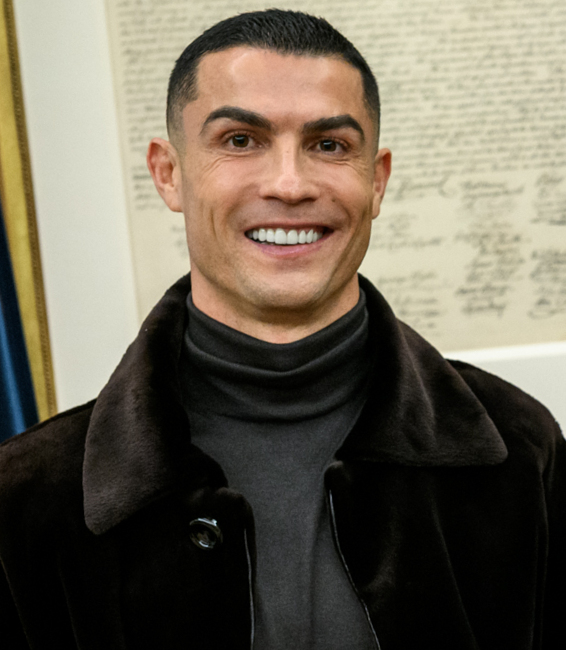
International Career: Portugal’s Captain
Ronaldo made his senior international debut for Portugal on 20 August 2003, aged eighteen, in a friendly against Kazakhstan. In the years that followed he became the most capped and most prolific scorer in the history of Portuguese football, and subsequently in the history of international football more broadly.
He participated in six FIFA World Cups (2006, 2010, 2014, 2018, 2022, and 2026), reaching the semi-finals in 2006 and the quarter-finals in 2022, where Portugal’s defeat by Morocco on penalties drew criticism of his leadership role at a stage of the tournament when his squad needed more from him. His tournament goals include moments of extraordinary quality: a hat-trick against Spain in the 2018 World Cup group stage, a free kick of outrageous technique against Spain in the same match, and consistent performances across tournaments spanning more than two decades.
The peak of his international career came at UEFA Euro 2016 in France, where Portugal, not among the pre-tournament favourites, reached the final against host nation France. Ronaldo went off injured in the first half of the final, in tears, with a serious knee injury sustained in a collision with Dimitri Payet. He spent much of the rest of the match on the sideline, hobbling on one leg, gesturing instructions to his teammates, exhorting them in a manner that seemed to communicate his will across the pitch regardless of his physical absence. Portugal won 1 to 0 in extra time, through an Eder goal. Ronaldo, in a tracksuit on the touchline, was as vocal in victory as he had ever been in play.
He also led Portugal to the inaugural UEFA Nations League title in 2019, defeating the Netherlands in Porto. His goals tally for Portugal passed 100 in 2021 and by the end of 2024 stood at over 130, a number so far beyond any previous international scorer that it will likely stand for decades.
The Rivalry with Messi
No account of Cristiano Ronaldo’s career is complete without addressing the extraordinary parallel narrative that ran alongside it for fifteen years: his rivalry with Lionel Messi of Barcelona and Argentina. The two men won the Ballon d’Or between them every year from 2008 to 2017, a decade of dominance over world football so complete that it effectively created a separate category of excellence above the rest of the game’s greatest players.
The rivalry was never personal in the sense of genuine hostility. Both men have been consistently respectful of the other in public statements, even as their supporters engaged in one of sport’s most tireless tribal debates. Each pushed the other to performances they might not have reached in the absence of a genuine peer. Ronaldo’s 50-goal La Liga season in 2011 to 2012 came in a year when Messi scored 73 goals in all competitions. The competition was not just between them; it was a competition between two different philosophies of what excellence in football means.
What Makes Ronaldo Ronaldo
The sports scientists, coaches, and teammates who have worked closely with Ronaldo over the years describe a combination of gifts that is genuinely unusual. His physical athleticism, including his vertical jump (documented at over 78 centimetres, above the average NBA player), his sprint speed (clocked at over 33 kilometres per hour at his peak), and his strength in the air despite not being exceptionally tall at six feet one inch, is matched by a technical range that encompasses finishing from every angle, free kick delivery of consistent quality, and heading ability that derives from physical power rather than positional sense.
But the reports that colleagues and coaches return to most consistently are not about his physical gifts. They are about his work ethic, and specifically about the gap between what he achieves in competition and what he does to prepare for it. Stories of Ronaldo staying in the gym for hours after his teammates have left, of monitoring his sleep with specialist technology, of adjusting his diet with a nutritionist’s precision, of reviewing his own performances with the analytical detachment of a coach, have been confirmed by too many independent sources across too many clubs and years to be dismissed as myth-making.
Legacy
By any statistical measure, Cristiano Ronaldo is the most prolific scorer in the history of football. His club and international goals combined surpass 900. His Champions League goals total more than 140. His international goals record of more than 130 for Portugal has no precedent in the history of the game. And yet the legacy he will leave is not purely statistical.
He changed the culture of professional football preparation. He demonstrated, over more than two decades, that physical peak performance is not simply a gift of genetics but a product of sustained, disciplined maintenance. He showed that a working-class boy from a remote Atlantic island could, through absolute commitment, build a career that no one from a similar background had ever built before. He gave to a generation of young footballers, particularly in Africa and Latin America, a model of individual achievement that owed nothing to privilege and everything to will.
Whether Messi or Ronaldo is the greater player is a question the sport will debate long after both of them are gone. What is not debatable is that Ronaldo, on his own terms and by his own definition of what excellence requires, achieved precisely what he set out to achieve from those early hours on a Madeiran hillside.
Key Facts
- Cristiano Ronaldo was born on 5 February 1985 in Funchal, Madeira, and grew up in a low-income family before moving to Lisbon at age twelve to join the Sporting CP academy.
- He won his first Ballon d’Or in 2008 with Manchester United and went on to win five in total, matching Lionel Messi’s record at the time.
- He became the all-time leading scorer in international football history, surpassing Iran’s Ali Daei’s record of 109 goals in September 2021.
- He is the all-time top scorer in UEFA Champions League history with more than 140 goals across his spells at Manchester United, Real Madrid, and Juventus.
- He led Portugal to their first major international trophy at UEFA Euro 2016, watching the final from the touchline after a first-half injury but remaining visibly influential throughout.