Over five decades and more than two dozen studio albums, David Bowie remade himself so thoroughly and so often that reinvention itself became his greatest art. He was never simply a rock star; he was a proposition about what a human being could choose to become. Where most artists find a sound, a look and a story and then protect them, Bowie treated every album as a passport to somewhere he had never been before. He burned his personas publicly, sometimes mid-tour, sometimes between takes in the studio, and rebuilt from the ashes with a discipline and an aesthetic intelligence that few of his peers could match. The result was a body of work that spans glam rock, soul, art-rock, electronic music, hard funk and ambient soundscapes, a catalogue so wide that any two fans are likely to have nearly incompatible ideas of which Bowie matters most.
Quick Facts
- Full name
- David Robert Jones
- Born
- 8 January 1947, Brixton, London, England
- Died
- 10 January 2016, New York City, USA (aged 69)
- Genre
- Glam rock, art rock, soul, electronic, pop
- Known for
- Ziggy Stardust, "Heroes", "Life on Mars?", constant reinvention
Early Life
David Robert Jones was born on 8 January 1947 in Brixton, a district of south London that in the immediate post-war years was solidly working-class and in the process of becoming one of the most culturally mixed neighbourhoods in Britain. His father, Haywood “John” Jones, worked in a charity that cared for children, and his mother, Margaret Mary Burns, known as Peggy, was a cinema usherette. The household was not wealthy, but it was not entirely without aspiration, and Peggy in particular harboured a fierce pride that she passed on to her son.
A half-brother, Terry Burns, the son of Peggy from an earlier relationship, would play a formative role in shaping the young David’s imagination. Terry was older, more worldly and intoxicatingly well-read, and he introduced the teenage David to jazz, to the Beat writers of America, and to the existentialist literature that was circulating in postwar European intellectual life. The brothers would visit Soho’s record shops together, flipping through jazz imports, and Terry would name-drop John Coltrane, Charles Mingus and Little Richard in the same breath, suggesting to the younger boy that music was not a form of entertainment but a form of thought. This was the intellectual seedbed from which Bowie’s own voracious, cross-disciplinary curiosity would grow.
The family moved from Brixton to Bromley, a quieter suburb on the southern edge of London, when David was six. Bromley was respectable and somewhat dull, and the distance between its tepid normalcy and the cultural heat David had absorbed through Terry created the productive friction that would drive his career. He was clever at school, and a junior-school teacher, recognising real artistic ability, paid for him to have a recorder and encouraged him to learn. At Bromley Technical High School he studied art and design, and he began to understand that the visual dimension of a performance, the costume, the gesture, the staging, was as expressive as the music itself.
A decisive event occurred when the fifteen-year-old David was involved in a playground dispute over a girl, during which his friend George Underwood punched him in the face. The blow damaged the muscles controlling one of his pupils, leaving it permanently dilated, so that for the rest of his life one eye appeared to be a different colour from the other (both were blue; the apparent difference was caused by the pupil, not the iris). The resulting mismatched gaze became part of Bowie’s mystique, a physical alteration that made him look perpetually alien, as if he were seeing the world from some vantage point slightly outside normal human experience. Underwood and Bowie remained friends, and Underwood later designed some of Bowie’s most celebrated album covers.
Musical Beginnings
By the time he was fifteen, David was playing the Hohner saxophone his father had bought him and was already fronting small groups performing skiffle and R and B at youth clubs around Bromley and London. He changed his surname from Jones to Bowie in 1965 to avoid confusion with Davy Jones of The Monkees, choosing the name partly because of its association with the American frontiersman Jim Bowie, and partly because, as he later said, he liked what the word suggested: a cutting implement that could be used in any situation.
Through the mid-1960s he recorded for a series of small labels, producing singles that received negligible commercial attention and that, while they showed a voice with real character, had not yet found a context in which to be extraordinary. Songs such as “Can’t Help Thinking About Me” (1966) for Pye Records and subsequent recordings for Deram reflected an artist absorbing influences from all directions: Anthony Newley’s theatrical English music hall style, the melodic ambition of the American pop songwriters, the hard R and B coming out of London clubs. The 1967 album “David Bowie,” released on Deram, was a collection of character sketches and whimsical vignettes that owed more to the English music hall than to rock and roll. It sold poorly, but it announced something important: even then, Bowie was thinking in personae rather than confessions, constructing characters rather than merely expressing himself.
During this period he also studied mime with the teacher Lindsay Kemp, whose company performed a highly physical, theatrical style of movement influenced by the commedia dell’arte tradition and by the work of the Japanese Butoh practitioners. The mime studies gave Bowie a vocabulary of the body that no amount of guitar practice could have provided, and the understanding that the stage was a three-dimensional space in which every movement carried meaning would shape everything from Ziggy Stardust to the Glass Spider tour two decades later.
Breakthrough
The career-making moment arrived in 1969 with “Space Oddity,” a song Bowie released to coincide with the Apollo 11 moon landing in July of that year. The song told the story of Major Tom, an astronaut who drifted free of the Earth and chose not to return, a parable about disconnection, longing and the seductiveness of the void. The BBC used it in its moon-landing coverage, giving Bowie national exposure that no amount of touring could have bought. “Space Oddity” reached number five on the UK Singles Chart, and suddenly he was a name rather than a rumour.
The album of the same name, later retitled “Space Oddity” after its original release as “Man of Words, Man of Music,” was a varied collection that showed an artist still searching for a consistent language. But the single had established the themes that would return obsessively throughout his career: outer space as a metaphor for alienation, the thin line between celebrity and isolation, and the figure of the outsider who chooses not to rejoin the crowd.
The years from 1969 to 1971 were a period of rapid development. Bowie formed a loose working partnership with guitarist and arranger Mick Ronson, assembled the band that would eventually be known as the Spiders from Mars, and began to crystallise the ideas about persona and performance that would culminate in his most celebrated creation. The album “The Man Who Sold the World,” released in late 1970, marked a decisive move toward heavier rock textures, and the album “Hunky Dory,” released in December 1971, is often cited as the moment he fully arrived as a songwriter. “Hunky Dory” contained “Changes,” a self-aware manifesto about the refusal to be pinned down, alongside “Life on Mars?” a cinematic tour de force of surreal imagery and soaring melody, and “Oh! You Pretty Things,” a meditation on evolution and the obsolescence of humanity that he had already given to another artist and then reclaimed. The album sold modestly on release but grew steadily in reputation as people caught up with what it contained.
Ziggy Stardust and the Glam Years
The creation of Ziggy Stardust in 1972 was one of the great acts of theatrical imagination in rock history. Ziggy was an alien rock messiah who descended to a dying Earth, told the audience it had five years left to live, burned with a wild and selfless love, and was ultimately destroyed by the adulation he inspired. The concept album “The Rise and Fall of Ziggy Stardust and the Spiders from Mars” (June 1972) was not quite a conventional narrative record but a collection of songs that established a mythology, each one a fragment of a larger story that listeners were invited to complete.
The character came with a complete visual language: a flame-red feather cut, platform boots, costumes designed by the Japanese fashion designer Kansai Yamamoto in fabrics that caught the stage lights and threw them back at the audience, and a physical performance style that mixed strutting confidence with something more ambiguous and unsettling. Bowie had been openly discussing his bisexuality in interviews, and the Ziggy persona pushed questions of gender and identity to the surface of mainstream pop culture in a way that had not been done before. For young people who felt themselves outside the norms of their communities, the message was electric: you could construct yourself, and the construction could be magnificent.
The Ziggy Stardust Tour of 1972 to 1973 was a theatrical production rather than a conventional rock show, with elaborate lighting rigs, costume changes and choreographed movement. Bowie performed at venues including the Carnegie Hall in New York (September 1972) and completed a lengthy UK and American tour that turned a cult following into a large and devoted audience. The single “Starman,” released ahead of the album, gave the concept record a commercial entry point, reaching number ten in the UK, but it was Bowie’s performance of the song on the BBC programme Top of the Pops on 5 July 1972, draping his arm around Ronson’s shoulders and pointing into the camera with a smile of conspiratorial delight, that produced one of the defining images of the era.
The follow-up album, “Aladdin Sane” (April 1973), brought the Ziggy concept to America, replacing the mythological ambiguity of its predecessor with something rawer and more anxious. The lightning bolt painted across Bowie’s face for the cover photograph became as iconic as any image in rock photography. Then, in July 1973, at the Hammersmith Odeon in London, he announced to a packed audience that it was the last show of the Ziggy Stardust tour and, by extension, that Ziggy was finished. The moment was theatrical and devastating. Fans wept. Critics argued about whether it was a genuine artistic decision or a stroke of calculated showmanship. The answer, almost certainly, was both.
Soul, Funk and the Plastic Soul Era
Having killed Ziggy, Bowie spent the rest of 1973 making an album of classic rock and roll covers, “Pin Ups,” which served as both a farewell to his own past and a loving tribute to the Soho club scene of his youth. Then he pivoted hard toward a new character and a new sound. “Diamond Dogs” (May 1974) was a dystopian concept album inspired by George Orwell’s “Nineteen Eighty-Four” and by William S. Burroughs’s cut-up literary technique. The Diamond Dogs Tour that accompanied it was the most elaborate and expensive theatrical production in rock history up to that point, featuring a city skyline set piece, a cherry picker that carried Bowie over the audience, and a catastrophic hydraulic system that occasionally failed mid-show. It was audacious, expensive and not entirely successful, but it demonstrated the scale of Bowie’s ambition.
The real transformation came in late 1974 when Bowie, now relocated to Philadelphia and deeply immersed in American black music, began recording what would become “Young Americans” (March 1975). This was his “plastic soul” album, a phrase he used self-deprecatingly but which undersold both the record’s quality and its influence. Working with producer Tony Visconti and a band of exceptional Philadelphia session musicians, he produced a sophisticated, horn-laden soul record that owed everything to the music coming out of Sigma Sound Studios. The title track, a sprawling, breathless meditation on American youth, reached number eighteen on the US Billboard Hot 100. More significantly, the collaboration with John Lennon produced “Fame,” which became Bowie’s first number-one single in the United States. The song was co-written between Bowie, Lennon and guitarist Carlos Alomar during a session that reportedly lasted much of a single night, and its funky, compressed guitar loop and paranoid lyrics about the dehumanising effects of celebrity felt like nothing else on the radio in 1975.
Berlin, Eno and the Trilogy
The mid-1970s were a period of serious physical and psychological difficulty for Bowie. His cocaine use had become extreme, his diet reportedly consisted almost entirely of bell peppers, milk and cocaine, and he was producing some of the strangest creative work of his career even as his personal life deteriorated. The album “Station to Station” (January 1976) introduced another persona, the Thin White Duke, a glacial, emotionless European aristocrat, and it contained some of Bowie’s most ferociously inventive music. The title track, nearly ten minutes long, moved from a motorik Germanic pulse to something approaching a classic soul ballad, with Bowie’s voice cutting across the arrangement with an icy, formal precision that was entirely new.
Recognising that he needed both to recover and to evolve, Bowie moved to West Berlin in 1976 alongside his friend Iggy Pop, who was himself attempting to stabilise his life. Berlin, still divided by its wall and heavy with a peculiar post-war atmosphere of melancholy and underground vitality, provided exactly the environment Bowie needed. He found a comfortable anonymity in the city, cycling to work, visiting museums, eating dinner in ordinary restaurants. He became fascinated by the Krautrock movement, particularly by the work of bands such as Kraftwerk and Neu!, and by the ambient theories of Brian Eno. The collaboration with Eno and producer Tony Visconti over the following two years produced what became known as the Berlin Trilogy.
“Low” (January 1977) was split into two sides: the first contained fractured, abrupt songs in which Bowie’s voice was treated as one instrument among many, often buried in the mix; the second was a series of instrumental soundscapes built from synthesisers, treated guitars and what felt like the sound of a city caught between two worlds. It was unlike anything that had been released by a mainstream rock artist. “Heroes” (October 1977) extended the experiments of “Low,” and its title track, built over the drone figure that guitarist Robert Fripp played while standing at the far end of the Hansa Tonstudio in Berlin, became one of Bowie’s most enduring songs. The three microphones positioned at increasing distances from Bowie, activated in sequence as he sang louder, gave the recording its distinctive quality of a voice straining against some overwhelming force. “Lodger” (May 1979) completed the trilogy, incorporating world music influences and a more conventional pop structure while retaining the experimental spirit of its predecessors.
The 1980s: Commercial Peak and Artistic Tension
The early 1980s saw Bowie make a calculated move toward the mainstream. “Scary Monsters (and Super Creeps)” (September 1980) retained some of the experimental textures of the Berlin years but was more immediate and structured, and it was received as one of his finest albums. Then came “Let’s Dance” (April 1983), produced by Nile Rodgers of Chic, and the commercial explosion that followed. The album reached number one in both the UK and the United States, and its singles “Let’s Dance,” “China Girl” and “Modern Love” were inescapable on radio and on the new medium of MTV throughout 1983. Bowie was simultaneously at the height of his commercial success and, by his own later admission, at the furthest remove from the artistic restlessness that had driven him.
The Serious Moonlight Tour of 1983 grossed enormous sums and confirmed him as one of the largest live draws in the world, playing arenas and stadiums including Wembley Stadium and the US Festival in California. But the albums “Tonight” (1984) and “Never Let Me Down” (1987) were received poorly by critics who felt that Bowie had traded the commitment to formal risk that had defined his greatest work for the glossy, over-produced sound of mid-decade pop. Bowie himself would later agree with that assessment. The Glass Spider Tour of 1987, a spectacularly theatrical production, played to enormous crowds but left many observers feeling that the spectacle had overwhelmed the music.
Later Years and the Return
The 1990s brought an extended period of searching. Bowie formed the hard rock band Tin Machine with guitarist Reeves Gabrels and recorded two albums under that name, “Tin Machine” (1989) and “Tin Machine II” (1991), which were valued by their defenders as a necessary stripping-back and dismissed by their detractors as a misguided detour. Whether or not the Tin Machine records were fully successful on their own terms, the experience of playing in a democratic band rather than as a solo artist renewed something in Bowie and prepared him for the subsequent return to interesting solo work.
“Black Tie White Noise” (1993) was a confident solo comeback. “Outside” (1995), another collaboration with Brian Eno, was a sprawling concept album set in a near-future world of ritual murder, co-written through a process that involved character-based improvisation and Eno’s Oblique Strategies cards. “Earthling” (1997) engaged with electronic and drum and bass music in a way that, unlike some of his 1980s experiments with contemporary sounds, felt genuinely integrated rather than decorative.
Then, following a heart attack during a concert in Germany in 2004, Bowie retreated from public life. For years almost nothing was heard from him, and fans wondered whether he had simply decided to stop. The 2013 announcement that he had made a new album, “The Next Day,” caused genuine shock and delight. The record, produced with Tony Visconti in conditions of great secrecy, reached number one in the UK and was received as a genuine late-career return to form. It contained songs that directly referenced his back catalogue while mapping new emotional territory.
“Blackstar,” released on 8 January 2016, his sixty-ninth birthday, was Bowie’s final album, recorded after he had been diagnosed with liver cancer in 2014. It was widely understood at release as something important, but only after his death two days later did the full weight of what he had made become clear. The album was a farewell, dense with allusion to mortality and transcendence, produced with the jazz ensemble assembled around saxophonist Donny McCaslin and shot through with a creative intensity that recalled the Berlin years. The title track, nearly ten minutes long, opened with a film clip riffing on his own mythology and closed with a sense of dissolution that was almost unbearable in hindsight.
Legacy
David Bowie’s influence on popular culture extends far beyond music. His insistence that identity was something constructed, performed and revisable rather than fixed gave permission to generations of young people to imagine themselves differently. The characters he inhabited, Ziggy Stardust, Aladdin Sane, the Thin White Duke, the Goblin King from the 1986 film “Labyrinth,” became archetypes in a cultural vocabulary that has only grown in richness since his death. Musicians from Duran Duran to Lady Gaga, from The Cure to Frank Ocean, have cited him as a formative influence, and the connection runs deeper than style: it is an influence on attitude, on the willingness to stake out uncomfortable artistic positions and defend them.
His engagement with questions of gender and sexuality, his androgyny and his open bisexuality, placed him ahead of the mainstream culture by decades. At a time when British broadcasting was still uncomfortable with overtly gay performers, Bowie was performing in dresses and speaking frankly about his attraction to men, and the courage of that, enacted on Top of the Pops and in the music press, changed what young audiences understood to be possible. He never turned that courage into a political programme, and he was careful to distinguish his theatrical explorations from lived queer experience, but the cultural permission his visibility granted was immense.
As a producer and collaborator he helped shape the careers of Lou Reed, Iggy Pop and Mott the Hoople, and his production work on Reed’s “Transformer” (1972) and Pop’s “The Idiot” and “Lust for Life” (both 1977) produced albums that have outlasted almost everything their own contemporaries made. His influence on electronic music, through the Berlin Trilogy and through his continued willingness to incorporate new technology into his work, runs through the entire history of synth-pop and post-punk. The Bowie catalogue remains in print in its entirety, and the 2016 memorial concerts and exhibitions held around the world confirmed a depth of feeling that transcended the ordinary parameters of celebrity.
Key Facts
- “Heroes” was recorded in Hansa Tonstudio 2, a studio located a short distance from the Berlin Wall, and the wall’s presence can be felt throughout the album’s atmosphere of defiance and longing.
- Bowie’s first US number-one single, “Fame” (1975), was co-written during a session with John Lennon and guitarist Carlos Alomar; Lennon received a co-writing credit for his contribution of the repeated “Fame” refrain.
- The cover of “Aladdin Sane” (1973), photographed by Brian Duffy with makeup by Pierre La Roche, is one of the most reproduced images in rock photography and was based on a lightning bolt Bowie had designed for his own stage use.
- Bowie studied mime extensively under the teacher Lindsay Kemp in the late 1960s, and the physical vocabulary he developed in those classes shaped his stage presence throughout his career.
- “Blackstar,” released two days before his death from liver cancer on 10 January 2016, debuted at number one in the UK, making Bowie the first artist to debut at number one in the UK posthumously with his most recent album.
I don’t know where I’m going from here, but I promise it won’t be boring.
David Bowie
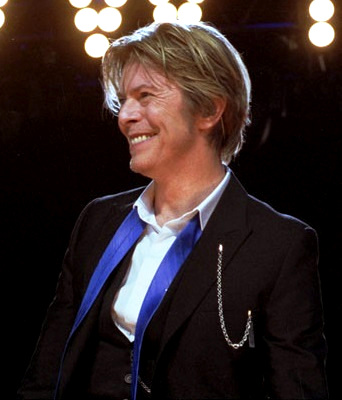
The quiet that followed his death on 10 January 2016 was the kind that arrives only when something genuinely irreplaceable has gone. Tributes poured in from world leaders, fellow musicians and millions of ordinary people who felt, without quite being able to explain why, that the world had become a less interesting and a less permissive place. What they were mourning, more than a singer or a songwriter or a performer, was a demonstration that the borders of the self are negotiable, that art is a method of becoming, and that the most extraordinary thing any human being can do is to refuse, with discipline and joy, to stay the same.