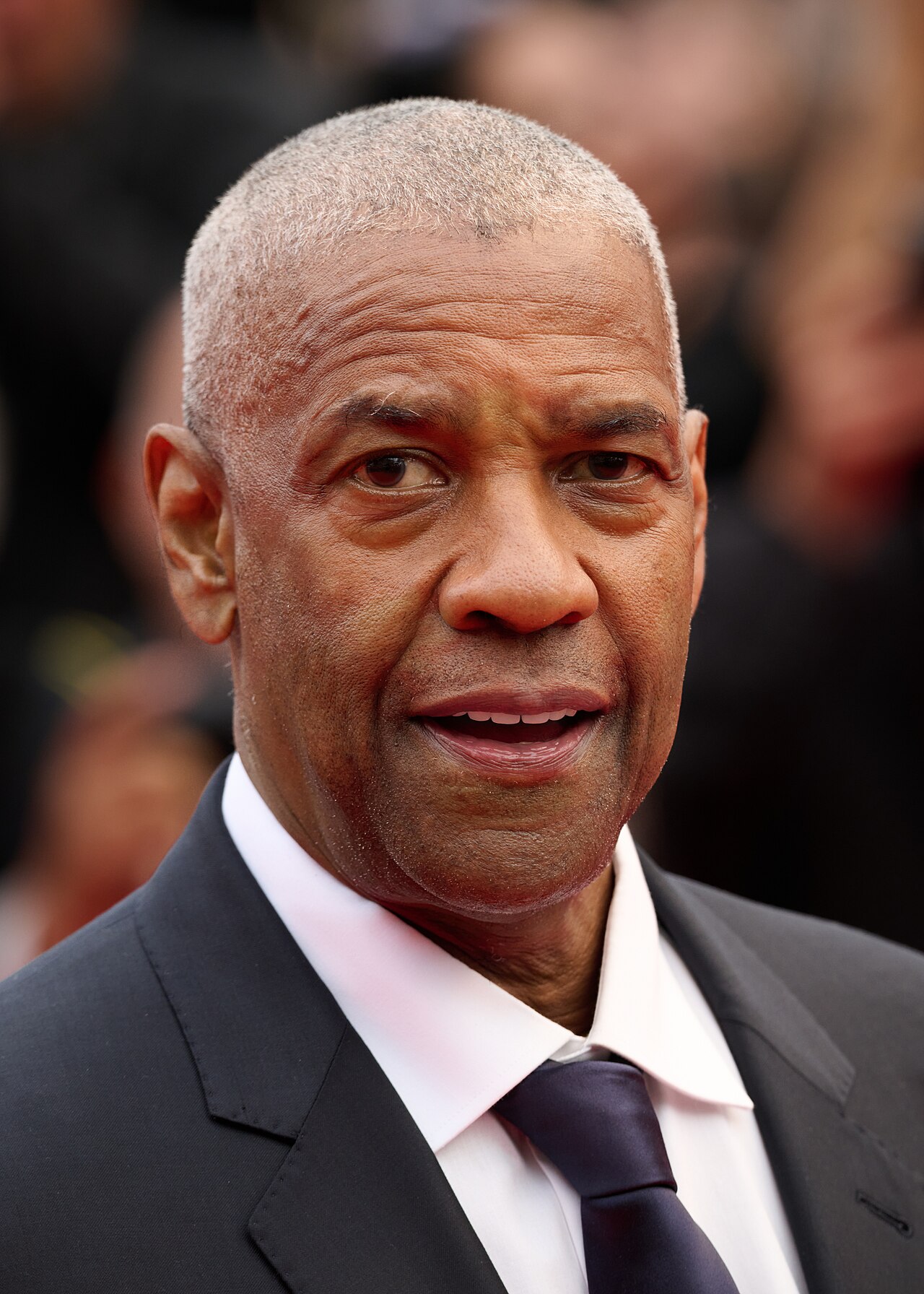
There is a particular stillness that Denzel Washington brings to the screen, a sense that the character is thinking faster than he is speaking, holding something in reserve. Across more than four decades he has used that quality to play soldiers and detectives, coaches and con men, saints and villains, earning a place among the most respected actors of his era and a reputation for craft that younger performers study like scripture. But the gravity he projects in front of the camera was forged long before Hollywood, in a household where faith, discipline and the possibility of redemption were everyday currency, and in a youth that could easily have taken a very different turn.
Quick Facts
- Full name
- Denzel Hayes Washington Jr.
- Born
- 28 December 1954, Mount Vernon, New York, USA
- Breakthrough
- TV's "St. Elsewhere" (1982 to 1988)
- Academy Awards
- 2 (Supporting, 1990; Lead, 2002)
- Other honours
- Tony Award; Honorary Academy Award; Cecil B. DeMille Award
- Also known for
- Acclaimed stage work and film direction
Early Life and Background
Denzel Hayes Washington Jr. was born on 28 December 1954 in Mount Vernon, a city just north of New York City. His father, Denzel Washington Sr., was an ordained Pentecostal minister who also worked for the water department and at a local store, a man of faith and tireless labour. His mother, Lennis, ran a beauty parlour. The values of that home, including discipline, hard work, church on Sundays and a deep belief in second chances, would echo through Washington’s life and through the characters he would later choose to portray.
The household was strict and religious, and the young Washington absorbed the rhythms of the church, including the cadences of his father’s preaching, which arguably planted the seeds of a performer’s ear for language and timing. But Mount Vernon was a place where a boy could easily drift, and when his parents divorced when he was around fourteen, Washington began to do exactly that. The divorce destabilised him, and he later spoke about how close he came to going down a path that claimed several of his childhood friends, some of whom ended up in prison or worse.
His mother, sensing the danger, made a decision that Washington has credited with changing the course of his life: she enrolled him in a private preparatory boarding school in upstate New York. The structure and distance from the streets of his neighbourhood gave him room to grow up, and the experience instilled in him a lifelong gratitude for the intervention of a parent who refused to let him slide. The theme of unrealised potential rescued by a single decisive act of care would recur, consciously or not, in many of the roles he later sought out.
Finding the Stage
Washington enrolled at Fordham University with no clear sense of direction, drifting between possible paths including pre-med, law and journalism. His grades were uneven and his ambitions unfocused. Acting found him almost by accident. During a summer job at a YMCA camp, he took part in a staff talent show and discovered, to his surprise, that he enjoyed performing and had a knack for it. Back at Fordham, he was cast in student productions, including Shakespeare and the title role in a production of Eugene O’Neill, and a professor recognised a raw talent worth nurturing.
That encouragement set him on a deliberate course. After graduating, he won a place to train at the prestigious American Conservatory Theater in San Francisco, where he immersed himself in the discipline of classical acting. He did not stay to complete the full programme, choosing instead to return east and pursue professional work, but the grounding he gained in technique and text would distinguish his screen acting for the rest of his career. Theatre taught him to serve the writing, to sustain a performance across a long arc, and to treat acting as a craft to be mastered rather than a stroke of luck to be hoped for.
Without commitment, you’ll never start. But more importantly, without consistency, you’ll never finish.
Breaking Through on Television
Washington’s first significant exposure came on the big screen in a low-budget comedy, but his true breakthrough arrived on television. In 1982 he was cast as Dr. Philip Chandler in the acclaimed hospital drama “St. Elsewhere,” a role he would play for six seasons until 1988. The series was a critical favourite known for its realism and its ensemble of complex characters, and Washington’s portrayal of a talented, ambitious physician made him a familiar face in millions of American homes.
Crucially, the role presented a Black professional as a fully realised human being, with flaws, ambitions and an inner life, at a time when such portrayals remained rare on American television. Washington was conscious from early in his career of the responsibility that came with visibility, and he developed a habit, which he maintained for decades, of declining roles he considered demeaning or stereotypical. Even as a relatively young actor with bills to pay, he turned down work that he felt would diminish him or the audiences who looked to him, a discipline that shaped the trajectory of everything that followed.
The Leap to Film Stardom
As “St. Elsewhere” raised his profile, Washington began to demonstrate a gift for inhabiting real historical figures, a recurring strand of his film career. He played the South African anti-apartheid activist Steve Biko in a major film about that struggle, earning an early Academy Award nomination and signalling that he was an actor of unusual depth and seriousness. He brought the same conviction to a range of roles that allowed him to explore questions of justice, identity and conscience.
In 1990 he won the Academy Award for Best Supporting Actor for his performance as a defiant former slave turned Union soldier in a Civil War epic about one of the first Black regiments in the United States Army. His character’s arc, moving from bitter, wounded rebellion to hard-won dignity, culminated in a wordless moment of such restrained power that it became one of the most quietly devastating in modern American cinema. The award confirmed his arrival as a major screen actor and as a performer capable of expressing volumes without a line of dialogue.
A Leading Man on His Own Terms
Through the 1990s Washington became a genuine movie star, but a deliberate and selective one. He gravitated toward characters of substance, among them journalists, attorneys, soldiers, detectives and ordinary men confronting injustice, and he resisted the pressure to soften or simplify himself for mainstream appeal. His collaborations with the director Spike Lee proved especially significant. In an ambitious biographical epic about the civil-rights leader Malcolm X, Washington carried a sprawling, three-hour film on the strength of a single, fiercely intelligent and charismatic presence, delivering a performance widely regarded as among the finest of his generation and earning another Academy Award nomination.
He moved fluidly between prestige dramas and commercial thrillers, demonstrating that an actor of integrity could also be a reliable box-office draw. He played romantic leads, action heroes and men of principle under pressure, and he brought to each the same intensity and preparation. Audiences came to trust him; his name on a poster signalled a certain seriousness and quality, and a generation of moviegoers grew up regarding him as one of the most dependable presences in American film.
The Oscar for Best Actor
In 2002 Washington made history. For his performance as a corrupt, magnetic narcotics detective in the gritty thriller “Training Day,” he won the Academy Award for Best Actor, becoming only the second Black actor to do so. The role was a startling departure from the upright, principled characters audiences associated with him, a figure menacing, seductive and morally bankrupt, and it proved that the very viewers who admired his integrity would follow him into far darker territory. The win, which came on the same night that Halle Berry won Best Actress, was widely seen as a watershed moment in the history of the Academy Awards.
Washington’s willingness to play a villain so persuasively spoke to his deeper philosophy of acting: that the work demanded full commitment to the truth of a character, however unpleasant, rather than the protection of a likeable public image. He often said that he was not interested in being liked on screen so much as in being believed, and “Training Day” was the most dramatic vindication of that approach.
Range, Reinvention and a Body of Work
What distinguishes Washington’s filmography is not only its quality but its range. Over the decades he moved with apparent ease between intimate character studies and large-scale entertainments, between period dramas rooted in history and contemporary thrillers built for the multiplex. He played men of unimpeachable principle and men consumed by corruption, victims of injustice and agents of it, fathers and loners, leaders and outcasts. The thread connecting them was less a type than a temperament: an interiority, a sense of withheld force, a feeling that the character knew more than he was letting on.
He developed a number of fruitful, recurring collaborations with directors who understood his strengths, returning to certain filmmakers across multiple projects in a way that allowed a shorthand of trust to develop between actor and director. He also proved durable in an industry that often discards its stars after a decade or two, sustaining his status as a leading man well past the age at which many of his peers had moved into supporting roles. He anchored action franchises and prestige dramas alike, demonstrating that audiences would turn out for him regardless of genre, and that a serious actor need not choose between artistic credibility and popular success.
Throughout, he remained attentive to the kinds of stories he was helping to tell. He repeatedly took on roles that illuminated the African American experience and historical struggles for justice, and he used his clout to support projects and performers who might otherwise have struggled to find backing. His choices reflected a sense, formed early in his career, that an actor of his visibility had a responsibility extending beyond his own performances to the broader landscape of who gets to be seen on screen and how.
The Discipline Behind the Talent
Colleagues speak of Washington’s preparation in almost reverent terms. He is known to arrive on set having memorised not only his own lines but everyone else’s, having interrogated the script for its internal logic, its silences and its possibilities. He treats acting as a profession to be mastered through repetition and study, and he brings to it a focus that can be intimidating to those who have not done their own homework. Younger actors who have worked with him frequently describe the experience as a masterclass, and many cite him as the standard against which they measure themselves.
That discipline is inseparable from his faith, which has remained central to his life. Raised in the church, he has spoken candidly about the role that belief plays in steadying him through the volatility of fame and about reading scripture daily. He has described his career as a kind of stewardship of a gift rather than a personal triumph, and he has used his platform to mentor and encourage, often emphasising to young people the importance of consistency, humility and gratitude. The combination of technical mastery and moral seriousness has made him a figure of unusual respect within an industry not always known for either.
Voice, Presence and the Art of Restraint
Part of what makes Washington so commanding on screen is purely physical: a resonant, controlled voice, inherited perhaps from a preacher father, and a stillness that draws the eye even in a crowded frame. He has long understood that film acting rewards economy, that a slight shift of expression or a beat of silence can carry more weight than a torrent of words, and he deploys that restraint with the precision of a musician choosing when not to play. Audiences lean in because he refuses to overplay; he makes them do the work of reading him, and in doing so he pulls them deeper into the character.
That instinct for restraint coexists with an ability to summon overwhelming force when a scene demands it. The same actor who can hold a room with a whisper can also detonate, and the contrast gives his performances their charge. Directors have spoken about how little he needs to do to register on camera, and about the discipline required to resist doing more. It is a paradox at the heart of his craft: the most powerful moments often come from what he withholds.
He has also been refreshingly candid about the realities of his profession and the temptations of fame. He has counselled younger actors against chasing money or applause for its own sake, urging them instead to focus on the work and on staying grounded in faith and family. He speaks of acting as a service and of his talent as something entrusted to him rather than earned, a perspective that has helped him navigate decades of stardom without the self-destruction that has claimed many others. That philosophy, as much as any single performance, is part of what younger performers absorb when they study him.
Stage, Direction and Stewardship
Even at the height of his film fame, Washington returned repeatedly to the theatre, the medium where he had first discovered his calling. He won a Tony Award for his performance in a celebrated Broadway revival and continued to take on demanding stage roles, including the great parts of the classical and modern repertoire, in productions that drew critical acclaim and sold-out houses. For Washington, the stage was both a discipline and a renewal, a place to test himself without the safety net of a second take.
He also became a champion of the work of the playwright August Wilson, whose ten-play cycle chronicling the African American experience across the twentieth century is one of the towering achievements of American drama. Washington starred in and directed a film adaptation of one of Wilson’s plays and committed himself to a larger project of bringing the entire cycle to the screen, an act of cultural stewardship aimed at preserving Wilson’s work for future generations. Behind the camera, his directorial efforts reflected his abiding interests in resilience, community and redemption, the same themes he had first absorbed in his father’s church. His films as a director favour patience, character and substance over spectacle.
Personal Life
Washington’s private life has been notably stable by the standards of his profession. He married the actress and singer Pauletta Pearson in 1983, and the couple raised four children together, one of whom, John David Washington, became an accomplished actor in his own right after an earlier career in professional football. Washington has often credited his wife and his family with keeping him grounded, and he has spoken about the importance of faith and family as anchors against the disorienting effects of celebrity. He has largely avoided scandal and the trappings of Hollywood excess, presenting instead the image of a serious professional devoted to his craft and his loved ones.
Legacy
Two competitive Academy Awards, an honorary Oscar recognising his body of work, a Tony Award, and the rarer distinction of a reputation that has remained largely untarnished across decades in an unforgiving industry: Denzel Washington’s record speaks for itself. He has been honoured with lifetime-achievement tributes and ranks among the most acclaimed and bankable actors of his generation, a combination that few performers ever achieve. Yet his deeper influence lies in the example he set: that an actor can demand dignity in the roles he plays, that thorough preparation is itself a form of respect for the work and for the audience, and that talent without discipline is only a promise left unkept.
Honours and Defining Traits
The recognition Washington has accumulated reflects both his artistry and the regard in which the industry holds him. Alongside his two competitive Academy Awards, he has received an honorary Oscar for his contribution to cinema, a Tony Award for his stage work, a Cecil B. DeMille Award for lifetime achievement, and a long list of other tributes and nominations across film and theatre. Few actors have been honoured so consistently across so many forms over so many years.
A handful of details capture the person behind the performances:
- His mother’s decision to send him to a private boarding school as a teenager is something he credits with saving him from a far darker path.
- He discovered acting almost by accident, in a staff talent show at a summer camp.
- He has been married to Pauletta Washington since 1983, an unusually enduring Hollywood marriage.
- His son, John David Washington, became a successful actor after a career in professional football.
- He committed to bringing the entire ten-play cycle of playwright August Wilson to the screen, an act of cultural preservation.
He remains, by common consent, one of the finest actors his country has produced, a craftsman who turned the second chance his mother gave him into a lifetime of work that will be studied long after the lights come up. For the young performers who look to him, and for the audiences who have followed him from a hospital drama in the 1980s to the great stages and screens of the present, Denzel Washington stands as proof that seriousness, faith and relentless effort can coexist with stardom, and that the most lasting kind of fame is the kind built on respect. His career offers a quiet rebuke to the idea that an actor must choose between commercial appeal and artistic integrity, or between popularity and principle. He has held all of those things together for the better part of half a century, and in doing so he has set a standard that the next generation of actors continues to measure itself against. What endures is not simply a list of credits but a way of working: the conviction that every role deserves full preparation, that dignity is something an actor can insist upon, and that a career, like a life, is built one disciplined choice at a time.