There are footballers who win matches, footballers who win trophies, and then there is a tiny, barrel-chested man from a shantytown on the edge of Buenos Aires who, for one extraordinary summer in Mexico, seemed to bend an entire World Cup to his will. Diego Armando Maradona stood just over five feet five inches tall, yet he played as though gravity had agreed to make an exception for him. He could turn a defender inside out with a single drop of his shoulder, thread a pass through a forest of legs, and strike a free kick that curled like it had been guided by an invisible hand. To watch him at his peak was to watch a magician who refused to explain a single trick.
But Maradona was never only a footballer, and that is why his story still grips people decades after he last kicked a ball in anger. He was a symbol of the poor who had risen impossibly high, a rebel who picked fights with the powerful, an addict who nearly destroyed himself in full public view, and a folk hero worshipped by millions who saw in his triumphs a victory over everything that had tried to keep them down. In Naples they painted his face on the walls of churches. In Argentina they wept in the streets when he died. He was brilliant and self-destructive in almost equal measure, and he wore both qualities without apology.
This is the story of that life: the boy who could do impossible things with a ball, the man who carried a nation, and the legend whose flaws only seemed to make people love him more.
Quick Facts
- Full name
- Diego Armando Maradona
- Born
- 30 October 1960, Lanús, Buenos Aires, Argentina
- Died
- 25 November 2020, Tigre, Argentina (aged 60)
- Sport
- Football (attacking midfielder / forward)
- Known for
- 1986 World Cup winner; widely regarded as one of the greatest footballers ever
Early Life
Diego Armando Maradona was born on 30 October 1960 and raised in Villa Fiorito, a poor shantytown on the southern outskirts of Buenos Aires. The family home had no running water and no electricity in its early years. His father, Diego Maradona senior, known to everyone as Chitoro, worked grinding bones in a factory. His mother, Dalma, whom Diego always called Tota, held the household of eight children together through sheer determination. Diego was the fifth child and the first son, and from his earliest years he carried the weight of being the boy the family hoped would lift them out of poverty.
The gift announced itself almost as soon as he could walk. The story he told for the rest of his life was that he received a leather football as a present when he was three years old, and from that moment the ball rarely left his feet. He slept with it. He dribbled it through the dirt streets of Fiorito. He performed tricks for older boys who could scarcely believe what they were seeing. By the time he was eight, neighbours were stopping to watch a child juggle the ball as though it were tied to his laces by an invisible string.
That talent quickly found a stage. Maradona joined Los Cebollitas, the youth team of Argentinos Juniors, and turned them into something close to a travelling circus act. The Little Onions, as the name translates, went on an unbeaten run that stretched to well over a hundred matches, and at the centre of it was a small boy whose ball control left grown spectators shaking their heads. At half-time during senior fixtures, the young Maradona would be sent out to entertain the crowd with keepie-uppies, and supporters who had come to watch professionals found themselves cheering loudest for the child. He was, even then, a performer who understood that football was theatre.
He left school early. The ball was always going to be his education and his escape, and everyone around him sensed it. The poverty of Fiorito never left him, not in memory and not in temperament. He carried it like a badge, and it shaped the man he became: proud, combative, fiercely loyal to those who had nothing, and forever suspicious of the powerful who, in his mind, looked down on people like the family he had come from.
Rise in Argentina
Maradona made his professional debut for Argentinos Juniors on 20 October 1976, ten days before his sixteenth birthday. He came on as a substitute, and almost immediately he nutmegged an opponent, a flourish that told everyone watching exactly what kind of player had arrived. Over the next five seasons he scored more than a hundred and fifteen league goals for the club, an astonishing return for a teenager, and turned Argentinos Juniors, a modest side, into a team people bought tickets specifically to see him play for.
There was an early heartbreak that scarred him deeply. In 1978, Argentina hosted the World Cup, and the seventeen-year-old Maradona, already a national sensation, was left out of the final squad by manager Cesar Luis Menotti, who judged him too young. Argentina went on to win the tournament without him, and Maradona later admitted the omission was one of the most painful moments of his early career. He resolved to make himself impossible to ignore. The following year he led Argentina to victory at the 1979 FIFA World Youth Championship in Japan, finishing as the player of the tournament and announcing himself to the wider world.
In 1981, Maradona finally got the move his heart had always wanted. He signed for Boca Juniors, the club he had supported as a boy, one of the two giants of Argentine football and the team most closely tied to the working classes he came from. The transfer fuelled a frenzy. He repaid it almost at once, scoring in the superclasico against bitter rivals River Plate and helping Boca win the 1981 Metropolitano championship, his first senior league title. The image of Maradona in the blue and gold of Boca, arms outstretched to the crowd, became one of the defining pictures of Argentine football. He had played only one season for them, but the bond was permanent. For the rest of his life Maradona considered himself, above everything else, a Boca man.
Barcelona Years
European football came calling, and in 1982 Maradona joined Barcelona for a fee reported at around five million pounds, a world record at the time. He arrived in Catalonia as the most expensive footballer on earth and with the burden of expectation to match. There were moments of brilliance that hinted at everything he would later become, but his two seasons at the Camp Nou were defined as much by misfortune and conflict as by football.
First came illness. Maradona contracted hepatitis, which sidelined him for months and drained his strength. Then came brutality. In September 1983, in a match against Athletic Bilbao, the defender Andoni Goikoetxea, a man whose nickname was the Butcher of Bilbao, caught Maradona with a horrific tackle from behind that fractured his ankle. The injury threatened his career, and the long, painful recovery tested both his body and his temperament. He played on through 1983 and into 1984, winning the Copa del Rey and the Spanish Super Cup, but the joy had drained out of his time in Spain.
The end was violent and unforgettable. The 1984 Copa del Rey final, again against Athletic Bilbao and played in front of the King of Spain, dissolved into one of the ugliest brawls in the competition’s history. After the final whistle, with tensions boiling over from months of bad blood, Maradona threw himself into a mass fight that spread across the pitch, kicking and head-butting opponents as players and officials swarmed in. It was broadcast live to the nation, and it horrified the Barcelona board. The relationship, already fragile, was now beyond saving. Within weeks the club agreed to sell him. Barcelona had bought a genius and grown weary of the chaos that came with him. Maradona, for his part, was glad to leave. He needed a place that would embrace him without reservation, and that place was waiting in the south of Italy.
Napoli and Immortality
In the summer of 1984, Maradona signed for Napoli for another world record fee, and the city of Naples greeted him as though a saviour had descended from the heavens. Around seventy thousand supporters packed the Stadio San Paolo simply to watch him be presented, before he had kicked a single competitive ball. They had reason to be desperate for a hero. Naples was poor, mistrusted, and looked down upon by the wealthier industrial north of Italy. Napoli had never won the Serie A title in its history and had only narrowly avoided relegation the season before. The club was an underdog in a league dominated by the giants of Turin and Milan.
Maradona changed everything. He carried Napoli on his back the way he would soon carry Argentina. In the 1986 to 1987 season, he inspired the club to the first Serie A championship in its history, a triumph that turned the entire city into a carnival that seemed to go on for weeks. They added the Coppa Italia in the same campaign, completing a domestic double that had once seemed unthinkable. In 1989 came European glory with the UEFA Cup, and in the 1989 to 1990 season Maradona led Napoli to a second Serie A title. For a club from the impoverished south to twice conquer the moneyed north was, to the people of Naples, far more than sport. It was justice. It was pride. It was vindication.
He became something close to a deity there. His face appeared on murals across the city, on shrines, on the walls beside images of saints. Children were named after him. To this day, a stretched canvas of Maradona’s hair is reportedly kept as a relic in a Naples bar, treated with the reverence of a religious artefact. No foreign athlete has ever been so completely absorbed into the identity of a place. When Naples speaks of him, even now, it is in the language of love and faith rather than the language of statistics. He gave the city the one thing money had always denied it: the feeling of being champions of everything.
The 1986 World Cup
If Napoli made Maradona a god to one city, the 1986 World Cup in Mexico made him an immortal to the world. He arrived as captain of an Argentina team that few expected to win, and he left having delivered one of the greatest individual performances in the history of any sport. Across the tournament he seemed to operate on a different plane from everyone else, dragging teammates and a nation behind him through the force of his own genius.
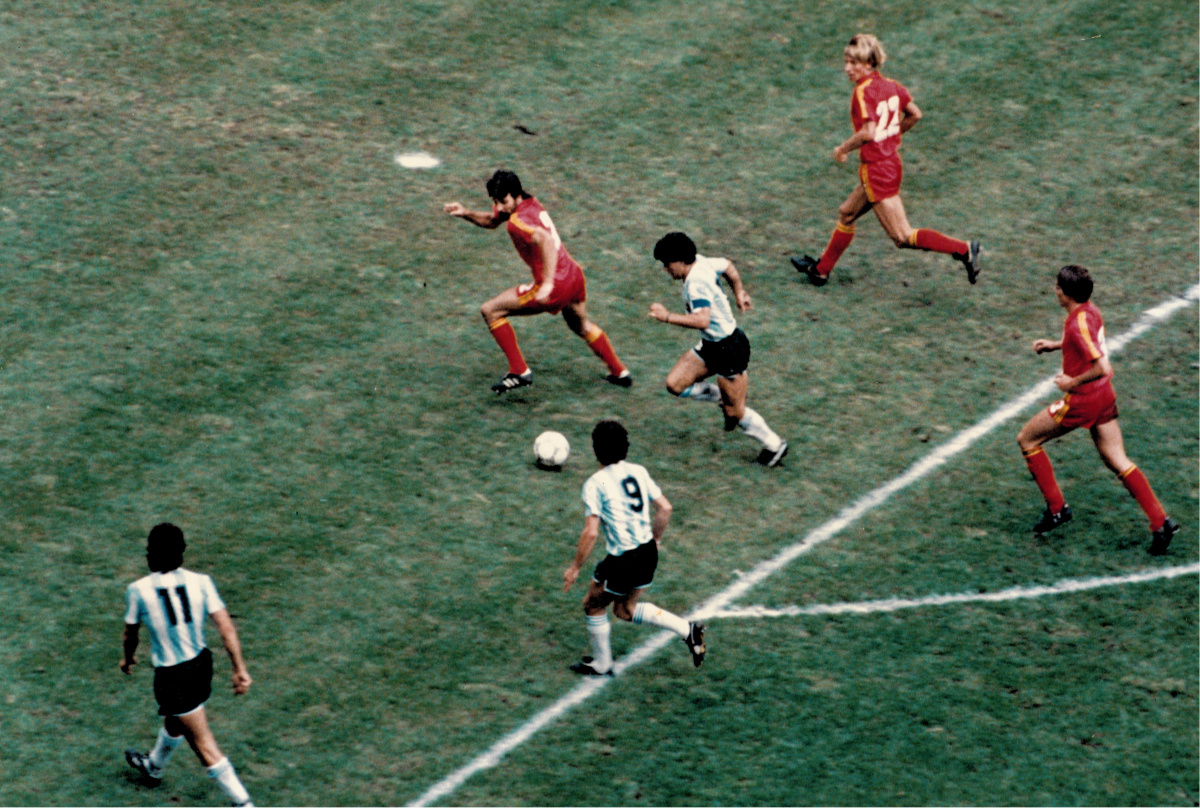
The defining day came on 22 June 1986, in the quarter-final against England at the Estadio Azteca in Mexico City. The match was charged with meaning well beyond football. Only four years earlier, Argentina and the United Kingdom had fought the Falklands War, and the wounds were raw on both sides. In that heated atmosphere, Maradona produced two goals separated by four minutes that, together, captured the whole of his contradictory nature.
The first, in the fifty-first minute, was an act of cunning and deceit. Chasing a looping ball into the England box, Maradona rose with goalkeeper Peter Shilton and punched it into the net with his left hand, disguising the offence so cleverly that the referee allowed the goal. Afterwards he described it, with a mixture of mischief and poetry, as a goal scored “a little with the head of Maradona and a little with the hand of God.” The phrase, the Hand of God, attached itself to him forever. To the English it was cheating, plain and simple. To many Argentines it was a sly act of revenge by a small nation against a powerful one. Maradona himself never fully apologised, and the ambiguity suited him.
Four minutes later came the answer to anyone who doubted his greatness. Collecting the ball in his own half, Maradona set off on a run that has been replayed more than almost any moment in football. He beat one England player, then another, slalomed past two more with the ball glued to his left foot, drew the goalkeeper, and slid it home. He had travelled more than sixty metres and left half the England team sprawled in his wake. It was later voted the Goal of the Century by FIFA, and it remains the purest distillation of what made him extraordinary: balance, speed, courage, and an imagination that other players simply did not possess.
Argentina beat England 2 to 1. In the semi-final, Maradona scored twice more against Belgium, including another mazy individual goal of staggering quality. Then came the final on 29 June 1986, against West Germany, again at the Azteca in front of more than a hundred thousand spectators. The Germans man-marked him relentlessly, yet it was Maradona who slipped the decisive pass to Jorge Burruchaga for the winning goal in a 3 to 2 victory. He lifted the World Cup as captain, a small man holding the heaviest trophy in football above a sea of celebrating Argentines. It was the summit of his career and, many would argue, the high-water mark of individual brilliance the sport has ever seen.
Decline and Struggles
The fall, when it came, was as steep and as public as the rise had been glorious. Even during his triumphs at Napoli, Maradona had been sliding into a cocaine addiction that would shadow the rest of his life. The pressures of fame, the isolation of being worshipped, and his growing entanglement with the criminal underworld of Naples pulled him deeper into a habit he could not control. The brilliance on the pitch began to flicker rather than blaze.
The 1990 World Cup in Italy offered a strange, bittersweet coda. Maradona led an ageing and limited Argentina side all the way to the final, knocking out host nation Italy in a semi-final played, painfully, in Naples itself, the city torn between loyalty to country and devotion to its adopted son. Argentina lost the final 1 to 0 to West Germany, and the images of Maradona weeping on the pitch became another iconic picture of a career lived at extremes.
Then came the bans. In 1991, while still at Napoli, Maradona tested positive for cocaine and was suspended from football for fifteen months. His time in Naples ended in disgrace, a sad finish to the most glorious chapter of his career. He drifted afterwards, playing briefly for Sevilla in Spain and later returning to Argentina with Newell’s Old Boys and finally back to his beloved Boca Juniors, but he was never the same force.
The most public humiliation arrived at the 1994 World Cup in the United States. Maradona, having worked himself into shape for one last campaign, played two matches and looked rejuvenated, scoring against Greece and celebrating with a wild, wide-eyed scream into a pitchside camera that unsettled observers. Then he failed a drug test for ephedrine, a stimulant, and was expelled from the tournament. It was the end of his World Cup story, an exit by scandal rather than by football. In the years that followed, his health deteriorated dramatically. His weight ballooned, he suffered heart problems linked to years of cocaine abuse, and on more than one occasion he was hospitalised in critical condition. The genius who had defied gravity now seemed to be at war with his own body.
Life After Playing
Retirement did nothing to quiet the storm around him. Maradona remained one of the most recognisable people on the planet, his every public appearance generating headlines. He underwent gastric surgery to control his weight, sought treatment for his addictions in Cuba, where he struck up a famous friendship with Fidel Castro, and threw himself into an endless series of dramas, feuds, and reinventions. He hosted a television show in Argentina. He picked fights with FIFA and its presidents. He spoke his mind about politics, often loudly and without caution, aligning himself with left-wing causes and leaders across Latin America.
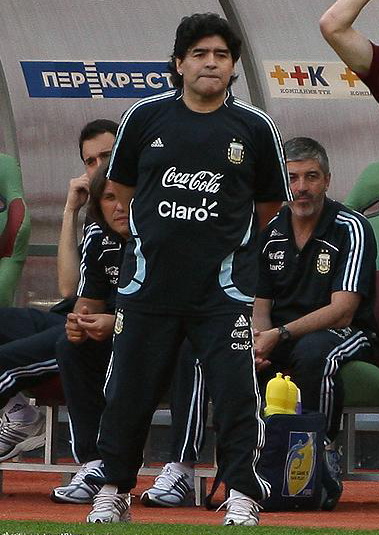
In 2008, in a move that astonished much of the football world, Maradona was appointed head coach of the Argentina national team. He guided them to the 2010 World Cup in South Africa, where his presence on the touchline, immaculately dressed and endlessly emotional, drew as much attention as the matches themselves. Argentina, with a young Lionel Messi in the side, reached the quarter-finals before being thrashed 4 to 0 by Germany, and Maradona’s spell in charge ended soon after. His tactical limitations were obvious, but his ability to inspire devotion was undimmed.
He coached on, taking jobs in the United Arab Emirates with clubs in Dubai, then in Mexico with Dorados de Sinaloa, and finally back in Argentina with Gimnasia y Esgrima de La Plata. His personal life remained chaotic to the very end: multiple children, some of whom he initially refused to acknowledge before later embracing, tangled finances, public romances and bitter breakups, and a body that grew frailer with each passing year. Through it all he stayed, somehow, beloved. People forgave Maradona things they would forgive no one else, because they sensed that his flaws and his genius came from the same restless, defiant source.
Death and Legacy
On 25 November 2020, Diego Maradona died of a heart attack at a house in Tigre, near Buenos Aires, while recovering from brain surgery for a blood clot. He was sixty years old. The news stopped Argentina in its tracks. The government declared three days of national mourning. His coffin was laid in state at the presidential palace, the Casa Rosada, where vast crowds queued through the night to pay their respects, and the farewell descended into tearful chaos as thousands of grieving fans pressed forward to say goodbye. People wept openly in the streets. In Naples, the city renamed its stadium in his honour, the Stadio Diego Armando Maradona, a final act of love from the place that had taken him most completely to its heart.
His legacy is as complicated as the man himself, and that is exactly why it endures. He cheated and he dazzled, sometimes within the same minute. He inspired millions and he hurt many of the people closest to him. He fought addiction in public for decades and never truly won. To reduce him to a saint would be a lie, and he would have hated it; to reduce him to a cautionary tale would miss everything that made people adore him. He was, in the end, gloriously and tragically human, and he never pretended otherwise.
“I am Maradona, who makes goals, who makes mistakes. I can take it all, I have shoulders big enough to fight with everybody.”
The argument about who stands as the greatest of all time inevitably circles back to him. For generations of Argentines and Neapolitans, the debate barely exists: Maradona is football, and Pele, for all his trophies and grace, was something more distant and corporate. The arrival of Lionel Messi, another small Argentine genius, only sharpened the conversation. Messi’s records dwarf Maradona’s, and when Argentina finally won the 2022 World Cup, many felt Messi had at last completed the journey Maradona began. Yet even Messi’s admirers concede that Maradona carried weaker teams further by sheer force of personality, and that he meant something to ordinary people that statistics can never measure.
That is the heart of it. Maradona belonged to the poor, the overlooked, the ones who saw in his impossible rise a proof that talent could defeat circumstance. In Naples and in Argentina he is not merely remembered but venerated, a god made of flesh who happened to play football better than almost anyone who ever lived. He gave them magic and he gave them belief, and in return they gave him a kind of immortality that no trophy could buy.
Key Facts
- Diego Maradona was born on 30 October 1960 and raised in Villa Fiorito, a poor shantytown outside Buenos Aires, debuting professionally for Argentinos Juniors just before his sixteenth birthday in 1976.
- He captained Argentina to victory at the 1986 World Cup in Mexico, scoring both the Hand of God goal and the Goal of the Century against England on 22 June 1986.
- At Napoli he won two Serie A titles (1987 and 1990), the Coppa Italia, and the UEFA Cup, transforming an unfashionable southern club into Italian champions and becoming a near-religious figure in the city.
- His career was scarred by cocaine addiction, a fifteen-month ban in 1991, and expulsion from the 1994 World Cup after failing a drug test for ephedrine.
- He died on 25 November 2020 at the age of sixty, prompting national mourning in Argentina and cementing his status as one of the greatest and most beloved footballers in history.