On 12 October 2019, in Vienna, Austria, a 34-year-old Kenyan man named Eliud Kipchoge ran 42.195 kilometres in 1 hour, 59 minutes and 40 seconds. He ran under the two-hour barrier that many sports scientists had, over the preceding decades, characterised as the boundary of human physiological possibility in the marathon. He crossed the finish line with tears on his face and the look of a man who had known, for longer than the rest of the world was ready to believe, that the barrier was a fiction and that he would be the one to erase it. The performance, conducted on an engineered course with rotating pacemakers and was not eligible for official world record certification under World Athletics rules, was nonetheless one of the most significant athletic achievements of the twenty-first century. It proved not just what Kipchoge could do but what human beings, properly prepared and properly believing, could do.
Quick Facts
- Full name
- Eliud Kipchoge
- Born
- 5 November 1984, Kapsisiywa, Nandi District, Kenya
- Sport
- Long-distance running (marathon and track)
- Known for
- World marathon record of 2:00:35, four Olympic gold medals, sub-2-hour run in Vienna
- Career highlight
- Breaking the two-hour marathon barrier in Vienna, October 2019
Early Life and Background
Eliud Kipchoge was born on 5 November 1984 in Kapsisiywa, a small village in the Nandi Hills area of Kenya’s Rift Valley. He is the last of four children born to his mother, Janet Rotich; his father died when Eliud was still very young. He grew up in a rural household where the family farmed and where material resources were limited. Kapsisiywa sits at an elevation of approximately 2,400 metres above sea level in one of the most productive running communities in the world, a region that has produced Olympic and World Championship champions in distance running for more than six decades.
The explanation for the Rift Valley’s extraordinary concentration of running talent is not fully settled in the scientific literature. Altitude is a significant factor: training at 2,000 to 3,000 metres above sea level builds red blood cell counts and increases aerobic capacity in ways that provide an advantage at sea-level competition. The culture of running, in which children routinely run significant distances to school and where the sport is integrated into daily life rather than set apart as a specialised activity, is likely equally important. The economic incentive, in a region where international athletics provides life-altering financial rewards, motivates a level of commitment from young runners that wealthy nations rarely see.
Kipchoge ran to school each day, approximately three kilometres each way, a practice shared by most of his peers but that in his case would later be recognised as the incidental beginning of a training habit. He attended primary school in Kapsisiywa and secondary school in Eldoret, the main city of the region and one of the world’s great running hubs. His talent was evident in school athletics, but he was not, in his early years, identified as obviously superior to the dozens of other talented young runners in the region. What distinguished him, and what those who trained alongside him in his early career consistently note, was not his natural speed but his consistency, his patience and a mental approach to the sport that seemed, even in young runners, unusually mature.
Discovery by Patrick Sang
The pivotal figure in Eliud Kipchoge’s development is Patrick Sang, a former Olympic silver medallist in the 3,000 metres steeplechase (Atlanta 1996) who had transitioned to coaching after his racing career and established himself as one of the most respected distance running coaches in Kenya. Sang identified Kipchoge early, around the age of sixteen, and began working with him at the NN Running Team camp in Kaptagat, a training facility in the Rift Valley that Sang has used as his base for multiple world and Olympic champions.
The relationship between Kipchoge and Sang is one of the most important in the history of athletics. Sang is not merely a technical coach; he is described by Kipchoge and others who have trained in their group as a philosopher of running and of life, a man who builds the mental frameworks around which physical training is constructed. Kipchoge’s famous aphorisms, including the phrase “No human is limited” that became his personal motto and the title of his Vienna project, reflect a worldview that was cultivated in the training camps of the Rift Valley under Patrick Sang’s guidance.
Track Career: From Kipsang to Aouita
Before he became the world’s greatest marathon runner, Eliud Kipchoge was among the world’s best 5,000-metre track runners. He burst onto the world athletics stage in spectacular fashion at the 2003 World Championships in Paris, winning the 5,000 metres final at the age of eighteen as an absolute unknown. He finished in a time of 12 minutes and 52.79 seconds, running the last 200 metres in approximately 24 seconds, defeating Hicham El Guerrouj of Morocco (a world record holder and two-time World Champion) and Kenenisa Bekele of Ethiopia (who would go on to become one of the greatest track runners in history). It was one of the most startling world championship debut performances in the history of the event.
He followed with gold at the 2004 Athens Olympics in the 5,000 metres and became a dominant force on the track. He won the 5,000 metres at the 2007 and 2008 African Championships and was the world number one at the distance for an extended period. His track career alone would represent a successful athletic life for most runners. But Patrick Sang saw something else, and in 2012, Kipchoge made his marathon debut.
Transition to the Marathon
Kipchoge’s marathon debut came at the Hamburg Marathon in April 2013, where he won in 2:05:30. It was the fastest marathon debut in history at the time. It was also, in retrospect, an announcement that the world’s best marathon runner for the next decade had just arrived. He followed the Hamburg debut with a second-place finish at the Berlin Marathon in September 2013 (2:04:05), then won the Rotterdam Marathon, the Chicago Marathon and the Berlin Marathon in 2014.
He was not yet running the times that would come later, but the winning margins and the ease of his performances were already distinct from what the competition could offer. Coaches and athletes who watched him run noted the mechanical efficiency of his stride: an unusually small vertical oscillation (meaning his body moved forward rather than up and down with each stride), a cadence above 180 steps per minute and a relaxation in his upper body even at race effort that most runners could not maintain. The efficiency reduced energy expenditure, and the energy not wasted on vertical movement could be converted into horizontal speed.
His first major championship marathon gold came at the 2016 Rio Olympics, where he won in 2:08:44 in oppressive heat and humidity that slowed most of the field dramatically. His handling of the conditions, a combination of pace judgment and thermal management that reflects years of learning how his body responds under stress, was what separated him from the field in the final stages.
No human is limited. You can do anything. What separates you is commitment.
The Berlin World Records
The Berlin Marathon, run on a certified flat course in September each year, has hosted more marathon world records than any other race in history. Eliud Kipchoge ran it to a world record twice, each time in conditions and with performances that reset the understanding of what the event could produce.
At Berlin 2018, he ran 2:01:39, breaking Dennis Kimetto’s existing world record of 2:02:57 by 78 seconds. A 78-second improvement on the marathon world record in a single race is essentially without precedent in the modern era of the event. The previous two decades had seen the record fall in increments of seconds, often single-digit seconds, occasionally just over a minute total. Kipchoge improved it by over a minute in a single race. He had run the second half of the marathon approximately one second per kilometre faster than the first half, a negative split of extraordinary precision.
At Berlin 2022, he returned and ran 2:01:09, improving his own world record by 30 seconds. The 2022 performance was notable partly for the conditions: a cool, calm morning in Berlin with ideal racing weather, but also for the fact that Kipchoge was 37 years old, an age at which marathon runners are typically in the final years of their competitive lives. He ran the fastest time in human history for the distance while past the age at which most marathon runners are at their physiological peak.
The Vienna Sub-Two Project
The INEOS 1:59 Challenge, conducted in Vienna’s Prater park on 12 October 2019, was the most meticulously engineered athletic performance in history. The course was a 9.6-kilometre loop, run 4.3 times, with every environmental variable controlled to the degree possible. The starting time was chosen to align with optimal temperature and light conditions. The pacemakers, 41 of them rotating in and out of the race in geometric formations, were arranged to reduce aerodynamic drag on Kipchoge by approximately 2.5 per cent compared to running alone. His Nike Alphafly shoes, a carbon-plated racing flat with a thick foam midsole, returned a significantly higher proportion of energy than conventional racing shoes.
Kipchoge ran the 42.195 kilometres in 1 hour, 59 minutes and 40 seconds, averaging 2 minutes and 50.8 seconds per kilometre. He ran the first five kilometres in 14 minutes and 10 seconds. He ran the last five kilometres in 14 minutes flat, accelerating throughout the final stages of a two-hour run. His heart rate at the finish was reported to be 163 beats per minute.
The performance is not listed in the official World Athletics record books because the rotating pacemaker arrangement did not conform to the rules for record certification. This distinction matters to record-keepers and is irrelevant to the physiological reality: a human being ran 42 kilometres in under two hours, and that human being was Eliud Kipchoge.
Olympic Dominance
Kipchoge’s Olympic record in the marathon is without precedent. He won gold at Rio 2016, Tokyo 2020 (held in August 2021 due to the pandemic) and Paris 2024, making him the only marathon runner in Olympic history to win three consecutive Olympic marathon titles. At Tokyo, he won in 2:08:38 in the brutal heat and humidity of Sapporo (the marathon was moved from Tokyo due to heat concerns). At Paris, competing over a course that crossed city streets and included sections of classic Parisian boulevard, he won by a 30-second margin in a race where the field was the strongest ever assembled at an Olympic marathon.
He also won the 2004 Athens Olympics 5,000 metres, meaning his Olympic medal collection spans track and road events across more than two decades of competition at the highest level. No other runner in history has maintained that breadth of competitive achievement across that timespan.
Life at Kaptagat
One of the most frequently told details of Kipchoge’s life, and one that tells a great deal about his philosophy, is that he has chosen to live in communal training camps in Kaptagat, sleeping in simple accommodation and following a highly regimented daily schedule, even during periods when his success and his endorsement income could have supported a very different lifestyle. He wakes at 5 AM, runs with his training group at 6 AM, and spends the remainder of the day in a routine of training, recovery, reading and chores.
The chores are the detail that most captures attention: Kipchoge and his training partners, regardless of their status or earnings, take turns cooking, cleaning and performing basic maintenance at the camp. He has explained this in various interviews as a deliberate choice to stay grounded, to avoid the entitlement that success can generate and to keep the training environment focused on the collective enterprise of running rather than on individual celebrity. His training partners have described the experience of living and training alongside him as unusual in the specifics: he is the most successful runner in the world, and he does his share of the cooking.
Patrick Sang’s role in the camp is not merely that of a coach who designs training programmes. He is described consistently as a philosopher and mentor who creates the intellectual and emotional framework within which the physical work happens. The training sessions are hard, often featuring weekly workouts of 40 kilometres at close to race pace, but the mental environment around those sessions, the discussions about purpose, commitment and the meaning of excellence, is, by multiple accounts, as important as the running itself.
The Kaptagat Training Group
Kipchoge’s training group at Kaptagat has, over the years, included some of the finest distance runners alive. Augustin Choge, Moses Kipsiro, Emmanuel Mutai and various others have trained alongside him at different points. The group functions as a collective, with everyone working together through the same workout sessions regardless of individual preparation or race schedules. The absence of star-system hierarchies, the shared difficulty of the sessions and the communal living arrangement create an environment that Kipchoge describes as essential to his performance: he is never alone in the hard moments, and the collective expectation maintains standards that individual discipline might allow to slip.
Family Life and Character
Kipchoge is married to Grace Suii, and they have three children. He is, by consistent accounts from journalists, fellow athletes and people who encounter him in ordinary settings, a genuinely warm and uncomplicated person whose public persona matches his private reality. The philosophical aphorisms he offers in interviews are not media constructions; they appear to reflect how he actually thinks about his life and his sport.
He has spoken about the role of books in his life, mentioning Viktor Frankl’s “Man’s Search for Meaning” and various works on philosophy and psychology as influences on his approach to training and competition. The intellectual dimensions of his preparation are unusual among elite athletes and have drawn attention from performance scientists and psychologists interested in understanding what distinguishes his mental approach from other world-class runners.
Legacy and Influence
Eliud Kipchoge has, in the course of his career, done something that only a handful of athletes in any sport have managed: he has changed the empirical understanding of what human beings can physically accomplish. The sub-two-hour marathon was, before 12 October 2019, a theoretical possibility that most exercise physiologists regarded as achievable in principle but probably not in the near future. He achieved it. And the official world record of 2:01:09 is itself a performance that was, just fifteen years before it was set, almost inconceivable in terms of what the race’s historical trajectory would have predicted.
His influence on Kenyan athletics and on African athletics more broadly is significant. He has represented, for a generation of young runners in the Rift Valley and in East Africa generally, the proof that the absolute summit of the sport is accessible to someone who comes from Kapsisiywa, who runs to school on dirt roads and who trains in a communal camp with minimal equipment. He has also been a significant commercial figure for running brands, with his partnerships with Nike and other sponsors having brought substantial investment into Kenyan athletics infrastructure.
Key Facts
- Eliud Kipchoge holds the official marathon world record of 2:01:09, set at the Berlin Marathon in September 2022, the second time he has broken the world record at the same race.
- He ran the marathon distance in 1:59:40 in Vienna in October 2019, becoming the first human to break the two-hour barrier, though the performance is not eligible for official world record status due to the use of rotating pacemakers.
- He has won four Olympic gold medals: the 5,000 metres at Athens 2004, and the marathon at Rio 2016, Tokyo 2020 (held 2021) and Paris 2024, making him the only marathon runner to win three consecutive Olympic marathon titles.
- He trains in communal camps in Kaptagat, Kenya at approximately 2,400 metres elevation, following a shared daily schedule that includes communal chores regardless of his status as the world’s greatest marathon runner.
- His marathon winning record stands at 16 victories from 18 starts, with the two non-victories being a second place at Berlin 2013 and a DNF at London 2020 (a race conducted in a COVID-era bubble format on a looped course that he found mentally difficult).
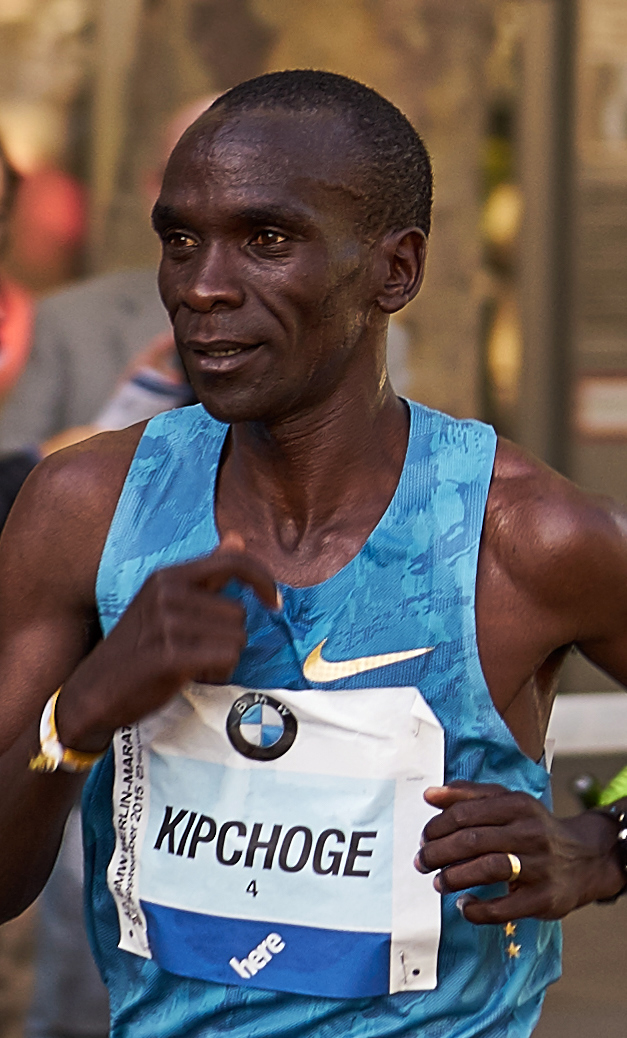
Running as a Way of Thinking
What separates Kipchoge from every elite distance runner who preceded him is not simply speed or endurance but the quality of his thinking. He has approached the marathon as an intellectual problem as much as a physical one. His willingness to engage with the Breaking2 and INEOS 1:59 Challenge projects reflected a belief that records and perceived limits are largely mental constructs, and that the right combination of preparation, conditions and mindset could dismantle them. That belief has proved correct twice: once in the world record of 2:01:39 at Berlin in 2017, and once in the sub-two-hour run in Vienna in 2019.
He has also thought carefully about the role that a simple life plays in peak performance. At Kaptagat, he does not have a personal chef or a performance psychologist or a data analyst reviewing his every stride. He trains with a group, eats with them, and rests with them. He believes that the ego that comes with privilege and isolation is the enemy of the focused, relaxed state that fast running requires. Whether or not that philosophy can be transplanted outside Kenya or outside the specific culture of the Rift Valley training camps, it has produced in his own career a standard of sustained excellence across two decades that the sport of marathon running has never previously seen.