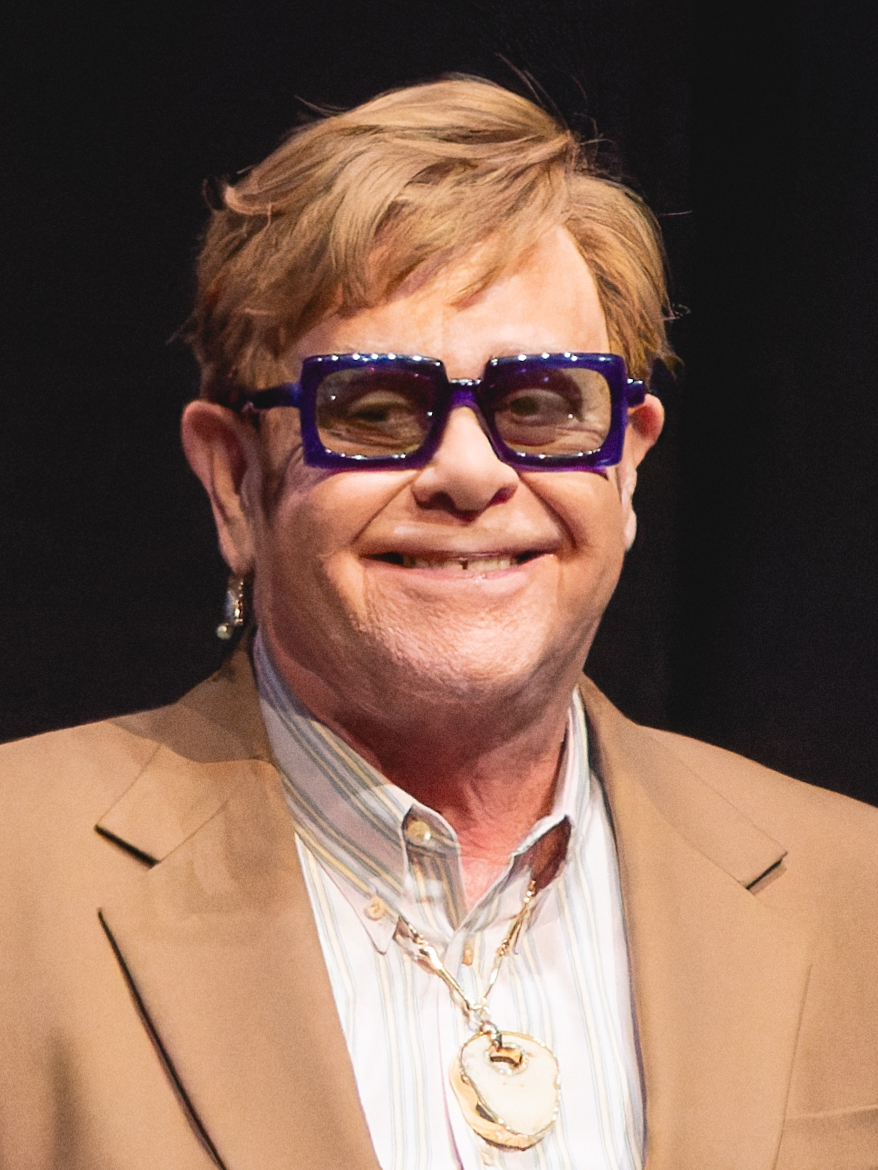
There is a particular sound that the world recognizes the instant it begins: a few cascading notes on a grand piano, a voice that can move from a whisper to a roar within a single bar, and a melody that seems to have existed forever even though it was written only moments before being recorded. That sound belongs to Elton John. Across more than five decades, the boy born Reginald Kenneth Dwight in a quiet corner of suburban England transformed himself into one of the most flamboyant, prolific, and beloved performers the music industry has ever produced. He has sold hundreds of millions of records, filled the largest stadiums on every continent, and written songs that have soundtracked births, weddings, funerals, and the ordinary heartbreaks of countless lives. Yet behind the feathered costumes and the rhinestone glasses sits a story far more complicated than the glitter suggests, a story of talent, addiction, reinvention, and an extraordinary capacity to keep going.
Quick Facts
- Full name
- Reginald Kenneth Dwight (Sir Elton John)
- Born
- 25 March 1947, Pinner, Middlesex, England
- Genre
- Pop, rock, glam rock
- Known for
- One of the best-selling music artists of all time
- Partner in song
- Lyricist Bernie Taupin
Early Life
Reginald Kenneth Dwight was born on 25 March 1947 in Pinner, Middlesex, a suburb on the northwestern edge of London. His father, Stanley Dwight, was a Royal Air Force officer and a skilled trumpet player, while his mother, Sheila Eileen, brought records into the house that would shape her son’s imagination. The marriage was tense and often unhappy, and the young Reginald grew up in a household where music offered an escape from the chill that hung over the family rooms. He was an only child for most of his upbringing, and the piano became both his refuge and his companion.
The talent revealed itself astonishingly early. By the age of three, Reginald could sit at the family piano and pick out melodies by ear, reproducing tunes he had only heard once. Relatives recall him playing pieces with a confidence that seemed impossible in someone so young. This was not the diligent progress of a child practicing scales under instruction. It was a natural gift, a kind of fluency with the keyboard that arrived almost fully formed. Recognizing this, his family encouraged him, and at the age of eleven he won a junior scholarship to the Royal Academy of Music in London, one of the most prestigious conservatories in the world.
For roughly five years he attended the Academy on Saturdays, studying classical piano and absorbing the discipline of formal training. He was a capable pupil, able to play complex classical works, yet his heart was drifting elsewhere. The records his mother brought home, the rock and roll and rhythm and blues coming out of America, lit a fire that Chopin and Bach could not quite match. He loved the energy of artists like Little Richard and Jerry Lee Lewis, performers who attacked the piano rather than merely played it, and he began to imagine a different kind of life behind the keys.
As a teenager he took his first real steps onto the stage. He played piano in the lobby of a local pub for tips, building stamina and learning how to hold an audience. Then came his first proper band, Bluesology, formed in the early 1960s. The group backed touring American soul and rhythm and blues acts when they came through Britain, and for a young man hungry for experience this was an education no conservatory could provide. Bluesology eventually became the backing band for the singer Long John Baldry, a towering figure on the British blues scene.
It was during this period that Reginald Dwight invented the name that would carry him to fame. Leaving Bluesology to pursue his own path, he chose a stage name by combining the first name of the band’s saxophonist, Elton Dean, with the first name of Long John Baldry. Reginald Kenneth Dwight became Elton John, and in time he would make the change permanent by deed poll. The shy, slightly awkward young man from Pinner had given himself a new identity, and that new identity would soon belong to the world.
The Bernie Taupin Partnership
Every great songwriting career has a turning point, and for Elton John it arrived in the form of a newspaper advertisement. In 1967, the music publisher Liberty Records placed a notice in the British music press inviting aspiring talent to apply. Elton answered it. He had melodies in abundance but struggled to write lyrics. As it happened, another young hopeful named Bernie Taupin had also responded to the same advertisement, and he had the opposite problem: he could write evocative, image rich words but had no music to set them to. An executive at the company handed Elton an envelope of Taupin’s lyrics, and a partnership was born that would last for the rest of their lives.
What made the collaboration so unusual was its method. The two men did not sit together in a room hammering out songs line by line, as most writing teams do. Instead, Bernie Taupin would write his lyrics on his own, complete poems full of American imagery, longing, and storytelling, and hand them over. Elton would then sit at the piano and, often in a matter of minutes, set the words to music, working at remarkable speed. He has spoken of writing a song in the time it takes to make a cup of tea, discarding any idea that did not come quickly. The result was a body of work in which the words and the music seemed to belong to one another even though they were created in separate rooms, sometimes on separate continents.
The early years were lean. The pair wrote songs for other artists and recorded material that went largely unnoticed. Elton’s self titled album in 1970 changed everything. It contained a song called “Your Song,” a tender, unguarded declaration set to a gentle melody, and it became his first major hit on both sides of the Atlantic. The track announced a new voice in popular music, one capable of sincerity without sentimentality, and it remains one of the most cherished songs in his entire catalogue.
The other decisive moment of 1970 came not on record but on stage. In August of that year, Elton John flew to Los Angeles to play a residency at the Troubadour, a small but influential club. American audiences had no idea what to expect. What they witnessed was a revelation. Far from the introverted balladeer his records might have suggested, Elton attacked the piano with the showmanship of the rock and roll heroes of his youth, kicking back the stool, standing on the keys, and electrifying the room. The reviews were ecstatic, word spread instantly through the industry, and within days an unknown Englishman had become the most talked about new act in America. Those Troubadour shows are widely regarded as the launchpad of his career.
The Golden Run
The years that followed represent one of the most astonishing creative streaks in the history of recorded music. Between roughly 1972 and 1975, Elton John released a sequence of albums that combined commercial dominance with genuine artistic ambition, and he did so at a pace that seems almost unbelievable in hindsight. He was not releasing an album every few years. He was releasing several across a short span, each one stuffed with songs that would become standards.
The 1972 album “Honky Chateau,” recorded at a chateau in France, gave him his first number one album in the United States and included the enduring “Rocket Man,” a melancholy meditation on isolation that would later lend its nickname to the man himself. The following year brought “Goodbye Yellow Brick Road,” a sprawling double album considered by many to be his masterpiece. It ranged from the orchestral grandeur of “Funeral for a Friend” to the pure pop of “Bennie and the Jets,” the rocking energy of “Saturday Night’s Alright for Fighting,” and the bittersweet title track. It was a record that captured the full range of his gifts, and it sold in enormous numbers.
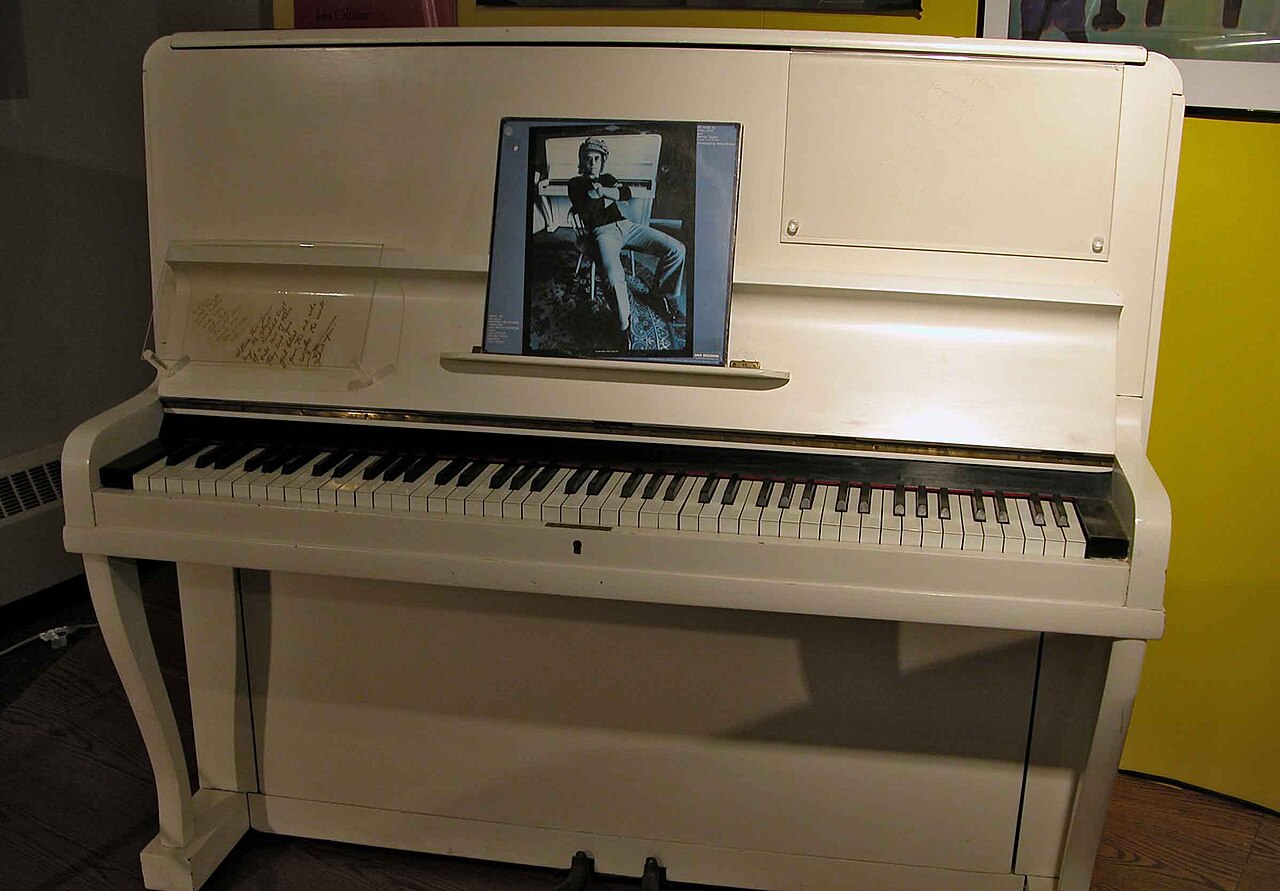
The hits kept coming. “Crocodile Rock” and “Daniel” became radio staples, and in 1975 the autobiographical album “Captain Fantastic and the Brown Dirt Cowboy” entered the American charts at number one, a feat no album had achieved before. Across this period Elton placed a remarkable run of albums at the top of the charts, a level of consistency that few artists in any era have matched.
As the music soared, so did the spectacle. Elton John understood that performance was theatre, and he dressed the part with a glee that bordered on the outrageous. He appeared on stage in feathered costumes, sequined jumpsuits, ostrich plumes, and platform boots. Above all there were the glasses, an ever expanding collection of extravagant spectacles in every shape and color, some so large and elaborate that they became part of his very silhouette. On one famous occasion he dressed as the Statue of Liberty, on another in a costume modeled on Donald Duck. The flamboyance was joyous rather than calculated, an extension of a personality that had finally found permission to be as big and bold as the music it produced. For millions of fans around the world, the image of Elton John at the piano in dazzling glasses became as recognizable as any in popular culture.
Struggles and Reinvention
The dazzling surface concealed deep private pain. The very speed and scale of Elton’s success left little room for an ordinary inner life, and over the course of the 1970s and 1980s he slid into serious addiction. Cocaine and alcohol became constant companions, and he later spoke with painful honesty about how close they brought him to ruin. Alongside the substance abuse he battled bulimia, an eating disorder that compounded the physical and emotional toll of years lived at an exhausting pace. He has described this stretch of his life as one of profound loneliness, in which fame and wealth offered no protection from despair.
His personal identity was also a source of turmoil during these decades. In 1976 he spoke publicly about being bisexual, a brave and unusual admission for a major star at the time, and one that drew a hostile reaction in some quarters. Years later he came out as gay, and he has since become one of the most prominent and outspoken figures for the rights and dignity of gay people worldwide. The journey toward living openly was not simple, and it included a brief marriage in the 1980s that ended in divorce, but it ultimately allowed him to build the honest life he had long been denied.
The decisive change arrived in 1990, when Elton finally sought treatment and got sober. He has often pointed to this moment as the one that saved his life and gave him a second act. Freed from the chaos of addiction, he found new clarity and purpose, both in his music and in his sense of responsibility to others.
“I never thought I’d make it to 43, let alone 70. So everything is a bonus.”
The 1990s brought a powerful comeback. He scored major successes with new music and reestablished himself as a vital force rather than a relic of the previous decade. Then, in 1997, came a moment that placed him at the very center of a global event. Following the sudden death of Diana, Princess of Wales, with whom he had been friends, Elton performed at her funeral in Westminster Abbey. He sang a version of “Candle in the Wind,” a song originally written years earlier, with lyrics newly rewritten by Bernie Taupin to honor the Princess. The recording released afterward became one of the best selling singles of all time, a staggering commercial phenomenon, and the proceeds were directed to charity. It was a moment of public grief and private feeling that bound the artist to the wider world in a way few performances ever have.
Broadway, Film and Activism
As his recording career matured, Elton John expanded into new arenas, and few transitions were as successful as his move into theatre and film. In 1994 he composed the music for the Walt Disney animated film “The Lion King,” again working with a lyricist, in this case Tim Rice. The songs, including “Can You Feel the Love Tonight,” won him an Academy Award and introduced his melodies to an entirely new generation of children and families. When “The Lion King” was later adapted into a stage musical, it became one of the most successful productions in Broadway history.
He continued to write for the stage with “Aida,” a musical based on the opera, which earned him a Tony Award, and later with “Billy Elliot the Musical,” a theatrical adaptation of the beloved British film that became a critical and commercial triumph in both London and New York. These works demonstrated a versatility that surprised even his admirers, proving that the man who could write a three minute pop hit in minutes could also sustain the dramatic arc of an entire musical.
Alongside the creative achievements came a profound commitment to philanthropy. In 1992 Elton John founded the Elton John AIDS Foundation, an organization dedicated to fighting the disease and supporting those affected by it. The foundation has raised vast sums over the years and has become one of the most significant charitable efforts in the field, reflecting a cause that became central to his life after he lost friends to the epidemic. His activism extended to advocacy for gay rights and public health more broadly, and he used his fame deliberately as a platform for these causes. The combination of artistic accomplishment and humanitarian work made him a figure respected far beyond the world of pop music.
Later Career and Farewell
As the decades accumulated, Elton John showed no sign of fading from public life. In 2019 his story reached cinemas in the form of “Rocketman,” a musical biopic that dramatized his early life, his rise to fame, and his battles with addiction. Unlike a conventional biographical film, it embraced fantasy and spectacle, using his songs as the fabric of its storytelling. The film was a critical and commercial success, and a song written for it, “(I’m Gonna) Love Me Again,” won Elton another Academy Award decades after his first.
The crowning achievement of his later years was the Farewell Yellow Brick Road tour, a vast global undertaking that he announced as the final concert tour of his career. Stretching across years and continents, the tour visited stadiums and arenas around the world and gave millions of fans a last chance to see him perform live. It became one of the highest grossing tours of all time, a fitting commercial capstone to a career built on connecting with audiences in the largest possible venues. When it concluded, it marked the end of an era of touring that had spanned the better part of half a century.
Honors and recognition accumulated throughout this period. Elton John was knighted by Queen Elizabeth II, becoming Sir Elton John, and he received numerous further distinctions for his contributions to music and to charity. He was inducted into the Rock and Roll Hall of Fame, celebrated with lifetime achievement honors, and feted by governments and institutions across the world. Through all of it he remained, at heart, a songwriter and a performer, someone who had never lost the thrill of sitting at a piano and finding a melody.
In his personal life he found a lasting stability that had eluded him during the turbulent earlier decades. He married David Furnish, his long term partner, and together they became fathers to two sons. The man who had spent years describing his loneliness built, in the second half of his life, the family and the contentment he had long sought.
Legacy
The legacy of Elton John is measured in numbers so large they almost lose meaning. He ranks among the best selling music artists in history, with hundreds of millions of records sold across the world. He has placed dozens of songs in the upper reaches of the charts in multiple countries, sustained popularity across an unbroken span of decades, and influenced generations of musicians who learned that a piano could be as commanding an instrument as any electric guitar.
Yet the statistics tell only part of the story. His true legacy lies in the songs themselves, melodies so durable that they have outlived the eras in which they were written and entered the permanent vocabulary of popular music. Songs like “Your Song,” “Rocket Man,” “Tiny Dancer,” “Bennie and the Jets,” and “Goodbye Yellow Brick Road” are not merely hits. They are part of the shared emotional landscape of the modern world, played at moments of celebration and mourning, recognized instantly by people who were not even born when they first appeared.
His partnership with Bernie Taupin stands as one of the most enduring and productive collaborations in the history of songwriting, a relationship that survived addiction, fame, and the passage of half a century without fracturing. Together they proved that two people working in separate rooms, one supplying words and the other music, could create art of remarkable unity and feeling.
Beyond the music, Elton John leaves a legacy of courage. He spoke openly about his sexuality when doing so carried real risk, he confronted his addictions publicly and used his recovery to help others, and he devoted enormous energy and resources to fighting a disease that the world was once afraid to discuss. He turned his fame into a force for compassion. For all the feathers and the glasses and the theatrical extravagance, the most lasting impression he leaves is of a man who refused to hide, who turned his struggles into solidarity, and who never stopped believing in the power of a good song.
Key Facts
- Born Reginald Kenneth Dwight on 25 March 1947 in Pinner, Middlesex, he won a junior scholarship to the Royal Academy of Music at the age of eleven before adopting the stage name Elton John.
- His lifelong partnership with lyricist Bernie Taupin, formed after both answered the same 1967 advertisement, produced classics including “Your Song,” “Rocket Man,” and “Goodbye Yellow Brick Road.”
- He ranks among the best selling music artists of all time, and his rewritten version of “Candle in the Wind” performed for Princess Diana in 1997 became one of the best selling singles in history.
- He won Academy Awards for his work on “The Lion King” and the biopic “Rocketman,” along with Tony Award recognition for his Broadway musicals, and he founded the Elton John AIDS Foundation in 1992.
- Knighted as Sir Elton John, he closed his touring career with the Farewell Yellow Brick Road tour, one of the highest grossing concert tours of all time.