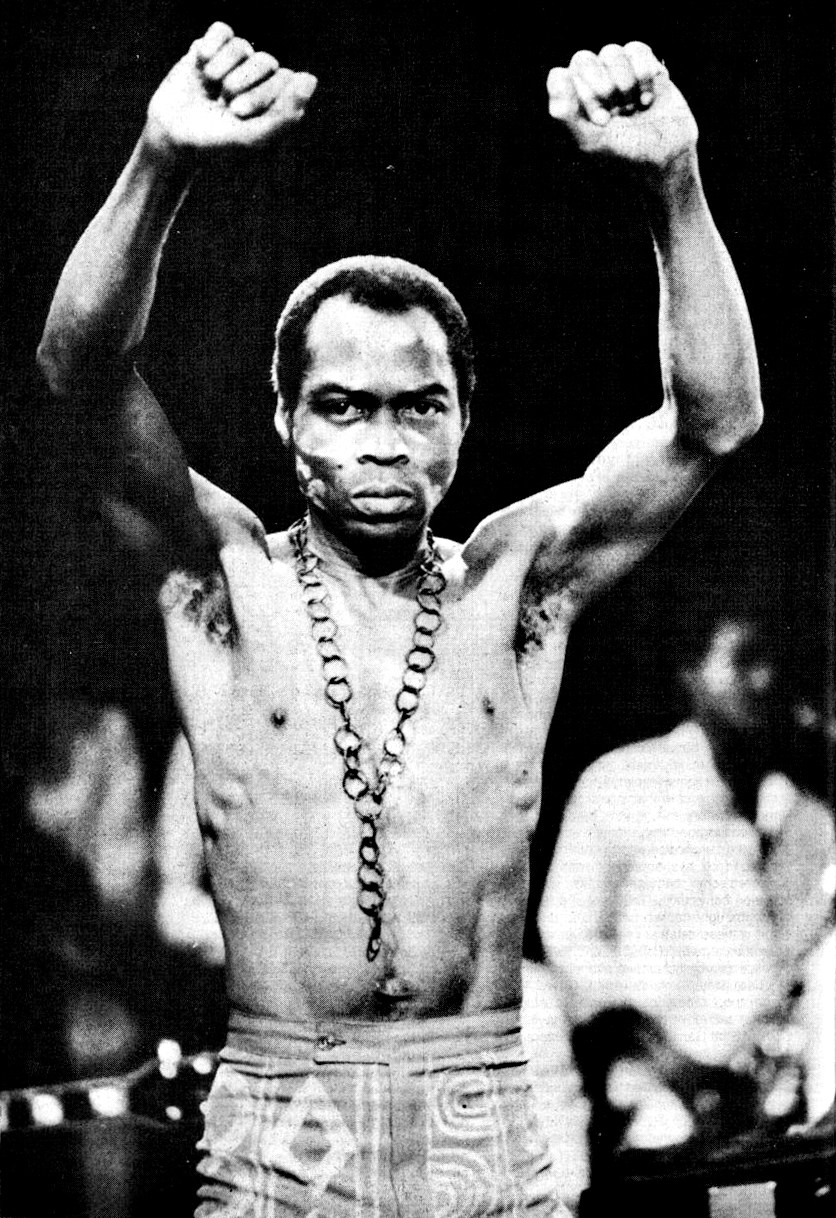
There are musicians who entertain, musicians who inspire, and, very rarely, musicians who enrage governments, galvanise the poor, and reshape the cultural identity of an entire nation. Fela Anikulapo Kuti occupied the third category with a ferocity and a consistency that bordered on the suicidal, and yet he survived to become the most influential African musician of the twentieth century, the father of a genre, the conscience of a country and one of the most original artistic voices the world has produced. To understand Fela is to understand something about Nigeria, about Africa, about the relationship between art and power, and about what it costs, personally and physically, to refuse to be silenced. He paid that cost in full, and the music he left behind makes clear that he considered every scar worth bearing.
Quick Facts
- Full name
- Olufela Olusegun Oludotun Ransome-Kuti
- Born
- 15 October 1938, Abeokuta, Nigeria
- Died
- 2 August 1997, Lagos, Nigeria (aged 58)
- Genre
- Afrobeat (creator), highlife, jazz, funk
- Known for
- Creating Afrobeat, political resistance through music, the Kalakuta Republic
Abeokuta and the Ransome-Kuti Legacy
Fela Anikulapo Kuti was born Olufela Olusegun Oludotun Ransome-Kuti on 15 October 1938 in Abeokuta, a city in what was then the colony of Nigeria under British rule. He was born into one of the most remarkable families in Nigerian intellectual and political history. His father, Israel Oludotun Ransome-Kuti, was an Anglican minister and educator who was among the pioneers of modern Nigerian education. His mother, Funmilayo Ransome-Kuti, was a political activist of extraordinary courage and vision, a leader of the women’s movement in colonial Nigeria who organised market women to resist the colonial government’s taxation policies and who travelled to the Soviet Union and China as part of her international political activity. She was, in every sense, a fighter, and her son inherited her combativeness along with his father’s cultural seriousness.
The Ransome-Kuti home was not just comfortable but intellectually stimulating in a way that was unusual even by the standards of the Nigerian elite. Books, political discussion and music all had a place. The family had long musical roots, and the church provided a framework in which Western harmony and African vocal tradition coexisted in ways that would later inform Fela’s own synthesis. He grew up aware of the political world, aware of the fight for independence that was reshaping Africa, and aware of the costs that principled resistance could exact. His mother’s activism was not abstract; it was visible, daily and demanding.
His uncle was the renowned Yoruba musician I.K. Dairo, and music was in the family’s blood in ways that went beyond religious practice. Fela absorbed highlife, the dominant West African popular music form of the era, along with the Western classical and church music that his family’s background provided. He showed early promise as a musician and was sent to London in 1958 to study medicine, fulfilling his parents’ vision of a professional career. He studied medicine for a very short time before changing course to study music at the Trinity College of Music, a decision that did not entirely please his family but that reflected where his real abilities lay.
London and the Seeds of a New Sound
Fela’s years in London from 1958 to 1963 were formative in ways that went beyond the technical musical training he received. He absorbed modern jazz, which was then at the height of its influence in British cultural life, and he encountered the work of musicians like Miles Davis, John Coltrane and Charles Mingus who were remaking the relationship between improvisation, structure and political consciousness. He also formed a band, Koola Lobitos, that mixed jazz with the highlife rhythms he had grown up with in Nigeria, and began exploring what a West African jazz synthesis might sound like.
He also married his first wife, Remilekun Taylor, known as Remi, in London, and the couple returned to Nigeria in 1963 after his graduation. Back in Lagos, Fela resumed work with Koola Lobitos and began performing at the clubs and venues that made up Lagos’s vibrant nightlife scene. The band was musically sophisticated, drawing on both the local highlife tradition and the jazz influences he had absorbed in London, but it had not yet found the sound that would define him.
The critical transformation came in 1969, when Fela took Koola Lobitos to the United States on what was intended to be a promotional tour. In Los Angeles, he encountered Sandra Isidore, an African American activist and associate of the Black Panther Party, who introduced him to the literature and thought of the Black Power movement, particularly the writings of Malcolm X. The encounter was genuinely revelatory. Ideas about African identity, colonial oppression, the dignity of African culture and the political responsibilities of Black artists that Fela had circled around without quite arriving at suddenly crystallised into a coherent and passionate framework.
The Birth of Afrobeat
When Fela returned to Nigeria in 1970, he came back transformed. He renamed his band Africa 70 and began making a new kind of music that had no direct precedent: Afrobeat. The new genre was built on a foundation of Yoruba musical traditions, particularly the polyrhythmic complexity and call-and-response structures of traditional music, combined with the driving rhythms of funk (itself a development from the African traditions that had survived in American music), the harmonic complexity and improvisational freedom of jazz, and the high-life melodic sensibility he had grown up with.
The signature Afrobeat sound involved long, repetitive grooves that could sustain themselves for an entire album side, typically twenty to thirty minutes, building gradually through collective improvisation to states of intensity that had more in common with West African communal music-making than with Western pop structure. Over these grooves, Fela would play saxophone, keyboards and trumpet, would lead the horn section through arranged passages, and would deliver his lyrics in a mixture of English and Pidgin English that was directly accessible to the urban Nigerian audience he was addressing.
Those lyrics were unlike anything in African popular music at the time: direct, furious, satirical, and politically precise in their identification of the corruption, military brutality and neo-colonial exploitation that were shaping post-independence Nigeria. He used language that was deliberately coarse and vulgar, a rejection of the polite codes that he associated with the educated elite’s accommodation of oppression. He named names, described specific events and policies, and delivered his denunciations with a theatrical energy that made the performances simultaneously entertaining and genuinely frightening to those in power.
“Music is the weapon of the future.”
He established his base of operations at a compound in the Surulere district of Lagos that he named the Kalakuta Republic, declaring it independent from Nigeria and posting the declaration on the gate. Inside the compound lived his band, his dancers, his family, and a community of followers. The Shrine, his regular performance venue, was nearby and operated as both a nightclub and a kind of political gathering space where the music was the medium through which his ideas reached the thousands who came to see him play.
Afrika 70 and the Classic Albums
Through the 1970s, Fela and Afrika 70 produced an astonishing body of work at a pace that reflected both his creative energy and the urgency he felt about communicating his ideas. The albums were released primarily on his own Coconut Records label and distributed through independent channels, partly because no major label would touch material so politically explosive. The titles gave a clear indication of the content: “Zombie” took the term used for Nigerian soldiers and extended it to describe the mindlessness of military obedience in general; “Expensive Shit” referred to a specific incident in which the Lagos police arrested Fela and forced him to ingest his own faeces in an attempt to retrieve evidence; “Coffin for Head of State” documented in musical form the funeral procession Fela organised after the attack on the Kalakuta Republic, in which his mother’s coffin was delivered to the military headquarters.
The recordings were made under difficult conditions, often with limited studio time and minimal resources, but the quality of the musicianship was consistently high. Tony Allen, Fela’s drummer from the late 1960s through much of the 1970s, is generally acknowledged as a co-creator of the Afrobeat sound. Allen’s drumming was the rhythmic architecture on which everything else was built: complex, layered, seemingly simple on the surface but containing subtleties that rewarded close listening. The partnership between Fela and Allen was one of the great creative collaborations in twentieth-century music, and when Allen eventually left in 1979, citing exhaustion and creative frustration, it marked the end of an era.
The horn arrangements were another defining element. The section of saxophones, trumpets and trombones moved with a precision and a power that gave even the most politically charged material a physical joy, a quality that made the music irresistible even to those who could not follow the lyrics. This was deliberate: Fela understood that the music had to be pleasurable to listen to, had to make people want to dance, in order to carry its message as far as possible. The politics and the pleasure were not in tension; they were the same thing.
The Kalakuta Republic and the First Raids
The Nigerian military government had been watching Fela with growing alarm throughout the early 1970s. His music reached enormous audiences, his concerts drew tens of thousands, and his compound had become a visible symbol of defiance. In 1974 the police raided the Kalakuta Republic, ostensibly searching for drugs but in reality attempting to intimidate and disrupt. Fela’s response was to record and release an account of the raid as an album, and to continue performing with undiminished intensity.
The government’s patience ran out in February 1977, following the release of “Zombie”, which had been circulating widely and causing genuine concern in military circles. A force of approximately one thousand soldiers descended on the Kalakuta Republic in what was officially described as a response to a disturbance but was clearly a punitive operation. They beat the compound’s residents with considerable brutality. They set fire to the buildings, destroying master tapes and equipment along with everything else. They threw Fela’s elderly mother, Funmilayo Ransome-Kuti, then in her seventies, from a second-floor window.
Funmilayo Ransome-Kuti never fully recovered from the injuries she sustained in the attack. She died in April 1978, and her death became a source of grief and fury that deepened Fela’s commitment to resistance rather than diminishing it. He organised the funeral procession that placed her coffin at the gates of Dodan Barracks, the military headquarters, a gesture of such audacity that it stood as one of the defining acts of artistic defiance in the history of the continent.
Marriage to 27 Women and the Challenge to Conventional Morality
In 1978, in a ceremony conducted according to Yoruba traditional practices, Fela married twenty-seven women simultaneously, nearly all of them dancers in his Egypt 80 band (the new name he had given his group after Afrika 70 dispersed). The mass marriage was an act of theatrical defiance directed at multiple targets: the Christian and Western moral framework that defined traditional African practices as primitive, the Nigerian state’s condemnation of his lifestyle, and the social conventions that he felt constrained human freedom. It was also, inevitably, a source of significant criticism from women’s rights advocates, who noted the power imbalance inherent in an arrangement where an employer married his employees en masse.
The complexity of Fela’s relationship with women is one of the genuine contradictions of his legacy. He was devoted to his mother’s memory and honoured her political courage. He employed women in his band at a time when this was unusual in Nigerian music. His music spoke of human dignity and freedom in terms that were ostensibly universal. Yet his treatment of the women in his life was frequently possessive and sometimes abusive, and the mass marriage, whatever its ideological intent, placed twenty-seven women in a relationship of dependency with a man of enormous ego who was simultaneously a target of state violence. These contradictions do not resolve easily, and any honest account of Fela must acknowledge them rather than smooth them away.
Prison and International Recognition
In 1984 Fela was arrested and convicted by the Buhari military government on currency smuggling charges that were widely understood to be politically motivated. He was sentenced to five years in prison, and the international musical community responded with campaigns for his release. Artists including Stevie Wonder and Amnesty International’s music sections participated in these efforts. He was released in 1986 after serving approximately two years, following pressure that demonstrated how far his reputation had spread beyond Nigeria’s borders.
The international recognition that had been building throughout the 1980s accelerated after his release. European and American audiences, increasingly aware of African music through the emerging world music category, found in Fela a figure whose music was both politically compelling and sonically extraordinary. His concerts in Europe drew large, enthusiastic audiences, and his influence on Western musicians was growing. Bands and producers working in rock, jazz and funk were absorbing the Afrobeat sound and integrating elements of it into their own work.
He reconstituted his band and continued recording through the late 1980s and early 1990s under the Egypt 80 name, though the output was more sporadic than during the peak years. The albums from this period were less consistently innovative than the classic 1970s work, but they contained moments of genuine power, and the live performances remained remarkable events. In 1979 he had run for President of Nigeria, a candidacy that was disqualified by the electoral commission on bureaucratic grounds, and he continued to engage with Nigerian political realities through both music and public commentary.
His Musical Philosophy and Influence on African Music
The philosophical framework that underpinned Fela’s art was a synthesis of Pan-Africanism, Yoruba spiritual tradition and a personal cosmology he called “the African philosophy”. He was deeply influenced by the Yoruba concept of “ori”, the individual spiritual essence, and he believed that African music had been distorted by colonialism and that the recovery of authentic African identity required both a political transformation and a cultural one. Music was not decoration or entertainment in this framework; it was a form of knowledge, a way of transmitting truth that bypassed the censorship of language and the distortions of Western education.
He changed his middle name from Ransome (which he regarded as a slave name imposed by colonialism) to Anikulapo, meaning “he who carries death in his pouch”, a declaration of personal sovereignty and defiance. The renaming was characteristic: in Fela’s world, identity was not given by colonial authorities or by tradition but was chosen, claimed and performed.
His influence on the subsequent development of African popular music is incalculable. The Afrobeats genre that emerged from Nigeria in the 2000s and 2010s, the sound of artists like Burna Boy, Wizkid, Davido and their contemporaries, owes a direct and acknowledged debt to the foundations Fela laid. Burna Boy, who has perhaps most explicitly embraced the connection, regularly describes himself as continuing Fela’s tradition and has performed at the Afrika Shrine. The political engagement, the pride in African identity, the fusion of Yoruba musical traditions with contemporary global sounds: all of this flows from the creative space Fela opened.
His influence also extends far beyond Africa. James Brown, one of the foundational figures of American funk, and Fela maintained a mutual admiration and influence that ran in both directions: Brown’s funk influenced Afrobeat, and Afrobeat’s structures influenced later American music. Brian Eno, Paul McCartney and many other Western musicians visited the Shrine or engaged with Fela’s work. The Talking Heads, the Red Hot Chili Peppers, and dozens of jazz musicians drew on Afrobeat’s rhythmic vocabulary.
The Final Years and Death
By the early 1990s Fela’s health was deteriorating. He had been a heavy marijuana user for decades, and there were other physical consequences of a life lived at the intensity he had maintained. In 1996, when a journalist noted that he appeared unwell, Fela denied it publicly. He died on 2 August 1997 in Lagos, at the age of fifty-eight, from complications of AIDS.
The announcement of his death was handled by his son Femi, himself an accomplished musician in the Afrobeat tradition. The revelation that Fela had died of AIDS was a shock to many, and it reopened questions about his lifestyle and his public health positions, which had included scepticism about the mainstream medical account of HIV transmission. His death also generated an outpouring of grief in Nigeria and across Africa that was proportionate to his stature: not just a musician had died, but a moral force, a persistent irritant to power, a man who had refused to stop telling the truth regardless of what it cost him.
His funeral was attended by hundreds of thousands of people in Lagos, one of the largest public gatherings the city had seen. His body lay in state at his compound, and the procession through the streets was both a mourning and a celebration, the kind of collective expression that his music had always sought to create.
Legacy: The Shrine Still Burns
Fela Kuti’s legacy is as complex, contradictory and vital as the man himself. He was a genius who could be selfish, a liberator who was sometimes a tyrant within his own household, a champion of African dignity who held views on women and on medicine that his admirers must honestly engage with rather than simply overlook. He was also one of the most original musicians in the history of recorded music, a political figure of genuine courage, and an artist whose work has proved more durable and more influential than that of most of his contemporaries anywhere in the world.
The Afrika Shrine in Lagos, rebuilt after the 1977 destruction and maintained by his son Femi and his grandson Made Kuti, remains an active venue where Afrobeat is performed regularly and where his spirit, in the most secular sense of the word, continues to inhabit the room. Visitors come from across the world to stand in the place where he performed, and the music that plays there on any given night connects the present moment to a tradition that Fela built from nothing.
Nigeria is a different country from the one he knew: the military governments he fought against have been replaced by civilian institutions of varying quality, the economy has been transformed, and Lagos has become one of the great cities of global culture. But the questions he asked, about who controls the wealth that comes from African soil, about the relationship between the African elite and the people it claims to represent, about the dignity and the creative power of African people, remain as relevant as they were when he first began asking them in the early 1970s. His music is the vehicle through which those questions keep reaching new audiences, and as long as it does, the fight he picked with power goes on.
Key Facts
- Fela Kuti founded Afrobeat in the early 1970s, fusing Yoruba musical traditions with funk, jazz and highlife to create a genre that continues to influence global music today.
- He was arrested more than 200 times by Nigerian authorities during his career, a testament to the government’s persistent anxiety about his influence.
- The 1977 military raid on the Kalakuta Republic involved approximately 1,000 soldiers and resulted in the destruction of the compound and the injury of his mother, who later died from her injuries.
- His 2009 Broadway biographical musical “Fela!” ran for over 400 performances and won three Tony Awards, introducing his story to new international audiences.
- His sons Femi Kuti and Made Kuti are both accomplished Afrobeat musicians who continue to perform at the Afrika Shrine in Lagos, maintaining the family tradition.