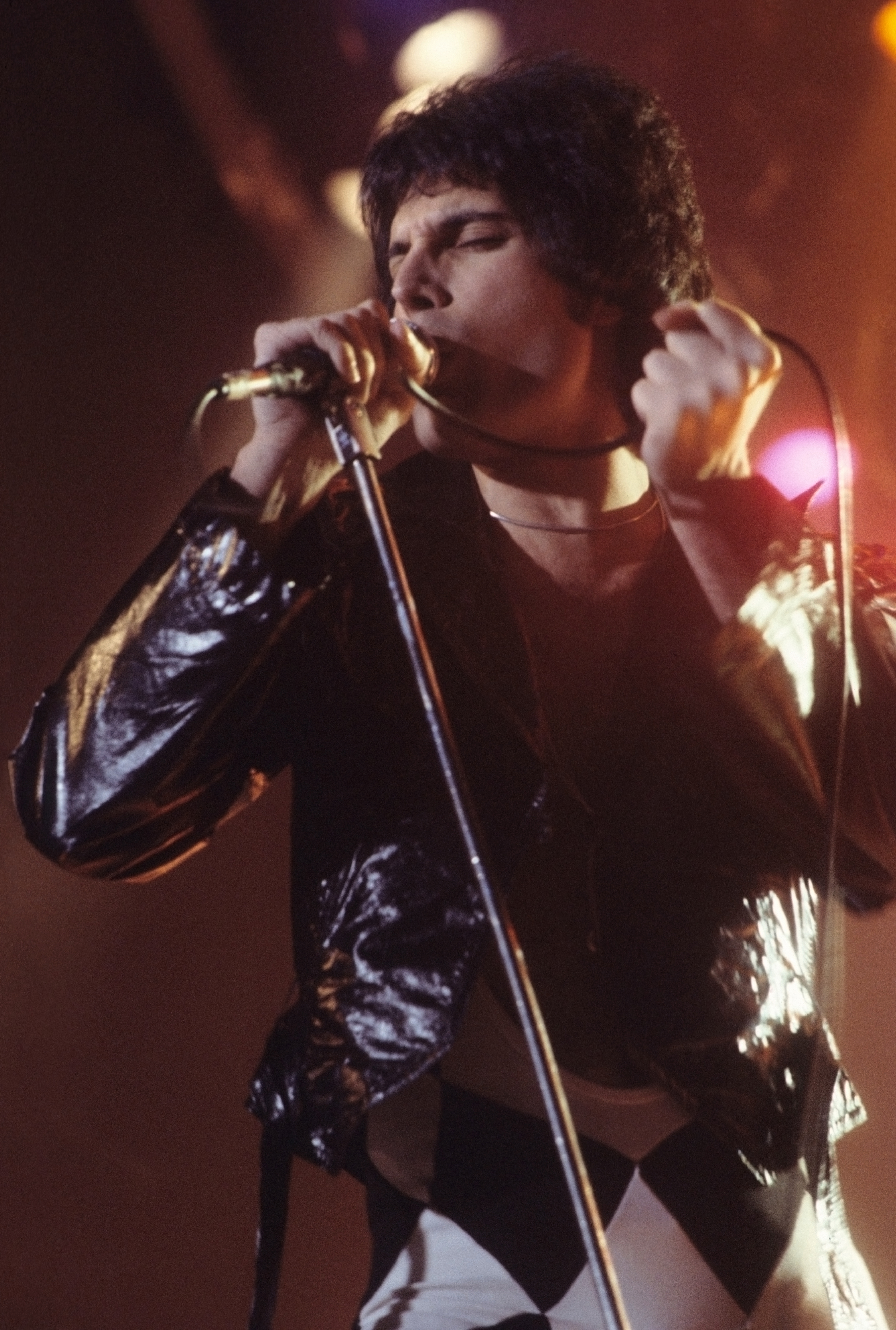
There is a moment in the Live Aid concert footage from July 1985 that people who were present at Wembley Stadium still talk about as the single most extraordinary piece of live performance they have ever witnessed. Freddie Mercury walked to the front of the stage, looked out at 72,000 people, and proceeded to conduct the crowd like an orchestra, drawing call-and-response patterns from tens of thousands of strangers through nothing more than the force of his own presence and the astonishing instrument of his voice. Cameras panned across the crowd and caught faces in states of something close to religious awe, and the performance that followed, Queen’s twenty-one-minute set, is widely described as the greatest live rock performance ever delivered. That it came from a man born in Zanzibar, raised partly in India, educated in England and largely ignored or condemned by the mainstream press at the time of his greatest work says something profound about the gap that can exist between contemporary critical assessment and the judgment of history.
Quick Facts
- Full name
- Farrokh Bulsara
- Born
- 5 September 1946, Stone Town, Zanzibar (now Tanzania)
- Died
- 24 November 1991, Kensington, London, England (aged 45)
- Genre
- Rock, hard rock, glam rock, progressive rock, pop
- Known for
- Lead vocalist of Queen, theatrical live performances, extraordinary vocal range
Stone Town to Panchgani: A Diaspora Childhood
Farrokh Bulsara was born on 5 September 1946 in Stone Town, the historic capital of Zanzibar, then a British protectorate. His parents, Bomi and Jer Bulsara, were Parsi Zoroastrians, members of an ancient Persian religious community that had settled in India centuries earlier and whose members tended to be educated, professional and thoroughly fluent in the complex navigation of multiple cultural identities. Bomi Bulsara worked as a cashier for the British colonial government, and the family occupied the comfortable if not wealthy position of educated colonial-era civil servants.
When Farrokh was eight years old, his parents enrolled him at St. Peter’s School, a boarding school for boys in Panchgani, a hill station in Maharashtra, India. The school was run on British public-school lines, with an emphasis on discipline, sport and academic performance, and it was here that Farrokh first found music as a serious pursuit. He formed a band with schoolmates called The Hectics and began performing rock and roll covers with a natural ease that led his piano teacher to describe him as a born performer. He also displayed the four extra teeth, resulting in a slightly overcrowded upper jaw, that would later contribute to the distinctive timbre of his voice (and that he chose never to have corrected, fearing it would alter his tone).
Zanzibar in 1964 underwent the revolution that overthrew the Arab sultanate and established a new government, producing widespread violence and political instability. The Bulsara family, like many of Zanzibar’s Indian and Parsi community, fled to England, settling in Feltham in Middlesex. Farrokh was seventeen, transplanted from the warmth and social familiarity of an expatriate community in India to the grey and somewhat unwelcoming England of the mid-1960s. The experience of being an outsider, of not quite fitting the available categories, was one he would carry through his life and eventually transmute into the theatrical persona that made him famous.
Ealing and the Art School Years
Farrokh enrolled at Ealing College of Art (now the University of West London) to study graphic art and design, graduating with a diploma in 1969. The art school environment of late 1960s London was extraordinarily fertile: the campuses and their surrounding neighbourhoods were incubators for the counterculture, populated by musicians, artists and writers who were engaged in the collective project of reimagining British culture. David Bowie, Pete Townshend, Ronnie Wood and many other significant rock figures of the era had art school backgrounds, and the sensibility the art school instilled, combining technical craft with a willingness to experiment with form and identity, was central to the kind of rock that would define the early 1970s.
During this period Farrokh was playing music with several groups in the London circuit, always on the periphery of more established acts, always impressive enough as a singer to attract attention. He was drawn to the flamboyant, theatrical end of the emerging rock scene, to the performers who treated the stage as a space for transformation rather than merely a platform for performance. He was also developing his visual identity, his instinct for the relationship between clothing, movement and persona, in ways that drew on both the rock culture around him and a camp sensibility that was becoming increasingly central to his sense of self.
In 1970, through a mutual friend, he connected with guitarist Brian May and drummer Roger Taylor, who had been performing together in a band called Smile. When Smile’s bass player left, Farrokh joined, and not long after he suggested that the group rename themselves. He proposed Queen. He also proposed changing his own name: Farrokh Bulsara became Freddie Mercury, a name that combined the divine messenger of Roman mythology with a hint of the musical scale (the planet Mercury governing communication), and that suited the persona he was already beginning to construct.
Building Queen: The Early Albums
Queen’s first album, released in 1973, was a confident if somewhat derivative piece of heavy rock that showed the influence of Led Zeppelin and Jimi Hendrix without yet demonstrating the distinctive voice the band would develop. It sold modestly and attracted some positive critical attention, particularly for the quality of the musicianship. The second album, “Queen II”, also released in 1973, was more ambitious and more idiosyncratic, its multi-layered guitar and vocal arrangements suggesting the baroque grandeur that would become the band’s signature. The contrast between the operatic complexity of the “Black Side” (the B side of the original pressing) and the more straightforward hard rock of the “White Side” demonstrated the range the band was already exploring.
“Sheer Heart Attack” (1974) and “A Night at the Opera” (1975) consolidated the band’s position and introduced them to genuinely massive audiences. “A Night at the Opera” in particular was a landmark: a hugely expensive production (at the time, it was reportedly the most expensive album ever made in Britain) that demonstrated Queen’s willingness to abandon any constraint of genre or style in pursuit of what the music required. The album moved between hard rock, vaudeville, music hall, opera, ballad and straight pop with a confidence that suggested a band in complete command of its capabilities.
The closing track on “A Night at the Opera” was the song that changed everything.
Bohemian Rhapsody: The Song That Broke the Rules
“Bohemian Rhapsody”, released as a single in October 1975, was six minutes long at a time when radio stations considered anything over three and a half minutes commercially unviable. It contained no conventional chorus, moving instead through a series of distinct sections: a melancholy a cappella introduction, a ballad section, an operatic middle passage featuring overdubbed voices singing wordless polyphonic arrangements, a hard rock section, and a final quiet resolution. It was built on a lyric of deliberate opacity, dense with theatrical imagery that resisted interpretation and seemed to invite projection.
DJ Kenny Everett at Capital Radio played it repeatedly against his station’s format guidelines, and the response was so overwhelming that it was impossible to ignore: listeners were calling in asking for the song by name before it was officially released. EMI released it with considerable reluctance, and it went to number one in the United Kingdom for nine weeks. It has since been voted the greatest British single of all time in multiple polls and remains one of the most recognisable pieces of popular music in the world.
The song also came with a promotional film, directed by Bruce Gowers on a budget of approximately four thousand pounds, that is often cited as the first modern music video: a deliberately visual supplement to the audio that used special effects, multiple exposures and theatrical staging to create an audiovisual experience separate from live performance. MTV would not exist for another six years, but “Bohemian Rhapsody” anticipated what it would mean to create a song as a visual as well as a sonic event.
“The reason we’re successful, darling? My overall charisma, of course.”
The Greatest Showman: Live Performance as Total Theatre
Through the late 1970s and into the 1980s, Queen’s concerts became extraordinary events that set new standards for rock production. Freddie Mercury was central to this, not merely as the band’s vocalist but as a theatrical intelligence who understood how the architecture of a show, its pacing, its dynamics, its visual composition, could create an experience that was fundamentally different from simply watching a band play songs. He choreographed his own movements with the same attention to detail that he brought to the vocal performances, and the result was a stage presence that was simultaneously intimate and commanding.
The “Jazz” and “News of the World” albums of 1977 and 1978 confirmed the band’s commercial dominance in Britain and established them in North America, where stadium rock was the dominant form. The “News of the World” sessions produced two of the band’s most enduring tracks, anthems of collective celebration built on handclaps, crowd participation patterns and massive chord progressions designed specifically to work in large arenas. These songs became fixtures at sporting events worldwide and demonstrated Mercury’s intuitive understanding of how music could create collective emotional experience.
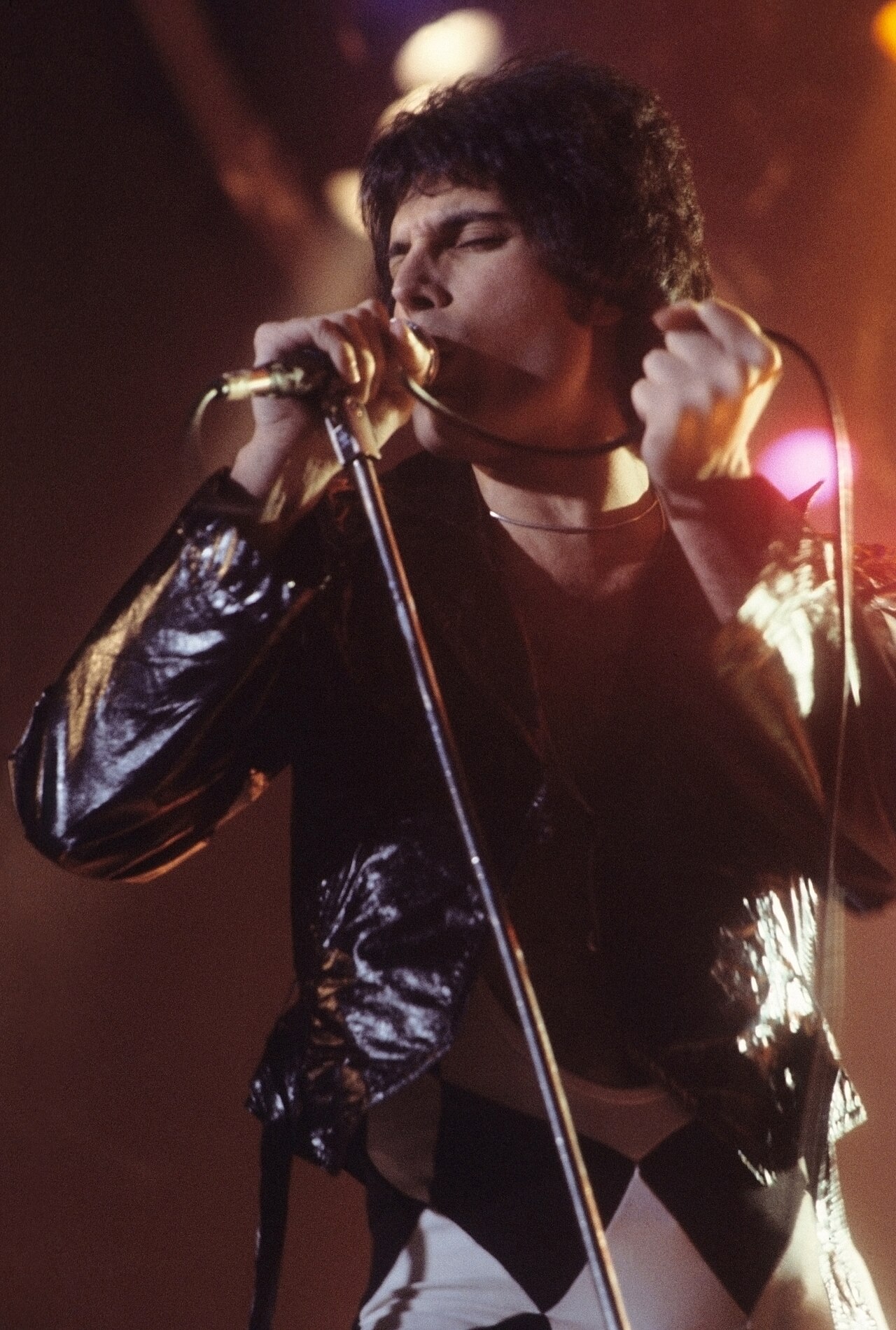
The “Crazy Tour” of 1979 in the United Kingdom, the South American tours of 1981 (which drew some of the largest audiences any rock band had yet attracted, with the Morumbi Stadium show in São Paulo drawing 251,000 people), and the subsequent “Hot Space” and “The Works” tours showed a band that had mastered the logistics and the artistry of global arena rock at a level that only a handful of their contemporaries could match. Mercury’s stamina, his vocal consistency over three-hour sets, and his ability to read and respond to an audience in real time were qualities that technical analysis alone cannot fully explain.
Flash Gordon, The Works and Wider Horizons
The 1980 “Flash Gordon” soundtrack, for which Queen provided the entire score to a Hollywood science-fiction film, was an interesting diversion that demonstrated the band’s interest in music as a narrative medium, not just a series of songs. The album had limited commercial success but showed Mercury and his bandmates engaging with film composition in a way that expanded their creative vocabulary.
“The Works” (1984) and the singles that came from it represented a kind of commercial recalibration after the divisive “Hot Space” album of 1982, which had moved toward funk and dance music in ways that alienated some of the band’s rock audience. “The Works” was harder, more guitar-driven, and produced the kind of arena-ready anthems that confirmed the band’s continued commercial strength. Mercury’s voice on these recordings shows the development that had taken place over a decade: deeper, more rounded, more confident in its lower registers than the more obviously operatic approach of the early albums.
The mid-1980s also brought Mercury’s most visible solo work. His 1985 solo album “Mr. Bad Guy” was a polished pop and dance record that showed his affection for the glam and disco traditions that had always sat alongside the rock in his musical tastes. It was less commercially successful than the band’s work but demonstrated his range as a musician and producer.
Freddie Mercury and His Personal Life
Freddie Mercury’s sexuality was for many years the subject of rumour and speculation that he declined to directly address in public. He was gay, a fact that became widely known within the music industry and in his personal circle while remaining officially unacknowledged to the press for most of his career. He had a long relationship with Mary Austin, whom he met in 1969 and who remained one of the central people in his life until his death; their relationship evolved from romantic to something more complex and more permanent, and he left her Kensington home (his principal residence) and a significant portion of his estate. He described her in interviews as his one true friend.
From the late 1970s onward he was in relationships with men, including the hairdresser Tony Bastin and the record shop manager Jim Hutton, who was with him in his final years. He lived with considerable openness within the circle of people close to him and with discretion toward the press, a balance that reflected both personal preference and the professional calculation that rock audiences of the 1970s and early 1980s were not necessarily ready for explicit acknowledgement of his sexuality. This calculation may now seem like a compromise, and in some respects it was, but it was made in a specific historical context that cannot be entirely dismissed.
The question of his Parsi and Indian heritage is also worth addressing, because it was another aspect of his identity that he held somewhat privately. He spoke Gujarati at home with his family, and the Zoroastrian framework of his upbringing left traces in his worldview even as he constructed a public persona that appeared thoroughly British. The complexity of navigating a Parsi Zoroastrian identity in the rock world of 1970s London is something that those close to him mentioned, and it contributed to the sense of multiple selves, multiple identities in play, that animated his theatrical sensibility.
The Miracle and Innuendo: Final Albums
In 1989, knowing that he was HIV positive but not yet having disclosed it publicly, Mercury made “The Miracle” with Queen. The album was warmly received and produced several successful singles, and those who knew what Mercury was dealing with privately noted the particular poignancy of its themes of survival, resilience and the value of human connection. The recording process was adapted to his declining stamina: rather than the marathon sessions of earlier years, the work was done in shorter bursts, with Mercury arriving at the studio when he was well enough and the band working around his schedule.
“Innuendo”, released in February 1991, was the final Queen studio album made during Mercury’s lifetime, and it is one of the most remarkable records in the band’s catalogue. The title track, a six-minute epic that moved through flamenco, progressive rock and full orchestral arrangements, announced that the band was not pulling its punches in the face of whatever private knowledge they carried. The album also contained tracks of great delicacy, songs that worked simultaneously as pop entertainment and as meditations on mortality that gained additional power from what the audience eventually learned about the context in which they were recorded.
Mercury announced publicly in November 1991 that he had AIDS. He died the following day, 24 November 1991, at his home in Kensington. He was forty-five years old. The public response to his death was enormous, and the memorial concert held at Wembley Stadium in April 1992 drew 72,000 people and a worldwide television audience of hundreds of millions, raising more than twenty million pounds for AIDS awareness and research. The concert featured performances by an extraordinary range of artists and served as both a tribute to Mercury and a mobilising event in the fight against the stigma and the spread of AIDS.
Voice and Craft
Any account of Freddie Mercury must engage, however briefly, with the technical qualities of the voice that made him extraordinary. Mercury’s vocal range is frequently cited as spanning approximately four octaves, from the bass range to the soprano range, and while the precise measurement has been debated, the functional range of the recorded performances is enormous and the control within that range is exceptional. What distinguished him was not simply the range but the quality at every point within it: the ability to produce full, resonant tone in the lower registers, the easy power in the mid-range, and the capacity to reach the upper register without the thinning or strain that affects most singers.
He had four extra teeth in his upper jaw, a fact that has been cited by vocal analysts as potentially contributing to the additional resonance in his sound. He never had them removed, as mentioned earlier, and while the connection between dental structure and vocal quality is not straightforwardly causal, the distinctiveness of his timbre is real and has been the subject of several academic studies. He was also a trained pianist who composed much of Queen’s material at the keyboard, and his harmonic sensibility was that of a trained musician rather than someone working by instinct alone.
His approach to the operatic middle section of “Bohemian Rhapsody” involved dozens of overdubbed vocal layers, a technique that required both exceptional vocal control (each layer had to be precisely pitched to fit the harmony) and enormous patience. The vocal overdubbing sessions for the song took weeks and reportedly left the studio’s multi-track tape physically worn from the number of passes. The result was a sound that had never existed in popular music before and has never been precisely replicated since.
Legacy: Why Freddie Mercury Still Matters
The legacy of Freddie Mercury is built on several foundations. The most obvious is the music: a body of work with Queen that has proved astonishingly durable, with streaming numbers and radio play figures suggesting that new generations are discovering the catalogue regularly rather than it fading into historical interest. “Bohemian Rhapsody” was the most streamed song of the twentieth century by the time streaming statistics were first compiled in the mid-2010s. “We Will Rock You” and its companion piece are played at sporting events on virtually every continent every weekend. The music has achieved the kind of ubiquity that is usually the mark of folk tradition rather than the recorded output of a specific band.
The 2018 biographical film “Bohemian Rhapsody”, despite significant criticism of its historical liberties, became one of the highest-grossing music biographical films in history and introduced the band and its lead singer to audiences who had grown up long after Mercury’s death. Rami Malek’s Oscar-winning portrayal brought attention to the humanity and complexity beneath the theatrical persona.
Mercury also matters as a figure in LGBTQ history, though he occupied that space with more complexity than is sometimes acknowledged. He did not live to see the significant shift in public attitudes toward homosexuality that occurred in the 1990s and 2000s, and for most of his career he navigated his sexuality without the kind of openness that the retrospective narrative sometimes implies. But his death, the cause of which he confirmed only days before it happened, became a watershed moment in public awareness of AIDS, and the memorial concert his band organised became one of the most significant AIDS awareness events in history.
For audiences in Africa and across the developing world, Mercury’s story carries additional resonances. He was born in what is now Tanzania, to a family from the Indian subcontinent, and he became one of the most recognisable and celebrated artists in the world, a trajectory that contains its own argument about the global mobility of talent and the universality of music as a language. His story is, among other things, a story about how far a person from an unexpected starting point can travel on the strength of an extraordinary gift, applied with discipline and conviction.
Key Facts
- Freddie Mercury was born in Stone Town, Zanzibar (now Tanzania) and grew up partly in India before his family settled in England.
- “Bohemian Rhapsody” spent nine consecutive weeks at number one in the United Kingdom in 1975 to 1976, and was later voted the greatest British single ever recorded in multiple polls.
- Queen’s performance at Live Aid in July 1985 is consistently ranked among the greatest live rock performances in history, with Mercury conducting a crowd of 72,000 in a spontaneous call-and-response sequence.
- Mercury’s vocal range is estimated to have spanned nearly four octaves, and his distinctive timbre is partly attributed to four additional upper teeth that he chose never to have removed.
- The 1992 Freddie Mercury Tribute Concert at Wembley raised more than 20 million pounds for AIDS awareness and was watched by a television audience estimated at hundreds of millions worldwide.