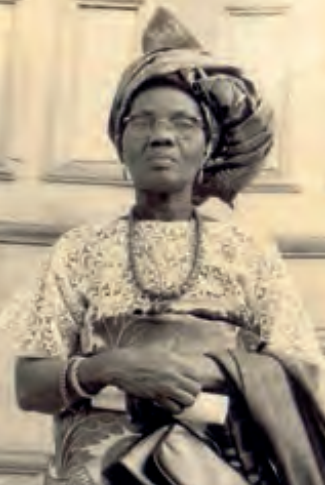
In November 1947, the colonial Resident of Abeokuta arrived at his office to find the grounds of the local palace occupied by tens of thousands of women. They had marched from the markets and the compounds, from the dye pits and the cloth stalls, and they sat down in the dust singing songs that mocked the Alake, the traditional king who taxed them. They refused to move. They cooked their food on the spot, slept where they sat, and stayed for days. At the head of this human ocean stood a small, immaculately dressed woman in Yoruba cloth who had once been christened Frances Abigail and who now insisted on being called only by her Yoruba name. Her name was Funmilayo Ransome-Kuti, and she had organised an uprising that would force a king to abdicate his throne. To understand modern Nigerian feminism, anti-colonial politics, and even the music of Afrobeat, you have to begin with her.
Quick Facts
- Full name
- Frances Abigail Olufunmilayo Ransome-Kuti (née Thomas)
- Born
- 25 October 1900, Abeokuta, Nigeria
- Died
- 13 April 1978, Lagos, Nigeria (aged 77)
- Known for
- Women's rights leader, educator and anti-colonial activist
- Family
- Mother of musician Fela Kuti and doctor-activist Beko Ransome-Kuti
Early Life and Education
Funmilayo Ransome-Kuti was born Frances Abigail Olufunmilayo Thomas on 25 October 1900 in Abeokuta, the capital of present-day Ogun State in south-western Nigeria. Abeokuta, whose name means “under the rock”, was a city founded earlier in the nineteenth century by Egba people who had gathered around the great Olumo Rock for protection during the turbulent Yoruba wars. By the time of Funmilayo’s birth, it had become a centre of trade, missionary activity and early Western education, a place where Christianity, Yoruba custom and the slow encroachment of British colonial power all pressed against one another.
Her father, Daniel Olumeyuwa Thomas, was a farmer and produce trader, and her mother, Lucretia Phyllis Omoyeni Adeosolu, came from a family that valued the new opportunities that mission schooling could offer. The Thomas household was Christian and aspirational, the kind of family that believed education was the surest path to dignity in a changing world. Importantly, that belief extended to their daughter. In an era when most Nigerian girls received little or no formal schooling, Funmilayo was sent to be educated.
She attended the Abeokuta Grammar School, the leading secondary school in the city, and was among the very first cohort of female students admitted to that institution. This was no small thing. Sitting in classrooms that had been built with boys in mind, she absorbed an education designed to produce clerks, teachers and clergy for the colonial order, and she did so with a sharpness that marked her out early. She completed her schooling in Abeokuta and then, like a number of privileged young Nigerians of her generation, travelled abroad to finish her education.
Between roughly 1919 and 1922, Funmilayo studied in England, attending a finishing school in Cheshire where she was trained in subjects such as elocution, music, domestic science and the social graces expected of a refined young woman of the period. The English years shaped her in complicated ways. She acquired fluent, confident English and a poise that would later allow her to face down colonial officials without flinching. Yet she also reported encountering racial prejudice, and the experience appears to have sharpened rather than softened her sense of being an African woman in a world arranged for the benefit of white Europeans. When she returned to Nigeria, she carried both the polish of an English education and a growing suspicion of the assumptions on which the colonial project rested.
Back in Abeokuta, she began work as a teacher, joining the small but influential class of educated Nigerian women who would help shape the country’s future. Teaching was one of the few respectable professions open to women of her standing, and she threw herself into it. It was through this world of schools, churches and educated families that she met the man who would become her partner in a remarkable life of work.
Teacher and Community Leader
In 1925 Funmilayo married the Reverend Israel Oludotun Ransome-Kuti, an Anglican clergyman and educator who was already becoming one of the most respected schoolmasters in Nigeria. Known to many simply as Daudu, he was a pioneer of organised teaching as a profession and would later help found the Nigeria Union of Teachers, serving as its first president. He was a disciplinarian, a gifted musician and a man of unbending principle, and in Funmilayo he found an equal rather than a subordinate.
Their marriage was, by the standards of the time, an unusually equal partnership. The couple shared a commitment to education, to Christian moral seriousness and, increasingly, to the idea that Nigerians should not accept second-class status in their own land. Israel’s career took them to the Abeokuta Grammar School, where he served as principal, and Funmilayo worked alongside him both as a teacher and as the organising force behind much of the community life that grew up around the school. Together they raised a family while building institutions, and their home became a meeting place for ideas about reform, nationalism and the proper education of the young.
As a teacher, Funmilayo was demanding and innovative. She believed that schooling should reach beyond the children of the elite, and she became increasingly aware of the gulf between educated women like herself and the vast majority of Nigerian women who could neither read nor write. The market women of Abeokuta, who dominated local trade and held real economic power, were often dismissed by colonial administrators and by the educated class alike as ignorant and beneath serious political consideration. Funmilayo did not share that contempt. She began to see in these women a potential force for change, and she began, quietly at first, to organise.
It was during this period that she made a decision rich with symbolic meaning. She had been baptised Frances Abigail, English names that announced her family’s Christian and mission-educated identity. As her political consciousness deepened and as she grew more critical of colonial cultural domination, she chose to drop the name Frances and to be known by her Yoruba name, Funmilayo, which means roughly “God has given me joy”. For a woman of her social standing, this was a deliberate act of cultural pride and resistance, a way of saying that to be modern and educated did not require becoming an imitation European. The name change foreshadowed the public stance that would soon make her famous.
The Abeokuta Women’s Union
In the early 1940s Funmilayo helped found a social organisation called the Abeokuta Ladies Club. At its beginning it was a fairly genteel association of educated, mostly Christian women who concerned themselves with charity, etiquette and self-improvement, the sort of club common among the colonial-era elite across Africa and beyond. Had it remained that, history would scarcely remember it. But Funmilayo had a different vision, and under her leadership the club transformed itself into something far more powerful.
The turning point came when she invited the market women of Abeokuta into the organisation. One of the women she worked with had asked her to help teach market traders to read, and through these literacy classes Funmilayo came into direct, sustained contact with the grievances of ordinary working women. They told her about the arbitrary taxes they were forced to pay, about the seizure of their goods, about the humiliations they endured at the hands of officials and tax collectors. The educated ladies of the club and the unlettered market women of the city were, she realised, members of the same oppressed sex, and their interests were bound together.
Around 1946 the organisation was renamed the Abeokuta Women’s Union, and it became a mass movement. Membership grew into the thousands, and by some accounts the union eventually claimed the loyalty of tens of thousands of women. It ran literacy and welfare programmes, taught hygiene and child care, offered legal support, and gave women a structure through which to defend their economic interests. Crucially, Funmilayo bridged the class divide with deliberate care. She wore Yoruba dress rather than European fashion, spoke Yoruba in meetings so that the market women could follow proceedings, and insisted that the union represent all women regardless of education or wealth. She treated the market women not as objects of charity but as members and leaders in their own right.
The Abeokuta Women’s Union became one of the most formidable women’s organisations in the history of colonial Africa. It combined the respectability and organisational skill of the educated class with the numerical strength, economic muscle and street-level courage of the market women. With this instrument in hand, Funmilayo was ready to confront the powers that had long taken the women of Abeokuta for granted.
The Revolt Against the Alake
The great confrontation came over taxation. Under the system of indirect rule that the British operated in Nigeria, colonial authority was exercised through traditional rulers. In Abeokuta, that ruler was the Alake, Oba Ademola II, who governed through the Native Authority and collected taxes on behalf of the colonial administration. Among the most resented of these was a flat tax levied on women, including the market women whose petty trade left them with little to spare. Women were taxed regardless of their actual income, and tax collectors were known to assess them harshly, to seize goods, and to subject them to degrading treatment, including, it was alleged, the forced public stripping of women to verify their age for tax purposes.
For Funmilayo and the Abeokuta Women’s Union, this was intolerable. They argued, with considerable force, that women who had no voice in government, no representation in the councils that decided how taxes were spent, should not be compelled to pay those taxes at all. It was, in effect, a Nigerian version of the old cry of “no taxation without representation”, advanced by women whom the colonial order regarded as politically invisible.
The campaign that followed, which gathered force through 1947 and into 1948, was a masterpiece of mass organisation. The union petitioned the authorities, wrote letters, and pressed its case through legal and bureaucratic channels. When those were ignored, it turned to direct action. The women refused to pay the tax. They staged enormous demonstrations outside the Alake’s palace at Ake, where thousands gathered, sang protest songs, and held all-night vigils that lasted for days at a time. They mocked the Alake in song, deployed ridicule as a weapon, and refused to be dispersed. Some demonstrations drew crowds reported in the tens of thousands. Throughout, Funmilayo insisted on discipline and on nonviolence, even as the women endured tear gas and the threat of force.
The pressure proved irresistible. The colonial administration and the Native Authority were forced to negotiate. In 1948 the direct taxation of women in Abeokuta was suspended, and the women won representation in the local government structures from which they had been excluded. The campaign struck so directly at the legitimacy of the Alake that in 1949 Oba Ademola II abdicated his throne and went into exile for a period, an extraordinary outcome driven in large part by an organisation of women. The separate tax on women was abolished. Although Ademola was eventually restored to his position some years later, the political world of Abeokuta had been permanently changed. A movement of women, many of them illiterate market traders, had brought a king to his knees. It remains one of the most successful protest movements in the history of colonial Nigeria, and it made Funmilayo Ransome-Kuti a national figure.
National and International Activism
The Abeokuta campaign was not the end of Funmilayo’s public life but the beginning of a still wider engagement. She moved naturally from local agitation into the broader struggle for Nigerian independence and for the rights of women across the country. She helped found the Nigerian Women’s Union and later the Federation of Nigerian Women’s Societies, organisations that sought to extend the lessons of Abeokuta to women nationwide and to press for women’s suffrage in a country where the vote was still being negotiated.
She became active in nationalist politics and joined the National Council of Nigeria and the Cameroons, the major nationalist party led by figures such as Nnamdi Azikiwe. Within and around these movements she was a forceful advocate for women’s right to vote and to hold office, arguing that independence would mean little if half the population remained politically excluded. She was for a time one of very few women admitted to the inner circles of nationalist leadership, and she did not hesitate to challenge male colleagues when she felt that women’s concerns were being sidelined.
Her activism increasingly took on an international dimension. She travelled widely, attending conferences and meeting women’s leaders abroad, and she developed connections with international women’s organisations, some of them associated with the political left. During the Cold War, she travelled to countries of the Eastern Bloc, including the Soviet Union, Hungary and China, in connection with the Women’s International Democratic Federation. To a colonial administration already nervous about anti-colonial agitation, and later to an independent Nigerian government wary of communist influence, these travels marked her as a dangerous radical.
The consequences were concrete. The authorities at one point withdrew her international passport, effectively trying to confine her and to silence her on the world stage, on the suspicion that she was spreading subversive ideas. She fought these restrictions with the same stubbornness she brought to every cause. Throughout, her politics defied easy labels. She was a Christian and a member of the educated elite who nonetheless aligned herself with market women, anti-colonial radicals and international socialists. What united these positions was a consistent commitment to justice and to the dignity of the powerless, especially women.
A Remarkable Family
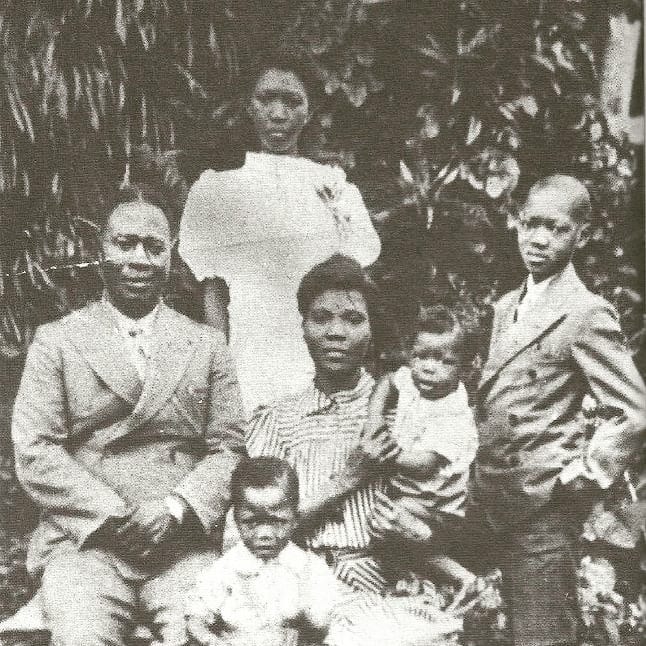
Funmilayo and Israel Ransome-Kuti raised a family that would become one of the most consequential in modern Nigerian history, a household in which the tradition of resistance passed from one generation to the next. Their children carried the family’s combination of education, principle and defiance into medicine, public health, politics and music.
Their son Olikoye Ransome-Kuti became a distinguished physician and a champion of public health. As Nigeria’s Minister of Health in the 1980s and 1990s, he was internationally recognised for his work in primary health care and immunisation and for his early, courageous public engagement with the HIV and AIDS crisis at a time when many leaders preferred silence. Another son, Beko Ransome-Kuti, became a medical doctor and one of Nigeria’s most fearless human rights and pro-democracy campaigners, repeatedly imprisoned for his opposition to military dictatorship in the 1980s and 1990s.
The most globally famous of her children was Fela Anikulapo Kuti, the creator of Afrobeat and one of the most influential musicians Africa has ever produced. Fela’s ferocious, politically charged music, his open defiance of Nigeria’s military rulers, and his lifelong insistence on speaking truth to power were rooted in the values he absorbed at home. He often credited his mother as the central influence on his political consciousness, and the courage that made him a thorn in the side of successive governments was, in a real sense, her inheritance to him. (Fela Kuti’s own life and music are explored in a separate article on this site.) In the Ransome-Kuti family, resistance was not an individual eccentricity but a shared inheritance, taught at the dinner table and lived out in public.
Death and the Kalakuta Tragedy
The same defiance that defined the family also exposed it to brutal reprisal. In February 1977, soldiers of the Nigerian military government launched an assault on Fela Kuti’s compound in Lagos, a property he had declared an independent commune and named the Kalakuta Republic. The raid came after Fela had released music sharply critical of the army and the government. Hundreds of soldiers stormed the compound, beating the residents, assaulting women, and ultimately burning the buildings to the ground.
Funmilayo Ransome-Kuti, then seventy-six years old, was present during the attack. In the chaos she was thrown, or fell, from a window of the building, suffering severe injuries. The assault on so revered an elder, a woman who had brought a king to abdication and helped win the vote for Nigerian women, shocked the conscience of many Nigerians and drew international attention. She never fully recovered from her injuries. Her health declined in the months that followed, and on 13 April 1978 she died in Lagos at the age of seventy-seven, with the wounds of the Kalakuta raid widely regarded as having hastened her death.
Her son Fela responded in the way he knew best. He composed and recorded music that turned his mother’s death into a political indictment of the military regime, and in a now-famous act of protest he and his supporters delivered a coffin, said to represent his mother, to the gates of the military barracks at Dodan, the seat of government, holding the soldiers responsible for her death. The grief of a son became a public accusation against the state. In this way, even her dying became part of the long struggle she had waged in life.
Career Timeline
- 25 October 1900: Born Frances Abigail Olufunmilayo Thomas in Abeokuta.
- Around 1919 to 1922: Studies in England, attending a finishing school in Cheshire.
- 1925: Marries the Reverend Israel Oludotun Ransome-Kuti and begins her career as a teacher in Abeokuta.
- Early 1940s: Founds the Abeokuta Ladies Club, which she opens to market women.
- Around 1946: The organisation becomes the mass-based Abeokuta Women’s Union under her leadership.
- 1947 to 1948: Leads the women’s revolt against unfair taxation and the rule of the Alake, suspending the women’s tax and winning representation.
- 1949: The Alake, Oba Ademola II, abdicates following the sustained protests.
- 1950s: Builds national and international women’s movements, joins nationalist politics, and travels abroad, leading authorities to withdraw her passport.
- February 1977: Injured in the military raid on the Kalakuta Republic in Lagos.
- 13 April 1978: Dies in Lagos, aged 77.
Lesser-Known Facts
- She was reportedly the first woman in Abeokuta, and one of the first in Nigeria, to drive a car, a striking image of independence for a woman of her era.
- The family name Ransome-Kuti was later partly set aside by her son Fela, who replaced “Ransome”, which he viewed as a colonial legacy, with the Yoruba name “Anikulapo”, meaning roughly “one who carries death in a pouch”. Funmilayo herself had earlier dropped her English first name for similar reasons of cultural pride.
- During the Abeokuta protests, the women weaponised humour and ridicule, composing songs that mocked the Alake and embarrassed the authorities, a deliberate tactic alongside their refusal to pay taxes.
- She insisted on conducting union business in Yoruba and on wearing Yoruba dress, choices that allowed unlettered market women to participate as full members rather than spectators.
- Her international links to the Women’s International Democratic Federation and her travels to socialist countries led colonial and post-independence Nigerian authorities to treat her as a subversive and to restrict her movement.
- She received international recognition late in life, including academic honours and, by some accounts, a national honour, though her sharpest critics in government never forgave her radicalism.
Frequently Asked Questions
Who was Funmilayo Ransome-Kuti? Funmilayo Ransome-Kuti (1900 to 1978) was a Nigerian teacher, women’s rights leader and anti-colonial activist from Abeokuta. She founded and led the Abeokuta Women’s Union, championed women’s suffrage, and became one of the most important figures in Nigeria’s struggle for justice and independence.
Was she Fela Kuti’s mother? Yes. She was the mother of the Afrobeat pioneer Fela Anikulapo Kuti, as well as of the public-health leader Olikoye Ransome-Kuti and the human rights campaigner Beko Ransome-Kuti. Fela frequently credited her as the central influence on his political consciousness.
What did the Abeokuta Women’s Union achieve? The union organised thousands of women, ran literacy and welfare programmes, and led a mass protest campaign in 1947 and 1948 against unjust taxation and the autocratic rule of the Alake. The campaign suspended the women’s tax, won women representation in local government, and contributed to the Alake’s abdication in 1949.
Why is she called the Lioness of Lisabi? Lisabi was a legendary Egba hero who, according to Yoruba tradition, freed his people from oppression. By calling Funmilayo the Lioness of Lisabi, admirers linked her courage and her fight for the people of Abeokuta to that heroic tradition of liberation.
How did she die? She was injured during the Nigerian military’s raid on her son Fela’s Kalakuta Republic compound in Lagos in February 1977, when she was thrown or fell from a window. She never fully recovered and died in Lagos on 13 April 1978, aged 77.
Legacy
The legacy of Funmilayo Ransome-Kuti runs deep through Nigerian life. She demonstrated, decades before the language of feminism became common in Africa, that women who were dismissed as ignorant and powerless could organise, think strategically, and reshape the politics of an entire city. The Abeokuta women’s revolt remains a textbook example of successful mass mobilisation under colonial rule, studied by historians of Africa, of women’s movements, and of nonviolent resistance.
She is honoured today as a pioneer of Nigerian feminism and as a founding figure in the country’s nationalist tradition. Her descendants carried her values into medicine, public health, human rights and music, ensuring that the name Ransome-Kuti would stand for principled defiance across generations. In the rhythms of Afrobeat, in the campaigns of pro-democracy activists, and in every Nigerian woman who claims her right to a political voice, her influence endures.
She was widely described by those who knew her as the most outstanding woman of her generation in Nigeria, a leader who refused to accept that women, or Africans, should be ruled without their consent.
More than a teacher, more than an organiser, she was a force who insisted that justice was indivisible: that the rights of the market woman and the rights of the educated lady, the freedom of the colonised and the dignity of women, were all part of one struggle. That insistence, lived out at great personal cost, is why she is remembered as the Lioness of Lisabi and the mother of Nigerian women’s rights.