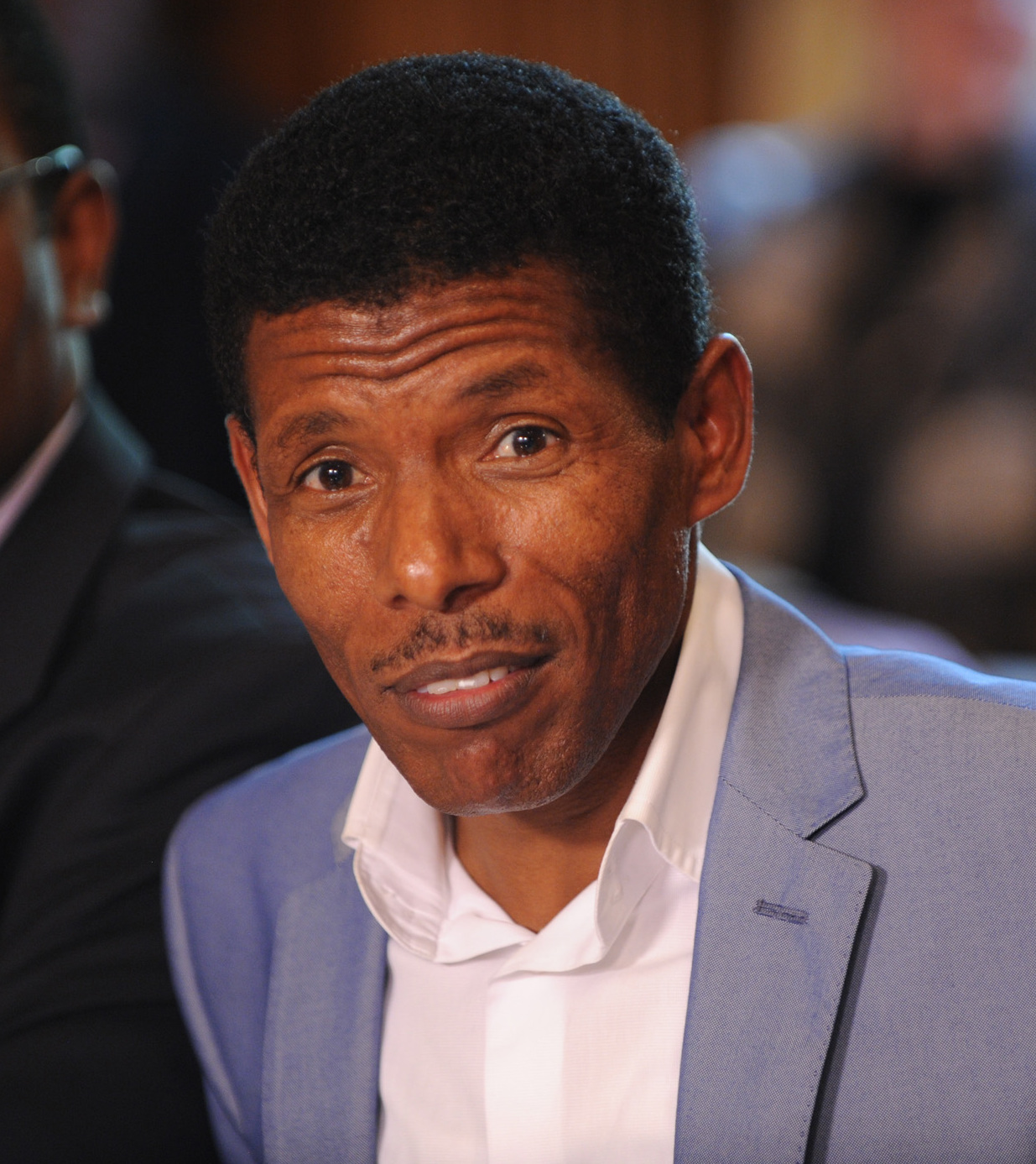
The smile came first, then the storm. On a summer evening in Atlanta in 1996, a small man from the Ethiopian highlands lined up for the 10,000 metres final wearing an expression that seemed almost too gentle for the brutal work ahead. Twenty-seven laps and a searing final sprint later, Haile Gebrselassie crossed the line as Olympic champion, then turned to the crowd with that same wide grin. For more than two decades, that combination defined him: a joyful face masking a competitive engine that simply would not quit. He would break world record after world record, win gold in front of the whole world, and eventually run a marathon faster than any human being ever had. This is the story of how a barefoot farm boy became one of the greatest distance runners the sport has ever seen.
Quick Facts
- Full name
- Haile Gebrselassie
- Born
- 18 April 1973, Asella, Ethiopia
- Sport
- Long-distance running (track and marathon)
- Known for
- 2-time Olympic 10,000m champion; multiple world records
- Marathon best
- 2:03:59 (Berlin, 2008 world record)
Early Life on the Highland Farm
Haile Gebrselassie was born on 18 April 1973 on a farm near Asella, a town in the Arsi Province of the Ethiopian highlands, a region that has since produced an extraordinary number of world-class runners. He was one of ten children raised in a modest farming household. The altitude was high, the land was demanding, and daily life for a child meant work: tending animals, helping in the fields, and above all, moving on foot across long distances.
The most famous story of his childhood is also the truest to his character. The school he attended was roughly ten kilometres from his home, and young Haile ran there and back, twice a day, carrying his books cradled in one arm. Over years of this routine, his body adapted to the load. His left arm, the one that held the schoolbooks, settled into a permanently crooked running position, held tighter and higher than the other. That distinctive, slightly hunched arm carriage stayed with him for his entire career and became one of the most recognisable silhouettes in athletics. What began as a schoolboy’s necessity turned into a personal signature.
His inspiration was close to home in more ways than one. Ethiopia already had a proud running heritage, built on legends like Abebe Bikila, who won the 1960 Olympic marathon in Rome running barefoot, and Miruts Yifter, the double gold medallist of the 1980 Moscow Games. For a boy running through the highlands, these were not distant celebrities but national heroes who proved that an Ethiopian could stand at the very top of the world. A defining memory came in 1980, when a seven-year-old Haile listened to a radio broadcast of Yifter winning the 5,000m and 10,000m double in Moscow. The excitement of that moment, absorbed through a crackling radio on the farm, planted a seed that never left him. Haile’s father initially wanted him to focus on farming rather than chase the uncertain dream of athletics, but the pull of the sport proved impossible to resist. By his teenage years he was training seriously, and it quickly became clear that the highland farm had produced something rare.
The path out of the highlands was not smooth. Losing his mother when he was young added hardship to an already demanding childhood, and the family’s expectation was that every set of hands would contribute to the farm. Yet the more Haile ran, the more obvious his gift became. He was small in stature, standing only about five feet five inches tall, but he possessed an unusual economy of movement and a capacity to endure discomfort that set him apart from other young runners in the region. When he finally committed himself fully to athletics, moving toward organised training and competition, he carried with him the toughness that highland farm life had instilled. That grounding in hard work would define his approach for the rest of his career.
Track Dominance in the 1990s
Gebrselassie announced himself on the global stage in 1992, winning the junior 5,000m and 10,000m titles at the World Junior Championships. But it was 1993 that marked his true arrival among the seniors. At the World Championships in Stuttgart, still only twenty years old, he won the 10,000m title, outrunning a field of established stars. It was the first of an astonishing run of championship victories that would make the 10,000 metres almost his personal property for the rest of the decade.
Watching him race in those years was a distinctive experience. He would often sit patiently in the pack, that gentle smile flickering across his face, biding his time while stronger-looking rivals set the pace. Then, in the closing laps, the demeanour would sharpen and the smile would give way to fierce concentration as he moved to the front. His running action was smooth and quiet, seemingly effortless even at the searing speeds required to break records, and it disguised the enormous effort he was pouring into every stride. Fans and commentators alike came to love the contrast between his warm, humble personality and the ruthlessness he showed once the racing began in earnest. He was, in the truest sense, a joyful assassin on the track.
He won the world 10,000m title four times in a row, in 1993, 1995, 1997 and 1999, a level of sustained dominance in a single event that few athletes in any sport have ever matched. Alongside the medals came the records. Gebrselassie treated the record books as something to be rewritten rather than admired. He broke the 5,000m world record and the 10,000m world record multiple times across the 1990s, trading marks back and forth with his greatest rivals and repeatedly pushing the limits of what seemed possible on the track. At various points he held world records at 2,000m, 3,000m, 5,000m and 10,000m simultaneously, indoors and out, a spread of distances that showcased both his blistering speed and his endurance.
The crown jewels were the Olympic titles. At the 1996 Atlanta Games he won the 10,000m gold medal, confirming his status as the best in the world when it mattered most. Four years later, at the 2000 Sydney Games, came what many still regard as the greatest 10,000m race ever run. Gebrselassie faced his fiercest rival, Paul Tergat of Kenya, in a final that came down to the last few strides. The two men, who had pushed each other for years, sprinted shoulder to shoulder down the home straight. Gebrselassie found just enough at the line to win by nine hundredths of a second, one of the closest finishes in Olympic distance history. Two Olympic golds in the same event, four years apart, sealed his place among the immortals of the track.
“When I run, I feel free. Running is not just moving your legs; it is a way of life for me.”
That rivalry with Tergat became one of the defining sporting duels of its era. The two were fierce competitors on the track and gracious rivals off it, and their repeated battles over 10,000 metres, at the Olympics, at world championships and in world record attempts, elevated both men. Tergat pushed Gebrselassie to his limits, and Gebrselassie, more often than not, found a way to win.
Part of what made Gebrselassie so dangerous over 10,000 metres was his finishing speed. Distance running is often thought of as a test of pure endurance, but at the very highest level, races frequently come down to who has the fastest last lap after twenty-four laps of hard running. Gebrselassie could close a 10,000m with a final 400 metres quicker than many pure middle-distance specialists could manage while fresh. That lethal kick meant that even when rivals set a punishing pace to blunt his speed, he could hang on and then unleash his sprint when it mattered. He complemented this with meticulous preparation, training at altitude in Ethiopia and constantly studying how to shave fractions from his times. The world records that fell to him during the 1990s were not accidents; they were the product of a runner who treated every race as a laboratory for testing the outer edge of human performance. His 5,000m and 10,000m marks lowered the standards of both events and forced an entire generation of rivals to chase him.
The Marathon Years
As the 2000s progressed and a new generation of track runners emerged, Gebrselassie made the transition that many great distance runners eventually attempt: he moved up to the marathon. It is a notoriously difficult step, and plenty of track legends have failed to translate their brilliance over 26.2 miles. Gebrselassie not only made the move successfully, he redefined the event.
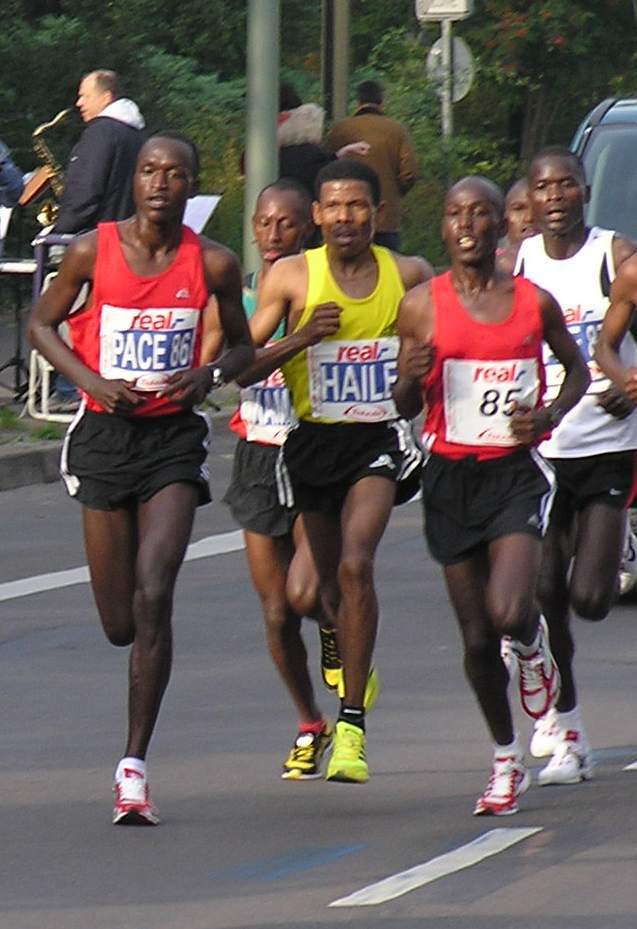
He built his marathon reputation on the fast, flat courses of the world’s biggest city races. In 2007, at the Berlin Marathon, he set a world record of 2:04:26, breaking Paul Tergat’s previous mark on the same course. Then came the moment that would come to define his marathon career. Returning to Berlin on 28 September 2008, Gebrselassie ran 2:03:59, becoming the first man in history to run a marathon in under two hours and four minutes. It was a landmark performance, a barrier broken by a runner who had already spent more than a decade at the summit of the sport. That 2:03:59 stood as the world record for several years and remains one of the great milestones in the history of the marathon.
He dominated the Berlin Marathon, winning it four consecutive times from 2006 to 2009, and he collected victories and fast times at other major races including Dubai and the Great North Run half marathon. His marathon years proved that his talent was not confined to the oval of the track. Across two distinct eras of the sport, on two very different stages, he had reached the very top. One notable disappointment lingered: an Olympic marathon gold eluded him. He withdrew from the 2008 Beijing Olympic marathon over concerns that the city’s air pollution would aggravate his asthma, a decision that denied fans a chance to see him chase gold over the distance he had come to own.
The transition from track to road was never guaranteed to succeed. The marathon demands a different kind of discipline: the ability to hold a relentless pace for more than two hours, to manage fuelling and hydration, and to withstand the punishment that 26.2 miles inflicts on the body. Many sprinters and track runners who moved up struggled with the sheer duration of the effort. Gebrselassie adapted his training to build the specific endurance the distance required, while still retaining enough of his track speed to run the second half of a marathon faster than the first. His Berlin performances were characterised by even, metronomic pacing, often supported by pacemakers who helped him hit the splits he needed before he pressed on alone. When he broke the world record in 2008, his half-marathon split showed just how precisely he had judged the effort, arriving at the finish with the record intact and enough composure to celebrate. It was a masterclass in how to run a fast marathon, and it inspired the wave of sub-2:04 and eventually sub-2:03 performances that followed in later years.
A National Hero and Businessman
In Ethiopia, Haile Gebrselassie is not merely a famous athlete; he is a beloved national figure, an ambassador for his country recognised and adored far beyond the world of sport. His success on the global stage gave enormous pride to a nation, and his warm, approachable personality made him an icon at home. Streets fill when he appears, and generations of young Ethiopian runners cite him as the reason they started training.
He was also remarkably astute about building a life beyond running. While still competing, Gebrselassie invested his earnings carefully and grew a substantial business empire. His interests came to span real estate, hotels, a coffee business, cinemas, a school, car dealerships and more. He became one of the significant private employers in Ethiopia, with his companies providing thousands of jobs, and he channelled resources into philanthropic efforts and community projects. For a man who grew up on a highland farm, the scale of what he built commercially is as striking as anything he achieved on the track.
What set his business story apart was that he did not simply lend his name to ventures; he ran them actively, applying the same discipline and attention to detail that had defined his athletics. He often spoke about wanting to create opportunity in Ethiopia, arguing that the country’s future depended on entrepreneurship and job creation as much as on medals. His companies became a source of local employment and pride, and he used his global profile to promote Ethiopia as a destination for tourism and investment. For younger Ethiopians, he offered a model of what was possible: that a runner from a farming family could build not only a sporting legacy but a lasting economic one.
His involvement extended into sports administration as well, though this chapter proved more turbulent. He served as president of the Ethiopian Athletics Federation, but his tenure was marked by public disputes and disagreements within the sport, and it ended amid controversy. It was a reminder that the qualities that make a champion runner do not always translate smoothly into the politics of governing a federation. Even so, his standing as a symbol of Ethiopian achievement remained undimmed, and he continued to be one of the most recognised and respected figures in the country.
Career Timeline
- 1992: Wins 5,000m and 10,000m titles at the World Junior Championships, announcing himself as a rising star.
- 1993: Wins his first senior world 10,000m title at the World Championships in Stuttgart at age twenty.
- 1996: Wins Olympic 10,000m gold at the Atlanta Games.
- 1999: Completes four straight world 10,000m titles (1993, 1995, 1997, 1999).
- 2000: Wins Olympic 10,000m gold at the Sydney Games, beating Paul Tergat by nine hundredths of a second in a legendary finish.
- 2007: Sets a marathon world record of 2:04:26 at the Berlin Marathon.
- 2008: Runs 2:03:59 in Berlin, becoming the first man to break two hours and four minutes for the marathon.
- 2006 to 2009: Wins the Berlin Marathon four years in a row.
- 2015: Formally retires from competitive running after a career spanning more than two decades.
Lesser-Known Facts
- His distinctive crooked left arm came from years of running to school while carrying his books in that arm, an involuntary style that became his trademark.
- He appeared as himself in the 1999 feature film “Endurance”, which dramatised his life story and his journey from the Ethiopian highlands to Olympic glory.
- His business empire grew to include hotels, real estate, cinemas, a coffee company and car dealerships, making him one of Ethiopia’s notable private employers.
- His rivalry with Paul Tergat of Kenya produced some of the closest and most celebrated distance races in history, including that nine-hundredths-of-a-second Sydney finish.
- Over his career he set or broke world records across a remarkable range of distances, from 2,000m up to the marathon, holding several marks at the same time.
- He withdrew from the 2008 Beijing Olympic marathon because of concerns that air pollution would trigger his asthma, meaning an Olympic marathon medal is a rare gap in his collection.
Frequently Asked Questions
Who is Haile Gebrselassie? Haile Gebrselassie is a retired Ethiopian long-distance runner, widely regarded as one of the greatest distance athletes of all time. He won two Olympic gold medals, multiple world titles, and set numerous world records on the track and in the marathon before becoming a prominent businessman in Ethiopia.
How many Olympic golds did he win? He won two Olympic gold medals, both in the 10,000 metres, at the 1996 Atlanta Games and the 2000 Sydney Games.
What is his marathon world record? His fastest marathon and the world record he set at the time was 2:03:59, run at the Berlin Marathon on 28 September 2008. It made him the first man in history to run a marathon under two hours and four minutes.
Where is he from? He was born on 18 April 1973 on a farm near Asella, in the Arsi region of the Ethiopian highlands, an area famous for producing many elite distance runners.
What does he do now? Since retiring from competitive running in 2015, he has focused on his extensive business interests in Ethiopia, which include hotels, real estate and other ventures, and he remains a celebrated national figure and ambassador for the sport.
Legacy
Haile Gebrselassie leaves a legacy that stretches far beyond the numbers, remarkable as those numbers are. Two Olympic titles, four consecutive world 10,000m crowns, a marathon world record and a spread of records across distances that few will ever match: that alone would guarantee his place among the greatest. Yet his true influence is measured in something harder to record. He helped make Ethiopia a running superpower, inspiring waves of young athletes who grew up watching that crooked arm pump down the home straight and dreaming of following him.
He changed the way the world thought about the marathon, dragging the record under 2:04 and proving that a track master could conquer the roads. He showed that a champion could be fierce and gracious at once, competitive to the core yet quick to smile and embrace a rival. And in retirement he demonstrated that a life in sport could become a foundation for building businesses, creating jobs and giving back to a nation.
His influence is visible in the runners who came after him. The Ethiopian dominance in distance events that continued through athletes like Kenenisa Bekele, who broke several of Gebrselassie’s own records, was built partly on the trail he blazed. He normalised the idea that Ethiopian runners belonged at the very top of every distance event, and he did it with a longevity that few could match, remaining competitive at the highest level across more than two decades. Honours and recognition followed him around the world, and his name became shorthand for excellence, resilience and joy in the sport. When lists of the greatest distance runners of all time are compiled, his name is always near the top, and often at it.
From a farm boy running to school with books under his arm to a global icon and one of the finest distance runners in history, Haile Gebrselassie ran a course that few could ever hope to follow, and he did it with that unmistakable, unbreakable smile.