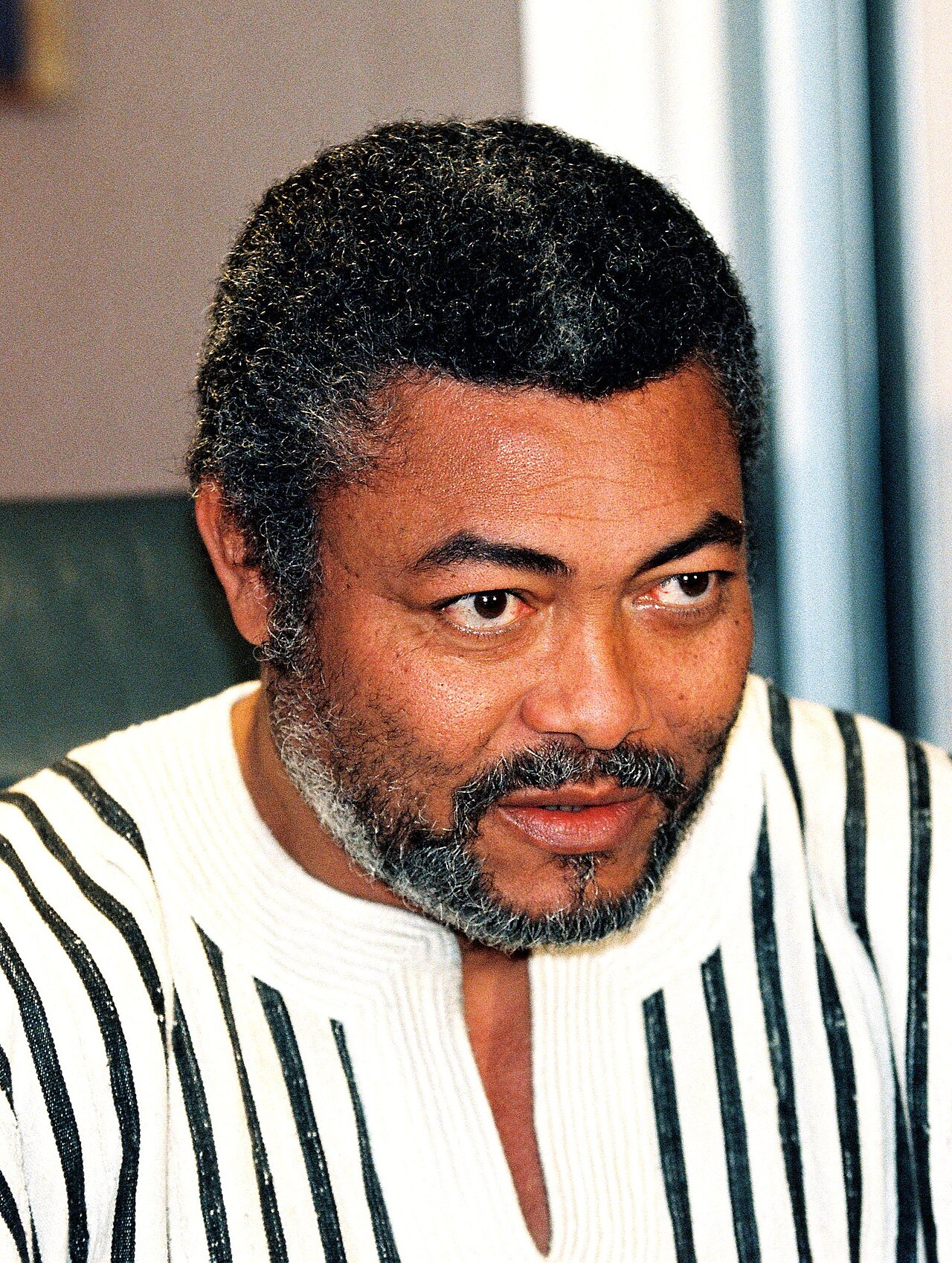
On the morning of 4 June 1979, a group of junior soldiers broke open a cell in Accra and pulled out a young air force officer who had been sentenced to die. Hours earlier he had been on trial for his life, accused of leading a failed mutiny. By nightfall he was the most talked about man in Ghana. That officer, Flight Lieutenant Jerry John Rawlings, would go on to rule the country longer than anyone else in its history, first as a revolutionary soldier who overturned governments by force, and later as a president chosen twice at the ballot box. Few political careers in modern Africa contain such sharp contradictions, and few figures remain as fiercely argued over.
Quick Facts
- Full name
- Jerry John Rawlings
- Born
- 22 June 1947, Accra, Gold Coast (now Ghana)
- Died
- 12 November 2020 (aged 73)
- Office
- President of Ghana (1981 to 2001)
- Known for
- The 1979 and 1981 coups, Ghana's democratic transition
Early Life
Jerry John Rawlings was born in Accra on 22 June 1947, in what was then the British colony of the Gold Coast. His background set him apart from the start. His father was James Ramsey John, a Scottish chemist who had come to West Africa for work, and his mother was Victoria Agbotui, a Ghanaian woman from the Volta Region, in the east of the country near the border with Togo. The surname Rawlings came through his father’s side, though Jerry grew up without the steady presence of that parent. His mixed Scottish and Ghanaian parentage would later feed both his critics, who questioned his roots, and his admirers, who saw in him a man who had chosen Ghana without reservation.
He was educated at Achimota School, one of the most respected institutions in the country, a place that had schooled a long line of future leaders and professionals. Achimota gave him a solid grounding and a certain polish, and it was there that he picked up the nickname Junior Jesus, a play on his initials J.J. that would follow him for the rest of his life. For all its advantages, the young Rawlings was drawn less to the lecture hall than to the sky. In 1968 he enlisted in the Ghana Air Force, entering the Military Academy and Training School at Teshie. He proved a gifted and daring cadet. In 1969 he won the coveted Speed Bird Trophy as the best cadet in flying, and he was commissioned as a pilot officer the following year.
Over the next several years he rose steadily through the ranks, qualifying as a fighter pilot and eventually reaching the rank of Flight Lieutenant. Those who served alongside him remembered a man of magnetic presence, a natural communicator who connected easily with ordinary soldiers and spoke their language. He was handsome, articulate, and physically commanding, yet it was his growing anger at the state of the nation that set him apart. By the late 1970s Ghana was sliding into economic ruin. Corruption had become routine among the senior ranks of the military government, shelves in the shops stood empty, and ordinary people queued for basic goods. Rawlings, watching the privileged skim wealth while soldiers and civilians alike went without, began to speak openly of the need for a reckoning. That sense of moral outrage, more than any coherent ideology, would propel him into history.
The 1979 Uprising
By May 1979 Ghana was preparing for a return to civilian rule after years of military government under the Supreme Military Council. Rawlings, however, had decided that the men in charge could not be trusted to clean up the mess they had helped create. On 15 May 1979 he led a group of junior officers and enlisted men in an attempt to overthrow the government. The plot failed. Rawlings was arrested and placed on trial before a military tribunal, facing a possible death sentence.
It was at this trial that the legend of Jerry Rawlings was born. Rather than plead for mercy, he used the courtroom as a platform. He took responsibility for the uprising, insisting that the junior ranks who had followed him were acting on his orders and his vision, and he turned his defence into a blistering attack on the corruption and injustice that had, in his words, made such a rebellion necessary. His defiance electrified a public exhausted by hardship. To many Ghanaians he became an instant folk hero, a soldier willing to die for the idea that those in power should answer for their abuses.
On 4 June 1979, before the sentence could be carried out, a group of soldiers loyal to his cause stormed the detention facility, freed Rawlings, and launched the uprising that would carry his name into the history books. The June 4 revolution swept aside the existing military leadership and installed the Armed Forces Revolutionary Council, with Rawlings as its chairman. What followed was a short and violent period often described as a house-cleaning exercise, a campaign meant to purge the system of corruption and hold the powerful accountable.
The most controversial episode of this period, and one that still divides opinion in Ghana, was the execution of several former heads of state and senior military officers. Three former leaders, General Ignatius Kutu Acheampong, General Fred Akuffo, and General Akwasi Afrifa, along with other senior officers, were tried and shot in June 1979. Supporters argued that the executions expressed a genuine popular fury at years of plunder and that they signalled an end to impunity. Critics, including many who otherwise admired Rawlings, condemned them as summary killings carried out without the protections of due process, a stain that could never be washed away. The debate over those deaths has never fully settled, and Rawlings himself remained unapologetic about the uprising even as he expressed more complicated feelings about its cost in later years.
What is often forgotten about this first period in power is how briefly it lasted and how it ended. Rawlings had seized control in the name of cleaning up the system, not of keeping power for himself. After roughly three months, having overseen the elections that were already under way, he handed authority to the democratically chosen civilian government of President Hilla Limann in September 1979. For a soldier who had taken power by force, the voluntary surrender of that power to an elected leader was a striking act, and it complicated every easy label that might be attached to him.
The Second Coming
The handover to Hilla Limann did not bring the renewal Rawlings had hoped for. In his view, the new civilian administration was weak, indecisive, and unable to arrest the country’s economic collapse. Relations between the former revolutionary and the government soured quickly. Rawlings was pushed out of the armed forces and watched with mounting frustration as conditions failed to improve. He concluded that the elected government was squandering the opportunity the June 4 uprising had created.
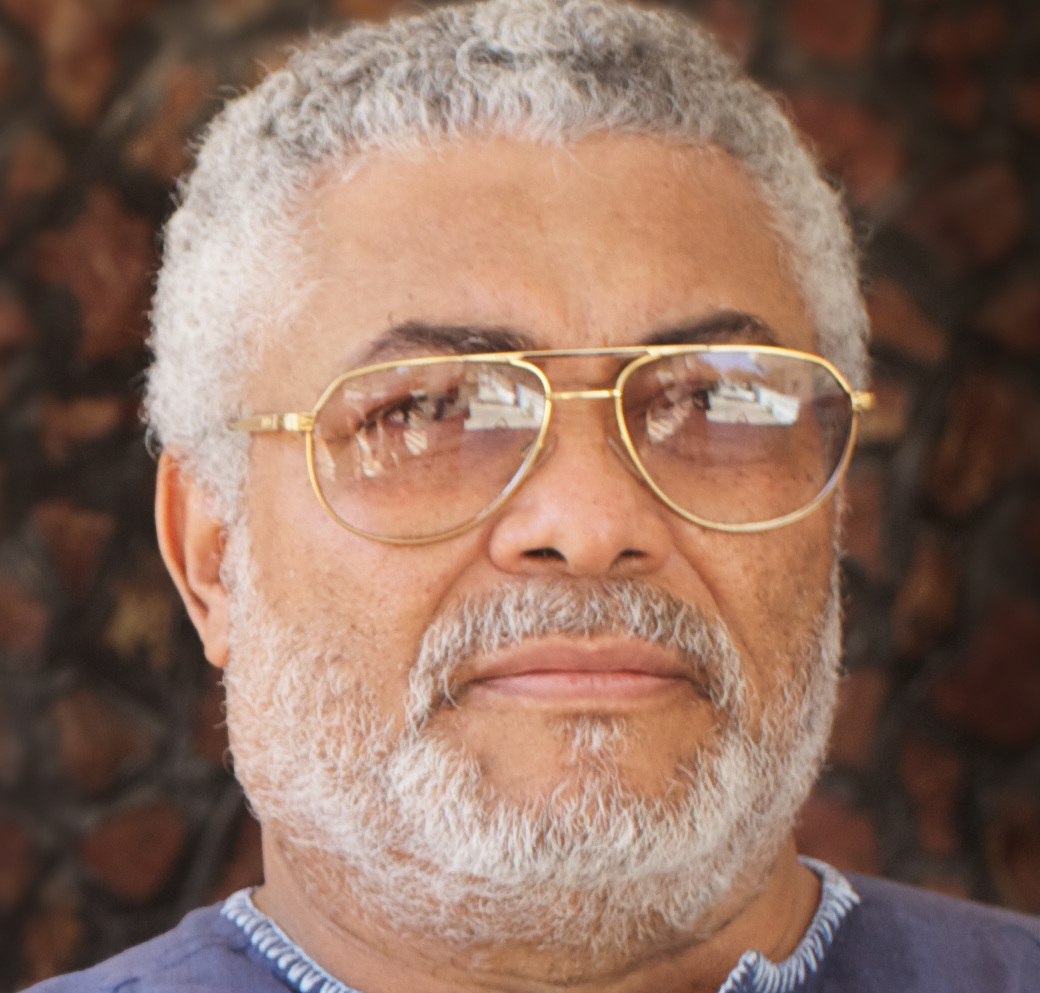
On 31 December 1981, Rawlings struck again. In a swift coup he overthrew the Limann government and this time he did not step aside. He established the Provisional National Defence Council, known by its initials as the PNDC, and installed himself as its chairman. The 31st December Revolution, as his followers called it, opened the longest and most consequential chapter of his career. For the next eleven years Rawlings governed Ghana as a military ruler, backed at first by a mixture of radical leftist advisers, student activists, and workers’ organisations who shared his language of revolution and popular power.
The early PNDC years were turbulent. The government set up People’s Defence Committees and Workers’ Defence Committees intended to give ordinary citizens a direct voice, though these bodies also became instruments of control. The economy, however, remained in free fall, battered further by drought, by the forced return of around a million Ghanaians expelled from Nigeria in 1983, and by chronic shortages. Faced with disaster, Rawlings made a decision that surprised many of his radical allies and alienated some of them permanently. He turned to the International Monetary Fund and the World Bank.
Beginning in 1983 the PNDC adopted the Economic Recovery Programme, a sweeping package of market reforms carried out with the support of the IMF and the World Bank. The government devalued the overvalued currency, cut subsidies, liberalised trade, reduced the role of the state in the economy, and worked to restore fiscal discipline. These measures were painful, and they drew criticism from both the left, who felt betrayed by a revolution that had embraced structural adjustment, and from ordinary Ghanaians who bore the cost of austerity. Yet over time the reforms stabilised the economy, restored growth, and turned Ghana into one of the showcase examples that international lenders pointed to across Africa. The man who had come to power denouncing the establishment had become, by the late 1980s, a pragmatic manager working closely with the global financial institutions.
From Soldier to Elected President
By the end of the 1980s the political climate across Africa and the wider world was shifting. The Cold War was ending, demands for multiparty democracy were rising, and donors increasingly tied their support to political reform. Rawlings, ever the survivor, read the moment and moved with it rather than against it. Under his watch the PNDC began a managed transition back to constitutional rule, first through a programme of decentralisation and district assembly elections, and then through a national debate on the shape of a new republic.
A new constitution was drafted and approved by referendum in 1992, restoring multiparty democracy and the office of an elected president. Rather than retire from the scene, Rawlings chose to compete for the leadership he had held by force. He founded the National Democratic Congress, the NDC, as the political vehicle for his movement, and he retired from the military to stand as a civilian candidate. In the presidential election of November 1992 he won a clear victory, and the Fourth Republic of Ghana was formally inaugurated in January 1993. Opposition parties disputed the fairness of that first contest and boycotted the parliamentary elections that followed, leaving questions hanging over the new order.
Those doubts eased over the following years. In 1996 Rawlings stood for re-election in a contest widely judged to be more open and credible, and he won a second term, this time with the main opposition participating fully. He had now achieved something rare for a man of his history: the soldier who had twice toppled governments had twice been chosen by voters in competitive elections. For eight years as elected president he presided over a period of relative stability, continued economic reform, and the gradual strengthening of democratic institutions.
The true test of his democratic conversion came at the end of his second term. The 1992 constitution limited a president to two terms, and Rawlings, bound by the document his own government had introduced, did not seek to cling to office. In the election of December 2000 his chosen successor and the NDC candidate, John Atta Mills, was defeated by John Agyekum Kufuor of the opposition New Patriotic Party. In January 2001 Rawlings handed over power peacefully to his elected opponent. The transfer of authority from one party to another through the ballot box, carried out without violence or crisis, was celebrated across the continent as a landmark for African democracy and as proof that Ghana had matured into a genuine constitutional state. For a leader who had entered national life at the point of a gun, it was an extraordinary way to leave high office.
Later Years and Legacy
Leaving the presidency did not mean leaving politics. Rawlings remained a towering and often disruptive figure within the NDC and in national life for the rest of his days. As the founder and elder statesman of his party he commanded enormous loyalty among the grassroots, yet his relationships with the party’s later leaders, including the very successors he had once backed, grew strained and at times openly hostile. His blunt public criticisms, directed at allies and rivals alike, kept him at the centre of debate long after he had formally stepped back.
On the international stage he took on a diplomatic role. The African Union appointed him as its High Representative for Somalia, charged with mobilising support for peace and reconstruction in a country shattered by decades of conflict. The assignment drew on his continental stature and his reputation as a man unafraid of difficult causes. He also travelled widely, lending his voice to pan-African themes and to the concerns of ordinary people that had animated him since his air force days.
His legacy was, and remains, deeply contested. To his admirers he was a patriot who shook a corrupt order to its foundations, restored national pride, stabilised a collapsing economy, and then, remarkably, built and respected the democratic institutions that eventually limited his own power. To his critics he was a man who came to office through violence, who presided over the execution of former leaders and the suppression of dissent in his early years, and whose revolutionary rhetoric masked a long and sometimes authoritarian grip on the state. Both portraits contain truth, and the enduring argument between them is itself a measure of how large he loomed.
“I am not a saint. I have never claimed to be one.”
Jerry John Rawlings died on 12 November 2020 at the Korle Bu Teaching Hospital in Accra, at the age of 73. His death prompted an outpouring of grief and reflection across Ghana and the wider continent. A period of national mourning was declared, and his state funeral in January 2021 drew heads of state and dignitaries from across Africa, a final acknowledgement of a man whose life had shaped his country for more than four decades. He was survived by his wife, Nana Konadu Agyeman Rawlings, a prominent political figure in her own right, and their children.
Career Timeline
- 1968: Enlists in the Ghana Air Force and enters the Military Academy and Training School at Teshie.
- 1969: Wins the Speed Bird Trophy as the best cadet in flying.
- 15 May 1979: Leads a failed uprising against the ruling Supreme Military Council and is arrested and placed on trial.
- 4 June 1979: Freed by loyal soldiers in the June 4 uprising and becomes chairman of the Armed Forces Revolutionary Council.
- September 1979: Hands power to the elected civilian government of President Hilla Limann.
- 31 December 1981: Overthrows the Limann government and establishes the Provisional National Defence Council (PNDC).
- 1983: Launches the Economic Recovery Programme with the IMF and the World Bank.
- November 1992: Wins Ghana’s first multiparty presidential election under the new constitution; re-elected in 1996.
- January 2001: Steps down after two terms and hands power peacefully to John Agyekum Kufuor.
Lesser-Known Facts
- He was of mixed heritage, born to a Scottish father, James Ramsey John, and a Ghanaian mother, Victoria Agbotui, from the Volta Region.
- The uprising that first brought him to power is remembered simply as June 4, and the date became a lasting symbol for his political movement.
- The execution of three former heads of state and other senior officers in June 1979 remains one of the most controversial events of his career and is still debated in Ghana today.
- He founded the National Democratic Congress (NDC) in 1992 to contest elections as a civilian, and the party became one of the two dominant forces in Ghanaian politics.
- After leaving the presidency he served as the African Union’s High Representative for Somalia, working to promote peace and reconstruction in that war-torn country.
- As a young cadet he was an accomplished pilot who reached the rank of Flight Lieutenant, the title by which he was popularly known throughout his revolutionary years.
Frequently Asked Questions
Who was Jerry Rawlings? Jerry John Rawlings was a Ghanaian air force officer who became the country’s longest-serving leader. He first took power through military coups in 1979 and 1981, then won two democratic elections in 1992 and 1996 to serve as the elected president of Ghana until 2001.
How did Rawlings come to power? He first came to power on 4 June 1979, when soldiers freed him from detention during a failed coup trial and he led an uprising that toppled the military government. After briefly handing power to a civilian administration, he seized control again in a coup on 31 December 1981, after which he ruled for nearly two decades.
Was Jerry Rawlings a dictator or a democrat? He was both at different points in his career, which is why his legacy is so debated. He first governed as a military ruler who took power by force and oversaw controversial executions, yet he later introduced a democratic constitution, won competitive elections, respected term limits, and handed power peacefully to an opposition winner in 2001.
How long did Rawlings rule Ghana? Counting his brief period as head of the Armed Forces Revolutionary Council in 1979, his years as chairman of the PNDC from 1981, and his two terms as elected president, Rawlings led Ghana for close to twenty years, longer than any other leader in the nation’s history.
When did Jerry Rawlings die? Jerry Rawlings died on 12 November 2020 at the age of 73, at the Korle Bu Teaching Hospital in Accra. His death was followed by a period of national mourning and a state funeral attended by leaders from across Africa.
Legacy
Jerry Rawlings left behind a Ghana that was profoundly different from the one he had first tried to overturn as a young officer. He inherited a country mired in corruption, economic collapse, and political instability, and he left it with a functioning democratic constitution, a tradition of competitive elections, and a reputation as one of Africa’s more stable states. The peaceful handover of power in 2001, carried out under rules his own government had written, stands as perhaps the clearest proof of how far he and the nation had travelled.
Yet his story resists a tidy conclusion. The same man who championed accountability also presided over acts of violence that many Ghanaians have never forgiven. The revolutionary who denounced the establishment ended his years in office as a careful partner of international lenders. He was charismatic and combative, visionary and controversial, a soldier who learned to govern by the ballot. More than twenty years after he last held the presidency, Ghanaians still argue about whether he was the country’s saviour or its strongman, and that unresolved argument is itself his most fitting memorial. Jerry John Rawlings was, by any measure, one of the defining figures of modern Ghana, a man whose contradictions were as large as his ambitions and whose shadow still falls across the politics of the nation he helped to shape.