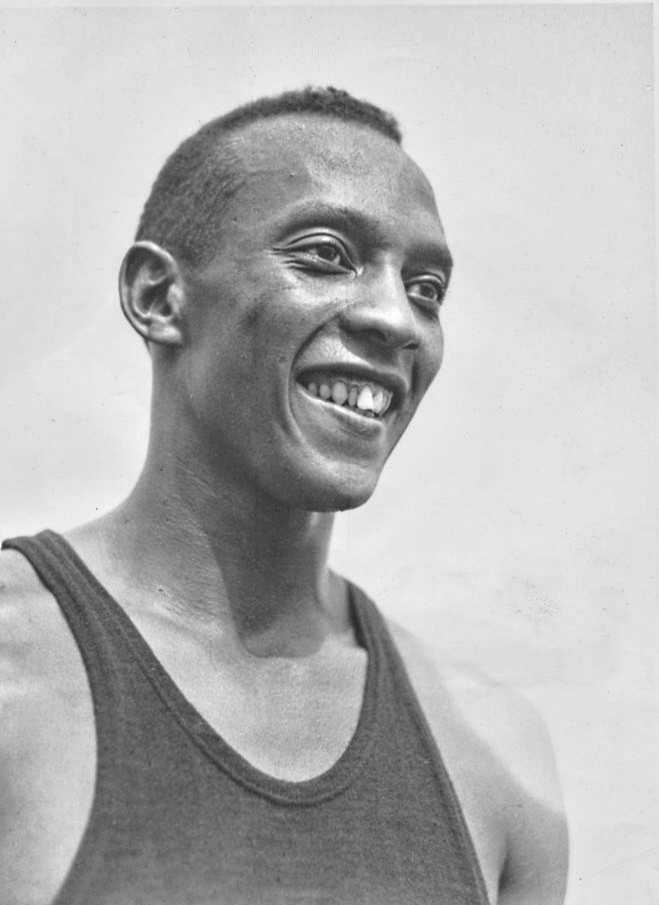
On the afternoon of 3 August 1936, inside a vast concrete bowl in the German capital, a slim young man from Alabama crouched into the cinders and waited for the gun. More than 100,000 spectators filled the Olympiastadion in Berlin. Somewhere among the flags and the uniforms sat the leadership of a regime that had built its entire worldview on the claim that some human beings were born superior to others. The young man in lane after lane that week would answer that claim not with speeches but with his legs, his lungs, and roughly ten seconds of effort at a time. His name was Jesse Owens, and over the course of a single week he would win four gold medals and turn the showcase the Nazi state had built for itself into a monument to the very thing it most wanted to deny.
The story of Jesse Owens is often told as a single triumphant week. The fuller story is stranger, harder, and more human than that. It is the story of a sickly child born to a sharecropping family in the Deep South, the grandson of people who had been enslaved, who rose through poverty and segregation to become, for one extraordinary stretch, the fastest and most complete athlete on earth. It is also the story of what came after: a return to a country that cheered his medals but still refused him a seat at its lunch counters, and a man who spent decades finding ways to make a living and a meaning out of a fame the world celebrated but rarely rewarded.
Quick Facts
- Full name
- James Cleveland "Jesse" Owens
- Born
- 12 September 1913, Oakville, Alabama, USA
- Died
- 31 March 1980, Tucson, Arizona (aged 66)
- Sport
- Track and field (sprints, long jump)
- Known for
- Four gold medals at the 1936 Berlin Olympics
Early Life
James Cleveland Owens was born on 12 September 1913 in Oakville, a small farming community in the cotton country of northern Alabama. He was the youngest of ten children born to Henry Owens and Mary Emma Fitzgerald Owens. The family worked as sharecroppers, a system that kept Black farmers in the South tied to the land of white landowners, perpetually in debt, and rarely able to keep more than a sliver of what they grew. Henry Owens was the son of a man who had been born into slavery, and the shadow of that history hung close over the family’s daily life. The Owens children grew up in a small wooden house with little money, working the fields almost as soon as they could walk.
As a boy, James was frequently ill. He suffered repeated bouts of pneumonia and chronic bronchial trouble, and at one point a growth on his chest had to be removed by his mother at the kitchen table because the family could not afford a doctor. He was thin and often weak. Few who knew him in those years would have predicted that this fragile child would one day be called the fastest man alive.
When James was around nine years old, his family joined the great wave of Black Americans leaving the rural South for the industrial cities of the North, a movement historians call the Great Migration. Millions of African Americans made that journey in the first decades of the twentieth century, seeking work, wages, and at least some distance from the brutal segregation of the South. The Owens family settled in Cleveland, Ohio, where Henry hoped to find steady work and his children might find better schooling than Alabama offered.
It was in Cleveland that James Cleveland Owens acquired the name the world would come to know. On his first day at his new school, a teacher asked his name. He answered, in the soft accent of rural Alabama, “J.C.” The teacher heard “Jesse,” wrote it down, and the name stuck. He would be Jesse Owens for the rest of his life.
Cleveland was no paradise. The family remained poor, and young Jesse worked a long string of jobs to help make ends meet: he delivered groceries, loaded freight, worked in a shoe repair shop, and pumped gas. Yet it was in Cleveland that the second decisive figure in his life appeared. At Fairmount Junior High School, a physical education teacher and track coach named Charles Riley noticed the boy’s speed. Riley, a white man of modest means himself, took a deep and patient interest in Jesse. Because Jesse worked after school, Riley arranged to train him in the mornings instead, before classes began. He taught Jesse not just how to run faster but how to run with control and economy, and he encouraged him to imagine running as though the track were on fire beneath his feet, so that his feet barely touched the ground.
Riley became a mentor and almost a second father. He fed Jesse meals, talked with him about life and discipline, and instilled in him a belief that hard work and self-respect could carry him beyond the limits the world placed on a poor Black boy. The relationship lasted long after Jesse left junior high. By the time Owens reached high school at East Technical, his talent was undeniable. At the 1933 National Interscholastic Championships in Chicago, the eighteen-year-old ran the 100 yard dash in 9.4 seconds, equalling the world record for that distance, and posted extraordinary marks in the 220 yards and the long jump. College recruiters across the country took notice.
College and the Greatest 45 Minutes
Owens chose to attend Ohio State University in Columbus, where the celebrated track coach Larry Snyder would guide his development. The decision brought athletic opportunity, but it did not bring equality. Even as a star athlete representing a major university, Owens lived under the constant weight of segregation. He was not permitted to live in the dormitories with white students and had to find housing off campus. On team trips, he often could not eat in the same restaurants or sleep in the same hotels as his white teammates. He frequently had to take meals at “blacks only” establishments and stay in segregated lodging while the rest of the team enjoyed ordinary accommodations. To pay his way through school, Owens worked as a night elevator operator, a library page, and a waiter, fitting jobs around his classes and his training.
Despite these burdens, Owens flourished on the track. And on one single afternoon, he produced what many historians of the sport still regard as the greatest performance in the history of track and field, accomplished in a span of roughly forty-five minutes.
The date was 25 May 1935. The place was Ann Arbor, Michigan, at the Big Ten Conference championships hosted by the University of Michigan at Ferry Field. Owens arrived hurting. In the days before the meet he had injured his back, reportedly in a fall down a flight of stairs, and the pain was severe enough that he had to be helped in and out of a hot bath and was uncertain he could compete at all. Coach Snyder considered withholding him from the events. Owens insisted on trying, and asked to run the 100 yard dash first to see how his back held up.
What followed defies easy belief. At 3:15 in the afternoon, Owens ran the 100 yard dash in 9.4 seconds, tying the world record. About ten minutes later, at 3:25, he took a single attempt at the long jump and soared 8.13 metres (26 feet 8 and a quarter inches), setting a world record that would stand for twenty-five years. At 3:34, he ran the 220 yard dash in 20.3 seconds, a world record that also counted as a record for the 200 metres run on a straight track. Then, at 4:00 in the afternoon, he ran the 220 yard low hurdles in 22.6 seconds, becoming the first man ever to break 23 seconds in that event, setting yet another world record that also stood as a 200 metre hurdles mark.
In the space of about forty-five minutes, a young man nursing an injured back had set three world records and tied a fourth. No athlete before or since has matched the concentration of record-breaking achievement in those minutes at Ferry Field. The performance announced to the world that Jesse Owens was not merely a fast college runner but one of the finest athletes who had ever lived. It also set the stage for the contest that would define his life, an Olympic Games already taking shape under a darkening sky in Europe.
The 1936 Berlin Olympics
The Games of the XI Olympiad had been awarded to Berlin in 1931, before Adolf Hitler and the Nazi Party came to power. By the time the Games opened in August 1936, Germany was a dictatorship, and the Nazi regime had decided to use the Olympics as a vast propaganda spectacle. The intention was to present the world with an image of a strong, orderly, modern Germany, and to demonstrate what Nazi ideology insisted was the natural superiority of the so-called Aryan race. Enormous resources were poured into the stadium and the ceremonies. The regime temporarily softened its public displays of antisemitism for the watching international press, even as its persecution of Jews and others continued beneath the surface.
There had been a serious movement in the United States and elsewhere to boycott the Berlin Games in protest of Nazi policies. The boycott effort ultimately failed, and American athletes traveled to Germany. Among them was Jesse Owens, by then the most famous track athlete in the country.
What unfolded over the following days dismantled the Nazi script. The Olympiastadion roared as Owens won the 100 metres on 3 August 1936 in 10.3 seconds, equalling the Olympic record, to claim his first gold medal. The crowds, including many ordinary German spectators, took to him with genuine enthusiasm, chanting his name in the stands.
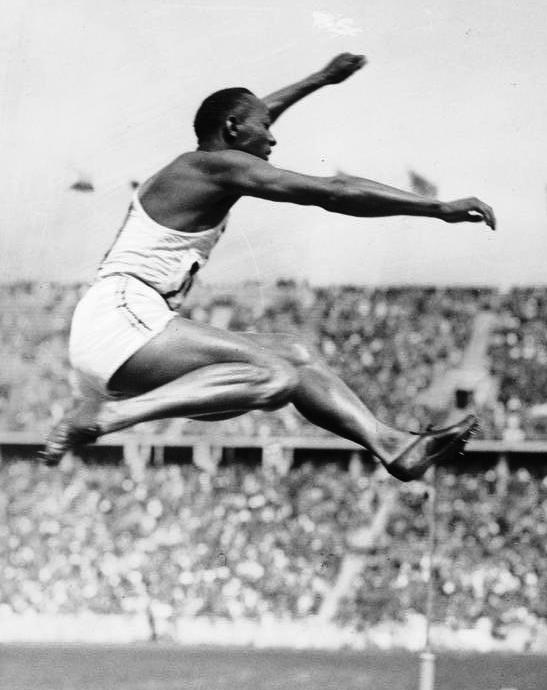
The long jump on 4 August produced one of the most enduring human stories of the Games. Owens fouled on his early attempts in the qualifying round and was at risk of failing to advance. According to the account that has been passed down, the German long jumper Carl Ludwig Long, known as Luz Long, a tall, blond athlete who in many ways resembled the Nazi ideal, approached Owens and offered friendly advice, suggesting he adjust his takeoff point to leave a safe margin before the board. Owens qualified, and in the final the two men pushed each other in a thrilling competition. Owens won the gold with a leap of 8.06 metres, setting an Olympic record, while Long took the silver. Long was among the first to congratulate Owens, and the two walked arm in arm in front of the German crowd. The friendship that formed between them, an African American and a German, in the heart of Hitler’s stadium, became one of the most celebrated images of sportsmanship in Olympic history. The two men continued to correspond by letter afterward. Long was later killed during the Second World War, fighting in the German army in 1943, and Owens kept up a relationship with Long’s family for years.
Owens was not finished. On 5 August he won the 200 metres in 20.7 seconds, an Olympic record, for his third gold medal. Then, on 9 August, he ran the opening leg of the United States 4x100 metres relay team, which won gold and set a world record of 39.8 seconds that would stand for two decades. Owens had not originally been scheduled to run the relay. He was added to the team at a late stage in a controversial decision that removed two Jewish American sprinters, Marty Glickman and Sam Stoller, from the lineup, a move many have long suspected was made to avoid embarrassing the Nazi hosts. Owens reportedly objected to the change, but coaches insisted, and he ran.
By the end of the Games, Jesse Owens had won four gold medals in a single Olympics, a feat in track and field that would not be matched until Carl Lewis did so in 1984. A persistent legend holds that Hitler deliberately snubbed Owens by refusing to shake his hand. The reality is more complicated. On the first day, Hitler had personally congratulated some German winners but left before others competed, prompting Olympic officials to insist that he either greet all medalists or none. Hitler chose to greet none publicly thereafter, so he did not shake hands with Owens, but he also did not single him out for a dramatic public snub in the manner the legend describes. Owens himself later said that the German people had treated him warmly and that the real snub he experienced came not in Berlin but back home in the United States.
Return to a Segregated America
If Jesse Owens expected that four Olympic gold medals would change his standing at home, he was quickly and bitterly disappointed. He returned to an America that remained rigidly segregated, where his achievements abroad did little to alter the daily indignities of his life. There was a ticker tape parade in New York City in his honor, but when a reception was held afterward at the Waldorf Astoria hotel, Owens, the guest of honor, had to ride a freight elevator to reach it rather than the main one reserved for white guests.
President Franklin D. Roosevelt never invited Owens to the White House and never sent him a public message of congratulation. Owens later remarked with some pain that he had not been received by the president of his own country after winning four gold medals for it. He would point out that the famous snub of his career came not from Hitler but from his own government and the racial system it tolerated.
Equally damaging was the financial reality. In that era, Olympic athletes were strictly amateurs and were not permitted to earn money from their sport. After the Games, American officials wanted Owens to continue competing in a series of exhibition races in Europe to raise money for the athletic establishment. Exhausted and seeing no benefit to himself, Owens refused and returned home. In response, the amateur athletic authorities suspended his amateur status, effectively ending his competitive career and cutting off the path many assumed his fame would open.
Owens needed to support his wife, Minnie Ruth Solomon, whom he had married in 1935 and known since childhood, and their growing family. He took whatever work he could find. He worked as a playground director, ran a dry cleaning business that eventually failed, served as a gas station attendant, and performed in various promotional appearances. Most famously and most painfully, to earn money he agreed to race against horses, dogs, motorcycles, and cars in exhibition stunts before sporting crowds. The fastest man in the world would line up against a thoroughbred and sprint for the entertainment of paying spectators. Owens was candid about the humiliation but also practical about it. He once observed that people said it was degrading for an Olympic champion to run against a horse, but he asked what else he was supposed to do, since the medals could not be eaten and there were bills to pay.
Through these lean years, Owens never lost the work ethic that Charles Riley had instilled in him as a boy. He kept moving, kept taking on new ventures, and kept presenting himself to the public with dignity and warmth even as the country failed to offer him the rewards his talent had earned.
Later Life and Recognition
Over time, Jesse Owens reshaped his fame into a working career. He became a popular and gifted public speaker, traveling the country to address business groups, youth organizations, religious gatherings, and athletic banquets. His speeches stressed discipline, faith, patriotism, clean living, and the power of determination to overcome obstacles. He worked with youth programs and served as a goodwill figure, and during the Cold War the United States government, which had once ignored him, sent him abroad as a goodwill ambassador to represent American ideals overseas. He ran a public relations firm and lent his name and presence to numerous causes and companies.
Owens’s relationship with the broader civil rights movement was complex. In the turbulent 1960s, he was sometimes criticized by younger, more militant Black activists who felt his message of individual effort and patient optimism failed to confront the structural racism that had shaped his own life. Owens, for his part, generally counseled a measured approach, though his views evolved over the years, and he was personally acquainted with the gulf between the honors a country offered and the equality it withheld.
Official recognition eventually came, though it took decades. In 1976, President Gerald Ford awarded Jesse Owens the Presidential Medal of Freedom, the highest civilian honor in the United States, at last giving him from his own government the formal recognition that had been denied him for forty years. In 1979, President Jimmy Carter presented him with the Living Legend Award, praising the way Owens had inspired generations.
Jesse Owens died of lung cancer on 31 March 1980 in Tucson, Arizona, at the age of sixty-six. He had been a heavy smoker for much of his life. His death was mourned across the world, and tributes poured in from people who recognized that his significance reached far beyond athletics.
The honors continued after his death. In 1990, President George H. W. Bush posthumously awarded Owens the Congressional Gold Medal, which was received by his widow, Ruth. Streets, schools, parks, and athletic awards were named for him. The Jesse Owens Award became the highest honor in American track and field. His name endured as a byword for excellence achieved against overwhelming odds.
“The battles that count aren’t the ones for gold medals. The struggles within yourself, the invisible, inevitable battles inside all of us, that’s where it’s at.”
Legacy
The legacy of Jesse Owens rests on more than the four gold medals, extraordinary as they were. He gave the world an enduring image of human achievement standing in direct rebuke to one of the most poisonous ideologies in history. In a stadium built to broadcast the myth of racial supremacy, a Black American grandson of enslaved people outran and outjumped everyone the regime could put forward, and he did it before the eyes of the entire world. No speech could have refuted Nazi racial theory as completely as those few days of athletic perfection did.
Yet his legacy is also a lesson in the painful gap between symbolic triumph and lived reality. Owens won glory abroad and returned to a country that denied him an elevator ride, a White House visit, and a fair living. His story exposes the contradiction at the heart of mid-century America, a nation that proudly claimed his victories as its own while continuing to treat him as a second-class citizen. That contradiction makes his dignity all the more remarkable. He carried himself with grace through humiliations that would have embittered many, and he turned his fame into a lifetime of encouragement for the young.
The friendship with Luz Long endures as a separate strand of his legacy, a reminder that even within a machinery of hatred, individual human decency could break through. The image of the two athletes walking arm in arm has outlasted the regime that tried to keep them apart.
For athletes around the world, including the many young runners across Africa who have since carried sprinting and jumping to new heights, Jesse Owens remains a foundational figure. He proved what the human body and human will could accomplish, and he proved that excellence itself can be a form of resistance. Decades after his death, his name is still spoken whenever someone runs faster than seemed possible, and whenever sport reminds the world that talent and character recognize no boundaries of race.
Key Facts
- Jesse Owens was born on 12 September 1913 in Oakville, Alabama, the youngest of ten children in a sharecropping family and the grandson of people who had been enslaved.
- On 25 May 1935 at the Big Ten meet in Ann Arbor, Michigan, he set three world records and tied a fourth in roughly forty-five minutes, including a long jump record of 8.13 metres that stood for twenty-five years.
- At the 1936 Berlin Olympics he won four gold medals, in the 100 metres, 200 metres, long jump, and 4x100 metres relay, undermining the Nazi regime’s propaganda of Aryan supremacy.
- His friendship with German long jumper Luz Long, who offered him advice and congratulated him before the German crowd, became one of the most celebrated stories of sportsmanship in Olympic history.
- He received the Presidential Medal of Freedom from President Gerald Ford in 1976 and was posthumously awarded the Congressional Gold Medal in 1990.