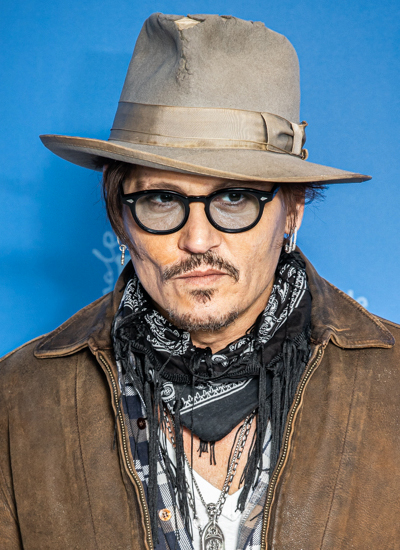
There is a particular kind of movie star who refuses to play the leading man. Hollywood is built to manufacture heroes with straight jaws and clean motives, yet every so often an actor arrives who would rather disappear into something stranger. Johnny Depp spent the better part of four decades doing exactly that. He turned pale, scissor-handed loneliness into poetry. He made a drunken, mumbling pirate into one of the most beloved characters in modern blockbuster cinema. He played writers and gangsters, demon barbers and chocolate makers, always reaching for the odd note rather than the obvious one. For a long time he was both a global box-office colossus and a stubborn outsider, a man who seemed faintly embarrassed by his own fame. Then came a courtroom, a former wife, and a televised trial that turned his private life into a worldwide spectacle. The story of Johnny Depp is the story of an artist who built a career out of misfits and then, in his most difficult chapter, became one himself.
Quick Facts
- Full name
- John Christopher Depp II
- Born
- 9 June 1963, Owensboro, Kentucky, USA
- Nationality
- American
- Known for
- Edward Scissorhands, Pirates of the Caribbean, Sweeney Todd
- Collaborator
- Director Tim Burton (8 films)
Early Life
John Christopher Depp II was born on 9 June 1963 in Owensboro, Kentucky, the youngest of four children. His father, John Christopher Depp, was a civil engineer, and his mother, Betty Sue Palmer, worked as a waitress. The family moved frequently during his childhood, drifting through a long string of homes before settling in Miramar, Florida, when Depp was around seven years old. By his own account the family relocated dozens of times, a restlessness that left him with a lifelong sense of being slightly out of place wherever he landed.
The household was not an easy one. His parents argued, and Depp has often described a childhood shadowed by tension and instability. He has spoken openly about acting out as a boy, experimenting with cigarettes, alcohol and worse before he had reached his teens. When he was around fifteen, his parents divorced, a rupture that hit him hard. The young Depp found refuge in music. His mother had given him a guitar when he was about twelve, and he taught himself to play by listening to records, locking himself away in his room for hours. Music, more than school, became the thing that organised his life.
He dropped out of high school at sixteen with the firm intention of becoming a rock musician. When he tried to return to class a couple of weeks later, a teacher reportedly advised him to follow his dream of playing music instead, and Depp never went back. He played in a series of garage bands around Florida, the most notable of which was a group called The Kids. Chasing bigger stages, the band relocated to Los Angeles in the early 1980s. The move was a gamble that did not pay off in the way Depp had imagined. The band, later renamed Six Gun Method, struggled to find traction in a crowded scene, and the gigs and the money were thin.
To make ends meet in Los Angeles, Depp took a string of odd jobs, including selling pens over the telephone. He has described that period as a hard scramble, the band slowly disintegrating around him while the rent came due. He married a makeup artist named Lori Anne Allison in 1983, and it was through her that the accidental pivot of his life occurred. Allison introduced him to the actor Nicolas Cage, who suggested Depp try acting. Depp had never seriously considered it, but he needed the work, and an audition led to a small but memorable role. Acting, the thing he had stumbled into almost by accident, would soon swallow the music career he had crossed the country to pursue. He kept the guitar, though, treating performance as a craft to be learned rather than a calling he had chosen, an outsider’s stance he never entirely abandoned.
Early Fame
Depp’s screen debut came in Wes Craven’s 1984 horror film A Nightmare on Elm Street. He played Glen Lantz, the boyfriend of the heroine, and met one of the most gruesome deaths in the franchise, pulled into a bed and erupted back out in a geyser of blood. It was a striking introduction, even if the part was small. More film and television work followed, including a role in Oliver Stone’s 1986 war drama Platoon, though much of his performance was trimmed in the editing room.
The role that changed everything arrived in 1987. Fox cast Depp as Officer Tom Hanson in the television series 21 Jump Street, a drama about young-looking police officers who go undercover in high schools. The show was a hit, particularly with teenage audiences, and almost overnight Depp became a heartthrob. His face appeared on magazine covers and bedroom posters across the United States. He was, by any commercial measure, a star.
He hated it. Depp has spoken many times about his deep discomfort with being packaged and sold as a teen idol. He felt the show reduced him to a pretty face and a marketable image, the opposite of the scruffy musician he still considered himself to be. He chafed against the constraints of the role and grew increasingly frustrated with the network, eventually pushing to leave the series. The experience left a lasting mark. The resentment he felt at being turned into a product would shape the rest of his career, driving him toward the strangest, least conventional roles he could find, almost as a deliberate rebellion against the heartthrob label that had been stamped on him. He would later describe the period as a time when he felt like a piece of merchandise rather than an actor, a commodity sold to teenagers by the magazine cover. That feeling of being misread, of having a false image imposed on him, hardened into a guiding principle. Whatever came next, he resolved, would be on his own terms and as far from the clean-cut television cop as he could travel.
Becoming a Character Actor
The escape route came in the form of an unlikely director with an even more unlikely project. In 1990, Tim Burton cast Depp in the title role of Edward Scissorhands, a gothic fairy tale about an artificial young man, left unfinished by his inventor, with sharp blades where his hands should be. It was a daring choice. Studios wanted a bigger name, but Burton saw something in Depp, and Depp, desperate to shed his teen-idol skin, threw himself into the part. He played Edward with barely any dialogue, communicating loneliness and longing through posture, silence and his enormous, sorrowful eyes. The film was a critical and commercial success, and it announced an entirely new Johnny Depp: not a heartthrob, but a character actor of rare delicacy.
It also began one of the most fruitful partnerships in modern cinema. Over the following decades Burton and Depp would collaborate on eight films, a creative marriage built on a shared love of outsiders and the macabre. In 1994 they reunited for Ed Wood, a black-and-white biopic of the man often called the worst director in Hollywood history. Depp played Wood with manic, sweet-natured optimism, and the performance is widely regarded as one of his finest.
Between and around the Burton collaborations, Depp built a reputation for choosing roles that other leading men avoided. In Lasse Hallstrom’s 1993 drama What’s Eating Gilbert Grape, he played a young man caring for his family in a small town, sharing the screen with a teenage Leonardo DiCaprio, who earned an Oscar nomination. In Mike Newell’s 1997 crime drama Donnie Brasco, Depp held his own opposite Al Pacino, playing an FBI agent who goes undercover in the Mafia. And in Terry Gilliam’s wild 1998 adaptation of Fear and Loathing in Las Vegas, he disappeared into the role of the gonzo journalist Raoul Duke, a part based on the writer Hunter S. Thompson, who became a close friend. Depp shaved his head and studied Thompson’s mannerisms obsessively, the kind of total immersion that became his signature.
These were not safe choices, and they did not always make money, but they cemented Depp’s standing as an actor’s actor, a star who valued the work over the spotlight. He seemed allergic to obvious roles. Again and again he reached for the broken, the eccentric and the overlooked, building a body of work that prized texture over heroics. By the turn of the millennium he was respected, admired and a little underestimated as a commercial force. That was about to change in the most spectacular way imaginable.
Captain Jack and Superstardom
In 2003 Walt Disney Pictures released Pirates of the Caribbean: The Curse of the Black Pearl, a swashbuckling adventure based, improbably, on a theme-park ride. The studio was nervous. Depp’s central creative decision made them more nervous still. He chose to play the pirate Captain Jack Sparrow as a slurring, swaying, kohl-eyed rogue, drawing inspiration from the Rolling Stones guitarist Keith Richards and the cartoon skunk Pepe Le Pew. Executives reportedly worried that the character seemed drunk or worse and feared Depp was sinking the film. He held firm.
The gamble paid off beyond anyone’s expectations. Captain Jack Sparrow became an instant icon, a performance so original and beloved that it carried the entire franchise. The film was an enormous hit, and Depp earned an Academy Award nomination for Best Actor, a remarkable feat for a comic role in a popcorn blockbuster. He would reprise the part across four more films released between 2006 and 2017, and the Pirates franchise grossed billions of dollars worldwide. For a long stretch Depp ranked among the highest-paid actors on the planet, his unconventional pirate having turned him into a genuine global superstar.
Superstardom opened doors to the kind of large, eccentric projects he loved. In 2005 he reunited with Tim Burton for Charlie and the Chocolate Factory, playing the reclusive candy maker Willy Wonka with a pale, peculiar strangeness. In 2007 the pair made Sweeney Todd: The Demon Barber of Fleet Street, a screen adaptation of the Stephen Sondheim musical. Depp, who had never trained as a singer, performed his own vocals as the murderous barber and earned another Academy Award nomination for Best Actor, along with a Golden Globe win. In 2010 they teamed again for Alice in Wonderland, in which Depp played the Mad Hatter in a film that crossed a billion dollars at the global box office.
Through the 2000s, Depp was a paradox: a former rebel against fame who had become one of the most famous men alive, yet who still insisted on playing weirdos, ghouls and grotesques. He had managed something almost no one else in Hollywood could claim. He had turned his commitment to oddity into the engine of a mainstream empire.
Music and Other Pursuits
For all his success on screen, Depp never abandoned the dream that had brought him to Los Angeles in the first place. Music remained central to his identity. He played guitar on records by friends and heroes over the years, lending his playing to projects by artists he admired, and he kept the instrument close throughout his life.
In 2015 he co-founded the rock supergroup Hollywood Vampires alongside the veteran shock-rocker Alice Cooper and the Aerosmith guitarist Joe Perry. The band took its name from a celebrity drinking club Cooper had run in the 1970s, and it specialised in covering songs by rock stars who had died young, a tribute to fallen idols. Depp served as a guitarist in the group, touring internationally and appearing on the band’s albums. For a man who had once crossed the country in a struggling garage band, the Hollywood Vampires represented a return to his first love, this time on the biggest stages in the world.
Beyond music, Depp pursued a number of side ventures. He produced films through his own company, Infinitum Nihil. He invested in a winery and other properties, and for a period owned an island in the Bahamas. His passions tended toward the romantic and the extravagant: rare books, vintage guitars, classic memorabilia. He was, in many ways, a collector of the strange and the beautiful, the same instinct that drew him to his most memorable roles.
The Legal Battles
The chapter that came to dominate public discussion of Johnny Depp had nothing to do with cinema. In 2015 he married the actress Amber Heard, whom he had met on the set of the 2011 film The Rum Diary. The marriage was short and turbulent, and it ended in divorce in 2016 amid allegations of domestic abuse. What followed was one of the most closely watched legal sagas in entertainment history.
The dispute escalated through the courts on both sides of the Atlantic. In 2018 Heard wrote an opinion piece, published in The Washington Post, in which she described herself as a public figure representing domestic abuse, though she did not name Depp directly. Depp sued for defamation, arguing that the article had falsely implied he was an abuser and had damaged his career. The case went to trial in Fairfax County, Virginia, in 2022.
The 2022 trial was televised and live-streamed, turning a painful private conflict into a global spectacle. For roughly six weeks, audiences around the world followed every development, and social media filled with commentary, clips and partisan debate. In June 2022 the jury found largely in Depp’s favour, concluding that Heard had defamed him on multiple counts, while also finding that Depp had defamed Heard on one count through a statement by his lawyer. Depp was awarded substantially more in damages than Heard, and the verdict was widely read as a vindication of his position. The two sides later reached a settlement.
The consequences for Depp’s career and reputation were enormous and complicated. An earlier libel case he had brought in London against a British newspaper had failed in 2020, and in its aftermath he had stepped away from the role of Gellert Grindelwald in the Fantastic Beasts film series, a Warner Bros. production. During those years he found himself effectively sidelined by much of Hollywood. The 2022 verdict shifted public sentiment in his favour and reopened doors, though the entire affair had exposed the rawest details of his personal struggles to the world.
Personal Life and Legacy
Long before the courtroom years, Depp’s personal life had been a fixture of celebrity culture. In the late 1980s and early 1990s he was engaged to several of his co-stars, and his relationship with the actress Winona Ryder, whom he met around 1989, became one of the defining romances of the era. He famously had a tattoo reading “Winona Forever” on his arm, which he later altered to “Wino Forever” after the couple separated.
His longest and most settled relationship was with the French singer and actress Vanessa Paradis, whom he was with from around 1998 to 2012. The couple had two children together, a daughter named Lily-Rose Depp, born in 1999, and a son named Jack, born in 2002. Lily-Rose Depp went on to build her own career as a model and actress, stepping out of her father’s long shadow into the spotlight on her own terms. For much of his relationship with Paradis, Depp lived in France, embracing a quieter, more private life away from the glare of Hollywood.
“I think the only person you really, fundamentally have to answer to is yourself. Wherever you are, whoever you’re with, you have to be at peace within your own skin.”
In the years following the 2022 trial, Depp set about rebuilding. He returned to the screen as King Louis XV in the French-language historical drama Jeanne du Barry, directed by Maïwenn, which opened the Cannes Film Festival in 2023. He continued touring with the Hollywood Vampires and moved behind the camera as a director, returning to filmmaking after decades with the biographical drama Modi, about the painter Amedeo Modigliani. These were the deliberate steps of a man determined to be defined by his work rather than his worst headlines.
Where Johnny Depp ultimately lands in film history is a question still being written, but the outline is already clear. He is one of the most distinctive actors of his generation, a performer who rejected the easy path of the leading man and instead built an unrepeatable gallery of oddballs, dreamers and outcasts. Edward Scissorhands and Captain Jack Sparrow alone would secure his place in the cinematic imagination, and behind them stand Ed Wood, Raoul Duke, Sweeney Todd and a dozen others. His later years brought turmoil that complicated the legend, yet they did not erase the achievement. For a kid who dropped out of school in Florida to chase a rock-and-roll dream, the strange and winding road he travelled produced one of the most singular careers Hollywood has ever seen.
Key Facts
- John Christopher Depp II was born on 9 June 1963 in Owensboro, Kentucky, and dropped out of high school at sixteen to pursue music before falling into acting in Los Angeles.
- His breakthrough as a serious actor came in Tim Burton’s Edward Scissorhands in 1990, beginning a partnership that produced eight films together.
- Depp earned three Academy Award nominations, including one for his iconic turn as Captain Jack Sparrow in Pirates of the Caribbean: The Curse of the Black Pearl in 2003.
- The Pirates franchise made him one of the highest-paid actors in the world, while roles in Charlie and the Chocolate Factory, Sweeney Todd and Alice in Wonderland confirmed his commercial reach.
- A televised 2022 defamation trial against his former wife Amber Heard ended largely in his favour and dramatically reshaped public perception of his career.