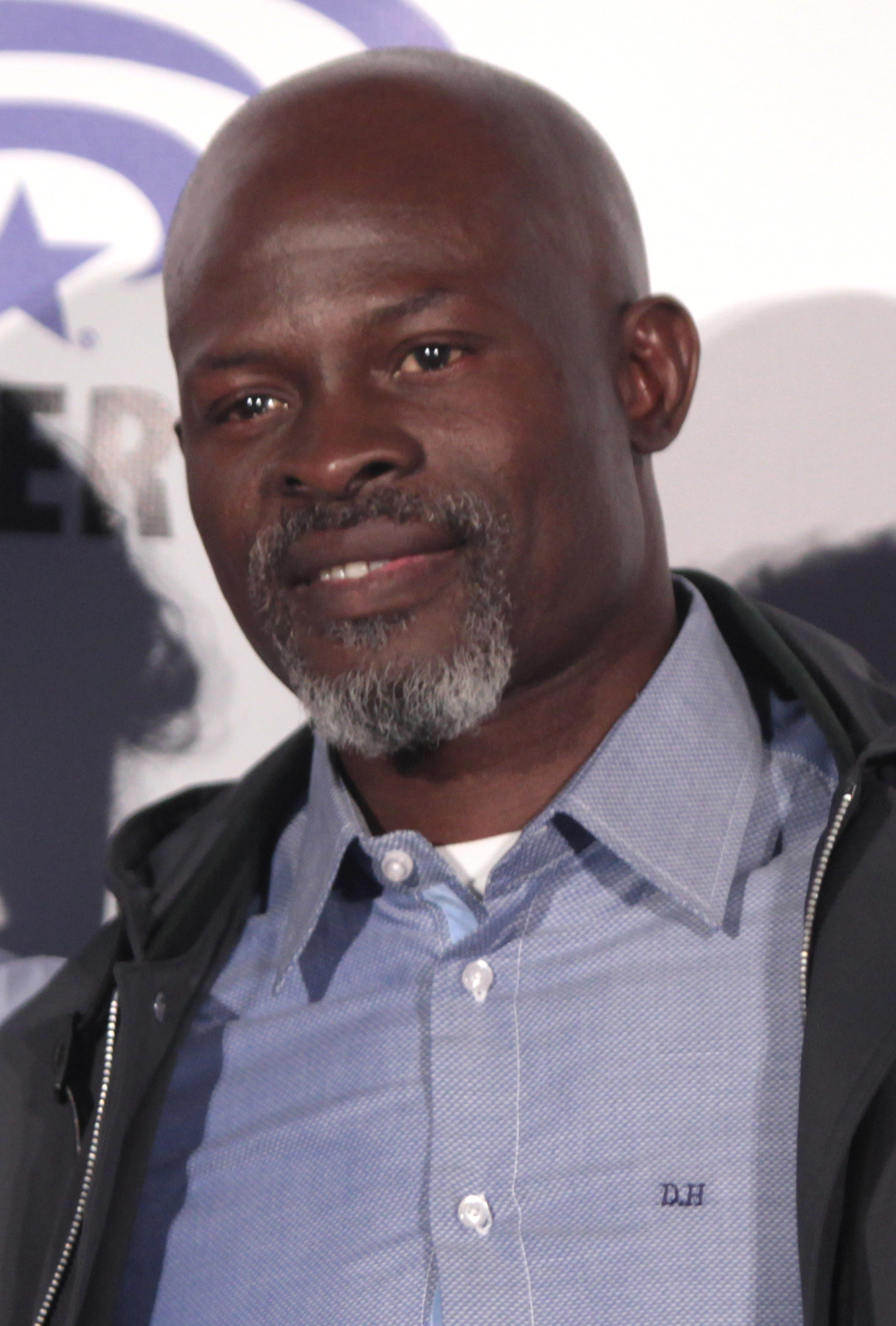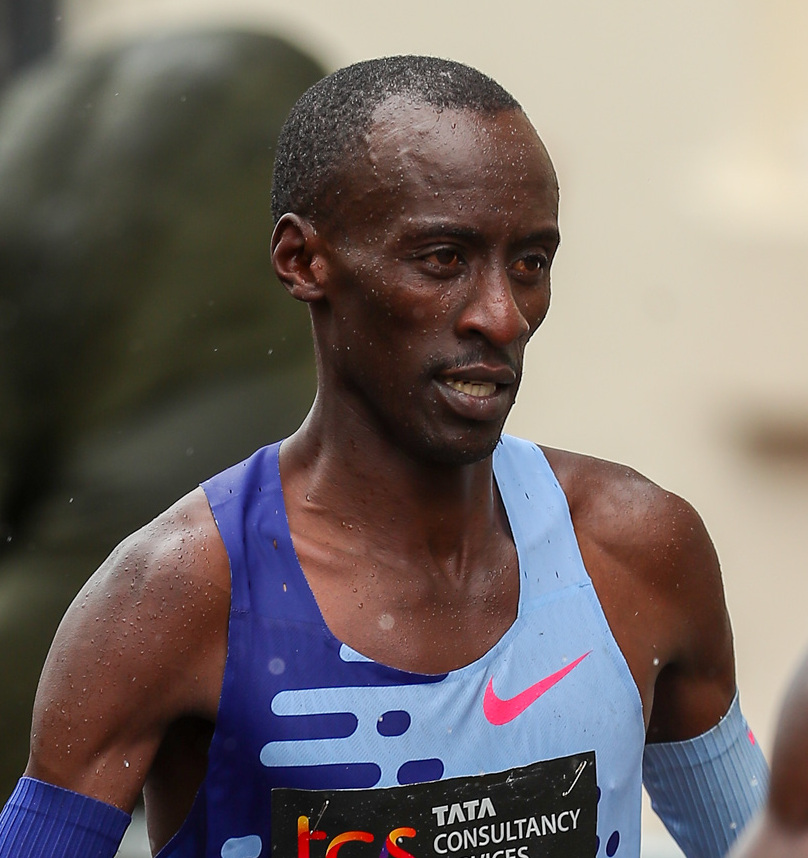
On the morning of 8 October 2023, along the flat, fast streets of Chicago, a slight young man from the highlands of western Kenya did something the sport of marathon running had spent decades inching toward. Kelvin Kiptum crossed the finish line in 2:00:35, a time so fast that the people who follow athletics closely had to read it twice. He had not simply won the Chicago Marathon. He had broken the world record by more than half a minute, and he had done it with a second half faster than his first, the kind of finish that seems to defy the physiology of running 26.2 miles. He was 23 years old. He had run only three marathons in his life. And when reporters asked him what came next, he spoke, almost casually, about the possibility of becoming the first human being to cover the marathon distance in under two hours in an official race.
For a few extraordinary months, it felt as though the sport had found not just a champion but a phenomenon, a runner who seemed to be redrawing the boundaries of what was possible faster than anyone could keep track. Then, four months later, on a dark road near Kaptagat in Kenya, it all ended. This is the story of Kelvin Kiptum, the marathon prodigy who ran into history.
Quick Facts
- Full name
- Kelvin Kiptum
- Born
- 2 December 1999, Chepsamo, Elgeyo-Marakwet County, Kenya
- Died
- 11 February 2024, near Kaptagat, Kenya (aged 24)
- Sport
- Long-distance running (marathon)
- World record
- 2:00:35 (Chicago Marathon, 8 October 2023)
Early Life
Kelvin Kiptum was born on 2 December 1999 in Chepsamo, a small village in Elgeyo-Marakwet County, part of Kenya’s Rift Valley. This is a region famous the world over for producing distance runners, a stretch of high-altitude highland where thin air and rugged terrain seem to breed endurance almost as a matter of geography. Yet Kiptum’s beginnings were modest even by the standards of that running country. He grew up in a farming family, the only child of parents who worked the land, and his boyhood was shaped by the ordinary rhythms of rural Kenyan life rather than by any grand athletic ambition.
As a boy he herded livestock, tending cattle and sheep across the hills near his home. Like countless children in the Rift Valley, he ran to and from school, covering long distances on foot each day simply because that was how a child got where he needed to go. There were no tracks, no coaches with stopwatches, no sports academies in those early years. The running was woven into daily survival, into the practical business of a farming childhood in the highlands.
What set Kiptum apart, even before anyone thought to measure it, was appetite. He began running seriously as a teenager, and from the start he trained with a hunger that unsettled the more experienced athletes around him. In a country where the traditional path to marathon greatness runs through years of patient apprenticeship, through the track and the road races and the slow accumulation of experience, Kiptum was largely self-coached in his early development. He piled up mileage on the dirt roads of the Rift Valley, running distances that veterans considered reckless, driven by an instinct that his own body could absorb more than the rulebook allowed.
He came to elite competition later than many. He was not a schoolboy sensation plucked from a national championship. He was a young man from a poor farming background who simply out-worked the terrain around him, running because it was the thing he could do better than anyone he knew, and running further and harder than caution advised. That willingness to break the accepted patterns of training would become the signature of his brief, blazing career.
In many ways his path was a Rift Valley story told at double speed. The region has long been the beating heart of Kenyan distance running, its altitude and its culture combining to send generation after generation of runners onto the world stage. But even in that context, Kiptum stood out for how little of the traditional apparatus he seemed to need. He did not wait for a sponsor to discover him or a camp to shape him. He built the foundation of his fitness himself, on ordinary roads, on ordinary mornings, and by the time the sport noticed him he had already laid the groundwork for something extraordinary.
A Meteoric Rise
The wider world of athletics had no reason to know the name Kelvin Kiptum until late 2022. He had run some road races, a half marathon here and there, respectable results that hinted at talent without shouting about it. Then, on 4 December 2022, he lined up for his very first marathon at the Valencia Marathon in Spain, and everything changed.
Marathon debuts are supposed to be careful affairs. Even the greatest runners in history have treated their first 26.2 miles with caution, testing the distance, learning its cruelty, holding something back against the wall that so often arrives in the final miles. Kiptum ignored all of that. He ran a time of roughly 2:01:53, one of the fastest marathon debuts ever recorded, a performance so far beyond what a first-timer was expected to produce that it left the sport blinking in disbelief. Only a tiny handful of men in the entire history of the event had ever run faster, over any number of attempts.
To run that time at all was remarkable. To run it on debut, at the age of 22, with a fraction of the racing experience of his rivals, suggested something rare. Here was a runner who did not seem bound by the usual learning curve, who arrived at the marathon distance already operating near its outer edge. The Valencia result was not a fluke to be explained away. It was a warning shot.
What made the rise so startling was its compression. Great marathon careers are usually measured in years, in a gradual climb toward peak performance. Kiptum seemed to be sprinting up that mountain. Within months of that debut, he would prove that Valencia had not been the ceiling. It had barely been the beginning.
The London Marathon
If Valencia announced Kiptum’s arrival, the 2023 London Marathon confirmed that the sport was dealing with a generational talent. On 23 April 2023, on the streets of the British capital, Kiptum ran his second career marathon, and he tore it apart.
He crossed the line in 2:01:25, winning the race and, in doing so, recording the second-fastest marathon time ever run at that point in history. Only the great Eliud Kipchoge, his fellow Kenyan and the reigning master of the event, had run faster in an official race. What stunned observers was not only the time but the manner of it. Kiptum ran a second half of the race that was dramatically faster than his first, unleashing a surge in the closing stages that pulled him clear of the field and into the record books. Runners are not supposed to accelerate over the back half of a marathon, when the body is depleted and the legs are heavy. Kiptum did it as though the distance were merely a suggestion.
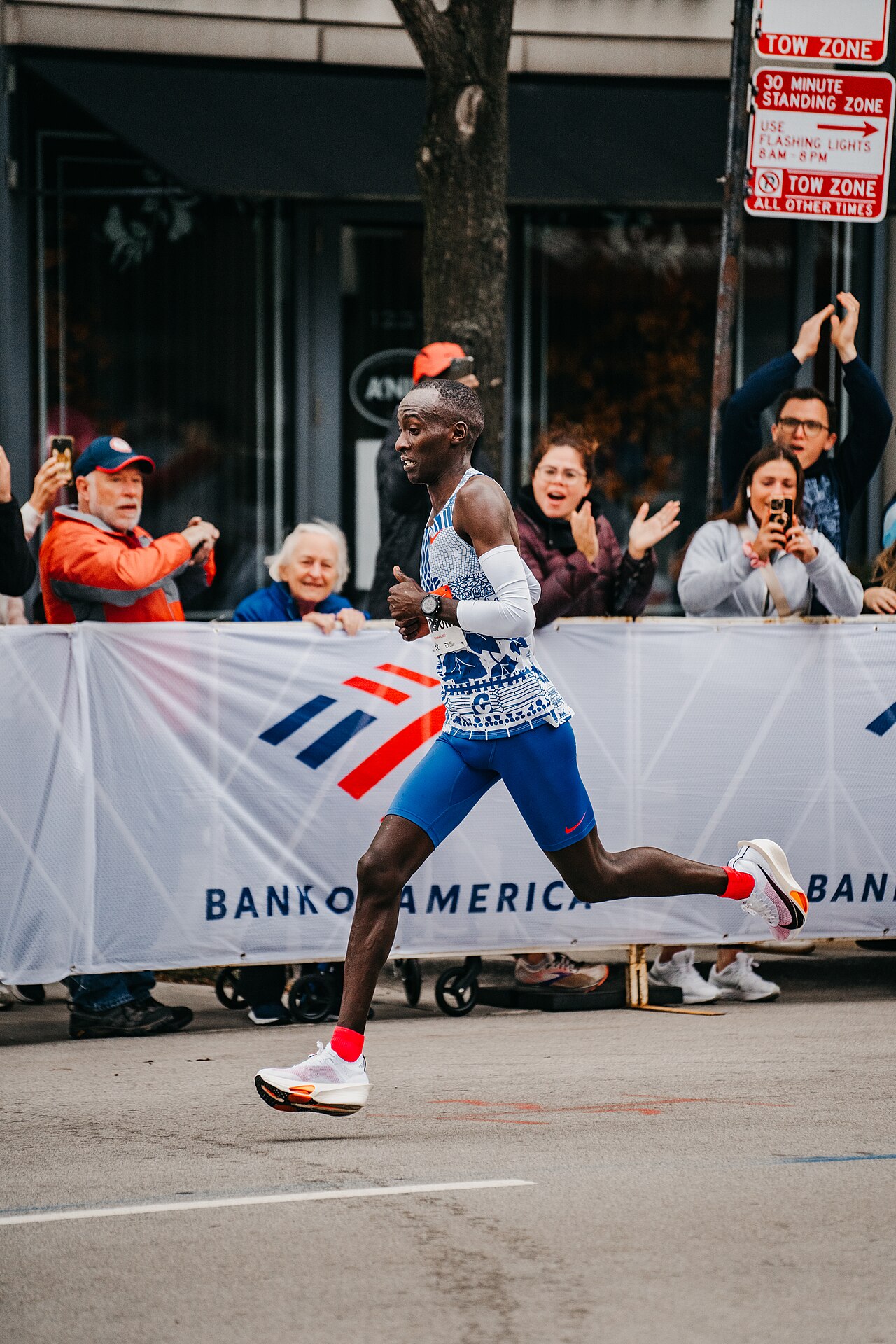
The London performance electrified the athletics community. Here was a 23-year-old, in only his second marathon, running the second-fastest time in the history of the event and doing it with a negative split that hinted at reserves nobody could quite fathom. The comparisons to Kipchoge were immediate and inevitable, but they came with a twist. Kipchoge had built his legend over more than a decade. Kiptum was assembling his in a matter of months, and he was doing it younger, and the trajectory of his times suggested he had not yet found his limit.
After London, the question was no longer whether Kiptum belonged among the elite. It was how far, and how fast, he could go. The answer arrived less than six months later, on the other side of the Atlantic.
The World Record in Chicago
On 8 October 2023, Kelvin Kiptum stood on the start line of the Chicago Marathon for the third marathon of his career. Chicago is a course built for speed, flat and forgiving, the kind of place where records fall. But nobody was quite prepared for what he did to it.
Kiptum ran 2:00:35, breaking the marathon world record and lowering the previous mark, held by Eliud Kipchoge, by 34 seconds. He became the first person ever to run an official marathon faster than two hours and one minute. And once again, in a feat that had by now become his trademark, he ran the second half of the race faster than the first, covering the closing miles at a pace that seemed physically impossible. Spectators and commentators watched the clock and the man and struggled to reconcile the two. He was not fading. He was flying.
“I knew a course record was possible, but a world record, I am so happy.”
The significance of the moment rippled far beyond Chicago. Kiptum had not merely broken a record. He had broken it emphatically, and the way he had done it, with so much apparent ease in the finishing stretch, opened a door that the sport had long treated as almost mystical. For years, the two-hour marathon had stood as running’s version of a mythical barrier, a threshold that felt as much philosophical as physical. Kipchoge had famously run under two hours in a specially staged, unofficial event, but no one had done it in a standard, record-eligible race. After Chicago, and after seeing how much Kiptum seemed to have left in reserve, the belief spread quickly that this young man might be the one to do it in real competition.
He was 23 years old. He had run three marathons and won two of them, one in the second-fastest time in history and one in the fastest ever. The mathematics of his progress pointed somewhere no runner had ever been.
The Two-Hour Dream
By the end of 2023, Kelvin Kiptum was the most talked-about figure in distance running, and the conversation had shifted from admiration to anticipation. The question on everyone’s mind was simple and enormous: could he become the first man to run an official marathon in under two hours?
Plans took shape for an attempt. Kiptum was set to race the Rotterdam Marathon in the Netherlands in April 2024, and there was open speculation that he would target the two-hour barrier there. The idea was no longer treated as fantasy. Given his world record, given his youth, given the terrifying pattern of his negative splits, it was regarded as a genuine possibility, perhaps even a probability if the conditions cooperated. Rotterdam is another fast, flat course, and the sport braced itself for the prospect of watching a barrier fall that had stood for as long as anyone had been keeping records.
What made the dream so compelling was Kiptum’s age. He was still in his early twenties, an age at which most marathon runners are only beginning to approach their prime. The distance rewards experience and patience, and its greatest champions have often produced their finest performances in their thirties. Kiptum had already run the fastest marathon in history, and he had done it with the sense that he was still learning the event, still figuring out what his body could do. The natural conclusion was almost dizzying. If this was Kiptum only getting started, where would he be in five years, or ten?
For a few months at the turn of 2024, the future of the marathon seemed to belong entirely to him. The sport waited for Rotterdam the way it waits for very few things, with the feeling that it might be about to witness one of the defining moments in the history of human athletic performance.
Tragedy
That moment never came. On the night of 11 February 2024, Kelvin Kiptum was killed in a car accident near Kaptagat, in Kenya’s Rift Valley, not far from the training grounds where so many of the world’s greatest distance runners live and work. He was 24 years old. His Rwandan coach, Gervais Hakizimana, who had worked alongside him during his astonishing rise, died in the same crash. A third person in the vehicle survived.
The news broke across Kenya in the early hours and spread around the world by morning, met everywhere with the same disbelief. A runner who days earlier had been the embodiment of the future, of records not yet broken and barriers not yet fallen, was suddenly gone. In Kenya, a nation for whom distance running is a source of profound national pride, the grief was overwhelming. Fellow athletes, government leaders, and ordinary citizens mourned openly. Around the world, the athletics community reeled at the loss of a talent that had seemed limitless, taken at the very moment it was reaching toward something no one had ever achieved.
The tragedy carried a particular cruelty. Kiptum had come from nothing, had built himself into the fastest marathon runner in history through sheer relentless work, and had done it so quickly that he had barely had time to enjoy the summit before it was taken from him. He was, at the time of his death, the world record holder, and he was preparing for the race that many believed would make him the first man to break two hours. He never got to run it. The two-hour dream, so close it could almost be touched, was left forever unfinished.
Career Timeline
- 2 December 1999: Born in Chepsamo, Elgeyo-Marakwet County, in Kenya’s Rift Valley.
- Early 2010s to early 2020s: Grows up in a farming family, herds livestock and runs to school, begins training seriously as a teenager while largely self-coached.
- 4 December 2022: Makes his marathon debut at the Valencia Marathon, running roughly 2:01:53, one of the fastest debuts in history.
- 23 April 2023: Wins the London Marathon in 2:01:25, the second-fastest marathon time ever run at that point.
- 8 October 2023: Sets the marathon world record of 2:00:35 at the Chicago Marathon, becoming the first to run an official marathon under 2:01.
- Late 2023: Recognized as the world record holder and the leading candidate to break the two-hour barrier.
- Early 2024: Prepares for the Rotterdam Marathon in April 2024 amid speculation of a sub-two-hour attempt.
- 11 February 2024: Dies in a car accident near Kaptagat, Kenya, aged 24, alongside his coach Gervais Hakizimana.
Lesser-Known Facts
- He came from a humble rural background. Kiptum grew up in a farming family in a small Rift Valley village, herding cattle and sheep and running long distances to school as a boy, far from any formal athletics system.
- He was largely self-coached in his early years. Unlike many Kenyan stars who rise through structured camps and academies, Kiptum developed his talent on his own for much of his early career, driven by instinct and appetite.
- He ran remarkably few marathons. In total, Kiptum competed in only a handful of marathons, and yet he won London and set a world record in Chicago, an astonishing record given how briefly he raced at the distance.
- He was famous for negative splits. In his greatest performances, including London and Chicago, he ran the second half of the race faster than the first, a rare and punishing feat that left rivals and analysts astonished.
- He trained on extraordinarily high mileage. Kiptum was known for logging enormous weekly training distances, running volumes that many coaches considered dangerous, a workload that seemed to fuel his rapid rise.
- He was strikingly young at his peak. He set the world record at 23 and died at 24, an age at which most marathon greats are only beginning to approach their prime.
Frequently Asked Questions
What was Kelvin Kiptum’s world record?
Kelvin Kiptum set the marathon world record of 2:00:35 at the Chicago Marathon on 8 October 2023. He became the first person to run an official marathon under two hours and one minute, lowering the previous record by 34 seconds.
How did Kelvin Kiptum die?
Kiptum died in a car accident on the night of 11 February 2024 near Kaptagat, in Kenya’s Rift Valley. His coach, Gervais Hakizimana, was also killed in the crash. Kiptum was 24 years old.
How many marathons did he run?
Kiptum ran only a handful of marathons in his career. His three headline races were his debut in Valencia in December 2022, his win in London in April 2023, and his world-record run in Chicago in October 2023.
Was he going to break two hours?
Kiptum was widely expected to attempt to break the two-hour barrier at the Rotterdam Marathon in April 2024. Given his world record and his youth, many believed he had a genuine chance to become the first man to run an official sub-two-hour marathon. He died before the race could take place.
Where was Kelvin Kiptum from?
Kiptum was from Chepsamo, a village in Elgeyo-Marakwet County in Kenya’s Rift Valley, a region renowned for producing many of the world’s greatest distance runners.
Legacy
Kelvin Kiptum lived a short life and had an even shorter career, yet in the span of barely two years he changed the way the world thinks about the limits of human endurance. When he first stepped to a marathon start line in December 2022, he was an unknown from a farming village. By the time of his death fourteen months later, he was the fastest marathon runner in history and the man most likely to break running’s most famous barrier. Few athletes in any sport have compressed so much achievement into so little time.
His world record stands as the headline of his legacy, but the deeper mark he left is a shift in imagination. Kiptum made the two-hour marathon feel not like a distant dream but like an approaching certainty, something that would happen soon because he was going to make it happen. He expanded the sense of what was possible, and that expansion outlives him. Every runner who now chases the barrier does so in a landscape he helped reshape.
There is grief woven inseparably into his story, the ache of a talent taken before it could be fully realized, of a race in Rotterdam that will never be run, of a career that ended at the moment it seemed poised to make history again. But there is also something enduring in what he represented: proof that a boy from a small village in the Rift Valley, herding livestock and running to school, could work his way to the very edge of human performance through nothing but talent and relentless effort. In Kenya and across the world of athletics, Kelvin Kiptum is remembered not only for the record he set but for the future he seemed to promise, a prodigy who ran into history and, in doing so, showed the sport how much further it might yet go.