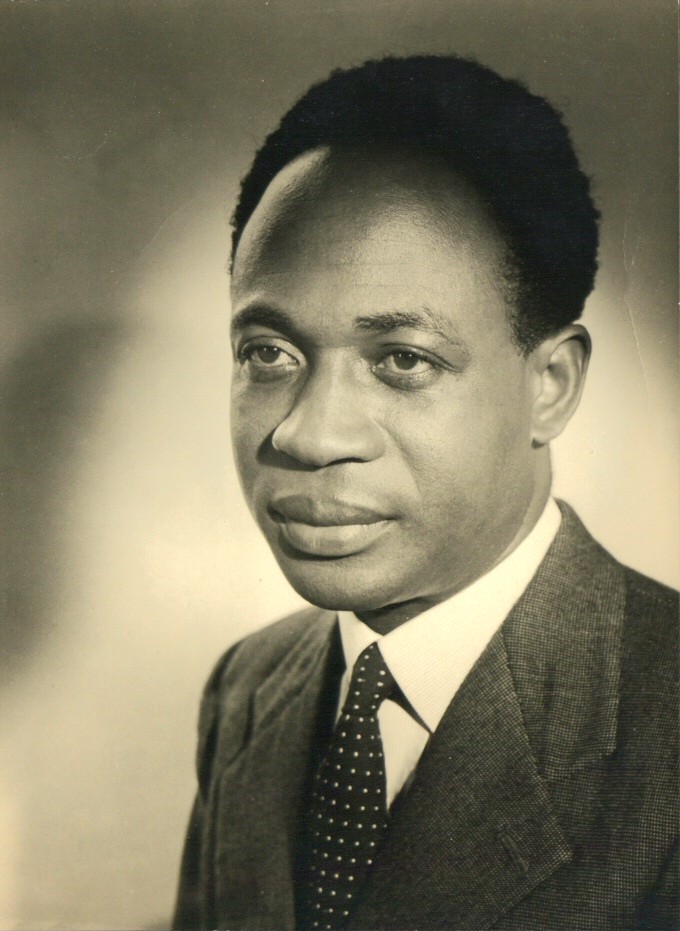
On the night of 5 March 1957, a crowd gathered at the old polo ground in Accra, restless and electric, waiting for the stroke of midnight. When the clock turned over into 6 March, the Union Jack came down for the last time, and a new flag of red, gold, and green rose in its place. A tall man in a white smock and a prison cap, the kind worn by political prisoners, climbed onto the platform and shouted into the night that Ghana, the country he had willed into being, was free forever. That man was Kwame Nkrumah, and in that moment he became not only the leader of the first sub-Saharan African colony to win independence, but the living symbol of a continent’s hope that the age of empire was finally ending.
His name would soon be spoken in Lagos and Nairobi, in Kingston and Harlem, in conference halls in London and student dormitories in Pennsylvania. To his admirers he was Osagyefo, the redeemer. To his critics he was a man who could not resist the temptations of power. To historians he remains one of the most consequential and most contested figures of the twentieth century. This is the story of how a boy from a small village on the coast of the Gold Coast became the father of African independence, and how his dream of a single, united Africa both inspired millions and outran the world he lived in.
Quick Facts
- Full name
- Francis Kwame Nkrumah
- Born
- 21 September 1909, Nkroful, Gold Coast (now Ghana)
- Died
- 27 April 1972, Bucharest, Romania (aged 62)
- Known for
- First Prime Minister and President of independent Ghana; Pan-Africanism
- Key achievement
- Led Ghana to independence in 1957, the first sub-Saharan African colony to do so
Early Life and Background
Kwame Nkrumah was born on 21 September 1909 in Nkroful, a small village in the Nzema country of the western Gold Coast, in what was then a British colony. He was given the name Francis at his Catholic baptism, and in the Akan tradition he carried the name Kwame, marking him as a boy born on a Saturday. His father was a goldsmith who worked in the larger town of Half Assini, and his mother, Nyaniba, was a retail trader who doted on her only child. The household was modest, the village close to the lagoon and the sea, and the rhythms of life were governed by the rains, the markets, and the church.
From an early age the boy showed an unusual quietness and a powerful memory. The local Catholic mission ran the school, and a German priest named Father George Fischer recognised the child’s intelligence. Nkrumah was enrolled at the mission school in Half Assini, and his progress was quick enough that, after completing his elementary education, he was taken on as a pupil teacher. Teaching, in colonial West Africa, was one of the few professions open to an ambitious African boy without family wealth, and Nkrumah threw himself into it.
His talent eventually carried him to Accra, where in 1926 he entered the Government Training College, soon absorbed into Achimota School. Achimota was the most prestigious institution in the colony, led by the educationist James Emman Kwegyir Aggrey, a Ghanaian who had studied in the United States and who preached that the cooperation of black and white, like the black and white keys of a piano, was needed to make harmony. Aggrey’s example planted something in the young Nkrumah: a sense that an African could match the wider world on its own terms, and that education abroad was the door to it. When Aggrey died suddenly in 1927, Nkrumah grieved deeply, and the dream of studying overseas began to take hold.
After qualifying as a teacher in 1930, Nkrumah taught at Catholic schools, including a posting at Axim and a seminary at Amissano, where for a time he considered becoming a Jesuit priest. But the pull of further study would not release him. He resolved to go to the United States, the land of Aggrey, of black colleges, and, as he had begun to learn through pamphlets and newspapers, of a powerful current of black political thought. With borrowed money and the savings of relatives who believed in him, he secured a place and prepared to leave the only country he had ever known.
Education Abroad
In 1935, at the age of twenty-five, Nkrumah sailed for the United States by way of London. The decade he spent in America would shape him more than any other period of his life. He enrolled at Lincoln University in Pennsylvania, a historically black college that had educated generations of African and African American leaders. There he studied economics and sociology, graduated in 1939, and then pursued theology, earning a further degree from Lincoln’s seminary while also taking courses at the University of Pennsylvania, where he studied philosophy and education and would later be associated with work on African languages.
The America Nkrumah encountered was a country of the Great Depression and of brutal racial segregation. He was poor, often desperately so. To pay his way he took whatever work he could find: he labored in a soap factory handling foul materials, he worked as a dishwasher, he sold fish on the streets of Harlem during the summers, and he slept in poor lodgings and sometimes on park benches and subway cars when money ran out. These were years of hardship that he never forgot, and they hardened in him a conviction that the suffering of black people, whether in Mississippi or in the Gold Coast, was bound together by the same chains.
It was in America that Nkrumah’s political mind caught fire. He read voraciously across socialism, Marxism, and the writings of black radicals. He was profoundly affected by the work of Marcus Garvey, the Jamaican who had built a mass movement around the idea of black pride and the redemption of Africa, and Nkrumah later wrote that of all the literature he studied, Garvey’s “Philosophy and Opinions” did more than any other to fire his enthusiasm for the cause of African liberation. He absorbed the ideas of W. E. B. Du Bois, the great scholar and Pan-Africanist, whom he would one day welcome to Ghana as an honored citizen. He spoke in black churches, organised African students, and began to form the conviction that the colonies of Africa must be free and, more than that, must one day come together as a single political force.
In 1945, after roughly ten years in the United States, Nkrumah crossed the Atlantic again, this time to London. He had intended to study law, but politics swallowed him whole. London in the years just after the Second World War was a hub of colonial students and exiles, and Nkrumah fell in with a circle of radical Pan-Africanists. Chief among them was George Padmore, the Trinidadian writer and organiser who became his close ally and mentor. Together with Padmore and others, Nkrumah helped organise the Fifth Pan-African Congress, held in Manchester in October 1945. The Manchester Congress was a landmark. Unlike earlier gatherings dominated by professionals and intellectuals, it brought together trade unionists, workers, and activists, and it demanded not gradual reform but the outright end of colonial rule. Among those present were figures who would go on to lead independent nations across Africa and the Caribbean. Nkrumah served as a joint secretary, and he left Manchester transformed from a student of liberation into one of its organisers.
Return and the Independence Struggle
Word of the young firebrand in London reached home. In 1947, leaders of a new political body in the Gold Coast, the United Gold Coast Convention (UGCC), invited Nkrumah to return and serve as their general secretary. The UGCC was a party of lawyers, merchants, and chiefs, men of property who wanted self-government “in the shortest possible time,” a careful phrase that suited their cautious temperament. Nkrumah accepted, sailing home in late 1947 after twelve years abroad, and immediately threw himself into building the organisation, traveling the country, founding branches, and rousing audiences with a passion the older leaders had never possessed.
The mood of the colony was tense. In February 1948, ex-servicemen who had fought for Britain in the war marched in Accra to demand promised benefits. Police opened fire, killing several marchers, and the city erupted into riots and looting. The British, alarmed, arrested the leaders of the UGCC, Nkrumah among them, suspecting them of orchestrating the unrest. The detention made him a national figure. But it also exposed the gap between Nkrumah and the conservative leadership: he wanted to mobilise the masses, the market women and the young men, while they wanted a respectable, gradual transfer of power. The split widened until it could not be repaired.
On 12 June 1949, Nkrumah broke away and founded his own party, the Convention People’s Party (CPP), with a slogan that electrified the country: “Self-Government Now.” Where the UGCC asked for freedom in the fullness of time, the CPP demanded it at once. Nkrumah built a movement of ordinary people, of clerks and laborers and traders, with a newspaper, a network of youth organisers, and a rhetoric of urgency and dignity. In January 1950 he launched a campaign of “Positive Action,” modeled in part on Gandhi’s methods, calling for strikes, boycotts, and nonviolent civil disobedience to pressure the colonial government. The British declared a state of emergency, arrested him, and sentenced him to prison.
Yet the strategy worked even as he sat behind bars. The colonial authorities, recognising that change could not be delayed, allowed elections in 1951 under a new constitution. Nkrumah, still a prisoner in James Fort in Accra, stood for a seat in the capital and won it by an overwhelming margin. The CPP swept the polls. Faced with a party that commanded the loyalty of the people and a leader the people had elected from his cell, the British governor, Sir Charles Arden-Clarke, made the pragmatic decision to release him. On 12 February 1951, Nkrumah walked free and was driven through cheering crowds, no longer a prisoner but the man who would lead his country to freedom.
The Birth of Ghana
After his release Nkrumah was appointed Leader of Government Business, and in 1952 the post was upgraded and he became Prime Minister of the Gold Coast, the first African to hold such an office in the colony. For the next several years he governed in an uneasy partnership with the British, who retained control of defence, foreign affairs, and the police, while he and the CPP ran the internal administration. It was a period of intense work and political maneuvering. Nkrumah had to prove that Africans could govern competently, fend off rival movements, including a strong regional opposition in Ashanti centered on the cocoa trade, and steadily negotiate the remaining powers out of British hands.
He won fresh electoral mandates in 1954 and again in 1956, the latter contest staged specifically to demonstrate to a doubtful Britain that the people supported full independence. The CPP triumphed once more, and the path was clear. The British government agreed that the Gold Coast, together with the trust territory of British Togoland, which had voted to join, would become a fully independent state within the Commonwealth.
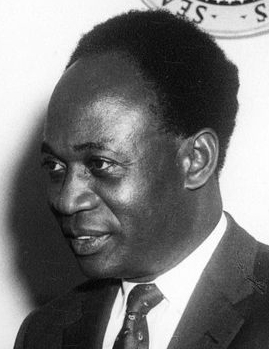
At midnight on 6 March 1957, the Gold Coast became Ghana, taking the name of a great medieval West African empire as a deliberate act of historical reclamation. It was the first sub-Saharan African colony to achieve independence, and the symbolism was immense. Delegations came from around the world. The American civil rights leader Martin Luther King Jr. was among the guests, and he later spoke of how the moment moved him and of meeting the new prime minister. To a roaring crowd at the old polo ground, Nkrumah declared that Ghana, their beloved country, was free forever, and then he added the line that defined the whole enterprise: that the independence of Ghana was meaningless unless it was linked up with the total liberation of the African continent. Independence for one nation was, in his mind, only the first step toward freedom for all.
President and Pan-African Leader
For three years Ghana remained a constitutional monarchy with Queen Elizabeth II as head of state, but Nkrumah intended his country to be a republic. On 1 July 1960, following a plebiscite, Ghana became a republic and Nkrumah became its first executive president, combining the roles of head of state and head of government. He set out to transform the country at a furious pace, determined to show that an African nation could industrialise and modernise on its own.
The centerpiece of his development vision was the Akosombo Dam on the Volta River. Begun in the early 1960s and completed in 1965, the dam created Lake Volta, one of the largest artificial lakes in the world, and supplied hydroelectric power to drive an aluminum smelter and to electrify the country. Nkrumah poured resources into roads, schools, hospitals, and a new harbor town at Tema. He expanded education dramatically and pushed for free schooling, helping to produce a generation of educated Ghanaians. He also invested heavily in industries and state enterprises, some successful, others wasteful, in a hurry to break the colonial pattern of an economy that exported raw cocoa and imported everything else.
But Nkrumah’s gaze was always fixed beyond Ghana’s borders. He believed that the small, fragmented states left behind by the colonial powers would remain weak and dependent unless they united. He championed the idea of a United States of Africa, a continental union with a common government, a common market, and a common defence. He set out these arguments in a series of books that gave him an intellectual stature few politicians possessed. In “Africa Must Unite,” published in 1963, he laid out the case for continental unity. In “Neo-Colonialism: The Last Stage of Imperialism,” published in 1965, he argued that political independence was being hollowed out by economic control exercised through foreign capital, trade, and aid, a system he called neo-colonialism. His writings circulated widely among activists and students across Africa and the diaspora.
His Pan-Africanism was not only theory. He helped fund and shelter liberation movements from across the continent, hosting fighters and exiles in Accra. In April 1958 he convened the first Conference of Independent African States, and later that year the All-African Peoples’ Conference, gathering nationalists from territories still under colonial rule. His efforts culminated in May 1963, when leaders of independent African nations met in Addis Ababa and founded the Organisation of African Unity (OAU), the body that would later evolve into the African Union. Nkrumah pressed hard at Addis Ababa for an immediate continental government, but most of the other leaders, jealous of their newly won sovereignty, preferred a looser association of states. He accepted the compromise, though he regarded the cautious outcome as a missed opportunity.
The Authoritarian Turn and Overthrow
As the years passed, the open and democratic movement that had carried Nkrumah to power gave way to something harder and narrower. Facing real opposition, regional rivalries, and several assassination attempts, including a bombing at Kulungugu in August 1962 that nearly killed him, he moved steadily toward concentrating power in his own hands. In 1958 his government passed the Preventive Detention Act, which allowed the state to imprison people without trial for renewable periods. Over the following years it was used against political opponents, and many were held without charge, among them his former ally Joseph Boakye Danquah, who died in detention in 1965.
In 1964, a referendum, conducted under conditions widely seen as neither free nor fair, formally turned Ghana into a one-party state with the CPP as the sole legal party and Nkrumah as president for life. A cult of personality grew up around him. His image appeared on currency and stamps, a large statue of him stood before Parliament, and the title Osagyefo, meaning redeemer or victorious warrior, was attached to his name. The vigorous internal democracy of the early CPP withered into loyalty and adulation.
At the same time the economy turned against him. The price of cocoa, Ghana’s main export and the source of most of its revenue, collapsed on world markets in the mid-1960s. The ambitious development projects and state enterprises had drained the reserves that Ghana held at independence, and the country slid into debt and shortages. Discontent spread among ordinary people who faced rising prices and scarce goods, and among soldiers and officials who resented both the economic mismanagement and the suppression of dissent.
The end came swiftly. In late February 1966, Nkrumah left Accra on a peace mission, flying east to China and then on toward North Vietnam, hoping to help mediate an end to the war there. While he was abroad, on 24 February 1966, a group of army and police officers seized power in a coup, declaring a National Liberation Council and accusing him of corruption, repression, and ruining the economy. Crowds in Accra toppled his statue. The man who had led Ghana into existence learned that he had been overthrown while he was thousands of miles away, unable to return.
Exile and Death
Nkrumah did not go home again. He flew instead to Guinea, the West African nation led by his fellow Pan-Africanist Ahmed Sekou Toure, who had stood with him in the years of struggle. In an extraordinary gesture of solidarity, Toure declared Nkrumah honorary co-president of Guinea and gave him a residence in Conakry, where he was received as a head of state rather than a fallen leader. From this base Nkrumah continued to write and to plot a return that never came. He produced further books, including reflections on the coup and works such as “Class Struggle in Africa” and “Consciencism,” sharpening his belief that genuine African liberation would require socialist transformation and unity, and that imperialism would always work to subvert leaders who threatened its interests.
The years in exile wore on his health. He was diagnosed with cancer, and in 1971 he traveled to Bucharest, in Romania, for treatment. There, far from the warm coast where he had been born and the country he had built, Kwame Nkrumah died on 27 April 1972, at the age of sixty-two. His body was first taken to Guinea, where Sekou Toure gave him a state reception. After negotiations, the government of Ghana allowed his remains to be returned home, and he was buried in his birthplace of Nkroful, the village where the goldsmith’s son had begun. Years later his remains were moved again, to a grand mausoleum in Accra built in his honor, so that the founder of the nation would rest at its heart.
Legacy
The judgment of history on Kwame Nkrumah has swung like a pendulum, and it is still in motion. In the years immediately after his fall, the governments that succeeded him often blamed him for Ghana’s troubles and tried to erase his memory. But the deeper currents of his life proved impossible to dam. As the decades passed, Ghanaians and Africans more broadly came to see him again as the man who broke the chains of colonial rule, the leader whose courage opened the door through which dozens of other nations would walk to freedom.
In Accra today, the Kwame Nkrumah Memorial Park stands on the site of the old polo ground where he proclaimed independence, his mausoleum and a striking statue drawing visitors from across the continent. His face appears on Ghanaian currency. In 2000, a poll by the British Broadcasting Corporation named him Africa’s man of the millennium. The African Union, the continental body that grew out of the OAU he helped found, traces part of its founding spirit directly to his vision, and Ghana observes Founders’ Day in his memory. Across Africa and in the diaspora, his name is invoked whenever people speak of unity, dignity, and the unfinished work of liberation.
His reputation remains complicated, and honestly so. The same man who led a mass democratic movement to topple an empire later jailed his opponents and built a one-party state and a cult of personality. The visionary who dreamed of industrial self-reliance also presided over economic mistakes that helped bring his government down. Admirers point to the historic achievement and the soaring ambition; critics point to the authoritarian drift and the costs it imposed. Both are part of the record. What is beyond dispute is his scale. Few individuals have so clearly altered the course of a continent. He gave a name to neo-colonialism, he founded a nation, and he carried, more fully than anyone of his generation, the idea that Africa’s many peoples shared a single destiny. The dream of a united Africa that he held has not been realised, but it has never died, and as long as it lives, so does Kwame Nkrumah.
Key Facts
- Kwame Nkrumah was born on 21 September 1909 in Nkroful, Gold Coast, and trained as a teacher before spending roughly a decade studying in the United States, where he was deeply influenced by Marcus Garvey and Pan-African thought.
- He founded the Convention People’s Party in 1949 under the slogan “Self-Government Now,” launched the Positive Action campaign, and won the 1951 election while imprisoned, leading to his release and rise to Prime Minister.
- On 6 March 1957 he led the Gold Coast to independence as Ghana, the first sub-Saharan African colony to break free from colonial rule; Ghana became a republic with Nkrumah as president on 1 July 1960.
- A leading Pan-Africanist, he helped found the Organisation of African Unity in 1963, built the Akosombo Dam, and wrote influential books including “Africa Must Unite” and “Neo-Colonialism: The Last Stage of Imperialism.”
- After moving toward a one-party state and amid economic crisis, he was overthrown in a military coup on 24 February 1966 while visiting China and Vietnam, and died in exile-related medical treatment in Bucharest, Romania, on 27 April 1972.
“The independence of Ghana is meaningless unless it is linked up with the total liberation of the African continent.” Kwame Nkrumah, 6 March 1957