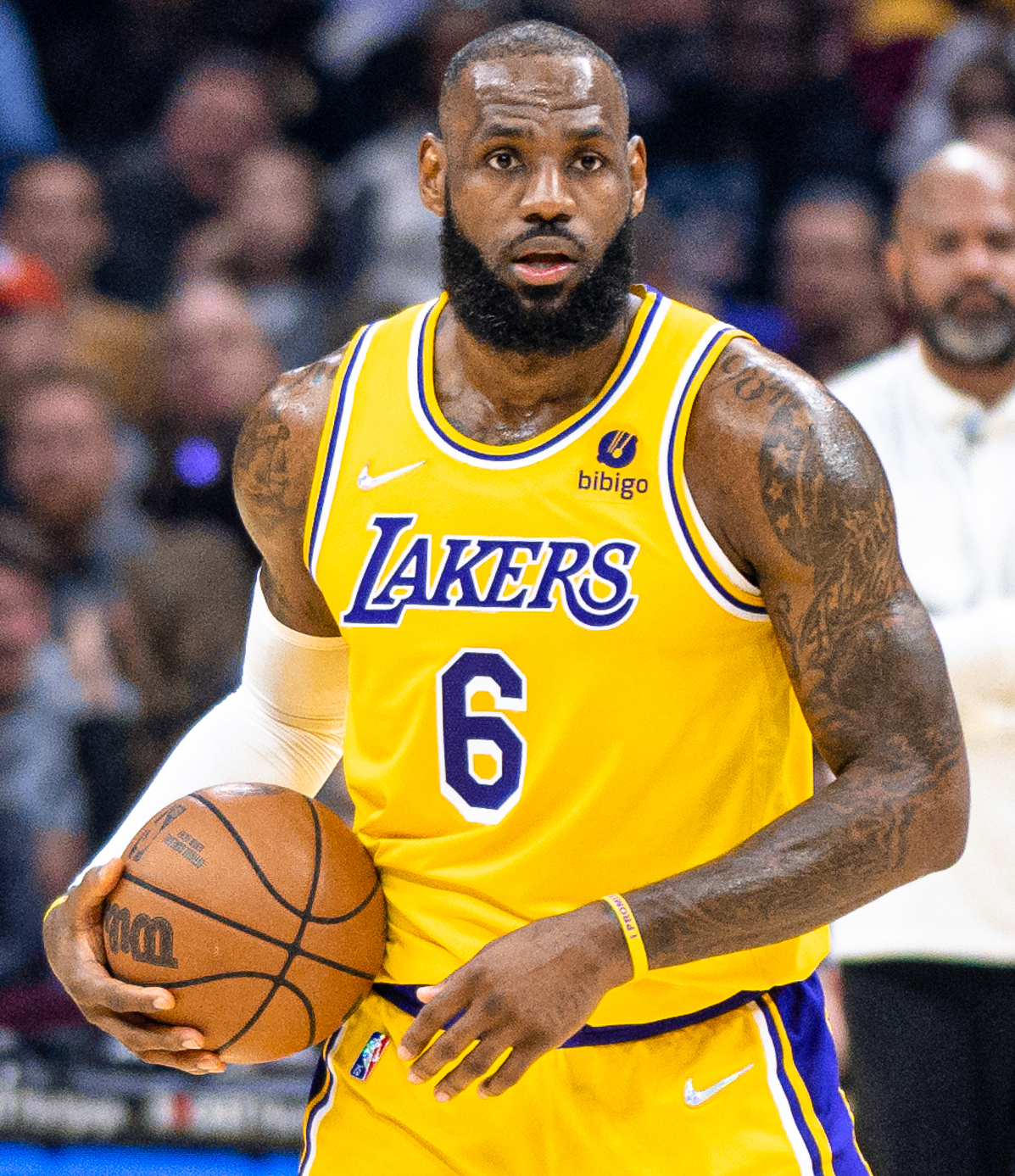
In the long and storied history of professional basketball, few players have ever entered the league carrying as much expectation as LeBron Raymone James. He was on the cover of Sports Illustrated at seventeen years old. He was dubbed “The Chosen One” before he had played a single minute of NBA basketball. The city of Akron, Ohio, a post-industrial city that had watched its rubber and manufacturing industries slowly collapse, pinned its hopes on a teenager who had never asked to be anyone’s saviour. What followed was not just a career but a sustained act of will, a four-decade demonstration that raw talent combined with relentless preparation and fierce intelligence could keep a man at the absolute summit of the most competitive sporting league in the world.
Quick Facts
- Full name
- LeBron Raymone James Sr.
- Born
- 30 December 1984, Akron, Ohio, USA
- Sport
- Basketball (NBA)
- Known for
- Four NBA championships, all-time NBA scoring record, four MVP awards
- Career highlight
- 2016 NBA Finals comeback from 3-1 deficit with the Cleveland Cavaliers
Early Life and Background
LeBron Raymone James was born on 30 December 1984 in Akron, Ohio, to Gloria James, who was sixteen years old at the time of his birth. His father, Anthony McClelland, was largely absent from his life, leaving Gloria to raise LeBron alone in circumstances that were frequently desperate. They moved often, sometimes staying with friends, sometimes in extended-family households, and sometimes without stable housing at all. Akron in the mid-1980s was a city in economic decline. The rubber industry that had once made it prosperous had been hollowing out for a decade, and the neighbourhoods where Gloria and LeBron found themselves were marked by poverty, crime and a chronic shortage of opportunity.
What saved LeBron, by his own account, was sport and the adults who gathered around it. When he was nine years old, Frank Walker Sr., a local youth football coach, invited LeBron to come and stay with his family for a time to give the boy some stability. It was a transformative intervention. Walker introduced LeBron to basketball in a structured setting, and the boy proved to have gifts that went far beyond anything Walker had expected. At a time when most children were still developing basic coordination, LeBron could already read the geometry of the court, anticipate where the ball was going and finish at the rim with either hand.
By the time he entered St. Vincent-St. Mary High School in Akron in 1999, word had spread across northeastern Ohio that something extraordinary was happening. His first-year varsity team, composed largely of freshmen, went 27 wins and 0 losses and won the Division III state championship. LeBron averaged 18 points per game as a fifteen-year-old. By his second season, the home gym could no longer contain the crowds that wanted to watch him, and the school moved its games to the University of Akron arena, which held 5,492 people. Those games sold out.
The Phenomenon Before the Draft
The 2001 to 2003 period of LeBron’s high school career was, by any measure, one of the most extraordinary passages in the history of American sport. He was competing against seventeen and eighteen year olds while performing at a level that NBA scouts said compared favourably with players already in the professional league. He averaged 31.6 points, 9.6 rebounds and 4.6 assists per game across his four-year high school career. His team went to four state championship games, winning three of them.
The hype around him became genuinely difficult to manage. A national television network, ESPN2, broadcast his games. Reporters from major newspapers and magazines followed him to practice. Nike, Adidas and Reebok were already circling, knowing that whoever signed him would secure not just an endorsement deal but a generation-defining commercial relationship. LeBron handled it with a composure that belied his age, deflecting questions about his future with careful humility while continuing to let his performances on the court do the loudest possible talking.
His senior year brought one controversy. The Ohio High School Athletic Association briefly declared him ineligible after he accepted two officially licensed football jerseys, valued at approximately 845 dollars, from a local sporting goods store. The decision prompted widespread outrage, was quickly reversed on appeal, and ultimately seemed to underscore just how absurd it was to apply amateur regulations to a player of his stature. He was already, before his nineteenth birthday, one of the most recognisable sportspeople in America.
Arriving in Cleveland
The Cleveland Cavaliers held the first pick in the 2003 NBA Draft, secured through what their fans would later describe as a miraculous lottery result. LeBron James was the inevitable selection. He was nineteen years old, 6 feet 8 inches tall and 240 pounds, and he stepped into a franchise that had never won an NBA championship and had spent most of its existence in the lower tier of the Eastern Conference.
His debut season was stunning by any reasonable standard. He averaged 20.9 points, 5.5 rebounds and 5.9 assists per game, becoming the youngest player in NBA history to average at least 20 points per game over a full season. He won the Rookie of the Year award. More importantly, he made the Cavaliers competitive almost immediately, dragging a roster of average players into the playoff picture through the sheer force of his presence, his ability to make teammates better and his willingness to take and make the biggest shots.
I like criticism. It makes you strong.
The 2006 to 2007 season brought the Cavaliers to the NBA Finals for the first time in franchise history, a remarkable achievement given the limitations of the supporting cast. Detroit, the team that had knocked Cleveland out of the playoffs two years running, was dispatched in a conference finals series that included one of the most iconic individual performances in playoff history. In Game 5, with the Cavaliers trailing in the final two minutes, LeBron scored 29 of his team’s final 30 points, finishing with 48 total. He virtually single-handedly dragged a team of limited co-stars into the championship series, where the San Antonio Spurs, then at the height of their dynasty under Tim Duncan and Gregg Popovich, swept them in four games. The series exposed the gap between LeBron’s individual brilliance and what his supporting cast could offer, a tension that would define his time in Cleveland.
The Decision and Miami
In July 2010, LeBron James announced his intention to leave Cleveland and join the Miami Heat in a one-hour live television special called “The Decision.” The announcement was almost universally condemned as self-aggrandising and needlessly cruel to Cleveland fans, and the backlash was swift and severe. Cavaliers owner Dan Gilbert published an open letter, written in comic sans font, denouncing LeBron and promising the franchise would win a championship before LeBron did. The letter captured the raw devastation of an entire city that felt abandoned.
In Miami, LeBron joined Dwyane Wade and Chris Bosh, forming a trio of stars that the basketball world instantly acknowledged as the most formidable collection of talent in the league. The Heat reached the NBA Finals in 2010 to 2011 but lost to the Dallas Mavericks in six games, with LeBron producing some of his least decisive performances in the most critical moments. The criticism reached a new pitch. He was accused of lacking the killer instinct that had defined Michael Jordan and Magic Johnson, of shrinking when the game was on the line.
The response was total. In the following 2011 to 2012 season, LeBron was remade, not physically but mentally. He carried the Heat back to the Finals, where they defeated the Oklahoma City Thunder in five games. LeBron averaged 26.9 points, 9.7 rebounds and 5.4 assists per game in the series and was named Finals MVP. The following year, 2012 to 2013, he did it again, leading Miami to another championship after one of the most dramatic comebacks in Finals history against the San Antonio Spurs. Game 6 of that series, in which the Heat trailed by five points with 28 seconds to play before rallying to win, is widely considered one of the finest single games in NBA history. LeBron’s contribution across the series: 37.1 points per game, 12.2 rebounds and 8.4 assists in Game 7 alone.
The Return to Cleveland and the Greatest Comeback
In 2014, LeBron announced he was returning to Cleveland. This time there was no television spectacle. He published a brief, carefully written essay explaining that he had unfinished business in Northeast Ohio and that he wanted to bring a championship to the city that had raised him. The reaction was the precise inverse of the reaction to “The Decision”: Cleveland celebrated, and much of the basketball world greeted the return with genuine warmth.
What followed over the next two seasons was a rebuilding process. The Cavaliers acquired Kyrie Irving and Kevin Love to give LeBron genuine co-stars, and the team went to the NBA Finals in 2014 to 2015, losing to the Golden State Warriors. The 2015 to 2016 season brought them back, this time against a Warriors team that had just won a record 73 games in the regular season, a team featuring Stephen Curry, Klay Thompson and Draymond Green at the absolute peak of their powers.
The Cavaliers fell behind three games to one in the series. No team in NBA Finals history had ever recovered from a 3-1 deficit to win the championship. LeBron James decided to change that. What he produced over Games 5, 6 and 7 is simply the most extraordinary sustained stretch of clutch performance in Finals history. He averaged 36.3 points, 11.3 rebounds and 8.9 assists across those final three games. In Game 7, with the score tied and the clock winding down, LeBron ran the length of the court to block Andre Iguodala’s layup from behind, a play that preserved the tie and changed everything. Kyrie Irving hit a three-pointer to put Cleveland ahead with 53 seconds left. The Cavaliers won by 93 points to 89.
LeBron James fell to the floor and wept. Cleveland had its championship. A city that had waited 52 years for a major professional sports title celebrated with an intensity that shook the country. The moment is regarded, by many who watched it, as the defining achievement of his career and one of the defining moments in the history of American sport.
Los Angeles and the Record Books
LeBron left Cleveland again after the 2017 to 2018 season, this time signing with the Los Angeles Lakers. The franchise that had been Michael Jordan’s great rival, the team of Magic Johnson and Kareem Abdul-Jabbar, was now his home. He brought them a championship in 2019 to 2020, played in a coronavirus-era bubble in Orlando, Florida. The title was the fourth of his career and came with his fourth Finals MVP award, making him the only player in NBA history to win Finals MVP with three different franchises.
In February 2023, against the Oklahoma City Thunder, LeBron James scored his 38,388th career point, surpassing Kareem Abdul-Jabbar’s record of 38,387 that had stood for 39 years. He became the all-time leading scorer in NBA history. He was 38 years old. The record prompted lengthy reflection on the sheer longevity of his career, maintained through extraordinary attention to physical conditioning, recovery and preparation. His annual spending on personal trainers, dieticians, sleep specialists and physical therapists is reported to exceed 1.5 million dollars, and the results are visible in the fact that he continued to produce All-Star level basketball deep into his thirties.
The Olympics and International Legacy
LeBron James has represented the United States at the Olympic Games on three occasions. He won a bronze medal at Athens in 2004, a gold medal at Beijing in 2008 as part of what became known as the “Redeem Team” (which recovered American pride after a string of international disappointments), and a gold medal at London in 2012. His participation in the Olympics gave him global visibility that extended well beyond basketball’s traditional markets and cemented his status as one of the most recognisable athletes on earth.
Beyond the court, LeBron has built a business empire that rivals those of any athlete in history. His company, SpringHill Entertainment, has produced films and television series. His production partnership, Uninterrupted, is a media platform aimed at amplifying athlete voices. His investment portfolio includes a stake in the Liverpool Football Club, one of the most valuable sports franchises in the world. In 2022, alongside partner Maverick Carter, he became part of a group that acquired a minority stake in the Boston Red Sox parent company.
The I Promise School
Perhaps the most significant of all his off-court contributions is the I Promise School, a public school in Akron opened in August 2018 in partnership with the LeBron James Family Foundation and the Akron Public Schools system. The school serves at-risk students from Akron’s most challenged communities, offering them extended school hours, additional social services, free meals, free uniforms, free bicycles and helmets for transportation, and guaranteed access to free tuition at the University of Akron upon graduation.
The school has been celebrated as a model for what athlete philanthropy can accomplish when it is grounded in genuine community knowledge and long-term institutional partnership rather than one-off charitable donations. LeBron does not write cheques to the school and move on. He visits, mentors students, employs family members and treats it as a living extension of his own origin story. The school serves approximately 1,600 students, and its graduation rates and academic outcomes have consistently exceeded those of comparable Akron schools.
Physical Gifts and Basketball Intelligence
Any honest assessment of LeBron James requires engaging seriously with what makes him extraordinary on the basketball court. The easy answer is his size: at 6 feet 8 inches and 250 pounds, he has the body of a power forward but the skill set of a point guard. He can post up smaller defenders, beat larger ones off the dribble, shoot from distance with reliable accuracy and deliver precise passes through the smallest windows. He can defend every position on the court. His athleticism at its peak placed him among the fastest and most explosive players in the league.
But what separates LeBron from physically gifted players who never fulfilled their potential is his basketball intelligence, what coaches call “court vision.” He processes the geometry of the game in real time at a speed that almost no player in history has matched. He knows where every player is, anticipates defensive rotations before they develop and delivers the ball to the correct spot consistently across a 48-minute game. He plays the game, in a phrase often used by analysts, as though he can see the immediate future.
His preparation is equally remarkable. He studies opposing defences with the diligence of a head coach. He has, by multiple accounts from teammates and opponents, memorised the tendencies of every player he has faced in important games. He adjusts his own game mid-series in ways that routinely surprise coaches who have prepared all week for his habits.
Legacy and Continuing Relevance
When the debate turns to the greatest basketball player of all time, LeBron James and Michael Jordan are the two poles around which all discussion orbits. Jordan has six championships to LeBron’s four. LeBron is the all-time scorer. Jordan’s defensive superiority is widely acknowledged. LeBron’s positional versatility is unmatched. The argument is genuinely unresolvable and entirely worthy of the enormous energy that fans and analysts pour into it, because both players represent the outer edge of what human beings can achieve in basketball.
What LeBron has done that no previous player quite managed is to sustain excellence across four decades of life. He was the best player in the world at nineteen and remained a legitimate contender for that title at thirty-eight. The volume of his statistics, measured across his entire career, is simply without precedent. He has more points, more assists and more win shares than any player who ever lived. He has made the playoffs in every season of his career except two. He has been selected to the All-Star Game twenty times.
He has also been, throughout his career, an unusually vocal athlete on political and social questions. He has spoken out on racial justice, police violence and voting rights with a consistency and specificity that goes well beyond the safe generalities most athletes permit themselves. When Nike chose to feature Colin Kaepernick in a 2018 advertising campaign, LeBron was among the most prominent public supporters. He launched a voter registration initiative called More Than a Vote before the 2020 presidential election that helped register hundreds of thousands of voters in key states, concentrating specifically on historically Black communities.
Key Facts
- LeBron James became the NBA’s all-time leading scorer in February 2023, surpassing Kareem Abdul-Jabbar’s record of 38,387 points, a record that had stood for 39 years.
- He has won four NBA championships (2012, 2013 with the Miami Heat; 2016 with the Cleveland Cavaliers; 2020 with the Los Angeles Lakers) and four Finals MVP awards.
- His 2016 Finals victory, overcoming a 3-1 deficit against the 73-win Golden State Warriors, is widely regarded as the greatest individual performance in NBA Finals history.
- The I Promise School in Akron, opened in 2018 through the LeBron James Family Foundation, serves approximately 1,600 at-risk students and offers guaranteed college tuition.
- He has represented the United States at three Olympic Games, winning gold medals at Beijing 2008 and London 2012.