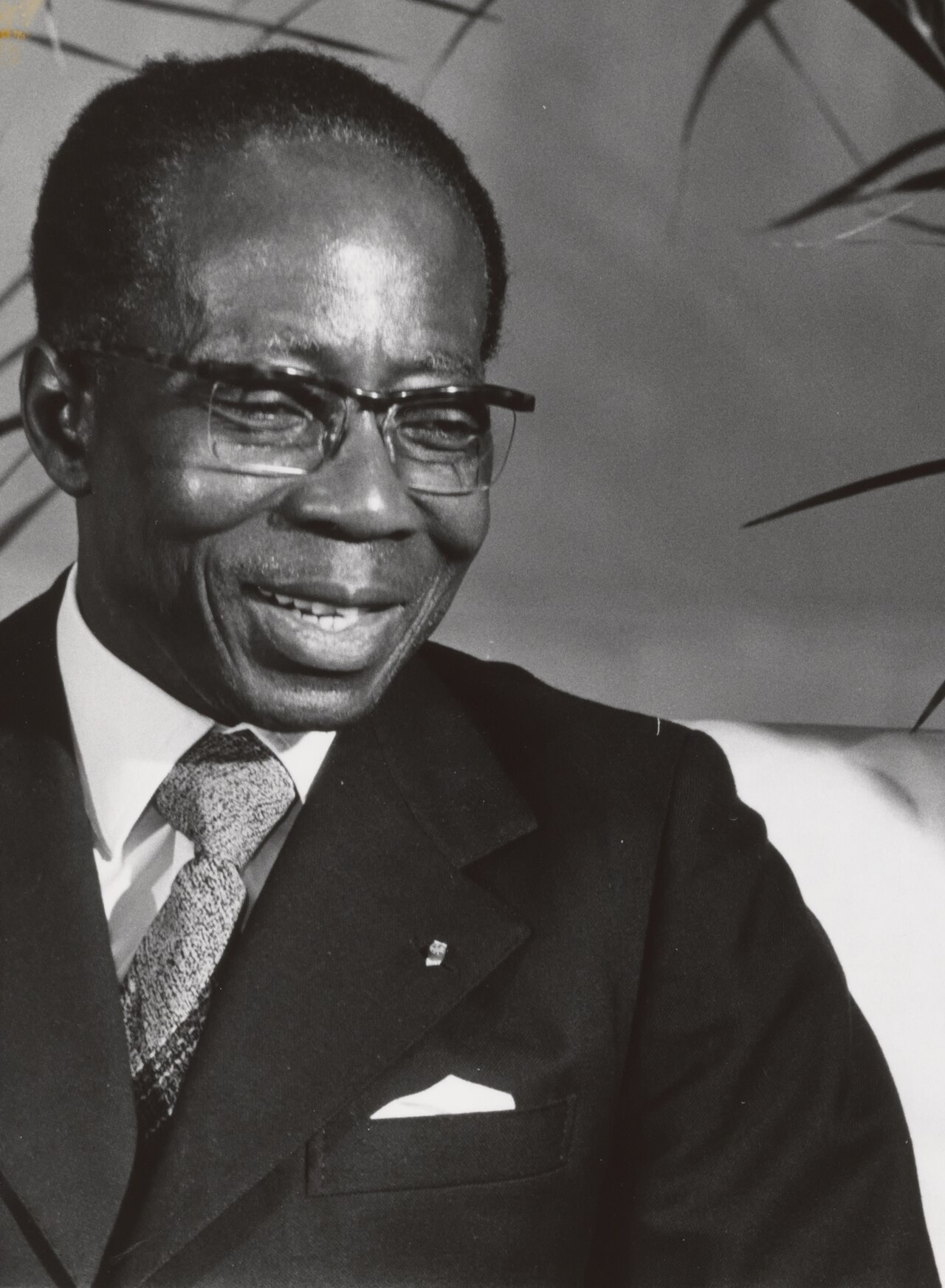
In the long history of the twentieth century, very few men managed to wear two crowns at once: the crown of the poet and the crown of the head of state. Leopold Sedar Senghor wore both, and he wore them for a lifetime. He was a man who could stand before the National Assembly in Paris to debate the future of a continent, then retreat to his study to labour over a single line of verse until it sang. He led Senegal to independence, governed it for two decades, and then did something almost unheard of among the leaders of his generation: he walked away from power of his own free will. And when the most exclusive literary institution in France, the Academie francaise, finally opened its doors to an African, that African was Senghor.
His life spanned nearly the whole of the twentieth century, from a fishing village on the Atlantic coast of West Africa in 1906 to a quiet town in Normandy in 2001. Along the way he became one of the founding thinkers of Negritude, a movement that taught a generation of colonised Africans and people of African descent to take pride in who they were. This is the story of how a boy from Joal became the poet-president who shaped modern Senegal.
Quick Facts
- Full name
- Léopold Sédar Senghor
- Born
- 9 October 1906, Joal, Senegal (then French West Africa)
- Died
- 20 December 2001, Verson, France (aged 95)
- Known for
- First President of Senegal (1960 to 1980); poet and theorist of Negritude
- Honour
- First African elected to the Academie francaise
Early Life in Joal
Leopold Sedar Senghor was born on 9 October 1906 in Joal, a small coastal town south of Dakar, on the Atlantic shore of what was then French West Africa. Joal was, and still is, a place shaped by the sea. Its people fished, traded, and lived with one foot in the salt air of the ocean and the other in the red earth of the Senegalese interior. Senghor’s memories of this landscape, the tides, the baobab trees, the sound of the drums during festivals, stayed with him for the whole of his life and later poured into his poetry.
His family belonged to the Serer people, one of the major ethnic groups of Senegal. His father, Basile Diogoye Senghor, was a relatively prosperous groundnut trader, a man of standing in the local community. Through his family Senghor absorbed the customs, proverbs, and spiritual sensibility of Serer culture, a world of ancestors, kinship, and deep attachment to the land. He often spoke in later years of the mothers and grandmothers of his childhood, of the storytellers and the rhythms of village life, as the true foundation of everything he became. His middle name, Sedar, carried Serer meaning, and he wore it with pride throughout his public career.
Yet Senghor was also raised a Roman Catholic in a country where the great majority of people were, and are, Muslim. This was unusual, and it marked him for life. He received his first schooling at a Catholic mission, the school of the Fathers of the Holy Ghost at Ngazobil, and later continued his studies in Dakar at a seminary and then at a secular secondary school. For a time the young Senghor even considered entering the priesthood, but the path of the seminary did not suit him, and he turned instead towards the wider world of learning. Even so, his Catholic faith remained a quiet constant in his life, a personal devotion that coexisted, without apparent contradiction, alongside his profound respect for the traditional beliefs of his own people and for the Muslim faith of his fellow citizens.
By his late teens Senghor had shown himself to be a gifted student, especially in the French language and in Latin and Greek. In 1928, at the age of twenty-one, he won a scholarship that would carry him across the sea to France. It was the journey that would change everything.
Education in France
When Senghor arrived in Paris in 1928, he stepped into the intellectual capital of the French empire. He enrolled first at the Lycee Louis-le-Grand, one of the most prestigious secondary schools in the country, a place that had trained generations of French statesmen and scholars. There he prepared for the entrance examinations to the grandes ecoles, and there he met a young man from the Caribbean island of Martinique named Aime Cesaire, a friendship that would prove momentous for the history of ideas.
Senghor’s academic gifts carried him steadily upward. He studied at the Sorbonne and immersed himself in French literature, philosophy, and linguistics. In 1935 he achieved something no Black African had done before: he passed the agregation, the fiercely competitive national examination that qualifies a person to teach at the highest levels of the French system. He became an agrege in grammar, a distinguished scholar of the French language itself. It was a remarkable accomplishment for anyone, and for a young man from a Senegalese fishing town it was extraordinary.
With this qualification Senghor began a career as a teacher in France. He taught for several years in the town of Tours and later in the suburbs of Paris, standing before classrooms of French pupils as a master of their own language and literature. He read the great French poets, absorbed the currents of European modernism, and at the same time began to reflect ever more deeply on what it meant to be an African living inside French civilisation. He was formed by France, and he loved much of French culture genuinely, yet the more he learned, the more he came to feel that something essential about his own heritage was being denied and diminished by the colonial world. Out of that tension a new philosophy began to take shape.
Negritude
In the Paris of the 1930s, a small circle of Black students and writers from Africa and the Caribbean began to meet, talk, and dream. Among them were Senghor from Senegal, Aime Cesaire from Martinique, and Leon Damas from French Guiana. Together these three men became the founders of what came to be known as Negritude, one of the most influential intellectual movements to emerge from the colonial world in the twentieth century.
Negritude was, at its heart, an act of self-reclamation. Colonial society had taught Black people that their cultures were primitive, their history empty, their skin a mark of inferiority. Negritude answered that lie with a defiant celebration of Black and African identity, culture, and values. Cesaire is credited with coining the word itself, and the three friends developed it through poetry, essays, and the reviews and journals they helped to create in Paris. They insisted that African civilisations had their own dignity, their own genius, their own contributions to make to humanity. Where colonialism preached shame, Negritude preached pride.
For Senghor, Negritude was never a call for hatred or for the rejection of other cultures. He conceived of it as a gift that Africa could offer to a shared human civilisation, and he spoke of a future in which the peoples and cultures of the world would meet and enrich one another. He famously described a coming together of world cultures as a great gathering of giving and receiving, a rendezvous where each civilisation would contribute its own truth. This generous, universalist vision distinguished his version of Negritude from more radical strands, and it drew criticism from some younger thinkers who felt it was too accommodating towards France. But it was authentically his, rooted in his conviction that African values of emotion, rhythm, community, and spiritual depth had a permanent place in the human story.
Above all, Senghor expressed these ideas as a poet. He became one of the most celebrated African poets writing in the French language, publishing collections that drew on the imagery of his Senegalese childhood, the sorrows of exile, the pain of colonialism, and the beauty of the African landscape and its people. His verse won admiration across the French-speaking world and beyond, and it remains central to the canon of African literature. He was, throughout everything else he did, a working poet, and he continued to write and refine his poetry across the decades of his political life.
“Emotion is completely Negro as reason is Greek.”
That single, often-quoted line, from his essays on Black civilisation, captures both the ambition and the controversy of his thought. It was meant as praise, an assertion that intuition and feeling were as valid a way of knowing the world as cold logic. Critics through the years have debated it fiercely, but no one disputes that Senghor forced the world to take African thought seriously as thought.
War and Politics
The Second World War interrupted the quiet life of the scholar-poet. When France went to war with Nazi Germany, Senghor, who had by then become a French citizen and a soldier of the French army, was called to serve. In 1940, as German forces overran France, he was captured and made a prisoner of war. He spent roughly two years in German prison camps, held in conditions of hardship, before he was released, in part because of illness. During his captivity he continued to write, and the experience of imprisonment deepened his poetry and sharpened his sense of the injustices of the colonial order that had sent African soldiers to die for a Europe that treated them as lesser men.
After his release he joined in the resistance to the German occupation and returned to teaching. But when the war ended in 1945 and France began to reorganise its relationship with its colonies, Senghor was drawn into public life. That year he was elected as a deputy representing Senegal in the French Constituent Assembly in Paris, part of the process of writing a new constitution for postwar France and its empire. He was, in effect, one of the African voices at the table where the future of French Africa was being discussed.
From that moment Senghor’s life belonged as much to politics as to literature. He worked within the French parliamentary system for well over a decade, representing Senegal, building alliances, and steadily accumulating influence. He also helped to found political movements at home in Senegal, cultivating a base of support among rural voters and forging a distinctly Senegalese political identity. He proved to be a patient, subtle, and formidable political operator, and by the late 1950s he had become the dominant figure in Senegalese politics.
The Road to Independence
The 1950s brought a wave of change across Africa as colony after colony pressed towards self-government and independence. In French West Africa the question was not only when independence would come, but in what shape. Senghor was deeply involved in these debates. He was cautious about breaking too sharply and too suddenly with France, favouring gradual approaches and larger federations rather than a scramble of small, separate states. He worried that tiny nations, carved arbitrarily from the colonial map, would struggle to survive alone.
Out of this thinking came the Mali Federation, an attempt to unite Senegal with the neighbouring territory of French Sudan (now the Republic of Mali) into a single larger nation. The federation was formally established and gained its independence from France in June 1960. But the union was fragile from the start. Political and personal tensions between the leaders of the two territories quickly proved impossible to bridge, and within a matter of months the federation collapsed. In August 1960 Senegal withdrew and declared itself a separate, fully independent republic.
On 5 September 1960, Leopold Sedar Senghor was chosen as the first President of the Republic of Senegal. The boy from Joal, the scholar who had mastered the language of the coloniser, the poet who had taught his people to be proud of who they were, now stood at the head of an independent African nation. He was fifty-three years old, and he would hold that office for the next twenty years.
President of Senegal
Senghor governed Senegal from 1960 to 1980, one of the longest presidencies of the first generation of African leaders. His years in power were shaped by the ideas he had spent his whole life developing, and by the hard realities of running a young and poor nation.
At the centre of his political philosophy was what he called African socialism. Senghor rejected the rigid, atheistic, class-war Marxism of the Soviet model. Instead he argued for a socialism rooted in African traditions of community, solidarity, and shared responsibility, blended with his Catholic humanism and a respect for spiritual life. He believed that Africa should not simply import European ideologies wholesale but should build its own path, drawing on the communal values of its own past. In practice this meant an emphasis on cooperatives, rural development, and the groundnut economy that was the backbone of Senegal, though the results were mixed and the country remained heavily dependent on that single crop and on French support.
Culture and education stood at the heart of his presidency in a way that was rare among heads of state. Senghor treated the life of the mind as a matter of national importance. He championed schools, promoted the arts, and in 1966 Senegal hosted the First World Festival of Negro Arts in Dakar, a landmark gathering that brought together artists, writers, musicians, and intellectuals of African descent from around the globe to celebrate Black creativity. For Senghor this was not a distraction from governing; it was the very expression of what he believed a free Africa should be.
His rule was not without serious criticism, and honesty requires that it be recorded. For much of his presidency Senegal was effectively a one-party state, with power concentrated in his own party, and opposition was constrained. There were periods of political tension, including a grave crisis in 1962 when his prime minister, Mamadou Dia, was accused of attempting a coup, arrested, and imprisoned, an episode that left a lasting shadow. Student and worker unrest, notably in 1968, tested his government. Later in his rule Senghor did move to loosen the system, permitting a limited number of opposition parties to operate towards the end of the 1970s, a cautious step back towards pluralism.
Senghor’s foreign policy was moderate and notably pro-French. He kept Senegal firmly within the French sphere of influence, maintained close ties with Paris, and remained a champion of the French language and of the broader Francophone world. To his admirers this brought stability, continuity, and international respect. To his critics it looked like a failure to break cleanly enough with the former colonial power. Both judgements contain truth, and both belong to the full picture of a complicated statesman.
A Peaceful Exit and the Academie
In 1980, at the very end of the year, Leopold Sedar Senghor did something that set him apart from almost every other African leader of his era. He resigned the presidency. He was not overthrown, not forced out by a coup, not dying in office. He simply chose to step down, of his own accord, and to hand power peacefully to his chosen successor, Abdou Diouf. In a period when African politics was too often marked by military takeovers and rulers who clung to power for life, Senghor’s voluntary, orderly transfer of authority was a rare and dignified act, and it did much to establish Senegal’s later reputation as one of Africa’s more stable democracies.
Having laid down the burdens of office, Senghor returned to the work he had never truly abandoned: literature. And in 1983 came the crowning honour of his intellectual life. The Academie francaise, the venerable institution founded in the seventeenth century to guard and cultivate the French language, elected Leopold Sedar Senghor to its ranks. He became the first African, the first Black person, ever to be admitted to that most exclusive body of forty immortals, as its members are traditionally called. It was a profound recognition, both of his own genius and of the place that African writers had won within the French language. That the man honoured as a master of French letters was the same man who had spent his youth teaching Africans to prize their own heritage was a symmetry that few could have imagined at the start of his life.
Senghor spent his final years largely in France, in his wife’s native Normandy, still reading, still reflecting. He died on 20 December 2001 in the town of Verson, at the age of ninety-five, having lived through nearly the entire century he had helped to shape.
Career Timeline
- 1906: Born on 9 October in Joal, in French West Africa (present-day Senegal), into a Serer family.
- 1928: Wins a scholarship and travels to Paris, enrolling at the Lycee Louis-le-Grand, where he meets Aime Cesaire.
- 1935: Passes the agregation in grammar, becoming the first Black African to earn this qualification, and begins teaching in France.
- 1930s: Helps found the Negritude movement alongside Aime Cesaire and Leon Damas and emerges as a leading French-language poet.
- 1940: Captured by German forces during the Second World War and held as a prisoner of war for roughly two years.
- 1945: Elected as a deputy representing Senegal in the French Constituent Assembly, entering political life.
- 1960: The Mali Federation gains independence in June; after its collapse, Senegal becomes fully independent and Senghor is chosen as its first president in September.
- 1980: Voluntarily resigns the presidency at the end of the year, handing power peacefully to Abdou Diouf.
- 1983: Elected to the Academie francaise, the first African ever admitted.
- 2001: Dies on 20 December in Verson, France, aged 95.
Lesser-Known Facts
- He was a poet first and a politician second, in his own heart. Senghor never stopped writing verse even while governing a nation, and he is regarded as one of the most important African poets of the French language, a rare case of a working head of state who was also a major literary figure.
- He co-founded Negritude in Paris in the 1930s. Together with Aime Cesaire of Martinique and Leon Damas of French Guiana, he built a movement that taught colonised Black people across the world to reclaim pride in their identity and culture.
- He was the first African elected to the Academie francaise. In 1983 he broke a barrier that had stood since the institution’s founding in the 1600s, becoming the first Black person ever to join France’s most prestigious guardian of its language.
- He gave up power voluntarily. His decision to resign the presidency in 1980 and hand over peacefully was almost unique among African leaders of his generation and helped set Senegal on a path of relative political stability.
- He was a Catholic leading a mostly Muslim nation. Roughly nine in ten Senegalese were Muslim, yet Senghor, a devout Roman Catholic, governed with broad acceptance, a testament to Senegal’s tradition of religious tolerance and to his own inclusive style.
- He passed one of France’s hardest exams. His 1935 success in the agregation in grammar made him a certified master of the French language itself, an achievement that placed him among the intellectual elite of the entire French system.
Frequently Asked Questions
Who was Leopold Sedar Senghor? Leopold Sedar Senghor was a Senegalese poet, philosopher, and statesman who served as the first President of Senegal from 1960 to 1980. He was also one of the founders of the Negritude movement and the first African to be elected to the Academie francaise. He is remembered as one of the most important African intellectuals and political leaders of the twentieth century.
What is Negritude? Negritude was a literary and philosophical movement founded in Paris in the 1930s by Senghor, Aime Cesaire, and Leon Damas. It was a celebration and reclamation of Black and African identity, culture, and values in response to the racism and cultural denial of colonialism. Rather than accepting the colonial idea that African cultures were inferior, Negritude asserted their dignity and their contribution to human civilisation.
When did Senegal gain independence? Senegal became independent in 1960. It first gained independence in June 1960 as part of the short-lived Mali Federation with French Sudan, and after that federation broke apart, Senegal declared itself a fully separate independent republic in August 1960, with Senghor becoming its first president in September of that year.
Was Senghor a poet? Yes. Senghor was a celebrated poet who wrote in the French language and is considered one of the greatest African poets of his era. He published several collections of poetry drawing on his Senegalese heritage and the themes of Negritude, and he continued to write throughout his long political career.
Why is he historically significant? Senghor is historically significant as a founder of Negritude, as the first president of an independent Senegal, as a rare African leader who voluntarily surrendered power, and as the first African admitted to the Academie francaise. He uniquely combined a life of the highest intellectual achievement with two decades of national leadership, shaping both African thought and the modern Senegalese state.
Legacy
The legacy of Leopold Sedar Senghor is written in ink and in institutions, in poems and in a nation. As a thinker, he gave the world Negritude, a philosophy that helped millions of people of African descent to stand taller and to see their own culture as a source of pride rather than shame. Its ideas rippled outward across the decades, influencing writers, artists, and political movements far beyond Senegal, and the debates he provoked about African identity remain alive today.
As a statesman, he built the foundations of a Senegal that, whatever the flaws of his rule, emerged as one of the more stable and open societies on the continent. His voluntary departure from the presidency in 1980 set a precedent for peaceful transitions of power that shaped Senegal’s political culture for generations after him. The country’s international airport near Dakar bears his name, as do schools, streets, and cultural institutions, and he is invoked as a father of the nation.
And as a poet who became an immortal of the Academie francaise, he stands as living proof that the boundaries of the mind respect no colour and no colonial line. He was a bridge between worlds, between Africa and Europe, between tradition and modernity, between the drumbeat of Joal and the salons of Paris. He did not resolve every contradiction of his time, and he did not try to. He lived inside them, and out of them he made poetry, philosophy, and a country. Leopold Sedar Senghor died in 2001, but the poet-president who shaped modern Senegal remains one of Africa’s enduring giants.