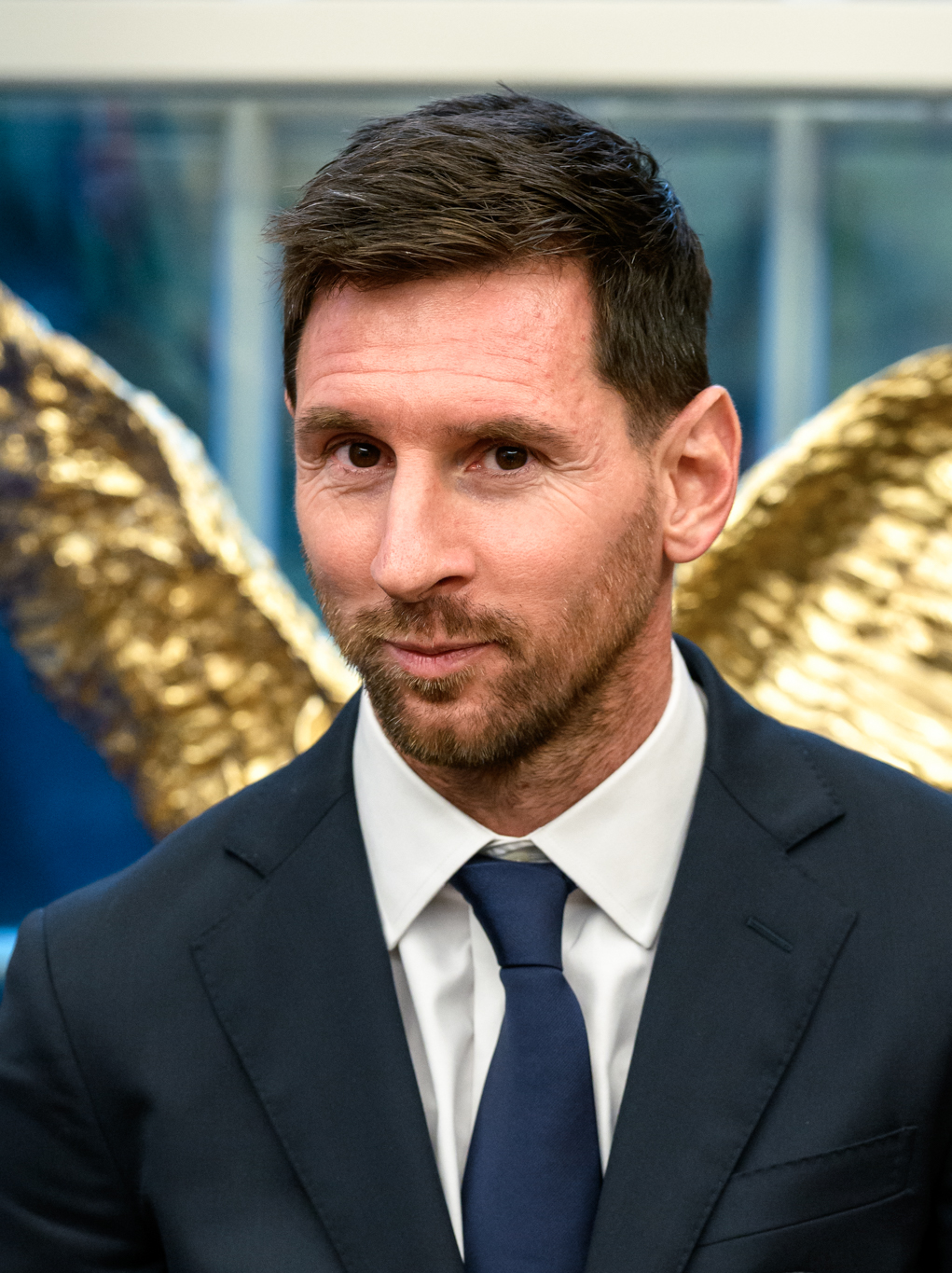
There are moments in sport that feel less like athletic achievement and more like the settling of a long-overdue debt. On the night of December 18, 2022, in Lusail, Qatar, Lionel Messi lifted the FIFA World Cup trophy above his head and Argentina erupted in a joy that had been building for thirty-six years. In that moment the last asterisk was removed from the most remarkable career in football history. A boy from Rosario who had been told his body was failing him at ten years old, who had left his family at thirteen to chase a dream in a foreign country, who had endured sixteen years of international heartbreak with Argentina before his nation finally embraced him as its saviour, held the only trophy he had never won. The debate, long the sport’s most passionate argument, was over. Lionel Messi was the greatest footballer of all time.
Quick Facts
- Full name
- Lionel Andrés Messi Cuccittini
- Born
- 24 June 1987, Rosario, Argentina
- Nationality
- Argentine (also holds Spanish citizenship)
- Known for
- Eight Ballon d'Or awards, 2022 FIFA World Cup winner, record 91 goals in a calendar year
- Career highlight
- Leading Argentina to the 2022 FIFA World Cup title in Qatar
- Club goals for Barcelona
- 672 (all-time record for a single club)
- International goals for Argentina
- 109 (national record)
A Boy from Rosario
Lionel Andrés Messi Cuccittini was born on June 24, 1987, in the city of Rosario, in the Santa Fe province of Argentina. Rosario is a port city of about one million people, known for its working-class pride, its passionate football culture, and the club Newell’s Old Boys, where young Lionel would begin to reveal what he was. His father, Jorge Messi, worked as a manager in a steel factory. His mother, Celia Cuccittini, balanced raising the family with work of her own. They were a tight-knit household in a modest neighbourhood, and football was the language everyone spoke.
The game found Lionel before he could properly read. His grandmother, Celia Olivia, recognised his extraordinary gift first and drove him to every training session he ever attended as a young child. When she died in 1998, the grief hit him so hard that he began his habit of pointing skyward whenever he scored a goal, a tribute to her that he has maintained ever since. Losing her was the first of several setbacks that would shape him, and the way he responded to each of them would become the defining pattern of his life.
By the age of eight he had joined Newell’s Old Boys, a club with deep roots in Rosario. In four years playing for the junior team he scored almost five hundred goals. Opponents and coaches alike described watching him as a surreal experience, a small boy who moved as though the ball were attached to his boot by an invisible thread, changing direction without slowing, absorbing contact without falling, seeing passes and runs that no one else around him had thought of. He was playing football at a different speed to everyone else, and he was doing it at age ten with his hands in his pockets when the weather was cold because he never needed to use them for balance.
The Diagnosis That Changed Everything
In 1997, when Messi was ten years old, doctors diagnosed him with a growth hormone deficiency, a condition in which the pituitary gland does not produce enough of the hormone that drives normal physical development. The treatment required daily injections of synthetic growth hormone, administered by needle into his legs. The cost at the time was roughly nine hundred dollars a month, a sum that stretched the family’s finances close to breaking point. Newell’s Old Boys agreed to fund the treatment for a while, then stopped. River Plate, another Argentine giant, expressed interest and then pulled back when the cost of the medication was raised. Every door at home seemed to close.
The therapy was working physically: Messi was growing, the injections were doing what they were supposed to do. But the family faced a genuine crisis. The solution, when it came, arrived from Spain. FC Barcelona had been alerted to the prodigy in Rosario, and in late 2000 a scout named Carles Rexach flew to Argentina specifically to see the boy. After watching him play for only a few minutes, Rexach was certain. The story of what followed has become part of football mythology: a handwritten agreement to sign the thirteen-year-old, composed because no official contract paper was available, scrawled on a paper napkin in the cafeteria of the Real Club de Tenis de la Salud in Barcelona. Barcelona would take Lionel Messi on, pay for his treatment, and set him on a path that would change the sport forever.
La Masia and the Making of a Champion
In February 2001, Lionel Messi arrived in Barcelona with his father Jorge. He was thirteen years old. He spoke no Catalan and limited Spanish. He missed his mother, his brothers Rodrigo and Matías, and his sister María Sol, who would follow later with the rest of the family. He missed Rosario, missed his friends, missed the streets he had grown up on. He enrolled in Barcelona’s famous youth academy, La Masia, a residential training centre that had already produced some of the finest players in Spanish football.
La Masia in those years was a place of genuine footballing education. Players were taught to control the ball under pressure, to think two passes ahead, to treat possession as sacred. For the Argentine teenager with the gift that no coach had quite been able to explain, the environment was both challenging and clarifying. He was now surrounded by genuinely good players, forced to raise his own standard to compete for his place in the youth sides. He did exactly that. Within a year he was regularly the best player at every age level he competed at.
His integration was not without difficulty. He was shy, small even compared to his youth-team contemporaries, and initially reluctant to speak up. His teammates and coaches recalled a boy who communicated primarily through his feet, letting the quality of his play do every bit of talking that was needed. When he did open up, usually in small groups over meals at the academy, a dry, quiet humour emerged. He was intensely private, already developing the reserve that would characterise his public persona for the rest of his career.
By 2003, at fifteen, he was attracting internal excitement at the club that filtered out to the Spanish football press. By 2004 the first-team staff were paying attention.
The First-Team Breakthrough
On October 16, 2004, under manager Frank Rijkaard, Lionel Messi made his official first-team debut for FC Barcelona in La Liga. He was seventeen years and three months old. The match was against Espanyol, the city’s second club and a fierce local rival. Messi came on as a substitute in the second half. He was the youngest player ever to appear for the first team at that point in the club’s history. Within minutes, those watching in the Camp Nou stood up to look more carefully at the small figure in the number-thirty shirt.
His full La Liga debut followed, and the goals and assists accumulated from the start. In May 2005, at a friendly in Porto, he scored his first official first-team goal, a moment of such instinctive beauty that the stadium fell briefly silent before the applause caught up with what had just happened. By this point it was already clear that Barcelona were not managing a talent; they were in the process of discovering what he was, a question that would take another fifteen years to fully answer.
He won his first La Liga title with Barcelona in the 2004 to 2005 season. He was seventeen. He was just getting started.
The Guardiola Era: Four Ballon d’Ors and a World Record
Everything accelerated when Pep Guardiola took charge of Barcelona in the summer of 2008. Guardiola, a former Barcelona midfielder and a tactical visionary, looked at the twenty-one-year-old Messi and made a decision that redefined the position of centre forward. Rather than asking Messi to play as a wide attacker or a second striker, Guardiola gave him the false-nine role: operating from the space between the opposing midfield and defence, dropping deep to collect the ball, dragging defenders out of position, and then releasing teammates or driving forward himself. It was a system designed to place the ball at Messi’s feet as often as possible and to give him the freedom to make every decision in real time.
The results were historic. In the 2008 to 2009 season Barcelona won the treble: La Liga, the Copa del Rey, and the UEFA Champions League. In the Champions League final in Rome, against Manchester United, Barcelona won 2-0. Messi scored the second goal with a glancing header from Xavi’s cross, rising improbably to meet the ball and send it past Edwin van der Sar. For a man of his height to score a header in a Champions League final was a comment, delivered without words, on the absurdity of trying to predict what he would do next.
That year he won the first of his Ballon d’Or awards, the prize given annually to the best footballer in the world. The following year he won it again. Then again in 2011. Then a fourth consecutive time in 2012, a sequence that had never been achieved before and remains unprecedented to this day.
The 2010 to 2011 season brought another treble and another Champions League title, the final won at Wembley against Manchester United 3-1, with Messi scoring the decisive third goal in a performance of complete mastery. Xavi, Andrés Iniesta, Dani Alves, Gerard Piqué, Víctor Valdés, Sergio Busquets: the team around him was extraordinary. But it was Messi who held it together and elevated it beyond anything those brilliant individual pieces might have produced without him.
Then came 2012, and a record that may never be broken.
Ninety-One Goals: The World Record That Still Stands
In the 2012 calendar year, from January through December, Lionel Messi scored 91 goals in official competitive matches for Barcelona and the Argentine national team combined. The previous record, set by Gerd Müller of West Germany across the entire year of 1972, was 85 goals. Messi did not just break the record; he obliterated it. He set the record in a match against Real Betis in December, scoring twice to take his tally past Müller’s mark, and the Camp Nou crowd gave him a standing ovation before the final whistle.
To understand what 91 goals in a calendar year means: it averages out to roughly one goal every four days. It includes Champions League goals, La Liga goals, Copa del Rey goals, and international goals. It was scored against every type of defence, on every kind of pitch, in every kind of pressure situation. No goalkeeper, no defensive shape, no tactical innovation thrown at him across the full year proved capable of stopping him consistently. He was operating at a level of sustained brilliance that had no reference point in the history of football.
That same year he won his fourth consecutive Ballon d’Or. The ceremony was marked by the conspicuous absence of Cristiano Ronaldo, who had won the award in 2008 and would win it again, but who at that moment was watching the Argentinian make the debate about football’s greatest player into a two-man argument that would run for another decade.
El Clasico and the Great Rivalry with Ronaldo
No discussion of Messi’s Barcelona years is complete without the rivalry with Real Madrid and, inseparable from that, the comparison with Cristiano Ronaldo. Between 2009 and 2019 the two men dominated every list, every award ceremony and every discussion about football to a degree that squeezed almost every other player to the margins. Ronaldo, the Portuguese superstar who joined Real Madrid in 2009 for what was then a world-record transfer fee of eighty million pounds, was the only player on the planet capable of matching, and sometimes exceeding, Messi’s statistical output in any given season.
Their meetings in El Clasico, the twice-yearly clash between Barcelona and Real Madrid that doubles as the biggest regular club match in world football, were spectacles of the highest order. Messi scored in countless Clasicos, frequently at decisive moments. He has stood in the Bernabéu stadium after scoring to hold up his shirt to the home crowd in a moment of deliberate, icy theatre. He has delivered late winners at the Camp Nou that reduced Real Madrid to silence. The rivalry between the clubs gave the rivalry between the two players a stage worthy of both, and their alternating wins of the Ballon d’Or from 2008 onward turned what had previously been an annual formality into a genuine contest.
The debate about which of the two was better split football supporters into opposing camps with a vehemence usually reserved for political arguments. Those who favoured Ronaldo pointed to his physical power, his goal-scoring record and his success across multiple leagues in England, Spain and Italy. Those who favoured Messi pointed to his creativity, his assists, his link-up play and the way that every team he played for, regardless of its quality, became better around him. That debate intensified after 2022 when Messi won the World Cup, a trophy Ronaldo has never reached the final of. It has not fully ended, and it probably never will. But the weight of collective expert opinion, by a considerable margin, has settled on the side of the Argentine.
Champions League Glory and Barcelona Records
By the time his Barcelona career was winding down, Messi had accumulated statistics that required a separate ledger. He won four Champions League titles with the club, in 2006, 2009, 2011 and 2015. The 2015 final in Berlin, won 3-1 against Juventus, was a masterclass in team play, with Messi, Neymar and Luis Suárez, the attacking trio nicknamed MSN, combining with a fluency that recalled the great Barcelona sides of the Guardiola era.
He won ten La Liga titles with Barcelona, six Copa del Rey titles, and three Club World Cup trophies. He was La Liga’s top scorer seven times. He won the Pichichi Trophy, awarded annually to the leading scorer in La Liga, on six occasions. He finished as Champions League top scorer six times, setting the record for most goals in a single Champions League season with fourteen in the 2011 to 2012 campaign.
His goals tally for Barcelona in all competitions reached 672 by the time he left the club in 2021, making him the all-time leading scorer in the history of a club that had been founded in 1899. To score more competitive goals for a single club than any player in the club’s 122-year history, by a margin wide enough to make the record feel untouchable, is perhaps the simplest single measure of what he was at the Camp Nou.
He won eight Ballon d’Or awards in total, adding further trophies in 2015, 2019, 2021 and 2023 to the four he had already collected. Each one came with its own context, its own accompanying narrative, and its own fresh round of the argument about whether he or Ronaldo deserved it more. By 2023, with eight trophies against Ronaldo’s five, the scoreboard of the individual award had resolved itself as clearly as the collective opinion of the sport.
The Argentina Years: Heartbreak Before Glory
If the Barcelona story was one of almost uninterrupted triumph, the story of Messi and Argentina was for many years a chronicle of near-misses, criticism and pain. He had made his senior international debut in August 2005 at eighteen, coming on as a substitute against Hungary and being sent off within forty-seven seconds of entering the pitch after retaliating to a foul. It was a raw introduction to the different emotional register of international football.
Argentina qualified for the 2006 FIFA World Cup in Germany, where Messi featured but was not yet the central figure. By the 2010 World Cup in South Africa he was the unquestioned star, but Argentina were eliminated in the quarter-finals by Germany, 4-0, a result so heavy that it sent a shockwave through the squad and began a cycle of scrutiny directed at Messi for not “doing enough” at major tournaments with the national team.
The 2014 World Cup in Brazil brought the closest Argentina had come to the title in twenty-eight years, and the closest Messi would come for the next eight. Argentina reached the final in Rio de Janeiro against Germany, with Messi winning the tournament’s Golden Ball as its best player. They lost 1-0 to a late extra-time goal from Mario Götze. Messi sat on the Maracanã pitch afterward, the Golden Ball in his hands and tears he was trying to hold back in his eyes, and the image became one of the most discussed photographs in football history. Here was the greatest player in the world, unable to win the one trophy that would silence every remaining critic.
What followed were three more final defeats. Argentina lost the 2015 Copa America final on penalties to Chile. They lost the 2016 Copa America Centenario final on penalties again to Chile. After the second defeat, Messi announced his retirement from international football at the age of twenty-eight, a decision that lasted barely two months before he reversed it. The criticism from sections of the Argentine press was ferocious: that he saved his brilliance for Barcelona, that he was not a “real Argentine” in the way Diego Maradona had been, that he could not lead when it mattered most.
Those criticisms looked very different after 2021.
2021 Copa America: The Moment Everything Changed
The 2021 Copa America, held in Brazil, was the tournament that shifted the narrative permanently. Messi was thirty-three years old. He had already announced in the summer of 2021 that he would leave Barcelona, ending a twenty-year association, after the club’s catastrophic financial mismanagement made it impossible for them to register his contract under La Liga’s financial fair play rules. He was about to sign for Paris Saint-Germain and begin a new chapter elsewhere. But first there was unfinished business with Argentina.
In the final, played at the Maracanã in Rio de Janeiro against Brazil, the host nation on home soil, Argentina won 1-0 with a goal from Ángel Di María. Messi had been the driving force through the tournament, scoring four goals and providing five assists, winning the tournament’s best player award. When the final whistle blew, he sat on the grass in the centre of the pitch and wept. His teammates mobbed him. The images of his tears, stripped of the usual composure he maintained in public, circulated around the world.
It was Argentina’s first Copa America title in twenty-eight years, and it was Messi’s first major international trophy. The weight of sixteen years of criticism lifted. Something changed in the relationship between the man and his country that night, and what came next, in Qatar the following year, completed the transformation.
Qatar 2022: The World Cup He Was Born to Win
The 2022 FIFA World Cup in Qatar was, by widespread consensus, the greatest in the tournament’s ninety-two-year history, and its greatest player was the thirty-five-year-old from Rosario who was widely expected to be playing in his last World Cup.
Argentina entered as one of the favourites, having gone thirty-six games unbeaten since their 2019 Copa America quarter-final exit. In their opening match they lost 2-1 to Saudi Arabia in one of the tournament’s great upsets. Messi walked off the pitch that afternoon with the expression of a man reworking his plans in real time. Argentina won every subsequent match, often in circumstances requiring a response from Messi himself.
He scored seven goals in the tournament, including two in the final against France and one in the penalty shootout. The final, played on December 18, 2022, is already considered among the greatest in World Cup history. Argentina led 2-0 with ten minutes to play. France scored twice in two minutes to equalise. The match went to extra time; France scored again to lead 3-2. Messi scored in extra time to make it 3-3. The match went to penalties. Argentina won 4-2 on spot kicks. Messi converted his penalty.
The scenes that followed, in Lusail stadium and in Buenos Aires and in Rosario, were unlike anything seen in Argentine public life since the 1986 triumph under Diego Maradona. An estimated four to five million people gathered in Buenos Aires to receive the team on their return. The celebrations, with a song called “Muchachos” serving as the unofficial anthem, were so enormous and so chaotic that the team’s bus was unable to complete its planned route and the players were transferred by helicopter to complete the journey. The images of Messi on that bus, kissing the trophy he had waited his whole career to hold, were shared by hundreds of millions of people.
He won the Golden Ball as the tournament’s best player for the second time, becoming the only player in history to win the award at two separate World Cups. He was the tournament’s joint leading scorer. He was, at thirty-five years old in his fourth World Cup, the best player in the competition. The debt had been paid in full.
Life After Barcelona: PSG and the Move to Miami
Messi’s departure from Barcelona in August 2021 was one of the most emotionally charged events in the club’s history. He had been prepared to sign a new contract on dramatically reduced terms; it was the club’s financial position, not any desire of his to leave, that made the renewal impossible. At his farewell press conference he broke down in tears. The Camp Nou, which had watched him score 672 goals and win every major honour in club football multiple times over, would never see him play in a competitive match again.
He signed for Paris Saint-Germain, joining Neymar and Kylian Mbappé in what was billed as the most expensive forward line in football history. His two seasons in Paris were complicated. The project of winning the Champions League that had driven PSG’s enormous investment never materialised; they were eliminated in the round of sixteen in both of Messi’s seasons at the club. He struggled to impose his game on a team that had not been built around him, suffered multiple injury setbacks, and earned mixed reviews from sections of the French press who questioned whether the investment had been justified.
The criticism was largely irrelevant in retrospect, because Messi was doing his most important work in those two Paris seasons not in Ligue 1 but with Argentina. He returned to Paris each time from international duty having delivered something new: a goal in a qualifier, a performance in a friendly, a piece of leadership that his younger teammates described in awed terms. When the World Cup came around in November 2022, he was prepared.
In July 2023, Messi announced that he would join Inter Miami CF in Major League Soccer, the professional football league in the United States. The decision was met with disbelief in some quarters and excitement in others. MLS was widely seen as a retirement destination for aging European stars, a place to collect a final large salary before hanging up the boots. What happened instead was a transformation of the league’s profile overnight.
In his first match for Inter Miami, coming on as a substitute against Cruz Azul in the Leagues Cup on July 21, 2023, Messi scored a free kick in injury time to win the match 2-1. Social media records were broken. Television viewing figures for MLS matches increased dramatically. Cities not hosting Miami games reported unprecedented demand for tickets to matches simply because Messi might be playing. He led Miami to the Leagues Cup title, winning the competition’s best player award. The league had a genuine global star, and it was impossible to overstate the promotional effect.
The Man Behind the Magic
In 2017, Messi married Antonela Roccuzzo in a ceremony in Rosario attended by many of his Barcelona teammates and a substantial portion of Argentine football. He and Antonela had known each other since childhood: her cousin, Lucas Scaglia, was Messi’s closest friend growing up, and the two were connected through the same Rosario social circle from his earliest years. When he left for Barcelona as a thirteen-year-old, she was the girl he had grown up knowing. When he returned as the most famous footballer in the world, she was the woman he would marry.
They have three sons: Thiago, born in 2012; Mateo, born in 2015; and Ciro, born in 2018. Messi has spoken in many interviews about how fatherhood changed his perspective on his career and his life, how it gave him a stability outside football that he credits with helping him stay grounded during both the highest moments and the hardest ones. His Instagram posts, which have accumulated hundreds of millions of followers, mix football and family with an informality that his public persona rarely permitted in earlier years. He is, by all accounts, a devoted father who attends school events and coaches his sons’ youth games in the spaces between playing at the highest level.
His business interests have expanded in parallel with his playing career. He has a clothing line, has been involved in hotel ventures, and carries endorsement relationships with major global brands that have made him one of the highest-earning athletes in the world across multiple years. His annual income from contracts and endorsements, even in his MLS years, has been estimated by financial publications in the region of one hundred thirty million dollars. Yet those around him consistently describe a man who is genuinely indifferent to wealth and status, who eats at the same kind of restaurants he always preferred, who spends his free time with his family and closest friends, and who talks about football with the enthusiasm of the boy from Rosario who first fell in love with the game on those Newell’s Old Boys training pitches.
“Sometimes you have to accept you cannot win all the time.” Lionel Messi, following Argentina’s 2016 Copa America Centenario final defeat
The GOAT Debate and What It Means
The question of whether Lionel Messi is the greatest footballer of all time has been discussed with enough energy over the past two decades to fill several libraries. It encompasses Cristiano Ronaldo, who has a legitimate claim to standing beside him if not quite above him. It also reaches back to Diego Maradona, the Argentine whose spiritual importance to the country is so profound that his death in November 2020 was treated as a national bereavement. Comparisons to Pelé, the Brazilian who won three World Cups between 1958 and 1970, are complicated by the fact that Pelé played in an era when neither the game’s defensive organisation nor its media coverage allows for reliable statistical comparison.
What can be said with confidence is this: Lionel Messi, in the modern era of football with its saturation of statistics, its global coverage and its forensic tactical analysis, performed at a level and across a duration that no player in the recorded history of the game has equalled. Eight Ballon d’Or awards. 672 goals for one club. 91 goals in a calendar year. Four Champions League titles. Four La Liga titles as a scorer of at least thirty goals. A World Cup. A Copa America. The first player in history to win the World Cup Golden Ball twice.
The numbers are not the full argument, though. The full argument includes the watching of him. The instinctive swerve away from two defenders at once. The pass played through a gap that did not visibly exist until it was played through. The free kick curling into the top corner at a moment when the match required it. The acceleration from a standing start that left physically superior athletes grasping at air. The way he played in the ninety-third minute of a tight match with the same engagement, the same quality, the same quiet hunger, that he played in the first minute. The watching of Messi, across twenty years at the highest level, felt less like watching a footballer and more like watching someone explain what the sport was originally invented to contain.
Legacy
Lionel Messi’s legacy is multifaceted, global and, in Argentina, something that transcends sport entirely. He gave his country something it had been waiting for since Maradona’s great days: a footballer who bore the weight of national expectation for a decade and a half and then, on a December night in Qatar, finally delivered the prize that justified every moment of the wait.
In football more broadly, he leaves a standard that will be cited for as long as the sport is played. Young players growing up in Lagos, in London, in Buenos Aires, in Tokyo and in every city where football is played will watch footage of him and be told: this is what the game looked like when it was played by its best practitioner. He brought a kind of joy to the sport that was so specific to his gifts that it cannot be reproduced, only admired. And he demonstrated that the greatest footballers are not necessarily the fastest or the most powerful or the most physically imposing; they are the ones who think most clearly, at the highest speed, in the smallest spaces.
For Argentina, the meaning runs deeper. Football is not just a sport in Argentina; it is the national language, the arena where identity is contested and confirmed. For a generation that grew up after Maradona, Messi carried a burden of expectation that would have crushed a lesser personality. That he carried it for so long, performed at such a level for such a sustained period, and eventually came home with the World Cup, is a story that his country will tell for as long as any country tells stories.
A few details capture the scale and character of his career:
- He set the world record of 91 goals in a single calendar year in 2012, surpassing Gerd Müller’s 1972 record of 85.
- He won eight Ballon d’Or awards, more than any other player in history, including four consecutive trophies from 2009 to 2012.
- He scored 672 goals for FC Barcelona across all competitions, the all-time record for a single club.
- He became the only player in history to win the FIFA World Cup Golden Ball twice, having first won it in 2014 and again in 2022.
- He led Argentina to the 2022 FIFA World Cup title in Qatar at the age of thirty-five, scoring seven goals including two in the final against France.
The injections into the legs of the ten-year-old boy in Rosario, the paper napkin contract in Barcelona, the tears after the 2014 World Cup final, the tears after the 2021 Copa America, the image of him kissing the World Cup trophy in Qatar: it is one of the most complete stories sport has produced. A small boy with a hormone deficiency and an extraordinary gift became, through decades of work and persistence and a refusal to give up, the finest footballer the world has ever seen. That is a fact now, and it will not change.