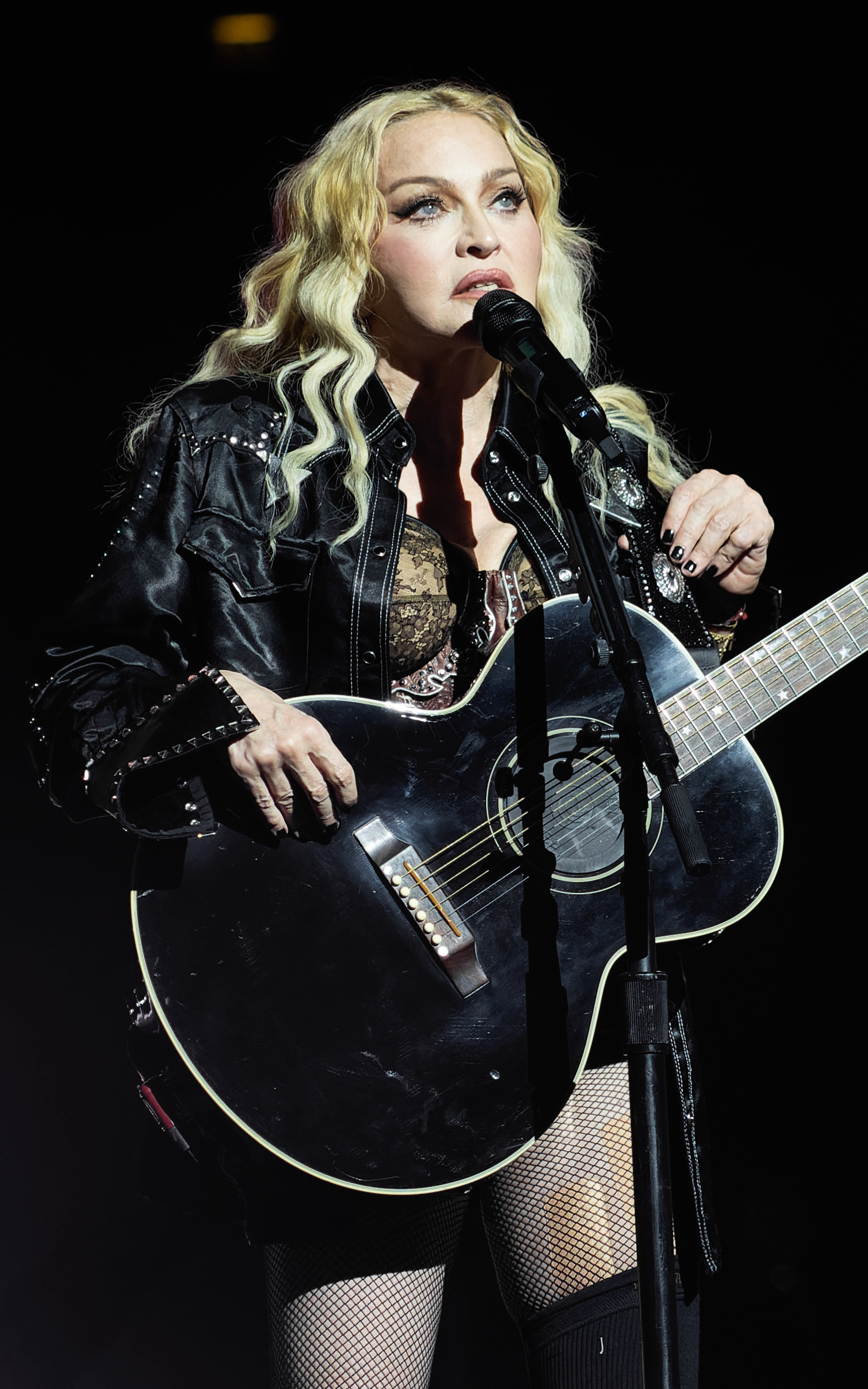
There are pop stars who define a moment, and then there is Madonna, who has defined moment after moment after moment, across more than forty years, without ever standing still long enough to be pinned down. By the time most artists release their second album, they have settled into an identity. Madonna spent her entire career refusing to settle, treating each new record, tour and decade as a fresh canvas to be painted over. She did not just survive the cultural shifts that ended the careers of her peers. She anticipated them, often causing them herself, then moving on before anyone could catch up.
To understand the scale of what she built, consider the numbers. An estimated 300 million records sold worldwide. The highest-grossing solo touring artist in history. A place in the Rock and Roll Hall of Fame. A Golden Globe for acting. A business empire spanning music, film, fashion, publishing and fitness. Yet the numbers, impressive as they are, miss the deeper point. Madonna’s true achievement was teaching the world that a woman could control her own image, her own sexuality, her own commercial destiny, and could do so on a stage as large as popular culture itself. She made reinvention not a sign of confusion but a deliberate, repeatable artistic strategy. This is the story of how a girl from Michigan with almost nothing in her pocket became the Queen of Pop.
Quick Facts
- Full name
- Madonna Louise Ciccone
- Born
- 16 August 1958, Bay City, Michigan, USA
- Genre
- Pop, dance, electronic
- Known for
- "The Queen of Pop"; best-selling female recording artist in history
- Records sold
- Estimated 300 million worldwide
Early Life
Madonna Louise Ciccone was born on 16 August 1958 in Bay City, Michigan, the third of six children in a large Italian American Catholic family. Her father, Silvio Ciccone, was an engineer who worked for Chrysler and General Motors, a disciplined man who expected the same discipline from his children. Her mother, also named Madonna, was a warm and devout presence at the center of the household. That center collapsed when Madonna was just five years old. Her mother died of breast cancer in 1963, a loss that shaped the girl in ways she would spend the rest of her life unpacking. She has spoken often about how her mother’s early death left her with a restless drive, a refusal to waste time, and an awareness of her own mortality that pushed her always forward.
The family settled in the Detroit suburbs, in Pontiac and later Rochester Hills. After her mother’s death, her father eventually remarried, and Madonna, the oldest daughter, often clashed with the new structure of the home. She was a bright, demanding, attention-seeking child who chafed against the strict Catholic discipline around her. She attended Catholic schools and absorbed the imagery of the church deeply, the saints and sinners, the guilt and the glamour, the rituals and the icons. That imagery would resurface throughout her career, sometimes as devotion, sometimes as provocation, always charged with meaning.
What channeled her energy was dance. Madonna threw herself into ballet and modern dance as a teenager, studying with a local instructor, Christopher Flynn, who recognized her talent and pushed her toward something larger than suburban Michigan. She was a strong enough student to earn a dance scholarship to the University of Michigan, where she trained seriously in the discipline that would later define her stage presence. But the structured world of a university dance program could not contain her ambition. In 1978, at the age of nineteen or twenty, she dropped out and moved to New York City with very little money, almost nothing beyond her talent, her nerve and her certainty that she belonged there. She has told the story many times: arriving in Manhattan, taking a taxi for the first time in her life, asking the driver to drop her in the middle of everything. That gamble, leaving behind security for the chance at greatness, set the pattern for everything that followed.
Breaking Into Music
New York in the late 1970s and early 1980s was raw, dangerous and electric, and it was exactly the right place for a young woman with limitless drive and no safety net. Madonna worked odd jobs, danced where she could, and immersed herself in the city’s downtown scene. She studied with the choreographers Pearl Lang and Alvin Ailey, danced in modern troupes, and briefly traveled to Paris as a backing dancer and singer for the disco performer Patrick Hernandez. But it was the club world, the sweaty, pulsing dance floors of Manhattan, that pulled her toward music.
She joined and formed several bands during these formative years, including the Breakfast Club and later a group called Emmy, working alongside the musician and former boyfriend Stephen Bray. She learned to play instruments, to write songs, to shape a sound. Gradually she moved away from the rock and new wave textures of her bands toward the dance-pop that suited both her voice and her instincts. The turning point came when her demo tracks reached the influential DJ and producer Mark Kamins and the dance scene around clubs like Danceteria. Her single “Everybody” caught fire on the club circuit, and Sire Records, part of the Warner Bros. family, signed her.
Her self-titled debut album, “Madonna,” arrived in 1983. It was a confident, club-ready record that captured the energy of the New York dance floors she had conquered. The singles built her audience steadily: “Holiday,” with its irresistible buoyancy, became a signature early hit, while “Borderline” and “Lucky Star” pushed her onto pop radio and into the consciousness of a mainstream audience. “Borderline” in particular became her first single to reach the top ten in the United States. The album presented a fresh kind of pop star, streetwise and stylish, with a distinctive look built from lace gloves, layered jewelry, rubber bracelets and tousled hair that teenage girls across the country began to copy. Madonna was no longer just a club sensation. She was becoming a phenomenon.
Superstardom
If the debut announced her, the 1984 album “Like a Virgin” made her a superstar of historic proportions. Produced largely by Nile Rodgers of Chic, the record was sharper, glossier and more ambitious than its predecessor. The title track, “Like a Virgin,” became a massive number one hit and a cultural lightning rod, its provocative subject matter generating exactly the kind of conversation that Madonna would learn to cultivate throughout her career. The album also delivered “Material Girl,” whose video, modeled on Marilyn Monroe’s performance from a classic Hollywood musical, gave the public an enduring and slightly ironic image of Madonna as a glittering, ambitious icon of the 1980s. The nickname “Material Girl” stuck to her for years, even as she spent decades complicating it.
The defining moment of this era came at the inaugural MTV Video Music Awards in 1984. Performing “Like a Virgin” in a wedding dress and a belt buckle reading “Boy Toy,” Madonna rolled across the stage in a performance that scandalized parents and thrilled a generation. Television executives reportedly feared her career was over before it had truly begun. Instead, the performance became legendary, a statement of intent from an artist who understood that controversy, properly channeled, was rocket fuel. She grasped the new medium of music video more completely than almost anyone of her time, recognizing that MTV had turned pop into a visual art form and that she could dominate it.
The hits kept coming through the middle of the decade. “Into the Groove,” “Papa Don’t Preach,” “Open Your Heart,” “La Isla Bonita” and “True Blue” filled the charts and the airwaves. She moved into film as well, charming audiences in the 1985 comedy “Desperately Seeking Susan,” a role that fit her downtown New York persona perfectly. Then, in 1989, she released “Like a Prayer,” widely regarded as her first true artistic masterpiece. The album was personal and serious, dealing with faith, family, her parents and her divorce, set to gospel-inflected pop production. Critics praised its depth and craft.
The title track triggered one of the most famous controversies of her career. The video for “Like a Prayer” featured burning crosses, religious iconography and a Black saint figure, imagery that the Catholic Church and conservative groups condemned as blasphemous. Pepsi had signed Madonna to a lucrative sponsorship deal and aired a commercial featuring the song, but amid the uproar and threats of boycott, the company pulled the advertisement while reportedly allowing her to keep the fee. The episode demonstrated a paradox that defined her: she could lose a corporate partner and win the larger cultural war at the same time, emerging more powerful and more talked about than before.
Constant Reinvention
The 1990s were the decade in which Madonna’s gift for reinvention became fully visible as a deliberate artistic philosophy. It began with the “Blond Ambition” tour in 1990, a theatrical, provocative spectacle that fused her dance training, her religious imagery and her sexual frankness into a single dazzling production. The tour featured the famous cone-shaped corset designed by Jean Paul Gaultier, a piece of costuming that became one of the most recognizable garments in pop history. The tour was documented in the 1991 film “Truth or Dare,” an intimate and revealing look at Madonna at the height of her powers, candid, controlling, vulnerable and ferociously ambitious all at once.
She pressed further into provocation in 1992 with the album “Erotica” and the accompanying coffee-table book “Sex,” a frank exploration of fantasy and desire that pushed against every boundary of mainstream taste. The “Sex” era divided critics and the public, and some accused her of going too far. Yet even when the reception cooled, she had once again forced a conversation about female sexuality and artistic control onto the front pages. The accompanying music, including the album “Bedtime Stories” in 1994 with its lush single “Take a Bow,” showed she could pull back toward warmth and craft when she chose.
Then came one of her most surprising and successful reinventions of all. In 1996 she took on the title role in the film adaptation of “Evita,” the musical about Eva Peron, the Argentine first lady. The part demanded serious singing and serious acting, and Madonna prepared intensely, taking vocal lessons that expanded her range and discipline. Her performance won her the Golden Globe Award for Best Actress in a Motion Picture, Musical or Comedy, a genuine triumph for an artist whose film career had often been treated with skepticism. The same year she gave birth to her first child, a daughter named Lourdes, marking the beginning of her life as a mother.
The decade reached its artistic peak with “Ray of Light” in 1998, a record that reinvented her sound entirely. Working with the British producer William Orbit, Madonna embraced electronica, ambient textures and a more spiritual, introspective lyrical voice, influenced by her interest in yoga and Kabbalah. The album was a critical and commercial sensation, winning multiple Grammy Awards and proving that, twenty years into her career, she could still be at the cutting edge of music rather than chasing it. “Ray of Light” silenced any suggestion that her best work was behind her. It was perhaps the clearest demonstration yet that reinvention, for Madonna, was not a gimmick but the very engine of her art.
“I think the biggest lesson that I’ve learned over the years is that the most important thing in life is to be true to yourself and to not be afraid to take risks.”
The Enduring Icon
The new century found Madonna still restless and still relevant. In 2000 she released “Music,” another electronic-leaning record, this time made largely with the French producer Mirwais. The title track became a global number one, with its instantly recognizable production and its playful, futuristic feel. That same year she married the British film director Guy Ritchie and gave birth to her son Rocco, settling for a time into life in England.
In 2005 she delivered “Confessions on a Dance Floor,” a euphoric, disco-infused return to the dance floor where her career had begun. The lead single, “Hung Up,” built around a sample of an ABBA classic, became one of the biggest hits of her later career and topped charts around the world. The album won the Grammy Award for Best Electronic/Dance Album and reasserted her command of the genre she had helped popularize decades earlier.
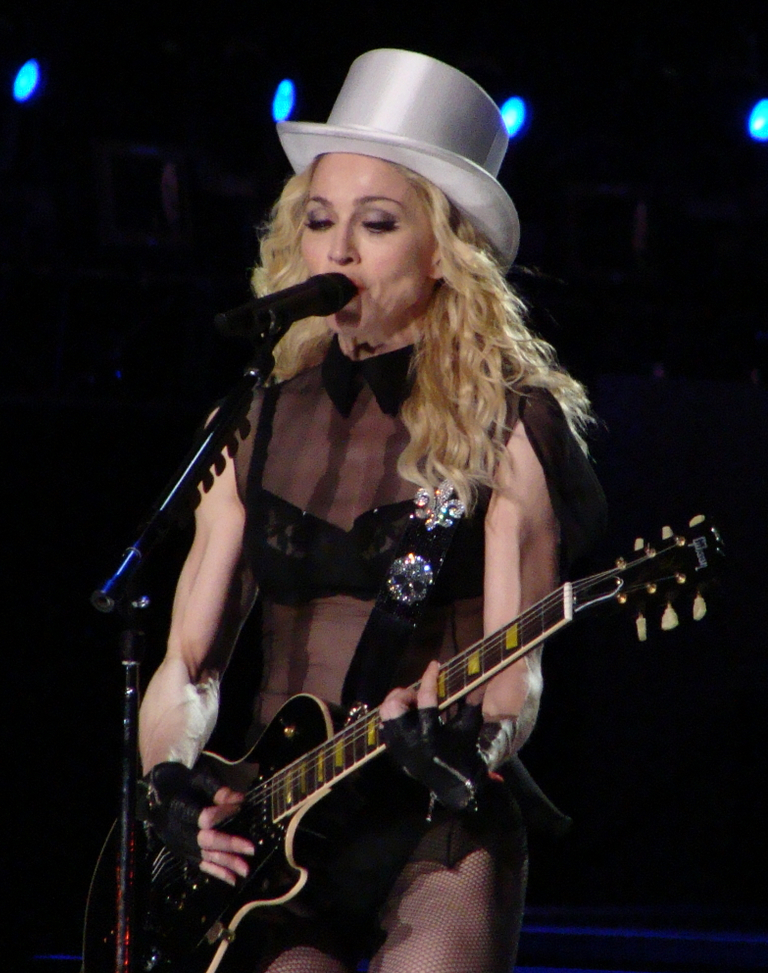
Her status as a live performer of unmatched scale only grew. Tour after tour, including the Confessions Tour and the Sticky and Sweet Tour, shattered box office records and confirmed her as the highest-grossing solo touring artist and the highest-grossing female touring artist in history. In 2012 she performed at the Super Bowl halftime show, one of the most-watched television events on earth, delivering a lavish, gladiatorial spectacle that introduced her to yet another generation. That same year she released the album “MDNA.”
She continued to release new music and stage ambitious tours into the 2010s and 2020s. The “Madame X” era, anchored by the 2019 album of that name, found her experimenting with Latin and global sounds, having lived in Lisbon, Portugal, and absorbing fado and other influences. The accompanying theatrical tour played intimate venues, a deliberate contrast to her usual arena spectacles. Then, in 2023 and 2024, she mounted the Celebration Tour, a sweeping retrospective journey through four decades of her catalog. It became one of the most successful tours of her career and a triumphant survey of everything she had built, reminding the world that the Queen of Pop remained, after all these years, on her throne.
Business, Activism and Personal Life
Madonna’s influence extends well beyond the recording studio and the stage. She built a genuine business empire over the decades, founding the entertainment company Maverick, which housed her record label, music publishing, film production and merchandising. The label scored major successes, including signing the band that became a global phenomenon, Alanis Morissette among its biggest acts. She ventured into fashion collaborations, fitness, children’s books and other enterprises, always treating her brand as an asset to be managed with the same control she exercised over her music.
Her personal life unfolded in the full glare of public attention. She married the actor Sean Penn in 1985 in a wedding besieged by paparazzi; the marriage ended in divorce in 1989. Her second marriage, to Guy Ritchie, lasted from 2000 to 2008 and produced her son Rocco. She has six children in total. Her daughter Lourdes was born in 1996 and her son Rocco in 2000. She adopted two children, David Banda and Mercy James, from Malawi, and later adopted twin daughters, Estere and Stella, also from Malawi. Her commitment to that country grew into a major philanthropic mission through her organization Raising Malawi, which has supported orphans, education and health care, including the building of a pediatric facility. Her involvement in Malawi has been both celebrated and, at times, scrutinized, but her financial commitment to the country has been substantial and sustained over many years.
Perhaps her most far-reaching legacy is her influence on the artists who followed her. It is difficult to name a major female pop star of the past three decades who has not, in some way, walked through a door that Madonna opened. The willingness to court controversy, to control one’s own image, to reinvent without apology, to fuse fashion and music and performance into a total spectacle, all of these became standard tools of pop stardom because Madonna proved they could work. Countless artists have cited her as a foundational influence, and the template she created for the modern pop diva remains the dominant one.
Legacy
Madonna’s legacy is not easily summarized, because she made a career out of refusing to be summarized. She is a singer, a dancer, a songwriter, an actress, a director, a businesswoman, a provocateur and a survivor. She arrived in New York with almost nothing and built a body of work and a personal mythology that few performers in any field have matched. She redefined what a woman in popular music could do, could say and could control, and she did it not once but continuously, decade after decade, as fashions and technologies and audiences changed around her.
In 2008 she was inducted into the Rock and Roll Hall of Fame, a formal acknowledgment of her place among the most important figures in the history of popular music. Yet the honors, the chart records and the sales figures only partly capture her significance. Her deeper achievement was cultural. She demonstrated that reinvention could be a sustained artistic practice rather than a desperate gambit, that provocation could be intelligent rather than merely shocking, and that a woman could remain at the absolute center of popular culture for forty years through sheer force of will and imagination. The girl from Bay City who lost her mother at five and arrived in Manhattan with empty pockets became the best-selling female recording artist in history. The Queen of Pop earned her crown, and she has worn it on her own terms ever since.
Key Facts
- Madonna has sold an estimated 300 million records worldwide, making her the best-selling female recording artist in history.
- She is the highest-grossing solo touring artist and the highest-grossing female touring artist of all time, with record-breaking tours across multiple decades.
- She was inducted into the Rock and Roll Hall of Fame in 2008, cementing her status among music’s most influential figures.
- Her decades-long career is defined by constant reinvention, a deliberate artistic strategy that influenced generations of pop stars who followed her.
- She won the Golden Globe Award for Best Actress in a Motion Picture, Musical or Comedy for her starring role in the 1996 film “Evita.”