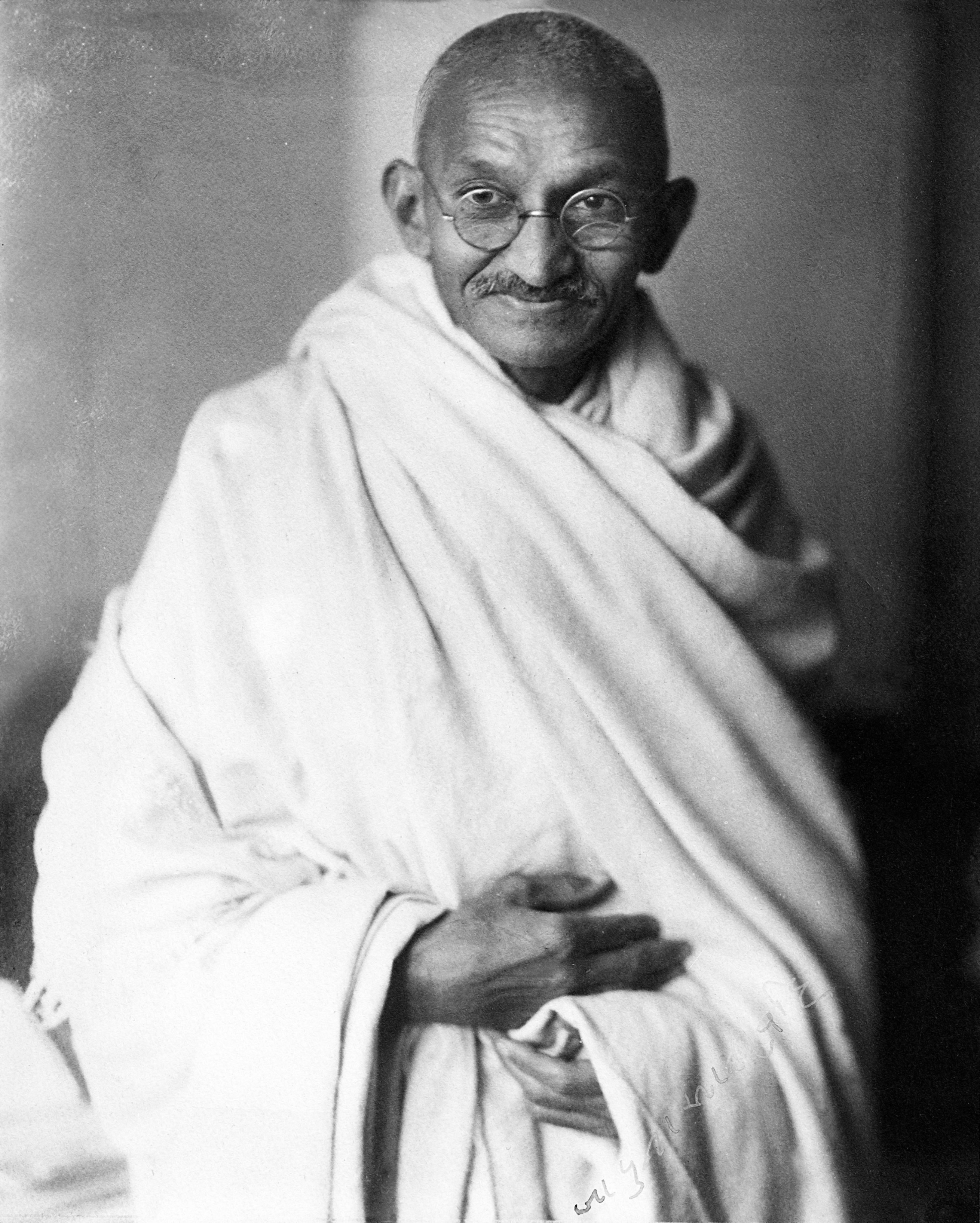
There is a photograph from 1930 that captures something essential about Mohandas Karamchand Gandhi. He is standing on a beach near Dandi, on the western coast of India, bending down to pick up a handful of salt. He is sixty years old, a small, lean man in a hand-spun loincloth, with wire-rimmed spectacles and sandals. Around him are thousands of people. Behind him, stretching back two hundred and forty miles along the dusty roads of Gujarat and into the centre of India’s independence movement, is a twenty-four-day march he has led on foot. The act he is performing, picking up salt from the sea, is technically a crime under British colonial law, which maintained a monopoly on salt production and taxed it at a rate that fell disproportionately on the poor.
The British Empire had gunboats and armies and codes of law backed by the coercive apparatus of the most powerful state in the world. Gandhi had a pinch of salt. And with it, by the calculation of historians looking back across the century, he did more damage to that empire’s legitimacy than any military campaign could have achieved, because he exposed, in the simplest possible terms, the fundamental moral incoherence of rule by force over a people who no longer consented to it.
Quick Facts
- Full name
- Mohandas Karamchand Gandhi
- Born
- 2 October 1869, Porbandar, Kathiawar, British India
- Died
- 30 January 1948, New Delhi, India (aged 78)
- Known for
- Leader of the Indian independence movement; pioneer of satyagraha (nonviolent resistance)
- Notable achievement
- Led India to independence from British rule in 1947; influenced civil rights movements worldwide
Porbandar and a Gujarati Childhood
Mohandas Gandhi was born on 2 October 1869 in Porbandar, a coastal town on the Kathiawar peninsula in what is now the state of Gujarat in western India. The town was a princely state under nominal British suzerainty, and Gandhi’s family occupied a position of modest but real social consequence. His father, Karamchand Gandhi, served as the diwan (prime minister) of Porbandar and later of other small princely states in the region. His mother, Putlibai, was a deeply religious woman whose faith shaped the household’s rhythms: she kept strict fasts, observed vows, and brought to her domestic life a quality of prayerful seriousness that her son absorbed and never fully left behind.
The family belonged to the Modh Bania sub-caste of the Vaishya (merchant) varna, a community associated with trade and business rather than with the Brahmin scholarly tradition or the Kshatriya warrior tradition. Their religious world was shaped by Vaishnavism, with its emphasis on devotion, nonviolence toward all living things (ahimsa), and vegetarianism. The Jain tradition was also strong in Gujarat, and the Jain concept of ahimsa, perhaps the most absolute philosophical commitment to nonviolence in any religious tradition, was part of the cultural water in which Gandhi grew up. He would later synthesise these inherited values with ideas he encountered in South Africa and in texts ranging from the Bhagavad Gita to the New Testament to Tolstoy, but the seed was planted in Porbandar.
He was an unremarkable student, by his own account timid, prone to running home after school to avoid having to speak to other children. He was married at thirteen, according to the customs of his community, to Kasturba Makanji, a girl of the same age from a merchant family in the same town. Gandhi later wrote about this marriage with a mixture of affection and guilt, guilt about the child marriage itself and about the sexual jealousy he felt toward his young wife that he came to see as a form of possessiveness incompatible with the ideals he was developing.
When his father died in 1885, Gandhi was fifteen. He was at his father’s bedside. The experience of loss arrived simultaneously with a deep shame: he had been with Kasturba rather than beside his father in the final minutes, and the baby that Kasturba delivered not long after died within days. Gandhi processed this cluster of events as a moral lesson about the destructive nature of attachment and the importance of self-discipline. The capacity for self-scrutiny, even self-flagellation, that characterised his later public persona began in these private griefs.
London and the Making of a Lawyer
Against the expectations of his community, which strongly discouraged its members from crossing the sea (the journey was considered polluting, a violation of caste law), Gandhi sailed for England in September 1889 to study law at the Inner Temple in London. He was nineteen. He left his wife and infant son in India.
His adjustment to London was uncomfortable and sometimes comic. He arrived with the conviction that he needed to dress and behave like an English gentleman, and he spent money he could not afford on a top hat, a morning coat, and lessons in dancing, elocution and violin. He abandoned these affectations when he understood that they were costing him money without making him English. He found a cheaper boarding house, adopted a systematic vegetarian diet (which he had struggled to maintain in London’s standard establishments), and discovered, in the vegetarian restaurants of the city, a community of principled non-conformists: Theosophists, religious reformers, and various varieties of idealist who were in revolt against the materialism and imperialism of Victorian society.
He read the Bhagavad Gita in an English translation produced by two Theosophist friends, Annie Besant’s associates Mabel Collins and Edwin Arnold. He also read Arnold’s poem “The Light of Asia,” about the life of the Buddha. He read the New Testament, and the Sermon on the Mount struck him with particular force: the idea that the meek would inherit the earth, that those who turned the other cheek were not weak but were demonstrating a power different from the power of the oppressor. These texts would become the intellectual furniture of his mature philosophy.
He passed the bar in 1891 and returned to India to practise law. The career was not initially promising: he was too shy to speak in court, so paralysed by stage fright during his first brief appearance before a judge that he sat down without uttering a word and refunded his client’s fee. He had a tentative family law practice in Bombay and then Rajkot, neither of them satisfying, and might have remained a moderately successful provincial lawyer had he not received, in 1893, an offer that changed everything.
South Africa: The Crucible
A Muslim firm based in Natal, South Africa, required a lawyer to handle a substantial commercial dispute. They offered Gandhi a one-year contract. He accepted, partly out of financial necessity and partly out of adventure. He was twenty-three when he arrived in Durban in May 1893. The transformation of Mohandas Gandhi into Mahatma Gandhi began almost immediately.
Within days of his arrival, he was physically thrown off a first-class train at Pietermaritzburg station because a white passenger objected to his presence in a first-class carriage. He had a valid first-class ticket. He sat in the waiting room at Pietermaritzburg for the rest of a freezing night, and somewhere in that long night he made the decision that determined the rest of his life. He could return to India, or he could stay and fight against the injustice he had just experienced. He stayed.
The Indian community in Natal and the Transvaal occupied a peculiar position in the colonial hierarchy. Brought originally as indentured labourers to work the sugar plantations, and supplemented by a class of free Indian merchants, they faced systematic discrimination: restrictions on property ownership, voting rights, movement, and business activity. The discrimination was nakedly racial, often brutal, and was being intensified in the years of Gandhi’s arrival.
He stayed not one year but twenty-one, from 1893 to 1914. In those years he developed the theory and practice of nonviolent resistance that would later reshape Indian and world history. He founded the Natal Indian Congress in 1894 to advocate for Indian rights. He established Phoenix Farm near Durban in 1904, an intentional community where he and his followers lived and worked according to the principles he was developing. He established Tolstoy Farm outside Johannesburg in 1910, named for the Russian author whose ideas about simplicity and nonviolence had influenced him.
He also developed the concept he called satyagraha, a word he coined as a response to what he considered the inadequacy of the English phrase “passive resistance.” Satyagraha combined the Sanskrit words for truth (satya) and force or firmness (agraha). The idea was active, not passive: the satyagrahi deliberately courted arrest, endured punishment without retaliation, and in doing so placed on the opponent’s conscience the full moral weight of the oppressor’s violence. Gandhi argued that no unjust regime could sustain itself indefinitely against the moral force of people willing to suffer for the truth. The claim was simultaneously political, psychological and spiritual.
The 1913 campaign, in which Indian women crossed the provincial border between the Transvaal and Natal in deliberate defiance of a law that required Indians to carry registration certificates, and Indian miners went on strike in the Natal coalfields, and Gandhi himself was arrested three times, ended in the Indian Relief Act of 1914, which granted a number of concessions to the Indian community. It was the first test of satyagraha at scale, and it worked.
You must be the change you wish to see in the world.
Return to India: Finding a Nation
Gandhi returned to India in January 1915, landing in Bombay to a reception that signalled his new status. Gopal Krishna Gokhale, one of the most eminent figures in the Indian National Congress, had prepared the ground, advising Gandhi to spend a year travelling and listening before forming opinions about what India needed. Gandhi followed the advice, touring the country by third-class rail, encountering the poverty, the caste system, the patchwork of languages and communities, and the colonial machinery of control, in a more systematic way than his earlier Indian experience had allowed.
He established his ashram on the Sabarmati River near Ahmedabad in 1915, and from that base began the campaigns that would eventually bring down the British Raj. His first major Indian campaign came in 1917 in Champaran, Bihar, where indigo farmers were locked into exploitative contracts that forced them to cultivate indigo on a portion of their land and sell it to British planters at below-market prices. Gandhi organised a satyagraha campaign, was arrested and ordered to leave the district, refused to go, and the resulting crisis forced the British authorities to conduct an inquiry that led to the abolition of the forced cultivation system. It was the first civil disobedience campaign in India, and it worked by following the same logic as the South African campaigns: make the injustice visible, make the cost of sustaining the injustice by force greater than the cost of ending it.
The Rowlatt Act of 1919 provoked Gandhi’s first truly national campaign. The Act extended emergency powers that allowed the colonial government to imprison suspects without trial, a provision that had been introduced under the exigencies of the First World War. Gandhi called for a hartal, a day of fasting, prayer and suspension of business, on 6 April 1919. The response exceeded his expectations and exceeded his control: in some areas, particularly the Punjab, protests turned violent. At Amritsar on 13 April 1919, a British general named Reginald Dyer ordered his troops to fire into a crowd gathered in the Jallianwala Bagh, a walled garden. At least 379 people were killed and more than 1,200 wounded. The Amritsar Massacre shocked the world and permanently altered the relationship between India and the British Empire.
Non-Cooperation and the Rise of Mass Politics
Between 1920 and 1922, Gandhi transformed the Indian National Congress from a middle-class debating society into a mass political movement. The Non-Cooperation Movement called on Indians to resign from government jobs, withdraw their children from colonial schools, boycott British goods and courts, and return medals and honours awarded by the colonial government. The response was extraordinary: hundreds of thousands of people participated, lawyers gave up their practices, students left schools, and the machinery of colonial administration was genuinely disrupted.
Gandhi suspended the campaign in February 1922 after violence broke out at Chauri Chaura, where a crowd attacked and killed twenty-two police officers who had fired on protesters. His decision to call off a campaign that seemed to be succeeding, on the grounds that violence had contaminated the movement’s moral foundation, was controversial and remains so. His critics argued that the movement had been on the verge of winning and that this decision squandered the opportunity. Gandhi’s position was that a satyagraha campaign that could not maintain nonviolence had forfeited its claim to moral authority and with it its effectiveness.
He was arrested in March 1922 and sentenced to six years in prison. He served two years before being released for an appendix operation. The mid-1920s were a period of internal debate and reorganisation within the independence movement, during which Gandhi focused on campaigns for Hindu-Muslim unity and for the rights of the Untouchables, whom he called Harijans (children of God), a term that is itself now contested as paternalistic.
The Salt March and Civil Disobedience
The Salt March of 1930 was Gandhi’s masterstroke of political communication. The British salt monopoly, which taxed a basic commodity that even the poorest Indian required, was both economically oppressive and symbolically perfect: it was something that every Indian, regardless of religion, caste, language or region, could understand as unjust. Gandhi announced the campaign in a letter to the Viceroy Lord Irwin that has been called one of the most extraordinary documents in the history of political correspondence: courteous in tone, utterly firm in substance, specific about grievances, clear about what was being proposed, and addressed to Irwin as a fellow human being whose conscience Gandhi was directly appealing to.
He set out from Sabarmati Ashram on 12 March 1930 with seventy-nine selected followers. The plan was to walk two hundred and forty miles to the coastal village of Dandi and there to make salt from the sea, in open violation of the monopoly. As the march progressed, gathering followers and international press attention with each mile, it became clear that something extraordinary was happening. By the time Gandhi bent down to pick up that handful of salt on 6 April 1930, the campaign had already achieved its first purpose: it had made the salt law look absurd and had made the empire’s enforcement of it look brutal.
More than 60,000 people were arrested in the weeks that followed. The most harrowing episode occurred at the Dharasana Salt Works, where a large group of satyagrahis attempted to peacefully enter the facility and were beaten by police with steel-tipped lathis. An American journalist, Webb Miller, watched the beatings and reported what he saw in detail. His dispatches reached readers around the world and produced exactly the moral shock Gandhi had calculated upon. The image of Gandhi and his followers enduring violence without retaliation became the defining image of the independence movement.
Independence and the Shadow of Partition
The final years of the independence struggle were a painful mixture of triumph and tragedy. The Second World War created a new set of pressures: Gandhi’s “Quit India” movement of 1942 demanded immediate British withdrawal from India and was met with the mass arrest of virtually the entire Congress leadership. Gandhi himself was held at the Aga Khan Palace in Pune from 1942 to 1944, during which time Kasturba died in detention in February 1944, after sixty-two years of marriage.
Independence came on 15 August 1947, but it came with partition. The British decision to divide the subcontinent into India and Pakistan along religious lines produced one of the largest forced migrations in human history, as Hindus and Sikhs moved from what became Pakistan and Muslims moved from what became India. The violence was catastrophic: estimates of the death toll range from 200,000 to 2 million people, and roughly 10 to 20 million people were displaced. Gandhi, who had spent his political life working for Hindu-Muslim unity, was devastated. He moved through the areas of communal violence, urging peace with a personal moral authority that did sometimes succeed in halting bloodshed where political arguments had failed.
On 30 January 1948, Gandhi was walking to a prayer meeting at Birla House in New Delhi when a young Hindu nationalist named Nathuram Godse stepped forward from the crowd and shot him three times at close range. Gandhi died almost immediately. His last words, by most accounts, were “He Ram,” invoking the name of God.
Legacy
The grief at Gandhi’s death was global. World leaders paid tribute; Albert Einstein said it would be hard to believe that such a one as Gandhi had ever in flesh and blood walked upon this earth. The United Nations General Assembly postponed its session. But the more enduring tribute is the legacy of nonviolent resistance as a political method.
Martin Luther King Jr. explicitly acknowledged Gandhi’s influence as the intellectual and strategic foundation for the American civil rights movement. Nelson Mandela cited Gandhi as a model, even as he also concluded that the specific conditions of apartheid South Africa required a response Gandhi himself had not found necessary in India. Cesar Chavez, the American farm labour organiser; Solidarity, the Polish trade union movement; the Velvet Revolution in Czechoslovakia; the anti-apartheid movement in South Africa; various phases of the Arab Spring: all drew on the satyagraha playbook.
The critiques of Gandhi are real and should be taken seriously. His earlier writings from South Africa expressed contempt for Black Africans that was thoroughly racist by any standard; he distinguished sharply between the claims of the Indian community and those of African people, and his language was at times as dehumanising as anything the colonisers produced. His treatment of Kasturba and his experiments with celibacy, which included sleeping beside young women to test his self-control, have been criticised as exploitative and manipulative. His position on the caste system was ambivalent: he opposed untouchability but not caste itself, a distinction that B.R. Ambedkar, the great Dalit leader and principal author of the Indian Constitution, argued was insufficient and self-serving.
But the core insight remains: that the power of the oppressor rests on the compliance of the oppressed, and that a movement willing to withdraw that compliance, to absorb violence without retaliation and in doing so expose the oppressor’s dependence on brutality, is engaging in a form of moral combat that can overcome military superiority. Gandhi did not invent this insight, but he was the first person in the modern world to test it systematically against a major empire. The results are part of the historical record.
Key Facts
- Gandhi was physically thrown off a first-class train in Pietermaritzburg, South Africa, in 1893, an event he described as the moment he decided to fight racial injustice rather than retreat from it.
- He coined the term “satyagraha” (truth-force or soul-force) to describe a philosophy of active nonviolent resistance that he first tested in South Africa between 1893 and 1914.
- The Salt March of 1930, in which he led a 240-mile walk to the sea to make salt in defiance of the British monopoly, is considered one of the most effective acts of political theatre in history.
- He was assassinated on 30 January 1948 by a Hindu nationalist who believed Gandhi had been too accommodating toward Muslims during the partition crisis.
- His influence on subsequent nonviolent movements, from the American civil rights movement to anti-apartheid campaigns to Eastern European democratic revolutions, makes him arguably the most influential political strategist of the twentieth century.