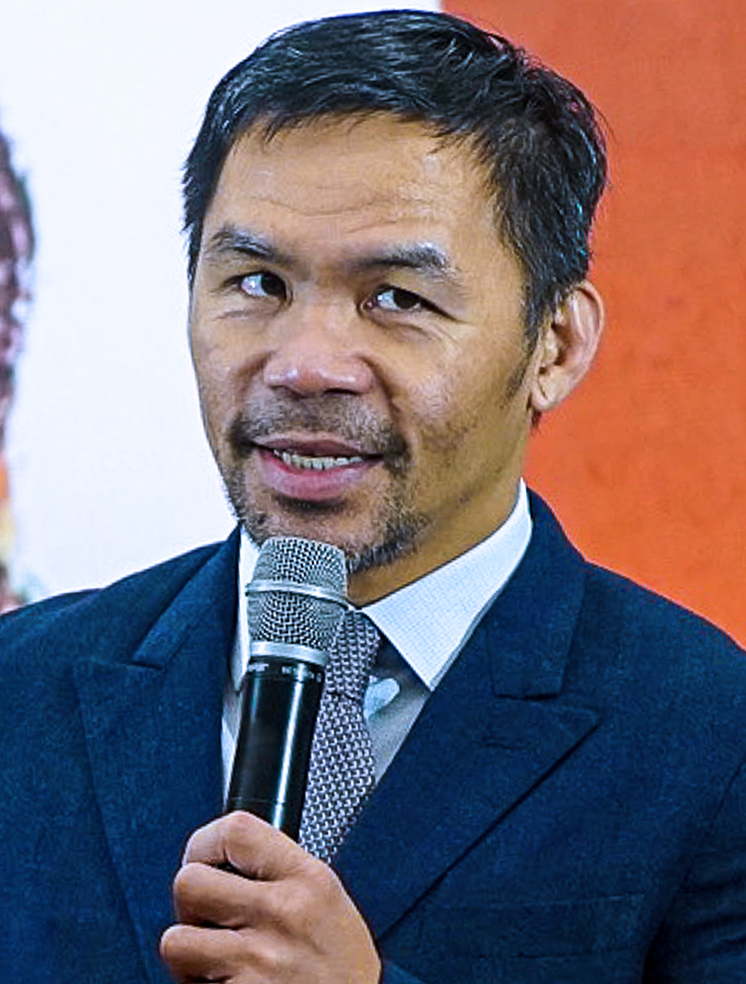
In the Philippines, Manny Pacquiao is not merely a sporting hero. He is a national symbol of a particular kind of ambition: the belief that a person born with nothing can, through courage and relentless work, achieve something so extraordinary that the rest of the world has to stop and pay attention. Emmanuel Dapidran Pacquiao was born in a small, impoverished municipality in Sarangani province on the island of Mindanao. He dropped out of school, left home at fourteen, slept rough on the streets of Manila and fought his first professional boxing match at sixteen, weighing only 106 pounds. The arc from that beginning to becoming the only boxer in history to win world titles in eight different weight divisions is the most improbable trajectory in the history of the sport. It is also entirely true.
Quick Facts
- Full name
- Emmanuel Dapidran Pacquiao
- Born
- 17 December 1978, Kibawe, Bukidnon, Philippines
- Sport
- Boxing
- Known for
- First and only eight-division world champion in boxing history
- Career highlight
- 2009 victory over Miguel Cotto for the WBO light welterweight title, his seventh world title in seven weight classes
Early Life and Background
Emmanuel Dapidran Pacquiao was born on 17 December 1978 in Kibawe, Bukidnon, in the southern Philippine island of Mindanao, though his family soon moved to General Santos City in Sarangani province, the city that would become his permanent home and the source of his nickname “Pacman from General Santos.” His father, Rosalio Pacquiao, abandoned the family when Manny was a child. His mother, Dionesia Dapidran-Pacquiao, raised him and his siblings in poverty that was not merely relative but absolute: there were periods when the family did not have enough to eat, when Manny and his siblings went to sleep hungry and woke wondering how the day would be fed.
He attended school briefly but the pressure of the family’s circumstances made sustained attendance impossible. By fourteen, he had left General Santos City and made his way to Manila, the capital, 1,500 kilometres to the north. He arrived knowing almost no one, with very little money and no plan beyond the general intention of finding a way to make something of himself. For a period he slept on the streets. He found work where he could, including on construction sites, and he began boxing, at first informally and then with increasing seriousness as it became clear that he had a talent for the sport.
He was small even by the standards of the lightest boxing categories, standing around 5 feet 5 inches and weighing, when he began boxing seriously, approximately 106 to 108 pounds. He had no formal training in the conventional sense: no famous coach, no gym with a history of producing champions, no mentor with connections to the sport’s establishment. He had speed, reflexes and a capacity for violence in the ring that was concentrated by the intensity of what he was fighting against, which was not simply the opponent in front of him but the entire weight of the life he had come from.
Professional Debut and Early Career
Manny Pacquiao made his professional debut on 22 January 1995, at sixteen years old, in a four-round bout at the Villamor Airbase Sports Complex in Pasay City, Philippines. He won by unanimous decision. His record in his first several years was not unblemished: he lost three times in his first sixteen fights, once by a first-round knockout. But the losses were part of the education, occurring at the lightest weight classes in the Philippines, in a competitive environment where young fighters were tested quickly and severely, and they did not deflect from the central observation that this was a fighter of unusual gifts.
By the late 1990s he was winning consistently and had attracted the attention of promoters and matchmakers who saw in him a fighter with the potential to compete internationally. He won the WBC International super bantamweight title in 1999 and began to develop a profile beyond the Philippines. The fighter who would emerge from this period, under the guidance of trainer Freddie Roach (their partnership beginning in 2001 and becoming the most celebrated trainer-fighter relationship in the sport), was in some ways a different fighter from the one who had debuted in 1995: faster combinations, better footwork, a more sophisticated understanding of distance and timing.
His work with Freddie Roach at Wild Card Boxing Gym in Hollywood, California, was transformative. Roach, himself a former professional boxer who had fought Carlos Zarate and others at the top level, recognised in Pacquiao a fighter with rare gifts that had not yet been fully developed. He refined the natural aggression, built a jab into the attack, improved the footwork and installed a physical conditioning programme that addressed the weight management problems that had complicated Pacquiao’s earlier career. Their partnership would last more than a decade and produce the most extraordinary sequence of world title victories in boxing history.
Conquering the Weight Divisions
Boxing organises its competitive landscape by weight class, with a fighter typically competing within one or two classes across their career. The idea of winning world titles in multiple classes is already unusual; winning world titles in eight separate classes is, as of this writing, something no other fighter has ever done. What follows is a brief account of how Pacquiao built that record.
He won his first world title at 112 pounds (flyweight), claiming the WBC flyweight title in December 1998 by defeating Chatchai Sasakul of Thailand on a third-round knockout in Bangkok. He then moved up to 122 pounds (super bantamweight), winning the IBF title at that weight in 2001 by defeating Lehlo Ledwaba in six rounds as a late substitute. The Ledwaba fight was significant: Pacquiao had been called in on three weeks’ notice to replace an injured fighter, was still unknown to American audiences, and produced a performance of such controlled aggression that the boxing press immediately began paying serious attention.
The third title came at 126 pounds (featherweight), which he captured in 2003 by defeating Marco Antonio Barrera in 11 rounds. Barrera, a Mexican champion with a 57-3 record at the time and a reputation for both boxing skill and physical durability, was expected by most to defeat the young Filipino challenger. Pacquiao dismantled him systematically, landing combinations at angles and speeds that Barrera’s defence could not account for.
The fourth title, at 130 pounds (super featherweight), arrived in 2008 with a second fight against Marco Antonio Barrera, ending in a ninth-round stoppage, and at the WBC title in the same weight class. The fifth world title came at 135 pounds (lightweight) when he knocked out David Diaz in nine rounds in June 2008.
The sixth title, at 140 pounds (light welterweight), was captured by stopping Ricky Hatton of England in May 2009. Hatton was a popular British champion with a huge following and an unbeaten record against British and European opponents, but he found in Pacquiao a speed and combination punching that was simply beyond his defensive capabilities. Pacquiao knocked him down twice in the first round and finished him with a left hook in the second. The 65 seconds of action generated more discussion among boxing analysts than most full championship fights.
The seventh title, at 147 pounds (welterweight), came in November 2009 against Miguel Cotto of Puerto Rico. Cotto was a legitimate world champion at welterweight, a strong and technically proficient fighter with two losses to points decisions and a reputation for toughness. Pacquiao dominated him across twelve rounds, cutting him, dropping him and winning by technical knockout in the twelfth. At the time this was the performance that most persuaded sceptics: Pacquiao was competing at welterweight and outperforming one of the weight class’s established champions with the same speed and precision he had shown at 112 pounds, 22 pounds lower.
The eighth title, at 154 pounds (light middleweight), was arguably the most astonishing, because it required Pacquiao to compete at a weight nearly 50 pounds above the class in which he had won his first world title. He defeated Antonio Margarito in November 2010 over twelve rounds at Dallas. Margarito was a natural 154-pound fighter, larger and stronger, but he was outworked and outlanded throughout the fight, finishing the bout with both eyes severely damaged. Pacquiao had become what no one had been before: an eight-division world champion.
Boxing is not the same as life. In boxing, you win or lose. In life, it is much more complicated than that.
The Floyd Mayweather Fight
For years, the boxing world demanded a single fight above all others: Manny Pacquiao versus Floyd Mayweather Jr. The two men were, through the first half of the 2010s, universally acknowledged as the two best fighters in the world at welterweight, and the failure to bring them together became one of sport’s great sustained frustrations. Negotiations collapsed repeatedly over disputes about drug testing protocols, revenue splits and promotional control.
The fight finally happened on 2 May 2015 at the MGM Grand Garden Arena in Las Vegas. It is the highest-grossing boxing match in history, generating approximately 600 million dollars in revenue from pay-per-view sales, ticket sales and ancillary rights. More than 4.4 million pay-per-view purchases were recorded in the United States, breaking all previous records.
The result disappointed those who had anticipated a competitive battle. Mayweather, fighting in the precise, defensive-oriented style that had preserved his unbeaten record of 49 and 0 at the time, controlled the distance and outpointed Pacquiao by unanimous decision. Scores were 116 to 112, 116 to 112 and 118 to 110, all in Mayweather’s favour. Pacquiao revealed afterward that he had been competing with a rotator cuff injury in his right shoulder that required surgical repair within weeks of the fight. The injury, which he and his camp had chosen not to disclose before the fight or seek an exemption for, generated controversy and Nevada State Athletic Commission sanction, but it also provided context for his inability to generate the sustained offence that had characterised his best performances.
Senator and Presidential Candidate
Manny Pacquiao’s life beyond boxing has been as remarkable as his life within it, and has sometimes been more controversial. He was elected to the Philippine House of Representatives in 2010, representing the Sarangani province, while simultaneously holding the WBO welterweight title. He was re-elected in 2013. In 2016 he was elected to the Philippine Senate, winning approximately 16 million votes and finishing second in a field of twelve candidates for twelve available seats.
His political positions have been the subject of significant international controversy. In 2016, he made statements comparing homosexual people unfavourably to animals, comments that resulted in Nike terminating its endorsement relationship with him. He subsequently apologised for the remarks. He has been a vocal opponent of divorce (the Philippines is one of the last countries in the world where civil divorce is not available), a position consistent with his publicly stated Catholic faith, which he adopted after a personal religious experience during his boxing career.
He announced his candidacy for the Philippine presidency in September 2021 for the May 2022 election. He finished fourth in the election, receiving approximately 3.5 million votes, well behind the eventual winner Ferdinand Marcos Jr. The defeat was a significant one for a figure whose popularity in the Philippines remained genuine and broad, and it reflected both the complexity of Philippine politics and the limitations of sporting celebrity as a political platform without matching organisational infrastructure.
Physical and Technical Gifts
Understanding Manny Pacquiao’s boxing requires some engagement with what made him physically exceptional. His handspeed was, at his peak, among the fastest ever measured in professional boxing: tests conducted at various points in his career showed him throwing combinations at speeds that left opponents unable to track individual punches. His footwork was unusual for a boxer of his background: trained and refined by Freddie Roach, it allowed him to create and close angles in ways that confused even highly experienced opponents.
He was predominantly a left-handed fighter (southpaw) in a sport that contains far fewer southpaws than right-handed fighters, which created structural matchup problems for opponents trained primarily against right-handed fighters. His left hand was exceptional both as a lead jab and as a power weapon, and the angles it created when thrown in combination with right-hand leads generated a rhythm that opponents found very difficult to time.
What he lacked, by the standards of elite heavyweight boxing, was the capacity to absorb punishment at the highest level and continue performing optimally. His three professional losses before his ascent to international prominence, plus later defeats in the last years of his career, occurred when opponents managed to land significant shots cleanly. But in his prime, the combination of movement, handspeed and offensive output made clean significant shots almost impossible to deliver.
Philanthropy and Community
Throughout his career, Pacquiao channelled resources back to the community he came from. He was known in General Santos City and in Manila for personal acts of generosity on a scale that bordered on the remarkable: paying for medical treatments for people he had never met who sought his help, contributing to natural disaster relief funds, supporting community projects in Sarangani province. The generosity was not merely strategic; multiple independent accounts describe encounters with Pacquiao in which he gave away personal possessions or significant sums of money to individuals in evident need.
His story also functioned as a public encouragement to a generation of young Filipinos who grew up watching his fights. Boxing gyms in the Philippines experienced significant increases in enrollment during the peak years of his international career. The national celebration that accompanied his major victories, including public holidays and citywide celebrations in General Santos, reflected the degree to which his success had become a collective pride rather than simply an individual achievement.
Later Career and Retirement
Pacquiao continued fighting into his late thirties and early forties, a period marked by significant defeats alongside occasional victories that reminded observers of what he had been. A 2012 knockout loss to Juan Manuel Marquez, a Mexican fighter he had previously beaten twice and drawn once, shocked the boxing world. A 2015 decision loss to Floyd Mayweather followed. A 2017 loss to Jeff Horn in Brisbane, Australia, on a controversial points decision generated debate about the standard of judging applied. He defeated Adrien Broner in January 2019 and Lucas Matthysse (by seventh-round knockout) in July 2018, performances that demonstrated he retained meaningful capability.
His final professional fight was a 2021 bout against Yordenis Ugas for the WBA welterweight title. Pacquiao lost by unanimous decision. He announced his retirement from boxing in September 2021, three weeks before the retirement announcement and two days after the presidential candidacy announcement. He was 42 years old and had been a professional boxer for 26 years.
His final professional record was 62 wins (39 by knockout), 8 losses and 2 draws across 72 fights over 26 years. Only eight other people had ever beaten him. He had competed in world title fights across five decades.
Legacy
Manny Pacquiao’s legacy operates at several levels simultaneously. Within boxing, he is the only eight-division world champion in history, a record that may never be equalled simply because the competitive and commercial structure of modern boxing does not encourage fighters to move between weight classes as freely as Pacquiao did. He is the most commercially significant Asian fighter in the sport’s history, having generated hundreds of millions of dollars in revenue and dramatically expanded boxing’s audience in Asia.
Within the Philippines, his legacy is that of the country’s most celebrated athlete, a figure who embodied a particular national hope and delivered on it in the most public way possible. The streets of General Santos City bear his name. Schools and buildings carry his name. His face appeared on Philippine currency.
Key Facts
- Manny Pacquiao is the only boxer in history to win world titles in eight different weight divisions, from flyweight (112 pounds) to light middleweight (154 pounds), a record no other fighter has matched.
- He won his first world title in December 1998, defeating Chatchai Sasakul of Thailand for the WBC flyweight title by third-round knockout in Bangkok.
- The May 2015 fight against Floyd Mayweather Jr. generated approximately 600 million dollars in total revenue and over 4.4 million pay-per-view purchases, making it the highest-grossing boxing match in history.
- He served in the Philippine House of Representatives from 2010 to 2016 and in the Philippine Senate from 2016, winning approximately 16 million votes in his Senate election, finishing second nationally.
- His professional boxing career spanned 26 years (1995 to 2021), producing a record of 62 wins (39 by knockout), 8 losses and 2 draws across 72 fights.
What It All Amounts To
Manny Pacquiao’s career in boxing stands as one of the most remarkable in the sport’s history. Eight divisional titles, a record that stretched from 1995 to 2021 and a global reach that no Filipino athlete before him had achieved. In a sport that can be brutal and exploitative, he retained throughout his career the character he had formed in the streets of General Santos City: generous, devout, utterly without affectation and driven by something that always looked more like joy than ambition, even in the hardest fights.
His life after boxing in Philippine politics is not without controversy, and the positions he has taken on certain social issues have disappointed some admirers. But the story of the man who emerged from genuine poverty to transform himself into one of sport’s most compelling figures, and who used the platform that brought him to give back to the community that formed him, is one that does not require the full agreement of the reader to be recognised as something remarkable. He was, at his best, an athlete who seemed to celebrate the very act of competition rather than merely endure it, and that quality was visible in everything he did.