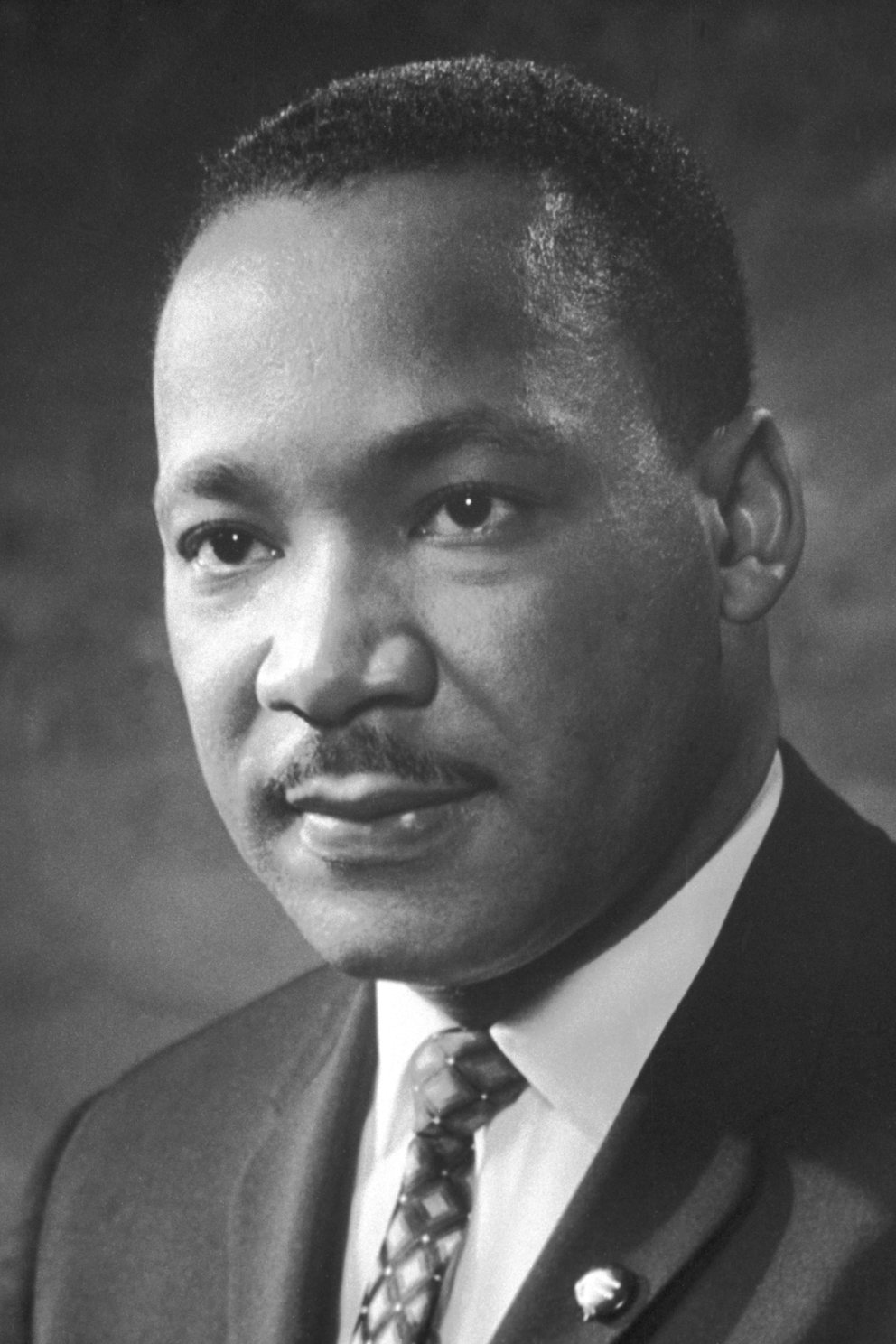
On 28 August 1963, a young Baptist minister from Atlanta stood at the base of the Lincoln Memorial and spoke to a quarter of a million people and, through the medium of live television, to the world. He had prepared a speech. He had notes. Somewhere in the middle of his address, prompted by the gospel singer Mahalia Jackson calling from behind him, “Tell them about the dream, Martin,” he set the notes aside and drew on something he had spoken before, in smaller venues, to smaller crowds. What came next lasted fewer than five minutes and contained phrases that would be quoted at every subsequent American inflection point about race and justice: the vision of a nation where his four children would be judged not by the colour of their skin but by the content of their character. No American orator since Abraham Lincoln had said something that landed with such force in the national memory. And Martin Luther King Jr. was, in 1963, only thirty-four years old.
Quick Facts
- Full name
- Michael King Jr. (later changed to Martin Luther King Jr.)
- Born
- 15 January 1929, Atlanta, Georgia, USA
- Died
- 4 April 1968, Memphis, Tennessee, USA (aged 39)
- Known for
- Leader of the American civil rights movement; advocate of nonviolent resistance
- Notable achievement
- Nobel Peace Prize, 1964; instrumental in passage of Civil Rights Act (1964) and Voting Rights Act (1965)
The Atlanta Childhood
Martin Luther King Jr. was born on 15 January 1929 on Auburn Avenue in Atlanta, Georgia, in a house that still stands and that has become a place of pilgrimage. He was named Michael King at birth; the transformation to Martin Luther King came later when his father, a Baptist minister, visited Germany and became inspired by the reformer Martin Luther, changing both his own name and his son’s. The King household was solidly middle class by the standards of Black Atlanta, a world unto itself known as “Sweet Auburn,” where a professional class of ministers, doctors, insurance men and teachers had built institutions and businesses that flourished behind the wall of segregation, turning exclusion into a kind of sheltered community.
His grandfather, Alfred Daniel Williams, had founded Ebenezer Baptist Church in 1894, and his father, Martin Luther King Sr., known as “Daddy King,” had built it into one of Atlanta’s most prominent Black congregations. The church was the axis around which the family’s social world turned, and from his earliest years Martin absorbed the rhythms of Black Baptist worship: the call and response, the integration of Scripture with the pressures of daily life, the expectation that the preacher did not merely explain the sacred texts but applied them to the condition of the people sitting in the pews.
Young Martin was precocious in the way that children of literary households often are, a voracious reader who had memorised long passages of the Bible by adolescence and who displayed a facility with language that startled adults who heard him. He also experienced, at an early age, the cruelty that segregation inflicted on Black children: a white friend’s parents told the boy he could no longer play with Martin because they were getting old enough that the races should not mix. The memory of that humiliation and his mother’s careful explanation of why it had happened lodged in him permanently.
Education and Intellectual Formation
King was so academically advanced that he skipped several grades, entering Morehouse College in Atlanta at the age of fifteen without having formally graduated from high school. Morehouse was the intellectual heartland of Black Atlanta, a place where a tradition of serious scholarship was combined with an expectation of public service and racial leadership. King’s father had attended Morehouse, as had his grandfather’s son-in-law. The college’s president, Benjamin Mays, became a powerful influence, a man who embodied the idea that rigorous intellectual life and active engagement with the injustices of the world were not in tension but were one project.
King initially planned to study medicine or law, vocations that his family associated with professional security and social standing. But somewhere in his undergraduate years, partly through Mays’s influence and partly through his own deepening engagement with the theological and social questions raised by the condition of Black Americans, he turned toward the ministry. He was ordained as a Baptist minister at Ebenezer in 1947, at eighteen.
He graduated from Morehouse in 1948 and enrolled at Crozer Theological Seminary in Chester, Pennsylvania, one of the few predominantly white seminaries that accepted Black students. At Crozer he encountered, for the first time in a sustained way, the intellectual tradition of liberal Protestant theology and the great philosophical questions about the relationship between faith, ethics and social change. He read Walter Rauschenbusch’s “Christianity and the Social Crisis,” which argued that the church had a fundamental obligation to address poverty and inequality rather than confining itself to individual salvation. He read Reinhold Niebuhr on the limits of human perfectibility and the complexities of political action. He read Thoreau on civil disobedience. He encountered the philosophy of Mahatma Gandhi.
Gandhi’s influence on King requires emphasis, because it was not superficial. King initially encountered Gandhi’s ideas in a lecture by Mordecai Johnson, who had recently visited India. The concept of satyagraha, the Sanskrit term for something like “truth-force” or “soul-force,” the idea that nonviolent resistance was not passivity but a form of active moral combat that could overwhelm the violence of the oppressor by refusing to match it, struck King as the practical application of the Sermon on the Mount. He bought six books about Gandhi after that lecture and began a reading programme that would eventually result in a trip to India in 1959. The synthesis of Gandhi’s method with the Black Baptist tradition of prophetic witness became the intellectual foundation of the civil rights movement.
King graduated first in his class from Crozer in 1951 and enrolled in a doctoral programme in systematic theology at Boston University, where he completed his dissertation in 1955. In Boston he met Coretta Scott, a gifted singer and musician from Alabama studying at the New England Conservatory of Music. They married in June 1953.
Montgomery and the Boycott That Changed History
In 1954 King accepted his first pastoral appointment, at Dexter Avenue Baptist Church in Montgomery, Alabama, a congregation that was already associated with civil rights activism. The following year he was completing his dissertation, settling into family life (the couple’s first child, Yolanda, was born in November 1955), and beginning to find his feet as a community leader, when an event occurred that changed the trajectory of his life and of American history.
On 1 December 1955, Rosa Parks, a seamstress and longtime NAACP activist, refused to give up her bus seat to a white passenger, as the laws of Montgomery required. She was arrested. The Women’s Political Council, led by Jo Ann Robinson, had already been planning a bus boycott in response to earlier incidents, and Robinson spent the night before Parks’s Monday court date printing and distributing more than 50,000 flyers. The boycott began that Monday.
King was elected president of the newly formed Montgomery Improvement Association, the organisation that coordinated the boycott, largely because he was new enough to the city to have made no political enemies and because his evident abilities made him the obvious choice. He did not seek the role. He had some ambivalence about it. But he accepted, and in doing so set himself on a path from which there was no returning.
The Montgomery Bus Boycott lasted 381 days, from December 1955 to December 1956. For more than a year, the Black residents of Montgomery, who constituted roughly 70 percent of the bus company’s ridership, walked to work, organised carpools, and endured harassment, intimidation and violence from white residents and law enforcement. King’s home was bombed in January 1956, while Coretta and their infant daughter were inside. Standing on his porch before a crowd of angry Black residents ready to retaliate, King persuaded them to go home peacefully. It was a pivotal moment: the choice of nonviolence under direct personal provocation.
The Supreme Court ruled in November 1956 that Montgomery’s bus segregation was unconstitutional, and the boycott ended in victory. King emerged from the experience as the most visible figure in the emerging civil rights movement, and he understood that the victory in Montgomery was only the beginning.
Darkness cannot drive out darkness; only light can do that. Hate cannot drive out hate; only love can do that.
Building the Movement: The SCLC and the Years of Direct Action
In January 1957, King and other Southern Black ministers founded the Southern Christian Leadership Conference, with King as its first president. The SCLC was designed to use the Black church’s networks, resources and moral authority as the organisational infrastructure for civil rights campaigns across the South. It differed from the older NAACP, which focused primarily on legal challenges, in its emphasis on direct action, mass mobilisation and the deliberate creation of confrontations that would expose the violence of segregation to national and international audiences.
The years from 1957 to 1965 were the period of King’s most intense and consequential activity. He travelled constantly, speaking, fundraising, strategising, organising. He survived a near-fatal stabbing in 1958, when a deranged woman stabbed him in the chest with a letter opener at a book signing in Harlem; the blade came within millimetres of his aorta. He was arrested dozens of times.
The strategy that defined the movement was the deliberate targeting of communities where the violence of white supremacy could be exposed before the cameras of national and international media. Birmingham, Alabama, in the spring of 1963 became the crucible. King and the SCLC chose Birmingham because it was one of the most segregated cities in America and because the city’s Commissioner of Public Safety, Eugene “Bull” Connor, was reliably violent. The campaign, Project C (for “Confrontation”), involved waves of marches and sit-ins. Connor responded with fire hoses and police dogs turned on protesters, including children. The images, broadcast around the world, provoked exactly the moral shock the campaign had calculated.
King was jailed during the Birmingham campaign, and it was from that jail cell that he wrote what is arguably the most important document produced by the American civil rights movement. Written on the margins of newspapers, on scraps of paper, in the margins of a letter from white ministers who had urged him to be patient, “Letter from Birmingham Jail” laid out with extraordinary precision and force the moral case for direct action, the urgency of the moment, the long history of Black patience already exhausted, and the distinction between just and unjust laws. It was addressed nominally to those Birmingham ministers but was in practice addressed to the white American liberal who understood abstractly that segregation was wrong but kept counselling delay.
The March on Washington and the Civil Rights Act
The Birmingham campaign, the fire hoses and dogs and King’s letter, generated the political pressure that caused John F. Kennedy to introduce comprehensive civil rights legislation in June 1963. To amplify that pressure and demonstrate the breadth of support for the legislation, civil rights leaders organised the March on Washington for Jobs and Freedom, held on 28 August 1963. It was the largest political demonstration in American history to that point, and King’s speech at its conclusion was the moral capstone of the entire movement.
Kennedy was assassinated in Dallas on 22 November 1963, three months after the march. His successor, Lyndon Johnson, proved more effective at moving legislation through Congress, partly because he understood the Senate’s internal politics and partly because he was willing to use Kennedy’s death as a moral argument for action. The Civil Rights Act was signed on 2 July 1964, outlawing discrimination in public accommodations and employment on the basis of race, colour, religion, sex or national origin.
That same year, King was awarded the Nobel Peace Prize in Oslo. He was thirty-five years old, the youngest person to have received the prize at that time. In his acceptance speech he addressed not only racial justice in America but the linked causes of poverty and militarism globally, a sign of the broader moral vision that would define his later years.
Selma, the Voting Rights Act and a Movement at Full Strength
The Civil Rights Act of 1964 addressed public accommodations and employment, but it left largely intact the systematic disenfranchisement of Black voters in the South, where a combination of literacy tests, poll taxes, bureaucratic obstruction and outright violence kept Black citizens from the polls. The next target was the right to vote.
Selma, Alabama, became the campaign’s chosen ground. In January and February of 1965, the SCLC and the Student Nonviolent Coordinating Committee conducted voter registration marches and rallies in Selma, meeting repeated violent repression. On 7 March 1965, a day that would become known as Bloody Sunday, six hundred marchers set out from Selma on a planned march to Montgomery. At the Edmund Pettus Bridge, Alabama State Troopers and a mounted posse attacked them with clubs and tear gas. The images broadcast on television that evening interrupted the broadcast of the film “Judgment at Nuremberg,” a juxtaposition that was not lost on viewers.
The outrage was immediate and national. Clergy and citizens from across the country converged on Selma. A third march, fully protected by federalised National Guard troops, completed the fifty-four-mile walk to Montgomery on 25 March 1965. King addressed the crowd of twenty-five thousand at the State Capitol from the same steps where, four years earlier, George Wallace had delivered his infamous “segregation now, segregation forever” inaugural address.
President Johnson introduced the Voting Rights Act before a joint session of Congress on 15 March 1965, concluding his address by invoking the movement’s own anthem: “We shall overcome.” The Act was signed on 6 August 1965, prohibiting discriminatory voting practices and authorising federal oversight of elections in states with a history of disenfranchisement.
The Later Years: War, Poverty and a Movement Divided
With the Voting Rights Act signed, King turned his attention to a broader programme of social and economic justice that went beyond the legal dismantling of segregation. He moved into a rented apartment in Chicago’s North Lawndale neighbourhood in January 1966 to campaign for fair housing and against the poverty concentrated in the city’s Black communities. The campaign was less successful than those in the South: Northern racism was more diffuse and harder to confront in a morally clear-cut way, the political dynamics were more complex, and the movements’ discipline was harder to maintain in an urban environment.
He also broke publicly with the Johnson administration over the Vietnam War. In his “Beyond Vietnam: A Time to Break Silence” speech at Riverside Church in New York City on 4 April 1967, exactly one year before his death, King argued that the war was draining resources from the fight against poverty at home, that it was being fought disproportionately by poor Black soldiers, and that its conduct was morally indefensible. The speech cost him dearly. FBI director J. Edgar Hoover, who had surveilled and harassed King for years, intensified his efforts. Mainstream civil rights organisations and sympathetic politicians urged him to stay in his lane. Editorialists condemned him. His approval rating among white Americans fell sharply.
But he was convinced that the linked crises of racism, poverty and militarism required a united moral response, and in the final months of his life he was organising the Poor People’s Campaign, a coalition across racial lines intended to bring the economically dispossessed to Washington and demand a fundamental restructuring of the American economy.
Memphis and Assassination
In March 1968, King went to Memphis, Tennessee, to support a strike by the city’s Black sanitation workers, who were striking over dangerous conditions and pay discrimination so severe that many qualified for public assistance despite working full time. The workers marched carrying placards bearing three words: “I Am a Man.” King led a march that turned violent when provocateurs broke windows and looted; the resulting disorder was used to discredit him. He returned to Memphis to lead a nonviolent march and to restore the movement’s moral credibility.
On the evening of 3 April 1968, at Mason Temple, he gave a speech that is now known as the “I’ve Been to the Mountaintop” address. Speaking apparently without a complete text, in a state of exhaustion and premonition, he reflected on the trajectory of his life and the movement, invoked the parable of the Good Samaritan as a model for the Memphis workers’ struggle, and concluded with words that have acquired an unbearable retrospective weight. He said he had been to the mountaintop and had seen the Promised Land. He might not get there with the rest of them. But he wanted them to know that night that they, as a people, would get to the Promised Land.
The next evening, 4 April 1968, Martin Luther King Jr. stepped onto the balcony of the Lorraine Motel. A bullet fired from a rooming house across the way struck him in the jaw and severed his spinal cord. He was pronounced dead at St. Joseph’s Hospital at 7:05 PM. He was thirty-nine years old.
Legacy
The assassination of Martin Luther King Jr. produced riots in more than one hundred American cities, the most widespread civil unrest in the country since the Civil War. It also produced, within days, the Fair Housing Act of 1968, the third major piece of civil rights legislation in four years, passed in part because Congress could not in good conscience refuse it after the murder of the man who had fought for it.
King’s legacy is embedded in the structure of American law and in the moral vocabulary the country uses to argue with itself about race and justice. The holiday bearing his name was established in 1983 and first observed in 1986. His words are inscribed in the monuments on the National Mall. His methods, the strategic use of nonviolent direct action to create moral confrontations, have been adopted by movements around the world, from anti-apartheid campaigns to contemporary environmental activism.
But King’s legacy is also contested in the way that the legacies of genuinely challenging figures always are. The official memory tends to sand down the edges: to remember the dreamer and forget the provocateur, to recall the “I Have a Dream” speech and set aside “Letter from Birmingham Jail,” to cite his words about the content of character while ignoring his arguments about structural economic inequality, the connection between race and poverty, and the moral bankruptcy of American militarism. The full King, the man who in 1967 and 1968 was one of the most unpopular figures in American public life precisely because he was pressing questions the country did not want to hear, is more radical and more demanding than the monument version.
He was thirty-nine when he died. The list of what he accomplished in those thirty-nine years is staggering. What he might have done in the years after is one of history’s most aching unanswerable questions.
Key Facts
- Martin Luther King Jr. entered Morehouse College at age fifteen, having skipped several grades due to academic excellence.
- His “Letter from Birmingham Jail,” written in April 1963 on the margins of newspapers in a jail cell, is considered one of the most important documents in American political and moral philosophy.
- He was awarded the Nobel Peace Prize in 1964 at age thirty-five, making him the youngest recipient at that time.
- The FBI, under J. Edgar Hoover, conducted extensive surveillance of King and sent him a letter in 1964 urging him to commit suicide before the award ceremony, one of the most notorious episodes of government misconduct in American history.
- He was assassinated on 4 April 1968 in Memphis, Tennessee, where he had gone to support a strike by Black sanitation workers, at the age of thirty-nine.