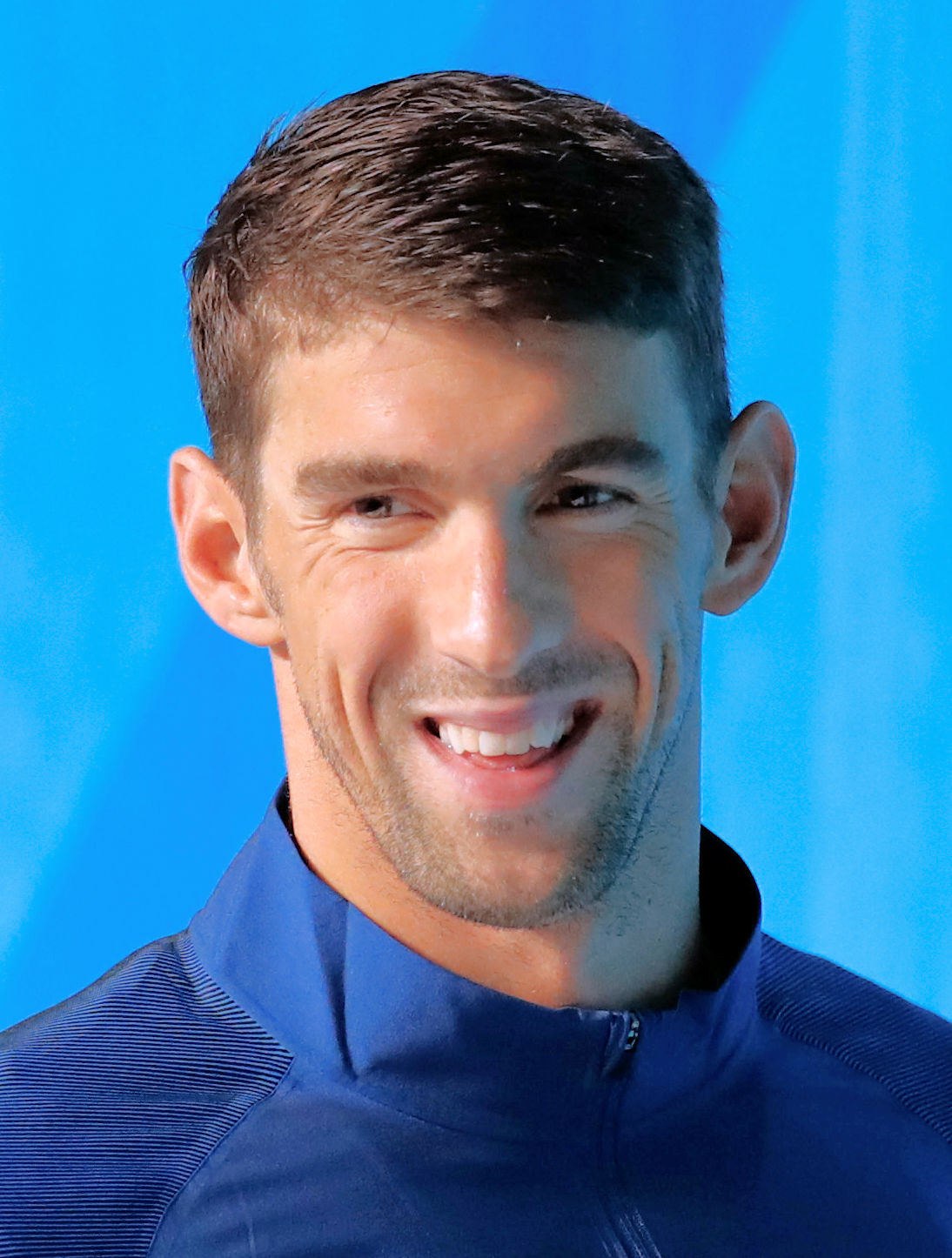
On the night of 16 August 2008, in the Water Cube in Beijing, the difference between sporting immortality and an ordinary great career came down to one one-hundredth of a second. Michael Phelps had been swimming for what felt, to the millions watching, like an impossibly long final fifty metres of the 100 metres butterfly. Serbia’s Milorad Cavic had led the race almost from the start. With a single body length remaining, Cavic was gliding toward the wall and Phelps appeared to be beaten. Then Phelps did something that defied the textbook. Instead of stretching into a smooth final stroke, he took a short, choppy half-stroke and slammed his hands into the touchpad. The scoreboard read 50.58 to 50.59. Phelps had won by a margin so small the human eye could not register it, and with it he had kept alive his pursuit of a record that many believed would never be matched. That race captured everything about the man: the obsessive preparation, the freakish feel for the water, and the refusal to accept that a race was lost until the timing system said so.
This is the story of how a hyperactive boy from suburban Baltimore who could not sit still in a classroom became the most decorated Olympian in the history of the Games, and how, long after the medals were counted, he found the courage to talk about the darkness that had followed him through all of it.
Quick Facts
- Full name
- Michael Fred Phelps II
- Born
- 30 June 1985, Baltimore, Maryland, USA
- Sport
- Swimming
- Known for
- Most decorated Olympian in history (28 medals, 23 gold)
- Career highlight
- 8 gold medals at the 2008 Beijing Olympics
Early Life
Michael Fred Phelps II was born on 30 June 1985 in Baltimore, Maryland, the youngest of three children and the only son of Fred Phelps, a Maryland State trooper, and Debbie Phelps, a middle school teacher who later became a principal. His two older sisters, Hilary and Whitney, were both competitive swimmers, and the family’s weekends revolved around the smell of chlorine and the early-morning drive to the pool. Michael followed his sisters into the water at the North Baltimore Aquatic Club, though in those first years he was less a prodigy than a restless, frightened little boy. He was so afraid of putting his face in the water that his coaches let him start by swimming on his back, which is part of the reason the backstroke became the first competitive stroke he mastered.
What set Michael apart in the classroom was not talent but trouble. He struggled to focus, fidgeted constantly, and was disruptive enough that one of his teachers told his mother flatly that her son would never be able to concentrate on anything. At the age of nine he was diagnosed with attention deficit hyperactivity disorder, or ADHD, and for a time he took medication to manage it. Debbie Phelps, the educator, refused to accept that her son was simply a problem to be controlled. The swimming pool, it turned out, did what no classroom could. The structured repetition of laps, the clear black line on the bottom of the pool, and the immediate feedback of the clock gave Michael a place to pour all that surplus energy. In the water, the thing that made him difficult on land became an advantage.
His parents divorced when he was nine, and Michael was raised largely by his mother. The pool became more than a sport; it was a refuge and a routine that held his world together. By the time he was ten he held a national age-group record, and the coaches at North Baltimore began to suspect they were dealing with something rare. The man who would shape that talent was Bob Bowman, a demanding, classically trained coach who had studied developmental psychology and child music education. Bowman saw in the gangly, big-handed boy a once-in-a-generation combination of physiology and drive, and he was not shy about saying so. He built Michael’s training around relentless volume, sometimes seven days a week, and around a mental approach as rigorous as the physical one. Bowman would deliberately step on Phelps’s goggles to crack them, or knock things over before a race, training the young swimmer to handle any disaster calmly. That partnership, equal parts ferocious and devoted, would last for the entirety of Phelps’s career.
By his early teens Michael’s body seemed almost custom-built for swimming: a long torso, relatively short legs, an enormous arm span that exceeded his height, large hands and feet, and ankles so flexible that his feet acted like flippers. But it was the work ethic Bowman instilled, the willingness to train on Christmas Day and through illness, that turned natural gifts into something historic. The rise was astonishingly fast.
Olympic Debut and Athens
In the spring of 2000, at the United States Olympic Trials, a fifteen-year-old Michael Phelps qualified for the Sydney Olympics in the 200 metres butterfly. He became the youngest male swimmer to make a United States Olympic team in 68 years. At the Sydney Games in September 2000 he did not win a medal, finishing fifth in the 200 metres butterfly final, but the experience was a revelation rather than a disappointment. He had stood on the biggest stage in sport before he could legally drive, and he had not been overwhelmed.
The transformation came quickly. In March 2001, still only fifteen, Phelps broke the world record in the 200 metres butterfly, becoming the youngest man ever to set a swimming world record. At the 2001 World Championships in Fukuoka, Japan, he lowered that record again and won his first world title. Over the next three years he rewrote the record books across multiple strokes and distances, establishing himself not as a butterfly specialist but as a swimmer of almost unprecedented range, capable of winning at the highest level in butterfly, freestyle, backstroke, and the individual medley, the event that combines all four strokes.
By the 2004 Athens Olympics, the questions had shifted from whether Phelps could win to how much he could win. There was open talk of whether he might match or break Mark Spitz’s legendary haul of seven gold medals at the 1972 Munich Games. Phelps entered eight events in Athens. He did not match Spitz, but what he did was extraordinary in its own right. He won six gold medals and two bronze medals, a haul of eight total that would have crowned almost any other career on its own. He took gold in the 100 metres butterfly, the 200 metres butterfly, the 200 metres individual medley, the 400 metres individual medley (in a world record), and two relays, with bronze in the 200 metres freestyle and the 4x100 metres freestyle relay.
One moment from Athens revealed the character behind the medals. Phelps had qualified to swim in the final of the 4x100 metres medley relay, but he chose to give his spot in the final to teammate Ian Crocker, the man who had beaten Phelps to the world record in the 100 metres butterfly and who had struggled earlier in the Games. The United States won gold, and because Phelps had swum in the preliminary heat, he still received a gold medal, but the gesture toward a rival was widely praised as a rare act of sportsmanship from a twenty-year-old at the height of competition. Athens announced that a new era had arrived. The greater story was still four years away.
Beijing 2008 and Eight Golds
The 2008 Beijing Olympics were built, from the American side, around a single audacious goal. Phelps would attempt to win eight gold medals at one Games, surpassing Mark Spitz’s record of seven that had stood for 36 years. The margin for error was nonexistent. Across eight events over nine days, in a brutal schedule of heats, semifinals, and finals, Phelps would have to be perfect. Any single second place, any disqualification, any off day would end the pursuit. What followed was one of the most sustained displays of excellence in the history of sport.
He opened with the 400 metres individual medley, winning gold in a world record. He took the 200 metres freestyle, the 200 metres butterfly, the 200 metres individual medley, and the 100 metres butterfly, setting world records in nearly every individual event. But the eight golds were never simply about individual brilliance. Twice the entire pursuit nearly collapsed, and twice it was saved.
The first scare came in the 4x100 metres freestyle relay. The United States team trailed France’s anchor, the world-record holder Alain Bernard, who had reportedly boasted that his team would “smash” the Americans. On the final leg, American swimmer Jason Lezak produced what is often called the greatest relay leg in history, running down Bernard in the closing metres to touch the wall first by eight hundredths of a second. Phelps, who had swum the opening leg, stood on the pool deck screaming, his pursuit kept alive by a teammate’s heroics.
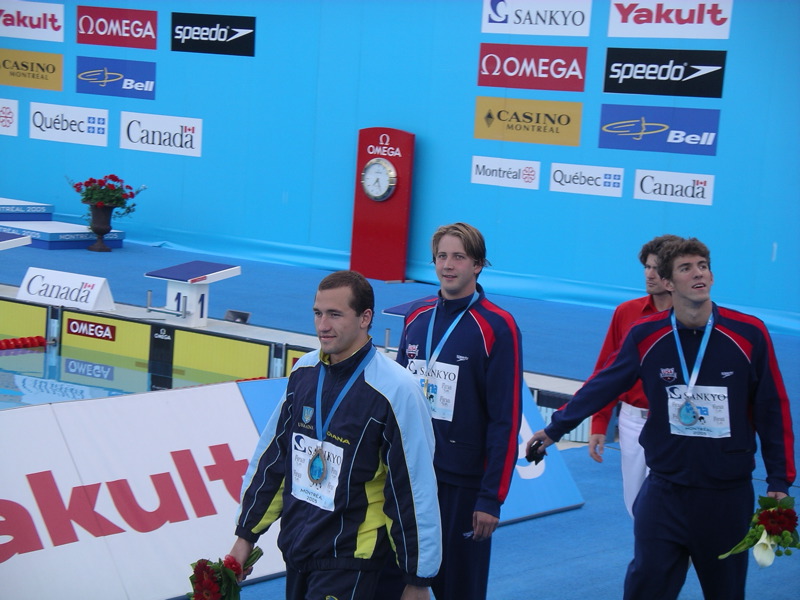
The second came in the 100 metres butterfly, the race against Milorad Cavic described at the start of this story, where Phelps’s frantic final half-stroke won by a single hundredth of a second. The Serbian team filed a protest, but a frame-by-frame review of the underwater cameras by the timing company Omega confirmed the result. Phelps had won his seventh gold, equalling Spitz.
The eighth and final gold came in the 4x100 metres medley relay, where the American team won in a world record to give Phelps his unprecedented total. Eight events, eight gold medals, seven of them in world-record time. The achievement immediately entered the conversation about the single greatest performance in Olympic history. Phelps had not just broken a record that had stood since 1972; he had done it under a pressure that would have crushed almost anyone, with two of the eight decided by a combined margin of nine hundredths of a second.
London and Rio
By the time the 2012 London Olympics arrived, Phelps was no longer chasing a number; he was chasing the all-time medal record and, in some sense, his own motivation. He has since spoken about how his preparation for London was not what it had been for Beijing, and the early results in London showed it. He finished fourth in the 400 metres individual medley, an event he had owned, and missed the podium entirely. But he recovered to become, during those Games, the most decorated Olympian of all time, overtaking the record of 18 medals held by Soviet gymnast Larisa Latynina. Phelps left London with four golds and two silvers, bringing his career total to 22 medals, 18 of them gold.
After London, Phelps announced his retirement. He was 27, he had been swimming competitively for two decades, and he stepped away from the sport apparently for good. But the retirement did not hold. The period that followed was one of the most difficult of his life, a stretch he would later describe with painful honesty, and the pool, once again, became part of how he found his way back. He returned to competition in 2014 and set his sights on one more Olympics.
The 2016 Rio de Janeiro Olympics became, for many, the perfect coda. At 31, an age considered old for an elite swimmer, Phelps was a husband and a new father, and he competed with a visible joy that had sometimes been missing in earlier years. He was chosen by his fellow American athletes to carry the United States flag at the opening ceremony, a profound honour. In the pool he added five more gold medals and one silver. He won the 200 metres butterfly, reclaiming a title he had lost in London; the 200 metres individual medley for a fourth consecutive Olympics, a feat unprecedented in any individual swimming event; and three relays. His silver came in the 100 metres butterfly. His final Olympic race, the anchor leg of the 4x100 metres medley relay, ended in gold. He climbed out of the water in Rio for the last time as a champion, on his own terms.
The Records
When the counting was finished, the numbers were almost difficult to comprehend. Across five Olympic Games, from Sydney in 2000 to Rio in 2016, Michael Phelps won 28 Olympic medals. Of those, 23 were gold, along with three silver and two bronze. The total of 28 is the most of any Olympian in history across all sports. The 23 gold medals are more than double the next highest total ever achieved by an individual Olympian. To put it in perspective often cited by commentators, if Phelps were counted as a country, his gold-medal haul would place him among the more successful nations in the history of the modern Games.
Beyond the Olympics, Phelps amassed 33 medals at the World Aquatics Championships, 26 of them gold. Across his career he set 39 world records, 29 of them individual and the rest in relays, a number unmatched in the sport. He was named World Swimmer of the Year a record number of times. His dominance was built on two pillars: the butterfly, the most physically demanding of the four competitive strokes, and the individual medley, which rewarded his rare ability to excel at all four strokes within a single race. His four consecutive Olympic titles in the 200 metres individual medley, won in 2004, 2008, 2012, and 2016, demonstrated a longevity at the very top that had no precedent in individual swimming.
What the raw statistics cannot convey is the consistency required to produce them. Olympic finals are decided by fractions of a second, by the timing of a turn or the depth of a breath, and Phelps won, again and again, across a span of sixteen years and against successive generations of rivals. Many great athletes have a single defining Games. Phelps had four.
Personal Struggles
For all the triumph, the years between and around the medals were marked by serious struggle, and Phelps’s eventual willingness to speak about it openly may prove to be as important as anything he did in the pool. In November 2004, only months after Athens, he was arrested for driving under the influence at the age of nineteen and pleaded guilty. In 2009, a photograph surfaced appearing to show him using a marijuana pipe, which led to a three-month suspension from USA Swimming and the loss of a sponsorship. Then, in September 2014, he was arrested a second time for driving under the influence, an incident that proved to be a turning point.
What few people understood at the time was that the public incidents were symptoms of a much deeper crisis. Phelps later revealed that he had suffered from depression for years, hidden behind the medals and the fame. After the 2012 London Olympics in particular, and again after the 2014 arrest, he descended into a depression so severe that he has said he sat alone in his bedroom for days and did not want to be alive. He has spoken publicly about having suicidal thoughts. The most successful Olympian in history, a man whose face was on cereal boxes and billboards, was privately fighting to survive.
“I think the biggest thing for me was being able to talk about it openly and honestly. After every Olympics I think I fell into a major state of depression.”
Following the 2014 arrest, Phelps entered a treatment facility, and that decision began a long process of confronting what he had buried for years. He emerged determined not to hide it. In the years that followed he became one of the most prominent athletes in the world to speak candidly about mental health, testifying before the United States Congress, partnering with mental health organisations, and repeating a simple, hard-won message: that asking for help is a sign of strength, not weakness. For an athlete whose entire public identity had been built on invincibility, choosing to speak about depression and suicidal thoughts was an act of courage that resonated far beyond sport. He has said more than once that he believes this advocacy may end up being the most important work of his life, more meaningful even than the 23 gold medals.
Life After Swimming and Legacy
Phelps’s life off the pool deck became, in retirement, a portrait of someone who had finally found balance. In June 2016, shortly before the Rio Olympics, he married Nicole Johnson, a former Miss California USA whom he had dated on and off for years. The couple have four sons, and Phelps has often described fatherhood and family as the source of the stability that competitive swimming, for all its structure, never fully gave him. The young man who once defined himself entirely by results learned, slowly and with help, to value the person beneath the athlete.
His charitable work has centred on the Michael Phelps Foundation, which he launched in 2008 using money from a bonus he received for the eight Beijing golds. The foundation promotes water safety and healthy, active lives for children, and it incorporates a programme that combines swimming instruction with lessons in goal-setting and emotional wellbeing. Alongside it, his mental health advocacy has continued to grow, including his support for crisis and counselling services and his frequent public appearances aimed at reducing the stigma around seeking help. He has lent his name and time to documentary projects exploring athletes and mental health, using the very platform his swimming built to talk about the things swimming alone could never fix.
The debate over whether Michael Phelps is the greatest Olympian of all time is, by the numbers, not much of a debate. No athlete in the history of the Games has won more medals, and none has come close to his gold-medal total. But his legacy is now twofold. There is the athlete who redefined the limits of his sport, who turned a childhood diagnosis and a restless mind into a discipline that produced 28 medals across sixteen years. And there is the man who, having reached a summit no one else has touched, came back down to tell the truth about how lonely it had been at the top. Both stories matter. The first inspires; the second saves lives. For a boy from Baltimore who was once told he would never be able to focus on anything, that combination may be the most remarkable record of all.
Key Facts
- Michael Phelps won 28 Olympic medals, including 23 gold, the most of any Olympian in history across all sports.
- At the 2008 Beijing Olympics he won eight gold medals at a single Games, breaking Mark Spitz’s record of seven set in 1972.
- He set 39 world records over his career and won the 200 metres individual medley at four consecutive Olympics (2004, 2008, 2012, 2016).
- Diagnosed with ADHD as a child, he found focus and discipline through swimming under coach Bob Bowman at the North Baltimore Aquatic Club.
- After retiring he became a leading voice on mental health, speaking publicly about his depression and suicidal thoughts to help reduce stigma.