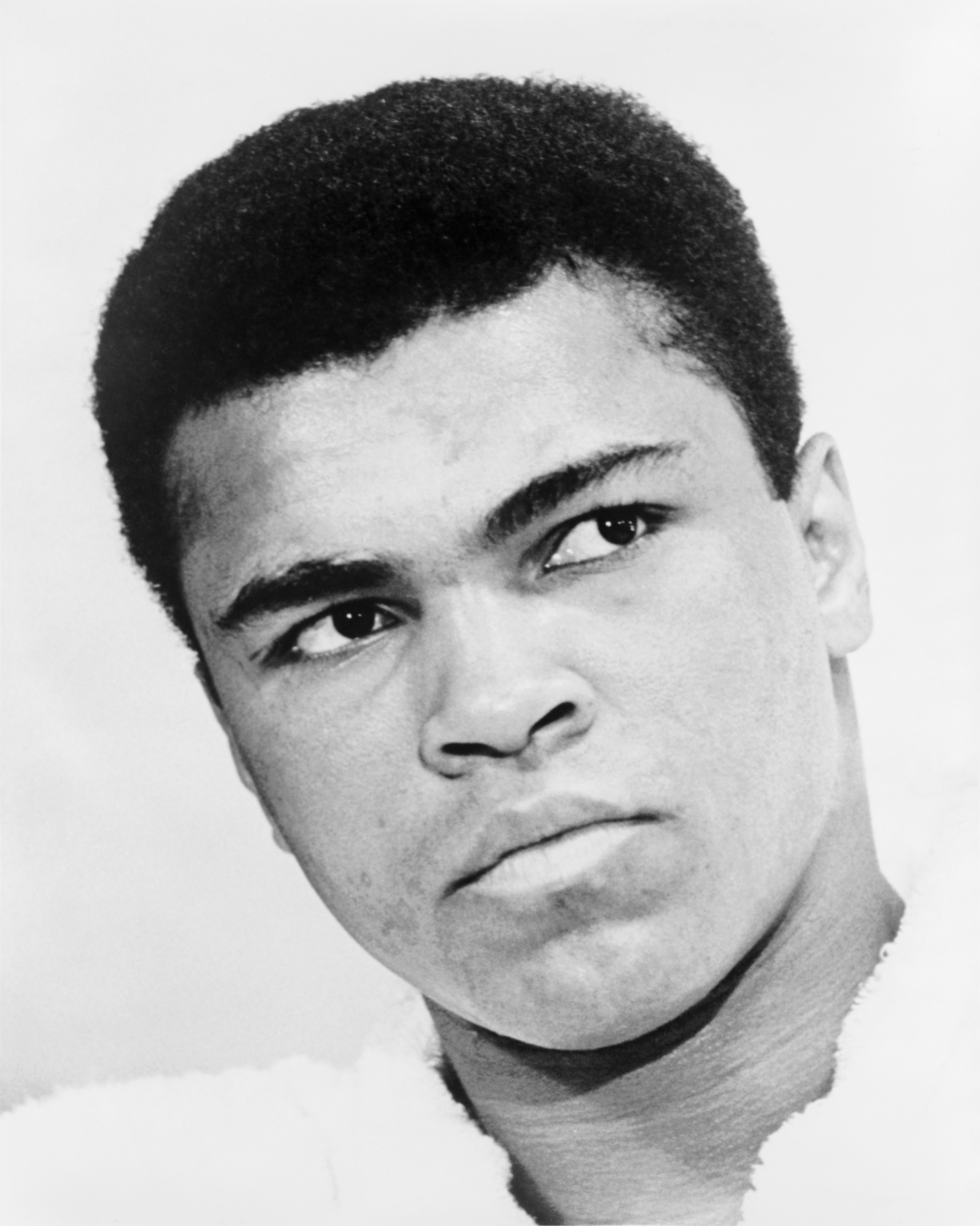
There are athletes, there are legends, and then there is Muhammad Ali. In a career spanning three decades and seventy-six professional bouts, Ali did something no other sportsman has quite managed: he made the entire world pay attention, not just to boxing, but to the human being throwing the punches. He was brash and poetic, gentle and ferocious, defiant and deeply principled, all at the same time. He renamed himself, refused a military draft at the cost of his prime years, and came back to win the heavyweight championship of the world twice more. Every time history tried to write him off, he rewrote the script himself.
Quick Facts
- Full name
- Muhammad Ali (born Cassius Marcellus Clay Jr.)
- Born
- 17 January 1942, Louisville, Kentucky, USA
- Nationality
- American
- Sport
- Boxing (heavyweight)
- Major titles
- 3x World Heavyweight Champion (1964, 1974, 1978); Olympic gold medallist, 1960
Louisville, Kentucky: The Beginning
Cassius Marcellus Clay Jr. was born on 17 January 1942, in Louisville, Kentucky, into a city that was still deeply segregated. His father, Cassius Sr., painted signs and murals for a living; his mother, Odessa, worked as a domestic servant for wealthy white families. The Clays lived in a modest house in the West End, a predominantly Black neighbourhood, and Cassius grew up knowing exactly where the invisible boundaries of Jim Crow ran. He was quick-witted, hyperactive and, by his own later admission, academically indifferent at school. What he was not was physically imposing, at least not yet.
The story of how he found boxing is one of the most celebrated origin stories in sport. In 1954, twelve-year-old Cassius had his bicycle stolen outside a Louisville community centre. Fuming, he told a police officer named Joe Martin that he wanted to beat up whoever had taken it. Martin happened to run a boxing gym in the basement of the centre, and he suggested the boy learn to fight before making any promises. Cassius showed up, and Martin saw immediately that something was different about this kid. He could move. He could slip punches instinctively. And he wanted, desperately, to be good.
The Making of a Fighter
Over the following years, Cassius Clay trained with the ferocious commitment of someone who had found the one thing that answered every question he had. He rose before dawn, ran miles through Louisville streets, and spent hours in the gym developing the style that would become his signature: upright stance, hands carried low, footwork that made heavyweight boxing look like ballet. Most coaches of the era taught heavyweights to plod forward and slug. Martin and his later trainer, Angelo Dundee, recognised that Clay’s instincts were revolutionary and largely left them intact.
He compiled a formidable amateur record. Between 1954 and 1960, he won 100 of 108 amateur bouts and took home six Kentucky Golden Gloves titles as well as two national Golden Gloves championships. The culmination came at the 1960 Summer Olympics in Rome, where the eighteen-year-old Clay won light heavyweight gold with such dazzling skill that the boxing world sat up and took notice. He charmed journalists, made friends with other athletes, and returned home a genuine local hero.
What happened next said everything about the America he had returned to. Wearing his gold medal, Clay was reportedly refused service at a whites-only restaurant in Louisville. The humiliation was complete and clarifying. He would later claim that the episode prompted him to throw his medal into the Ohio River, though the precise details of that story have been debated by biographers. Whatever the literal truth, the symbolic truth was undeniable: America could celebrate him as an Olympic champion and still treat him as something less than a full citizen.
Going Professional
Clay turned professional in 1960 under the management of a group of Louisville businessmen called the Louisville Sponsoring Group. Angelo Dundee, based in Miami, became his trainer, and the partnership would last for most of his career. Dundee was tactically shrewd and psychologically astute; he understood that Clay needed encouragement more than correction, and that his unconventional style required patience rather than reconstruction.
The early professional years were a careful construction project. Clay built his record win by win through 1961 and 1962, taking on increasingly capable opponents and announcing each coming victory in verse beforehand. He predicted the round in which he would stop his opponent. Sometimes he was wrong by a round or two, but the theatre was unmistakable. Here was a heavyweight who talked, rhymed, danced and delivered. Promoters and television executives loved him; the boxing establishment was not entirely sure what to make of him.
By 1963, Clay was the mandatory challenger for the heavyweight championship held by Sonny Liston, a physically terrifying fighter with connections to organised crime who had demolished Floyd Patterson in a single round, twice. The boxing press overwhelmingly expected Liston to destroy the young Louisville braggart. Clay spent the weeks before the fight conducting a masterclass in psychological warfare, taunting Liston at every press conference, calling him “the big ugly bear,” and generally behaving in a way designed to unsettle a man who relied on intimidating his opponents before the first bell.
Becoming “The Greatest”
On 25 February 1964, in Miami Beach, Cassius Clay fought Sonny Liston for the heavyweight championship of the world. Liston, for all his power, could not corner a target that refused to stand still. Clay moved, jabbed, circled and made the champion look slow and ordinary. When Liston did not come out for the seventh round, citing a shoulder injury, the arena dissolved into chaos. At twenty-two years old, Cassius Clay was heavyweight champion of the world.
The following morning, he made an announcement that shook the sports world as forcefully as the fight itself. He revealed his membership in the Nation of Islam and his close friendship with Malcolm X. Within days he announced that he was abandoning his “slave name” and would be known as Cassius X, and shortly afterward took the name Muhammad Ali, given to him by Nation of Islam leader Elijah Muhammad. It was a declaration of identity that went far beyond religion, a public refusal to accept the version of himself that white America had been comfortable with.
Three Years Stripped Away
Ali defended his championship nine times between 1964 and 1967, including a rematch with Liston in May 1965 that lasted barely a minute before Liston went down from a punch so fast the ringside crowd barely saw it. He destroyed the previously unbeaten Floyd Patterson in November 1965, outclassed Cleveland Williams in November 1966, and in May 1967 assembled perhaps the most technically precise performance of his career against Zora Folley.
Then, on 28 April 1967, Ali refused induction into the United States Army, citing his religious beliefs and his objection to the Vietnam War. His statement to reporters was not elaborate: “I ain’t got no quarrel with them Viet Cong.” He was stripped of his title the same day. He was convicted of draft evasion, sentenced to five years in prison and fined ten thousand dollars, though he remained free on bail during his appeal. He was thirty-five when the Supreme Court finally overturned his conviction in June 1971. He was twenty-five when the exile began.
Those three years between 1967 and 1970 represent one of sport’s great unanswerable questions. He was not in prison; he was simply banned from boxing in every American jurisdiction. He gave lectures on college campuses, spoke at anti-war rallies, and lived on the margins of the financial security his ring earnings had built. The sporting consensus is that those were precisely the years he was at his absolute physical peak, the years in which no other heavyweight on the planet could have beaten him. Whatever losses those years represent in terms of title defences and prize money, they represent something richer in terms of what Ali’s stand meant to a generation of Black Americans who saw themselves in his defiance.
The Return: Three Acts
Ali’s return to the ring in October 1970, following a court ruling that his New York boxing licence could not be withheld, was among the most anticipated sporting comebacks in history. He had missed three years and four months. His legs were not quite what they had been, and he was no longer able to dance for fifteen rounds with the same effortless fluency. What he retained was his jab, his chin, his ring intelligence, and an extraordinary capacity to absorb punishment.
His first major test came in March 1971, against Joe Frazier, who had won the heavyweight title during Ali’s exile and was undefeated in twenty-six professional fights. The fight at Madison Square Garden was billed with uncharacteristic accuracy as “the Fight of the Century.” Both men were undefeated champions with legitimate claims to the title. The arena was electric with tension the world had rarely seen compressed into a sporting event. Frazier won a unanimous decision, knocking Ali down in the fifteenth round with a left hook of devastating force. It was Ali’s first professional defeat.
What followed across the next decade was a trilogy with Frazier and a single defining contest with George Foreman that collectively constitute the most storied rivalry chapters in boxing history.
“I am the greatest. I said that before I knew I was.”
The rematch with Frazier, in January 1974, went Ali’s way on a unanimous decision, though neither man was at his sharpest. That same year, Ali was handed the opportunity most boxing observers considered impossible: a fight against George Foreman, who had dismantled Frazier twice and was generally regarded as the most ferocious heavyweight alive. The fight, scheduled for Kinshasa in what was then Zaire (now the Democratic Republic of Congo) in October 1974, was promoted by Don King and became the subject of the celebrated documentary “When We Were Kings.”
Ali’s strategy for what became known as the “Rumble in the Jungle” was extraordinary and counterintuitive. Against a man of Foreman’s power, Ali chose to lean against the ropes, cover up, and allow Foreman to punch himself to exhaustion. He called it the “rope-a-dope.” Foreman threw enormous punches for round after round; Ali took them on his arms and occasionally his body, talked to Foreman throughout, and waited. In the eighth round, Foreman’s legs went under him. Ali leapt off the ropes, unloaded a combination, and Foreman went down for the count. Ali was, at thirty-two, heavyweight champion of the world for the second time.
Thrilla in Manila
The third and final fight with Joe Frazier, in Manila in October 1975, is widely considered the most brutal heavyweight championship fight ever staged. Both men were past their technical peaks, but the hatred between their camps and the intensity of their history produced a contest of almost unbearable violence. Ali took appalling punishment in the early rounds. Frazier absorbed Ali’s combinations but would not go down. By the fourteenth round, Frazier’s eyes were nearly swollen shut, and his trainer Eddie Futch made the decision to retire him, over Frazier’s protests. Ali himself admitted afterward that it was the closest he had ever come to dying in a boxing ring.
He would later describe Frazier with genuine respect and, in later years, express regret for the personal insults he had directed at him throughout their careers. The two men were never fully reconciled before Frazier’s death in November 2011, a fact that Ali’s family has said weighed on him.
The Final Years of Competition
Ali defended the heavyweight title ten times between 1974 and 1978. In February 1978, he lost it for the second time to Leon Spinks, a relatively inexperienced fighter who had won Olympic gold the previous year, in a result that shocked the sport. Seven months later, in a rematch, Ali won a unanimous decision to become the first man to win the heavyweight championship three separate times.
He retired following the Spinks victory, then came back for two further contests that are difficult to watch. In October 1980, he fought Larry Holmes, who had held the WBC heavyweight title since 1978. Holmes, who had once been Ali’s sparring partner and revered him, was asked to fight his idol at a point when Ali’s speed and reflexes had deteriorated markedly. Holmes stopped Ali in eleven rounds, and later said that the fight had reduced him to tears. A final contest, against Trevor Berbick in December 1981, resulted in a ten-round decision loss. Ali retired for good at thirty-nine years old, with a professional record of 56 wins, 5 losses, and 37 knockouts.
Beyond the Ring: Faith, Politics, and Global Citizenship
The years after boxing cemented what the years inside the ring had suggested: Muhammad Ali was something larger than a heavyweight champion. His conversion to Islam, his stand against the Vietnam War, his willingness to sacrifice his career for his principles, and his charismatic global presence all combined to make him one of the defining public figures of the twentieth century.
In 1984, he was diagnosed with Parkinson’s syndrome, a condition that gradually robbed him of his voice and mobility. He faced it with the same dignity he had brought to everything else, never shrinking from public view, appearing at the 1996 Atlanta Olympics to light the flame, trembling but proud, and reducing an entire stadium to tears. He visited war-torn countries as a peace envoy, worked with humanitarian organisations across Africa and Asia, and used his fame with a deliberateness and generosity that many public figures claim but few actually demonstrate.
He married four times: to Sonji Roi in 1964, Belinda Boyd in 1967, Veronica Porsche in 1977, and Lonnie Williams in 1986. He had nine children, and his family has been vocal and consistent in protecting his legacy since his death. His relationship with his daughter Laila, who became a professional boxer herself and remained undefeated through her career, was one of the most publicly visible father-daughter relationships in sport.
The Parkinson’s Years
The progression of Parkinson’s over the three decades after his diagnosis was gradual but relentless. The man who had been the most articulate self-promoter in sporting history was reduced to communicating in whispers and then largely in silence. Yet his physical presence, even diminished, carried an authority that other men in their prime cannot project. When he appeared at events, people wept. Not out of pity, but out of recognition: here was a man who had given everything, who had been braver than almost anyone, and who bore his suffering without complaint.
He continued to travel internationally, visiting countries in conflict and communities in need, his presence alone delivering a message that his voice no longer could. His wife Lonnie managed his affairs with fierce protectiveness, and the Muhammad Ali Center, a museum and cultural centre in Louisville that opened in 2005, became a monument to his life while he was still alive to appreciate it.
Ali and the Wider World
One of the elements of Ali’s career that distinguishes him most sharply from other great athletes is the degree to which his sporting legacy and his political legacy cannot be separated. He did not simply box well and then say interesting things. His boxing was itself a form of political self-expression, a demonstration that a Black American man could be unashamedly loud, unashamedly proud, and unashamedly dominant in a country whose racial structures were designed to contain precisely those qualities.
The Nation of Islam membership that he announced in 1964 was not simply a religious affiliation. It was a statement of alignment with a community that had concluded, with considerable evidence behind it, that integration into white American society on white America’s terms was not available or desirable. His friendship with Malcolm X, which predated his championship fight with Liston and which he maintained until Malcolm X’s assassination in February 1965, was a friendship between two men who understood the world similarly and who found in each other an intellectual companion as much as a spiritual one.
His relationship with the Nation of Islam became more complicated after Malcolm X’s break with Elijah Muhammad and subsequent murder. Ali, who remained loyal to Elijah Muhammad through this period, distanced himself from Malcolm X in the final months of his life, a decision he later expressed regret over. After Elijah Muhammad’s death in 1975, Ali transitioned to Sunni Islam under the influence of Muhammad’s son Warith Deen Mohammed, who guided the Nation of Islam itself toward mainstream Sunni practice.
He also used his platform in ways that extended beyond American civil rights. He visited countries across Africa, the Middle East, and Asia, meeting heads of state, touring hospitals and schools, and engaging with communities that had limited access to the American celebrity culture he represented. In 1974, the “Rumble in the Jungle” fight was itself a statement: two Black American athletes competing at the highest level on African soil, in front of an African audience, under the gaze of the world. Promoter Don King and Ali himself were both aware of the symbolic weight of that geography, and Ali embraced it in a way that Foreman, who arrived with two German shepherd dogs (which Congolese observers associated with the dogs used by Belgian colonial authorities), did not.
His fundraising and humanitarian activities in later life, particularly through the Muhammad Ali Center and his work with various United Nations agencies, were consistent with a life philosophy that held individual achievement in high regard and collective responsibility in equal regard.
Legacy
Muhammad Ali died on 3 June 2016, in Scottsdale, Arizona, from septic shock. He was seventy-four years old. The tributes that poured in from every corner of the world made clear what the sporting record had long implied: this was not merely the greatest boxer who ever lived. This was one of the most consequential human beings of the modern era.
He was voted the BBC’s Sports Personality of the Century in 1999. Sports Illustrated named him the Sportsman of the Century. He appeared on the cover of more major international magazines than virtually any other athlete. And beyond all the awards and rankings, he endures in memory because the story of his life is a story about what is possible when a human being refuses to accept the limits that the world imposes on them.
He came from a segregated city, fought the most powerful government in the world, returned from exile to win back everything he had lost, and spent the last three decades of his life serving something larger than himself. He was, by almost any measure, precisely what he always claimed to be: the greatest of all time.
“I hated every minute of training, but I said, ‘Don’t quit. Suffer now and live the rest of your life as a champion.’”
Key Facts
- Muhammad Ali was born Cassius Marcellus Clay Jr. on 17 January 1942 in Louisville, Kentucky.
- He won an Olympic gold medal in the light heavyweight division at the 1960 Rome Olympics.
- He was stripped of his heavyweight title in 1967 after refusing military induction on religious grounds, and had his conviction overturned by the Supreme Court in 1971.
- His fights with Joe Frazier (three times) and George Foreman (“Rumble in the Jungle”) are considered the greatest rivalries in boxing history.
- He was diagnosed with Parkinson’s syndrome in 1984 and continued public service work for three decades before his death on 3 June 2016.