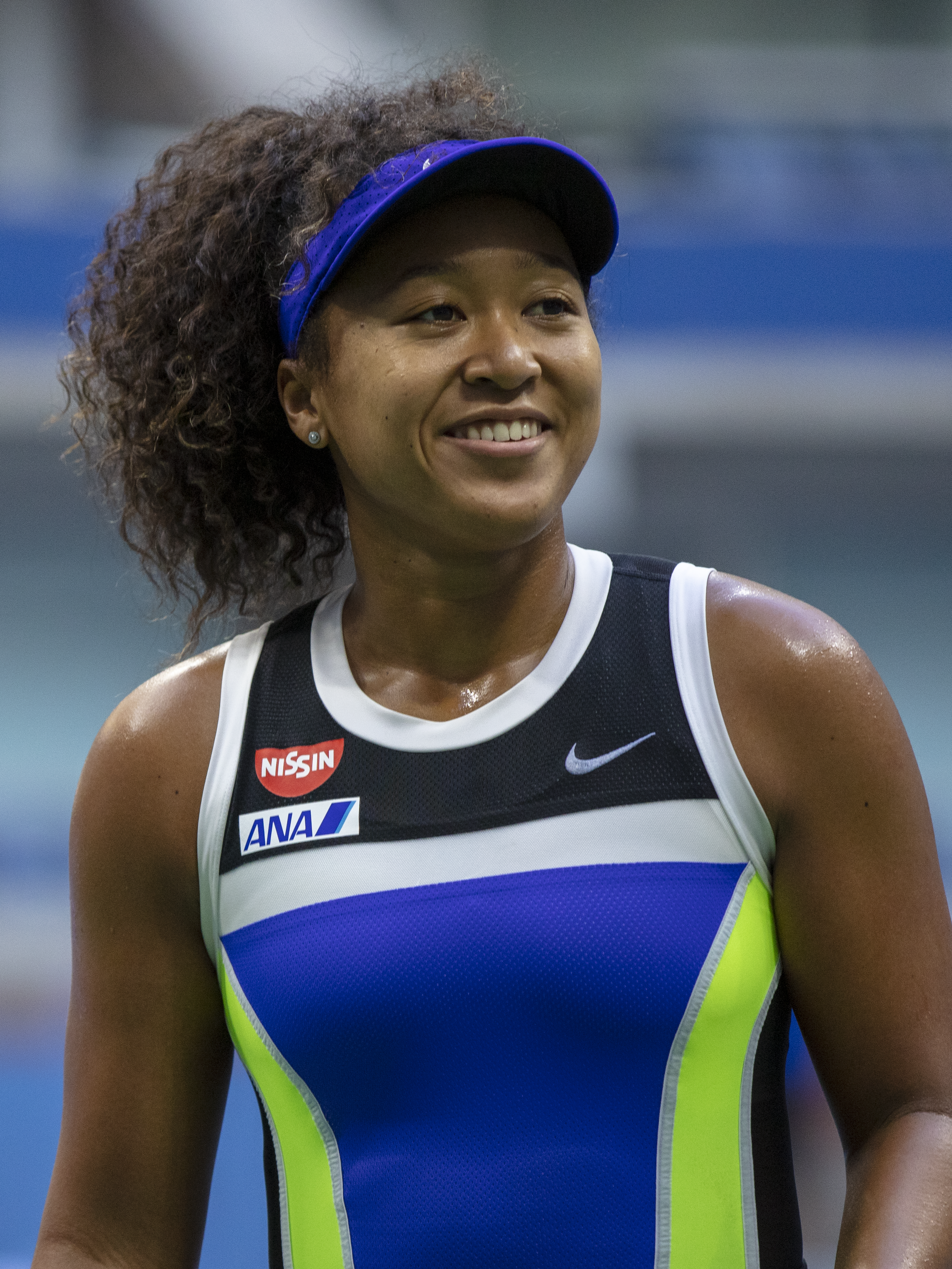
There are athletes who transform their sport through their performances. There are athletes who transform public conversation through their courage off the field of play. Very occasionally, an athlete does both, and the combination produces something more significant than either achievement would represent alone. Naomi Osaka, born to a Haitian-American father and a Japanese mother in Osaka, Japan, raised in the United States from age three, speaking English as her primary language while representing Japan in international competition, occupies a category of complexity that reflects the world she was born into as much as the tennis courts she has dominated. She was the world’s highest-paid female athlete in 2020 and 2021. She won her first four Grand Slam titles at four consecutive major finals, a feat without precedent in the professional era. She was twenty years old when she defeated Serena Williams in the 2018 US Open final and cried as the crowd booed the circumstance. She was twenty-three when she withdrew from the 2021 French Open citing mental health and started the most significant public conversation about athlete wellbeing that sport had witnessed in a generation.
Quick Facts
- Full name
- Naomi Osaka
- Born
- 16 October 1997, Osaka, Japan
- Sport
- Tennis
- Known for
- Four Grand Slam titles, world number one ranking at 21, 2021 French Open withdrawal for mental health
- Career highlight
- 2018 US Open title, defeating Serena Williams to win her first Grand Slam at age 20
Early Life and Background
Naomi Osaka was born on 16 October 1997 in Osaka, Japan, the second of two daughters born to Leonard François, a Haitian-American who had grown up in the United States, and Tamaki Osaka, a Japanese woman who had defied her family’s wishes to marry him. The couple had met when Tamaki’s family were living in New York, and the relationship, and then the marriage, strained her relationship with her parents, who disapproved of the interracial union. When Naomi was three years old, the family moved to the United States, settling initially in Long Island, New York.
The move to the United States was partly motivated by Leonard François’s ambition to raise his daughters as tennis players. He had been inspired, in his own account, by watching the 1999 French Open on television and seeing the Williams sisters competing, and he had concluded that he could, with sufficient dedication, raise his daughters to similar heights. His methodology consciously drew on what he understood about the Williams family’s approach: immersive early training, independence from the conventional junior tournament circuit, a focus on development over short-term results, and the belief that what others dismissed as impossible was merely unconventional.
The family eventually settled in Boca Raton, Florida, a location with weather suitable for year-round outdoor tennis and proximity to the training academies and coaching resources of the South Florida tennis community. Resources were limited. Leonard coached Naomi and her older sister Mari himself, learning the technical aspects of the game as he went and supplementing his own coaching with whatever instruction he could access and afford. The family lived modestly. The girls hit balls on public courts and private club courts wherever time could be arranged.
Naomi was, from her early years, the more naturally gifted of the two sisters, though Mari competed professionally for a period and reached a WTA ranking. Naomi’s serve was extraordinary from early in her development: a high toss, a relaxed trophy position and a powerful shoulder rotation produced a serve that, by her mid-teens, was already clocked at speeds comparable to established professionals. Her groundstrokes were flat and heavy, struck with a technical consistency that spoke to the thousands of hours of repetition that had built them.
Growing Up Between Cultures
One dimension of Naomi Osaka’s story that is essential to understanding her and that resists simplification is her identity. She was born in Japan to a Japanese mother and a Haitian-American father, raised in the United States from age three, educated in American schools, speaking English as her primary language while understanding but speaking Japanese imperfectly. She made the decision, with her family, to represent Japan in international tennis competition rather than the United States.
The decision was partly strategic: Japan had limited tennis depth at the time she was making her professional debut, and the path to Olympic participation and national team representation was more accessible through Japan. It was also personal: Naomi felt a genuine connection to her mother’s culture, even if her day-to-day life was entirely American in its texture. The decision has been both an enormous success commercially, given Japan’s deep interest in her career, and a source of ongoing complexity as she has navigated what it means to represent a national identity that she expresses differently from most of her Japanese contemporaries.
She has spoken in multiple interviews about feeling neither fully Japanese nor fully American, about encountering prejudice in Japan for her mixed heritage, about the difficulty of representing a national culture whose language and daily customs she had not grown up immersed in. These are not complaints about her choices but honest engagements with a complexity that more straightforwardly monocultural athletes do not encounter. Her ability to discuss that complexity publicly and thoughtfully has made her a figure of significance to mixed-race and diaspora communities worldwide.
Professional Career Begins
Naomi Osaka turned professional in 2013 at fifteen. Her early years on the WTA Tour were unremarkable by the standards of what she would become, though the serve was immediately noted as exceptional. She won her first WTA title at Indian Wells in 2018, defeating seven opponents including Karolina Pliskova in the final. Indian Wells, played on a hard court in the California desert, hosts one of the most prestigious WTA events outside the four Grand Slams, and winning it announced Osaka as a genuine title contender rather than a promising player.
Her ranking at the start of 2018 was 72nd in the world. By the end of the year it would be 4th. The trajectory of that ascent, concentrated into a few extraordinary months, is one of the most dramatic in recent WTA Tour history.
The 2018 US Open
On 8 September 2018, Naomi Osaka stood across the net from Serena Williams in the US Open final in New York. Osaka was twenty years old, ranked 20th in the world, making her first Grand Slam final appearance. Williams was thirty-six, the twenty-three-time Grand Slam champion, making what many expected to be her triumphant return to competitive dominance after giving birth to her daughter Olympia in September 2017.
The match began calmly enough, with Osaka winning the first set 6 to 2 in a display of flat, heavy hitting that gave Williams little opportunity to find rhythm. In the second set, at 3 to 3, Williams received a coaching violation from chair umpire Carlos Ramos, a penalty for receiving coaching signals from her coach Patrick Mouratoglou in the stands. Williams disputed the call vigorously. Later, after breaking a racquet, she received a point penalty, and then, after continuing to argue with Ramos, a game penalty. She demanded an apology from Ramos and the tournament referee. The crowd, which had come to see Serena Williams win a Grand Slam final, began to boo, not at Osaka specifically but at the situation.
Osaka won the match 6 to 2, 6 to 4, claiming her first Grand Slam title in the most celebrated and most written-about match of the year. At the trophy ceremony, with the crowd still unsettled, Osaka wept. She apologised to the crowd for winning. The image of a twenty-year-old champion, holding her first Grand Slam trophy and apologising for the conditions of her victory, said something about both her generosity and the weight of the moment she had walked into. She was asked later about the experience and said she hoped people would remember the match for her performance rather than the controversy.
Three More Grand Slam Titles
Osaka won the 2019 Australian Open in January 2019, defeating Petra Kvitova in the final 7 to 6, 5 to 7, 6 to 4 in a match of extraordinary quality and tension. Kvitova, who had survived a knife attack on her playing hand in 2016 and made one of sport’s great comebacks, was an entirely worthy finalist, and the match was contested at a level that justified the significance of the occasion. Osaka’s victory made her, at twenty-one, the world number one ranked player, the first Japanese player to hold that position.
She won the 2020 US Open in September 2020, the tournament played during the pandemic at Flushing Meadows in a bubble without spectators. She wore seven face masks across seven matches, each bearing the name of a different Black American who had been killed by police violence or in racially motivated incidents: Breonna Taylor, Elijah McClain, Ahmaud Arbery, Trayvon Martin, George Floyd, Philando Castile and Tamir Rice. The masks generated significant attention and generated, for Osaka personally, both support and a volume of hostile commentary that she would later describe as contributing to her mental health challenges.
She won the 2021 Australian Open in February 2021, defeating Jennifer Brady in straight sets. The victory was her fourth Grand Slam title in four Grand Slam finals, a record unprecedented in the professional era of women’s tennis. The sequence of 2018 US Open, 2019 Australian Open, 2020 US Open and 2021 Australian Open, all won on first appearance in the respective finals, established a consistency at the major level that placed her among the elite players of her generation before her twenty-fourth birthday.
Stand for what you believe in, even if it means standing alone.
The 2021 French Open Withdrawal
On 26 May 2021, the day before her second-round match at the French Open, Naomi Osaka announced on social media that she would not participate in the mandatory post-match press conferences during the tournament, citing concern for her mental health. She described the press conference format as something she found damaging, a context in which players who had just competed at the highest level were asked questions designed to generate negative emotion and then judged for their emotional responses.
The announcement generated immediate controversy. Grand Slam officials from all four major tournaments issued a joint statement threatening significant sanctions, potentially including disqualification, for failure to comply with media obligations. Osaka attended the press conference after her first-round victory but then withdrew from the tournament after her second-round win, issuing a statement in which she disclosed that she had experienced long bouts of depression since the 2018 US Open final and described social anxiety that made large press conferences extremely difficult.
The reaction was divided along predictable lines: some commentators argued that press conferences were a professional obligation and that wealthy athletes had no grounds for complaint, while others (including the majority of active WTA players and virtually the entire sports psychology community that commented publicly) expressed support for her transparency and argued that the mental health of athletes deserved the same consideration afforded their physical health. She subsequently withdrew from Wimbledon 2021 and sat out the remainder of the clay court season.
At the Tokyo Olympics in August 2021, held on Japanese soil and carrying enormous symbolic weight for Osaka as a representative of Japan, she lit the Olympic cauldron at the opening ceremony, an extraordinary honour and a moment of genuine emotional complexity for someone who had spent much of the preceding months under intense public scrutiny. She was eliminated in the third round of the singles draw, losing to Marketa Vondrousova of the Czech Republic, and gave interviews afterward that were honest about the difficulty she had felt performing under the specific pressures of the home Olympics.
Fashion, Business and Cultural Presence
Naomi Osaka’s commercial profile is, for a tennis player in her age bracket, exceptional. She was the world’s highest-paid female athlete in 2020 and 2021, earning more than 55 million dollars annually from prize money and endorsements during that period. Her commercial relationships have included partnerships with Nike, Louis Vuitton, Mastercard, Levi’s, Beats by Dre and numerous Japanese brands, reflecting both her international profile and her particular importance to the Japanese market.
She launched her own skincare brand, Kinlò, in 2021, aimed specifically at providing sun care products formulated for people with darker skin tones, a gap she identified in the consumer market from personal experience. The brand’s mission was explicitly inclusive and tied to her broader public commitments around racial equity and representation. She has also been an investor and spokesperson for various social enterprise ventures.
Her fashion presence is significant: she has appeared at the Met Gala, walked in fashion weeks and collaborated with luxury brands in ways that reflect a genuine interest in design and aesthetics rather than simply commercial opportunity. She was named to the Time magazine list of the 100 most influential people in the world in both 2019 and 2021.
Return to Competition and Motherhood
Osaka returned to competition in stages through 2022 and 2023, navigating the balance between her desire to compete and the mental health management she had made public. Her results in this period were mixed: she won first-round matches at Grand Slams and made middle-round exits, without returning to the final stages where she had been dominant in 2018 to 2021.
In January 2023, she announced that she was pregnant with her first child. Her daughter, Shai Malakai Cordae, was born in July 2023. The name Cordae comes from Shai’s father, rapper and artist Cordae Dunston. Osaka returned to professional tennis in January 2024 at the Brisbane International, competing and winning matches within six months of giving birth, a return that she managed on her own timeline and in her own way.
Her return to Grand Slam competition at the 2024 Australian Open drew significant attention, and she won matches before a fourth-round exit. She described the experience of returning as a mother, with different priorities and a different relationship to the competitive outcome, as in some ways easier than the period before her withdrawal in 2021, when the pressure had felt total and inescapable. She was competing now, by her own account, for herself and for her daughter and not for the validation of the crowd or the approval of the sport’s establishment.
The Mental Health Conversation
The lasting significance of Naomi Osaka’s 2021 French Open withdrawal and the discussion that followed is likely to outlast her individual career achievements, significant as those achievements are. She demonstrated publicly that an athlete at the summit of their profession could acknowledge mental health struggle, choose to prioritise their own wellbeing over a competition obligation and survive the reaction, financial, reputational and otherwise.
The institutional response of the Grand Slam organisers, their joint statement threatening sanctions before any discussion about accommodation or support had been attempted, was itself widely characterised as indicative of the problem. Tournament and sports organisations that had no comparable public position on player mental health were confronted by a player forcing them to engage with the question. The WTA subsequently developed more explicit mental health support frameworks for players. Multiple athletes in multiple sports cited Osaka’s transparency as creating space for them to discuss their own mental health struggles more openly.
The conversation was not comfortable or simple. It revealed genuine tensions between athletes’ contractual obligations to the commercial infrastructure that funds their sport and their right to make decisions about their own health. It revealed the gap between the rhetoric about athlete welfare that sporting organisations publish and the practical reality of how they respond when a specific welfare concern conflicts with commercial interests. Naomi Osaka did not resolve those tensions, but she forced them into the open in a way that could not be ignored.
Legacy
Naomi Osaka is twenty-seven years old as of the time of this writing and is still competing. Her legacy is therefore still in formation. What is already established is a playing record of four Grand Slam titles at a consistency rate that only the very greatest players achieve, a world number one ranking reached at 21 and representing Japan in international competition. Her cultural significance extends into fashion, commerce, racial identity politics and the specific field of athlete mental health advocacy. She is one of the most recognised athletes in Japan, in the United States and globally, and the audiences that follow her cross the conventional boundaries of sport fandom.
The moment at the 2018 US Open, when she wept at the trophy ceremony and apologised for winning, is the image that many people carry of her, and it is in some ways the beginning of her story as a public figure rather than its defining moment. The defining moment may be the French Open withdrawal: the act of choosing herself in the most public way possible and discovering that she could survive it.
Key Facts
- Naomi Osaka won four Grand Slam titles in four Grand Slam final appearances (2018 US Open, 2019 Australian Open, 2020 US Open, 2021 Australian Open), a record in the professional era of women’s tennis.
- She became world number one in January 2019 at age 21, the first Japanese player in history to hold the top ranking in women’s tennis.
- She was the world’s highest-paid female athlete in 2020 and 2021, earning approximately 55 million dollars annually from prize money and endorsements.
- Her withdrawal from the 2021 French Open, citing depression and anxiety, is widely credited with changing how sporting organisations discuss and address athlete mental health.
- She wore masks bearing the names of seven Black Americans killed by police violence across her seven matches at the 2020 US Open, and lit the Olympic cauldron at the 2021 Tokyo Olympics opening ceremony.