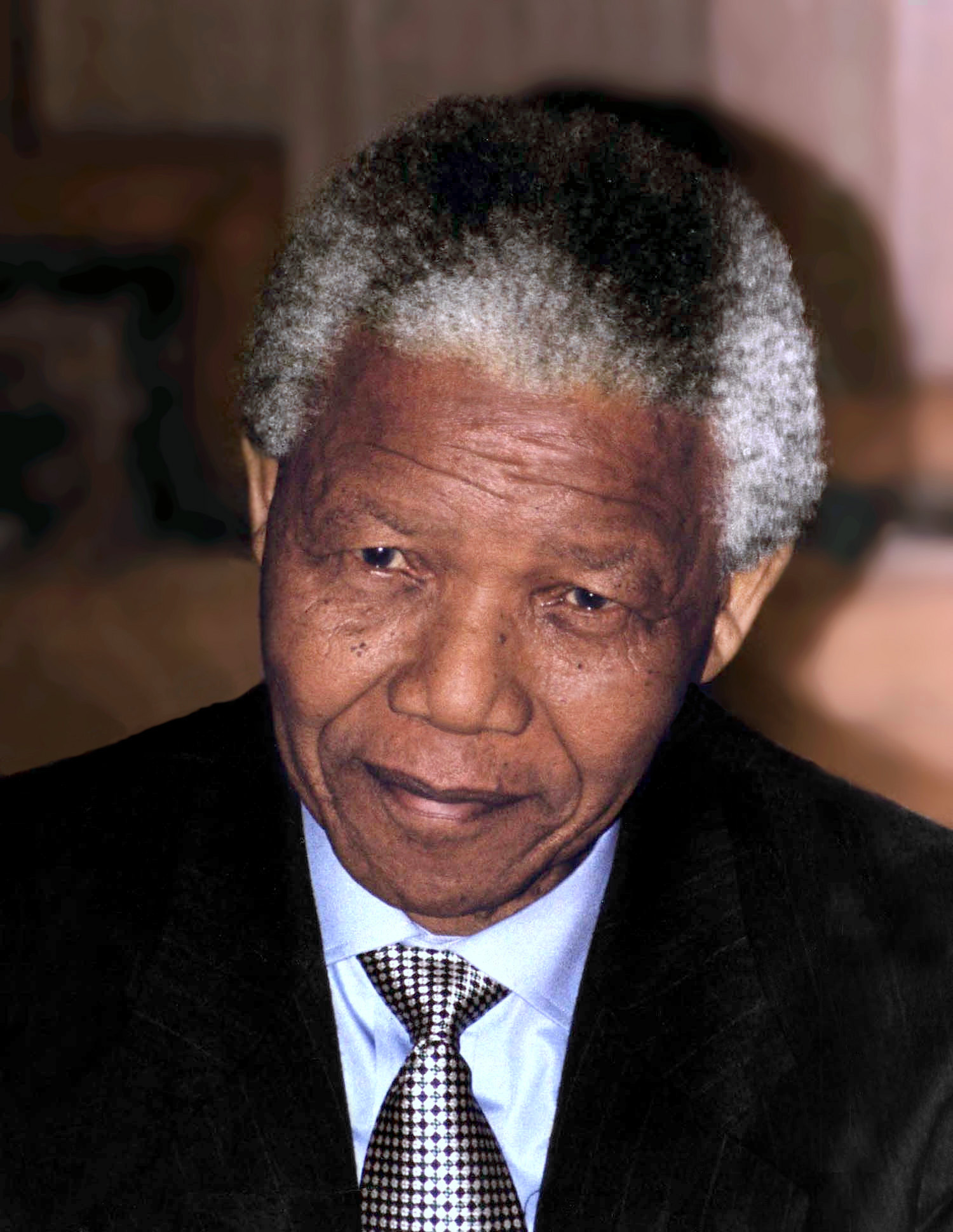
Few lives in modern history bend so dramatically toward justice as that of Nelson Rolihlahla Mandela. Born into a royal Thembu family yet stripped of his freedom for nearly three decades, he emerged from prison not with vengeance but with an extraordinary capacity for forgiveness. His journey, from a herd-boy in the rolling hills of the Eastern Cape to the first democratically elected president of South Africa, remains one of the twentieth century’s defining moral narratives. To understand how one man came to embody the conscience of a nation, you have to follow the whole of that journey: the village, the courtroom, the prison quarry, and finally the presidential office he occupied for a single, deliberate term.
Quick Facts
- Full name
- Nelson Rolihlahla Mandela
- Clan name
- Madiba
- Born
- 18 July 1918, Mvezo, South Africa
- Died
- 5 December 2013, Johannesburg (aged 95)
- Known for
- Anti-apartheid leader; 1st President of a democratic South Africa (1994 to 1999)
- Imprisoned
- 1962 to 1990 (27 years)
- Nobel Prize
- Peace, 1993 (shared with F. W. de Klerk)
Early Life and Background
Mandela was born on 18 July 1918 in the small village of Mvezo, on the banks of the Mbashe River in what was then the Cape Province. He was given the Xhosa name Rolihlahla, which literally means “pulling the branch of a tree” but is colloquially understood as “troublemaker,” a label that would acquire a certain irony over the decades that followed. His father, Gadla Henry Mphakanyiswa, was a local chief and a counsellor to the Thembu royal house, a man of standing whose authority rested on custom rather than wealth.
That standing did not last. When Mandela was still an infant, his father fell into a dispute with a local colonial magistrate and was stripped of his chieftainship and much of his land. The family moved to the even smaller village of Qunu, where Mandela spent the happiest years of his childhood herding cattle and sheep, playing in the veld with other boys, and absorbing the oral traditions of his people. He belonged to the Madiba clan, and “Madiba” would later become the affectionate name by which millions of South Africans knew him.
When Mandela was nine, his father died of what was probably a lung disease. The boy was placed under the guardianship of Jongintaba Dalindyebo, the regent of the Thembu people, and moved to the Great Place at Mqhekezweni, the regent’s royal residence. There, in a world of councils and protocol, he received a formative political education simply by watching. He observed how the regent listened to every voice before speaking, how decisions were reached by consensus, and how a chief was expected to serve the community rather than rule over it. The lesson that a leader should be like a shepherd, staying behind the flock and letting the most nimble go ahead, stayed with him for life.
Education and Awakening
A Methodist teacher at his first school gave the boy the English name “Nelson,” following the colonial habit of assigning European names to African pupils. He proved a serious, diligent student. He attended the Clarkebury Boarding Institute and then Healdtown, a Methodist college, where he encountered a wider African world and began to think of himself not only as a Thembu but as part of a larger Black South African nation.
In 1939 he enrolled at the University of Fort Hare, the most prestigious institution of higher learning open to Black students in southern Africa. It was a crucible of future leaders, and there he met Oliver Tambo, who would become a lifelong friend and political partner. But Mandela’s time at Fort Hare ended abruptly: he was suspended for joining a boycott of the Students’ Representative Council over the quality of food and the limits placed on student power. Refusing to back down even when the principal demanded it, he left without his degree, an early demonstration of a stubbornness that would define his life.
Returning home, he discovered that the regent had arranged marriages for both Mandela and his cousin. Unwilling to be bound by a union he had not chosen, the young man did what countless restless youths have done before and since: he ran away to the city. Johannesburg, the sprawling, gold-driven metropolis of the Witwatersrand, would become the stage on which his political life unfolded.
Johannesburg and the Law
Mandela arrived in Johannesburg in 1941 with little money and no clear plan. He found work first as a night watchman at a mine and then, crucially, as a clerk at a law firm, a position arranged through the activist and estate agent Walter Sisulu, who became a mentor and another lifelong friend. Sisulu introduced him to a circle of thinkers and organisers who were beginning to imagine a different South Africa.
Living in the township of Alexandra and later Orlando, Mandela experienced first-hand the daily indignities of segregation: the pass laws that controlled where Africans could live and work, the overcrowded townships, the casual contempt of officialdom. He completed his bachelor’s degree by correspondence through the University of South Africa and then began studying law at the University of the Witwatersrand, one of very few Black students in a hostile environment.
In 1952 he and Oliver Tambo opened Mandela and Tambo, the first Black-run law firm in the country. Their offices were besieged daily by Africans who had fallen foul of the apartheid bureaucracy: arrested for being in the wrong area, for lacking the right stamp in a passbook, for living on land suddenly declared “white.” Day after day Mandela saw the machinery of racial law grind down ordinary people, and the experience hardened his conviction that the system itself, not merely its excesses, had to be dismantled.
The struggle is my life. I will continue fighting for freedom until the end of my days.
The Fight Against Apartheid
Mandela had joined the African National Congress in 1943, and in 1944 he helped found the ANC Youth League alongside Tambo, Sisulu and others. The Youth Leaguers were impatient with the cautious, petition-based politics of their elders, and they pushed the ANC toward mass action. When the National Party came to power in 1948 and began constructing the formal architecture of apartheid, with its separate amenities, racial classification, forced removals and notorious pass system, the stakes rose sharply.
In 1952 the ANC and its allies launched the Defiance Campaign, a programme of deliberate, non-violent law-breaking modelled in part on Mahatma Gandhi’s earlier South African campaigns. Volunteers courted arrest by entering “whites-only” facilities and ignoring curfew and pass regulations. Mandela served as the campaign’s national volunteer-in-chief, travelling the country to organise. The campaign swelled the ANC’s membership and made Mandela a national figure, but it also brought the first of many banning orders, restricting his movements and forbidding him from attending gatherings.
Through the 1950s the government tightened the screws. In 1955 the Congress of the People adopted the Freedom Charter, a visionary document declaring that South Africa belonged to all who lived in it, black and white. The state responded by charging Mandela and 155 others with treason. The Treason Trial dragged on for years before ending in acquittals in 1961, but it consumed energy and signalled that the authorities were prepared to use the courts as weapons.
The Turn to Armed Struggle
For most of the 1950s Mandela publicly championed non-violence. But events were closing off peaceful avenues. In March 1960, police at Sharpeville opened fire on a crowd protesting the pass laws, killing 69 people, many shot in the back as they fled. The massacre shocked the world and convinced Mandela and many of his colleagues that a state willing to gun down unarmed citizens could not be moved by moral persuasion alone. The government banned the ANC, forcing it underground.
In 1961 Mandela helped found Umkhonto we Sizwe, meaning “Spear of the Nation” and often abbreviated MK, the armed wing of the ANC. Its initial strategy was sabotage aimed at installations rather than people, intended to pressure the government while limiting loss of life. Mandela slipped underground, adopting disguises and moving from safe house to safe house. His ability to evade the security police earned him the nickname “the Black Pimpernel.” He travelled secretly abroad to gather support and undergo military training, and he returned to continue the struggle knowing that capture was only a matter of time.
The Rivonia Trial
In August 1962 Mandela was arrested near Howick, reportedly after a tip-off, and was convicted of leaving the country illegally and inciting workers to strike. While he was already serving that sentence, police raided a farm at Rivonia, outside Johannesburg, and seized documents that linked the ANC leadership to MK’s sabotage plans. Mandela and several co-accused were put on trial for sabotage, a charge that could carry the death penalty.
At the Rivonia Trial in 1964, Mandela chose not to mount a conventional legal defence to save his own life but instead to make a political statement from the dock. In a long speech he set out the reasoning behind the struggle, the humiliations of apartheid, and his refusal to accept a society built on white supremacy. He closed with words that would echo around the world for decades: he had cherished the ideal of a democratic and free society in which all people lived together in harmony and with equal opportunities. It was an ideal he hoped to live for and to achieve, but, if need be, an ideal for which he was prepared to die.
He and most of his co-accused were spared execution and instead sentenced to life imprisonment.
Twenty-Seven Years Behind Bars
Mandela spent the first eighteen of his twenty-seven prison years on Robben Island, a windswept former leper colony in the cold Atlantic off Cape Town. Conditions were deliberately harsh. As a Black political prisoner he received the lowest category of treatment: thin clothing, meagre rations, and long days of hard labour breaking rocks in a blinding limestone quarry, where the glare permanently damaged his eyesight and the dust harmed his lungs. For years he was allowed only a single visitor and a single letter every six months, and even those were heavily censored.
Yet the island did not break him. It became, in the words of those who were there, a kind of university. The prisoners taught one another, debated politics and history, and organised to demand better conditions. Mandela emerged as a natural leader among them, insisting on dignity in dealings with the warders and mediating disputes between rival factions. He also made a decision that revealed his strategic mind: he set out to learn Afrikaans, the language of his jailers, reasoning that to negotiate with and ultimately persuade his adversaries he first needed to understand them and their fears.
Outside the prison walls, his stature only grew. The international anti-apartheid movement adopted “Free Mandela” as a global rallying cry. Sanctions tightened, sporting and cultural boycotts isolated South Africa, and his name became one of the most recognisable on Earth, even as, inside the country, it remained illegal to publish his image or his words.
In 1982 Mandela was transferred to Pollsmoor Prison on the mainland and later to Victor Verster Prison, where he was held in a warder’s house. By the late 1980s the apartheid state was straining under internal unrest, economic pressure and international isolation. Secret, exploratory talks began between Mandela and government representatives. These were conversations he conducted largely alone, careful not to compromise the movement while testing whether a negotiated settlement was possible.
Release and the Road to Democracy
On 11 February 1990, after President F. W. de Klerk lifted the ban on the ANC and other organisations, Mandela walked free. Hand in hand with his then-wife Winnie, he stepped out of Victor Verster before the world’s cameras: upright, composed, and famously without visible bitterness. He was 71 years old and had entered prison as a vigorous man in his forties; he emerged as an elder statesman who would now have to convince a frightened, divided country to choose negotiation over civil war.
The next four years were among the most dangerous in South Africa’s history. Political violence flared, particularly between supporters of the ANC and the Inkatha Freedom Party, and hardliners on all sides sought to derail the talks. The assassination of the popular leader Chris Hani in 1993 brought the country to the brink, and it was Mandela, not the government, who went on television to appeal for calm, a moment that confirmed where real moral authority now lay. Through the multi-party negotiations known as CODESA, Mandela and de Klerk hammered out the framework for a democratic constitution. In 1993 the two men shared the Nobel Peace Prize for their efforts.
President and Peacemaker
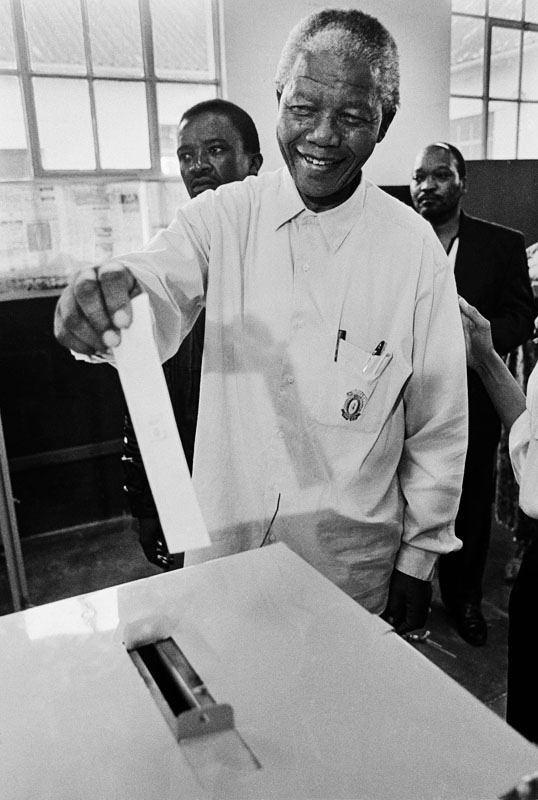
On 27 April 1994, South Africans of every race queued for hours to vote in the country’s first fully democratic election. The images of those snaking lines became symbols of a nation being reborn. The ANC won decisively, and on 10 May 1994 Nelson Mandela was inaugurated as president, with de Klerk and Thabo Mbeki as his deputies in a Government of National Unity.
Rather than pursue retribution against those who had imprisoned and oppressed the Black majority, Mandela made reconciliation the defining theme of his presidency. He established the Truth and Reconciliation Commission, chaired by Archbishop Desmond Tutu, which offered a forum for victims to be heard and for perpetrators to confess in exchange for amnesty, an imperfect but pioneering attempt to confront a violent past without tearing the country apart.
He understood the power of symbols. When South Africa hosted and won the 1995 Rugby World Cup, Mandela walked onto the field wearing the green Springbok jersey, a garment long associated with white Afrikaner identity, and presented the trophy to the team’s white captain. The gesture, watched by millions, did more to ease racial fear than any speech could have. His government also launched the Reconstruction and Development Programme, extending electricity, clean water, housing and health care to communities the old order had ignored, though the scale of inequality he inherited could not be undone in a single term.
Major Achievements and Challenges
Mandela’s presidency rested on a single, almost impossible achievement: he helped steer South Africa away from the racial civil war that nearly every observer had predicted. That accomplishment alone would secure his place in history, but it sat alongside many others. He oversaw the drafting and adoption of one of the most progressive constitutions in the world, with an entrenched bill of rights, an independent judiciary and protections that explicitly outlawed discrimination. He reintegrated South Africa into the community of nations, ending the isolation of the apartheid years and welcoming the country back into international sport, trade and diplomacy.
The challenges were equally immense, and Mandela never pretended otherwise. The economy he inherited was deeply unequal, with wealth concentrated in a small minority and millions living without basic services. Unemployment was high, the education system had been deliberately starved for Black children, and the HIV/AIDS epidemic was gathering force. Critics on the left argued that the negotiated settlement protected too much existing economic power; critics elsewhere worried about the pace of change. Mandela’s response was characteristically measured: he prioritised stability and reconciliation in the conviction that a democracy which survived its first years could correct its failings over time, whereas one that collapsed into vengeance would help no one.
Personal Life
Mandela’s private life was as turbulent as his public one. His first marriage, to Evelyn Mase, produced several children but did not survive his deepening immersion in politics. In 1958 he married Winnie Madikizela, a charismatic social worker who became a formidable activist in her own right during his long imprisonment, enduring banishment and detention. The marriage, strained by decades apart and by later controversies, ended in separation soon after his release and in divorce in 1996. On his 80th birthday in 1998 he married Graça Machel, the widow of the former president of Mozambique, finding companionship in his final decades. He fathered six children and suffered profound personal losses, including the deaths of two of his children, and he often spoke of the price his family paid for his public commitments.
Retirement, Legacy and Death
True to a promise that distinguished him from many leaders, Mandela served only one term and stepped down in 1999, handing power to Mbeki. In a continent too often scarred by rulers who cling to office, his voluntary departure was itself a lesson in democratic restraint.
In retirement he devoted himself to humanitarian work through the Nelson Mandela Foundation and the Nelson Mandela Children’s Fund, and he became an outspoken advocate in the fight against HIV/AIDS, a cause given painful resonance when his own son died of an AIDS-related illness, a fact Mandela announced publicly to combat the stigma surrounding the disease. He lent his prison number to the 46664 campaign to raise awareness, and he spoke out on global issues until age and frailty drew him from public life.
Nelson Mandela died on 5 December 2013 at his home in Johannesburg, at the age of 95. The world paused. Leaders and ordinary people alike gathered to mark the passing of a man who had become, in his own lifetime, a near-universal symbol of dignity and forgiveness. The United Nations had already declared his birthday, 18 July, as Nelson Mandela International Day, encouraging people everywhere to devote time to serving others.
Honours and Lasting Recognition
The accolades Mandela received in his lifetime are almost too numerous to list. He shared the Nobel Peace Prize in 1993 and received the highest civilian honours of dozens of countries, honorary degrees from universities around the globe, and the freedom of countless cities. Statues of him stand from Johannesburg to London, schools and streets bear his name on every continent, and his face has appeared on his country’s banknotes. Yet he was consistently uneasy with being treated as a saint, insisting that he was an ordinary man who had been shaped by extraordinary circumstances, and that the credit belonged to the collective movement rather than to any single individual.
A few details capture the man behind the icon:
- His Xhosa name, Rolihlahla, is often translated as “troublemaker,” a nickname history made fitting.
- He taught himself Afrikaans in prison so he could understand and one day negotiate with his jailers.
- He was a keen amateur boxer in his youth, valuing the discipline of training more than the violence of the sport.
- He insisted on serving only one term as president, stepping down voluntarily in 1999.
- His prison number, 46664, became the name of a global HIV/AIDS awareness campaign.
What endures is not only the politician but the example: that a person can suffer profound injustice and still choose grace; that freedom is meaningful only when it is shared; that an enemy understood can become a partner in peace; and that the longest walk is worth taking if it leads to dignity for all. Madiba’s long walk to freedom was, in the end, a walk the whole of his country, and much of the world, took with him.