She arrived on stage like a force of weather rather than a performer. Tall, self-possessed and radiating a severity that audiences found both intimidating and magnetic, Nina Simone occupied the piano bench with the authority of someone who knew she was sitting at the centre of her own world. Her voice, a deep, husky instrument that could lean into a note and shake it loose from its moorings, was unlike anything else in American popular music. Her piano playing drew equally on the formal discipline of classical training and the raw emotional directness of the Black church. And her convictions, her absolute refusal to allow her art to remain politically neutral in a country that was murdering its Black citizens, made her a figure who transcended the usual categories of musician, activist, artist and prophet.
Quick Facts
- Full name
- Eunice Kathleen Waymon
- Born
- 21 February 1933, Tryon, North Carolina, USA
- Died
- 21 April 2003, Carry-le-Rouet, France (aged 70)
- Genre
- Soul, jazz, blues, gospel, classical, folk
- Known for
- "Feeling Good," "Mississippi Goddam," "I Put a Spell on You," civil rights activism
Early Life
Eunice Kathleen Waymon was born on 21 February 1933 in Tryon, a small town in the Blue Ridge Mountains of North Carolina. She was the sixth of eight children in a family headed by her father, John Divine Waymon, a preacher and entertainer, and her mother, Mary Kate Waymon, a Methodist minister. The household was deeply religious, music was the oxygen of daily life, and the young Eunice absorbed gospel harmonies, hymn structures and the emotional architecture of Black American church music before she could name what she was learning.
She began picking out hymn tunes on the piano by ear before she was four years old, and her gift was recognised immediately. A local white woman, Muriel Mazzanovich, who had heard the girl playing in church, offered to give her piano lessons free of charge and then raised funds among the white families of Tryon to send her to study at the Allen High School for Girls, a boarding school that prepared Black students for college, and later to pursue formal classical training. This patronage was genuine and well-intentioned, but it also lodged in Eunice something complicated: a sense that her gifts had been recognised by white benevolence, a knowledge that her ambitions existed within a racial economy she had not designed and did not control.
The experiences of racial violence and exclusion that surrounded her childhood, growing up in the segregated South during the 1930s and 1940s, were not abstract for Eunice. Her parents were moved from the front row at her first public recital to make room for white latecomers, and she stopped playing until they were returned to their seats, an act of defiance that she was still describing with pride six decades later. The incident crystallised something essential in her character: she would not negotiate her dignity for the comfort of anyone else’s prejudice.
Musical Beginnings
After studying at Allen High School, Eunice was awarded a scholarship to the Juilliard School of Music in New York City, where she arrived in 1950 to prepare for an audition to the Curtis Institute of Music in Philadelphia. She studied intensely for a year and then submitted her application to Curtis, whose piano programme was among the most prestigious in the country. She was rejected, and she believed for the rest of her life that the rejection was at least partly due to racial prejudice at an institution that admitted very few Black students. The loss was shattering. She had planned to become the first Black classical concert pianist of international standing. That dream was taken from her, and she never entirely forgave the world for taking it.
To earn money, she began giving piano lessons and playing in Atlantic City bars, where she was required to sing as well as play. She had not thought of herself as a singer, but the audiences responded to her voice with a fervour that surprised her, and she adapted. She adopted the stage name Nina Simone so that her deeply religious mother would not discover she was playing in bars: “Nina” was a nickname that had come from a Spanish-speaking boyfriend, meaning “little one”; “Simone” came from the French actress Simone Signoret, whose intelligence and self-possession Eunice admired. The new name created a performer who could exist separately from the church world of Eunice Waymon, even as the music she made was saturated in the feeling of that world.
Her first recordings came in 1957 and 1958, when she was signed to Bethlehem Records and recorded the album “Little Girl Blue,” released in 1958. The centerpiece of the album was her arrangement of “I Loves You, Porgy” from George Gershwin’s opera “Porgy and Bess,” which she transformed from a stage number into a stark, intimate declaration. The single reached number eighteen on the US Billboard Hot 100, an extraordinary result for a debut recording, and it announced a talent of unusual depth. The recording was made in a single day, and Simone always claimed she was paid a flat fee of approximately three thousand dollars, with no royalties attached, a financial injustice that she cited when discussing the ways the music industry exploited Black artists.
Breakthrough
Through the late 1950s and into the early 1960s, Simone built her reputation through live performance, particularly at small clubs and venues in New York and Philadelphia. She was signed to Colpix Records and then to Philips, and she recorded a series of albums that demonstrated the extraordinary range of her influences and her interpretive gifts. Where most jazz and soul singers stayed within the conventions of their genre, Simone drew freely from classical music, from the folk songs of the American tradition, from gospel, from show tunes and from the work of poets she admired. A single concert might move from a Bach prelude to a Screamin’ Jay Hawkins blues to a Kurt Weill theatre song, with the audience accepting these transitions because the voice and the intelligence behind it imposed a coherence that transcended genre.
Her live performances at venues including the Village Gate and the Village Vanguard in New York, as well as Carnegie Hall, where she performed as early as 1963, were the site of the music’s real power. Simone was a notoriously demanding and sometimes unpredictable live artist. She would stop a performance if she felt the audience was not paying proper attention, speak at length between songs about politics, philosophy and personal grievance, and occasionally walk off stage if she felt she was being disrespected. For audiences who were fully present and prepared to meet her on her own terms, the experience was extraordinary. For those who wanted comfortable entertainment, she was liable to be an unsettling evening.
Activism and “Mississippi Goddam”
The assassination of Medgar Evers in Mississippi in June 1963 and the bombing of the 16th Street Baptist Church in Birmingham, Alabama, in September of the same year, which killed four young girls attending Sunday school, pushed Simone across a threshold she had been approaching for years. She sat down at her piano and wrote “Mississippi Goddam” in less than an hour. The song was a furious, sardonic showstopper that named the states where Black people were being murdered, mocked the counsel of white moderates who said change would come gradually, and used the vocabulary of a Broadway musical, all upbeat tempo and sing-song phrasing, to make its fury impossible to dismiss.
She performed “Mississippi Goddam” publicly for the first time at Carnegie Hall in 1964, and the reaction was immediate and polarising. Radio stations in several Southern states refused to broadcast it and returned their copies of the record to the label in pieces. The song could not be safely performed in many venues below the Mason-Dixon Line. For Simone, the response confirmed that she had made something with genuine power, something that had drawn blood rather than polite applause.
She became deeply embedded in the civil rights movement, forming friendships with writers and activists including Lorraine Hansberry, whose play “A Raisin in the Sun” had moved her deeply, and James Baldwin, with whom she maintained an intense intellectual friendship for many years. At the request of the Student Nonviolent Coordinating Committee she performed at rallies and benefit concerts throughout the mid-1960s, and her music became part of the soundtrack of the movement. “To Be Young, Gifted and Black” (1969), written with Weldon Irvine and named after a phrase from a Lorraine Hansberry memoir, became an anthem of Black cultural pride that was adopted by schools, youth programmes and activists across the country.
The Sound of Nina Simone
What made Simone’s music so distinctive and so durable was the integration of elements that most musicians kept in separate compartments. Her classical training gave her a pianistic technique of unusual sophistication, and she applied that technique not to the reproduction of the European canon but to the reinvention of whatever material she chose to touch. She could voice a chord in a way that suggested both the harmonic richness of a Bach chorale and the blue notes of the Mississippi Delta at the same time, and she navigated those worlds with the ease of someone who understood them both as native languages.
Her voice was not beautiful in the conventional sense. It was dark, slightly rough at the edges, capable of passages of startling tenderness and of moments of stark ferocity. She used silence as deliberately as any instrumentalist, allowing notes to decay while she looked out at the audience, creating a quality of suspended time that was uniquely hers. She reworked other people’s songs so radically that they became something else entirely. Her versions of “Feeling Good” (from the 1965 UK musical “The Roar of the Greasepaint, the Smell of the Crowd,” by Anthony Newley and Leslie Bricusse), “I Put a Spell on You” (originally a Screamin’ Jay Hawkins recording) and “Ne Me Quitte Pas” (Jacques Brel’s 1959 French song) are all more widely known in her interpretations than in their original forms, a fact that says everything about the transformative power of her artistic personality.
Her recordings for Philips Records from 1964 to 1967 represented a peak of studio productivity. Albums including “In Concert” (1964), “Broadway Blues Ballads” (1964), “I Put a Spell on You” (1965), “Wild Is the Wind” (1966) and “High Priestess of Soul” (1967) documented an artist at the height of her powers, working with repertoire drawn from an extraordinary range of sources and bringing each song into a unified world that was entirely her own. The live recordings from this period, particularly the Carnegie Hall concerts, capture the quality of the live performances that made her reputation.
Later Years and Exile
The late 1960s and the 1970s brought increasing personal and professional difficulty. Simone’s marriage to her manager, Andrew Stroud, was turbulent and eventually ended in divorce in 1970. She had a daughter, Lisa Simone, who would herself become a successful singer and actress. The commercial market for the kind of uncompromising, politically engaged music Simone was making contracted as the civil rights movement fractured and as the record industry moved toward more formulaic products. She signed with CTI Records and later with other labels, but the major commercial success that “I Loves You, Porgy” had briefly suggested never fully materialised, and the feeling of having been systematically undervalued and financially exploited by a music industry that had profited from her talent without fairly compensating her became a source of lasting bitterness.
In 1974 she left the United States, cycling through Barbados, Liberia and Switzerland before settling eventually in France, where she lived for much of the rest of her life. The self-imposed exile was both a response to the American racial climate and an expression of a larger disillusionment. She had poured her talent and her moral energy into a struggle for justice and had seen the movement’s achievements compromised and its leaders murdered. She had watched the music industry take her recordings and her royalties with minimal accountability. She had been diagnosed with bipolar disorder, and the management of that condition, which had manifested in erratic behaviour throughout her career, became a major challenge.
Her live performances became increasingly unpredictable during this period. She was capable of extraordinary evenings, but also of concerts that veered into incoherence or hostility. She remained a deeply compelling figure, and the audiences who caught her on a good night in the 1970s and 1980s described experiences they did not forget. She recorded sporadically, and the album “Baltimore” (1978), produced by Creed Taylor and featuring a title track written by Randy Newman, was particularly well received.
A commercial renaissance came in the late 1980s through a circumstance that was characteristic of the era’s media culture. Her 1958 recording of “My Baby Just Cares for Me” was used in an advertisement for Chanel No. 5 in 1987, and the resulting exposure pushed the song to number five on the UK Singles Chart and introduced her to a generation that had not grown up with her music. The UK audience, in particular, took her back with great warmth, and she toured there several times in the late 1980s and early 1990s. A late-career recording of “A Single Woman” (1993) on Elektra Records was a dignified, intimate collection that reminded her audience of the extraordinary intelligence and feeling that were still fully present in her voice.
Legacy
Nina Simone died on 21 April 2003 at her home in Carry-le-Rouet, in southern France, from breast cancer. She was seventy years old. The tributes that poured in from musicians, writers and activists across the world reflected the multiplicity of roles she had occupied: she was a jazz musician, a soul singer, a classical pianist, a songwriter, a political activist and a theorist of Black culture, and she had been all of these things simultaneously, without apology, at a time when the entertainment industry rewarded performers who stayed in their lanes.
Her influence on subsequent generations of musicians has been enormous and is still growing. Artists as varied as Alicia Keys, Jeff Buckley, Lauryn Hill, Mary J. Blige and Kanye West have cited her as a formative influence, and her recordings have been sampled, covered and referenced continuously. The documentary “What Happened, Miss Simone?” directed by Liz Garbus and released on Netflix in 2015, introduced her to a new global audience and won the Emmy Award for Outstanding Documentary. The subsequent re-release of her back catalogue and the renewed critical attention confirmed what her most devoted listeners had always known: that she was one of the essential American artists of the twentieth century.
What she insisted on, above everything else, was that art and morality were inseparable, that a musician who could move an audience to tears and then return home to a country that treated those same audience members as less than human had a responsibility to address that contradiction. She paid a commercial price for that insistence, and she knew it, and she refused to pay the alternative price of silence. The songs she made in the white heat of that refusal, the ones that named names and stated facts and demanded something from the listener, are among the most powerful documents of the American experience in any art form.
Key Facts
- “Mississippi Goddam,” written in under an hour in 1963 following the murders of civil rights activists and the Birmingham church bombing, was banned by radio stations across the American South and copies were returned to the label in pieces, yet it became one of the defining protest songs of the civil rights era.
- Simone was rejected by the Curtis Institute of Music in Philadelphia in 1951 and believed until the end of her life that the rejection was at least partly racially motivated; the institute awarded her an honorary degree in 2003, the year she died.
- Her recording of “I Loves You, Porgy” in 1957, her professional debut, reached number eighteen on the US Billboard Hot 100, an extraordinary result for a first recording.
- “To Be Young, Gifted and Black” (1969), co-written with Weldon Irvine and named after a phrase by Lorraine Hansberry, was adopted by schools and community organisations as an anthem of Black pride and self-determination.
- Her 1958 recording of “My Baby Just Cares for Me” became a UK hit in 1987 after it was used in a Chanel advertisement, reaching number five on the UK Singles Chart and introducing her to an entirely new generation of listeners.
I’ll tell you what freedom is to me: no fear. I mean really, no fear.
Nina Simone
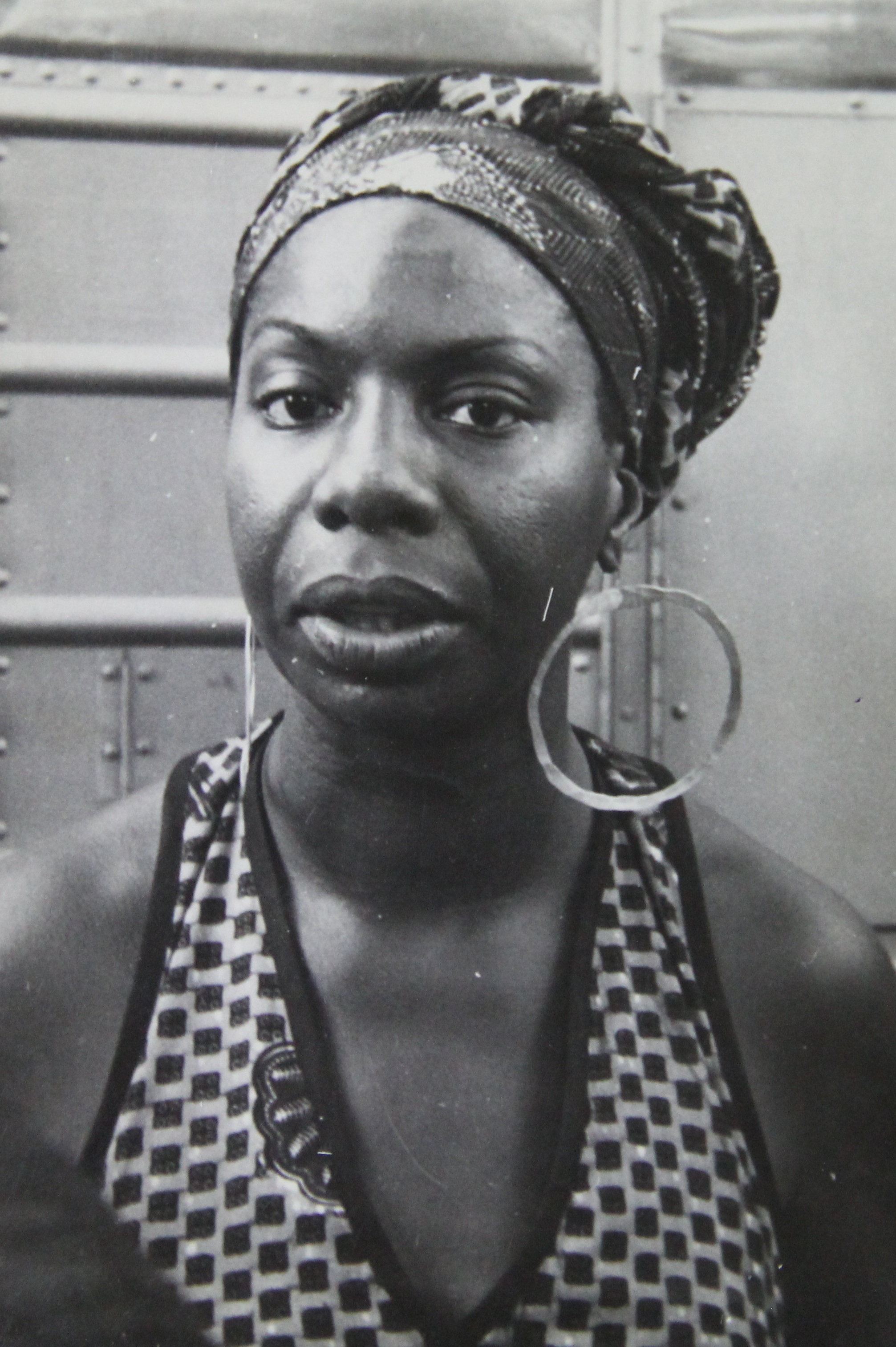
In the years since her death, the adjective most often applied to Nina Simone is “uncompromising,” and it is accurate as far as it goes. But it leaves out the warmth, the wit, the evident joy in music that coexisted with the fury and the grief. She was uncompromising precisely because she cared so much, because she had seen too clearly what music could do at its best to settle for less. The recordings she left behind carry that double quality, the iron of principle and the warmth of feeling, and it is that combination that ensures they will continue to be heard long after the circumstances that produced them have receded into history.