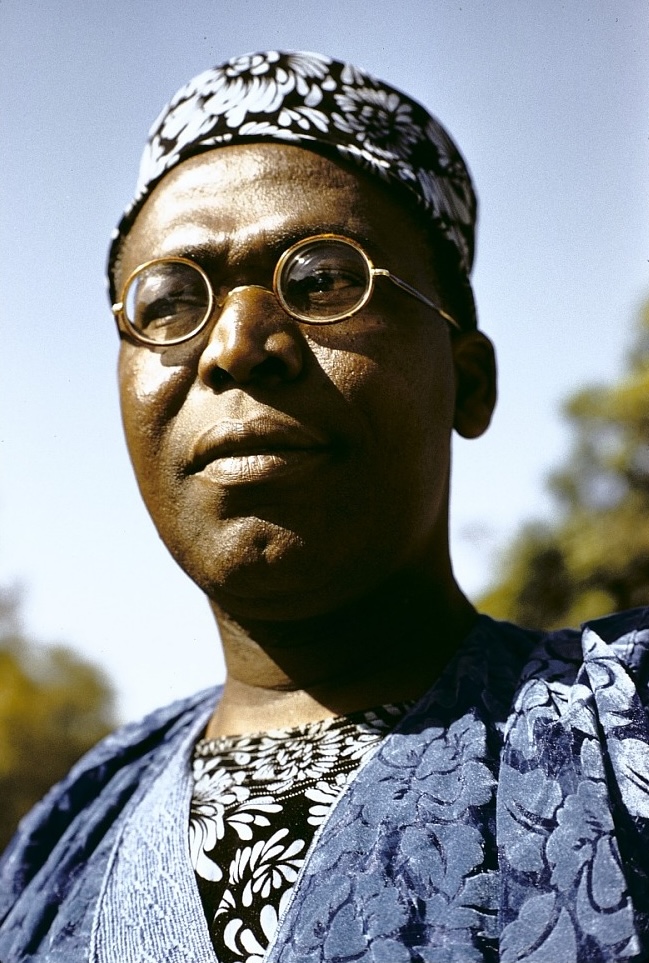
Few names sit as heavily on the conscience of modern Nigeria as that of Chief Obafemi Awolowo. To millions of people across the south west and far beyond, he was simply “Awo,” a single syllable that carried the weight of free schoolrooms, paved roads, the first television tower on the African continent and a stubborn, lifelong insistence that government existed to lift the ordinary person. He was a lawyer, a journalist, a trader, a premier, a federal finance minister, a prisoner of the state and a three-time candidate for the presidency he never won. Across half a century of public life he argued, organised, planned and built, and he left behind a body of policy and thought that Nigerians still measure their leaders against. This is the story of a man who rose from rural hardship to become, in the judgement of many, the best president the country never had.
Quick Facts
- Full name
- Obafemi Jeremiah Oyeniyi Awolowo
- Born
- 6 March 1909, Ikenne, Southern Nigeria
- Died
- 9 May 1987, Ikenne, Nigeria (aged 78)
- Known for
- First Premier of the Western Region; pioneer of free education in Nigeria
- Nickname
- "Awo"; "The Sage"
Early Life and Background
Obafemi Jeremiah Oyeniyi Awolowo was born on 6 March 1909 in Ikenne, a small Yoruba town in what was then the Remo district of the Southern Nigeria Protectorate. His father, David Sopolu Awolowo, was a farmer and a sawyer, a man of modest means but firm character who had embraced Christianity and was determined that his son would learn to read and write in an age when formal schooling was rare among rural families. His mother, Mary Efunyela Awolowo, was a trader. The household was not wealthy, but it valued discipline, faith and the promise that education held for a boy born into a colonised land.
That promise was nearly broken before it could be fulfilled. When Awolowo was around ten years old his father died, and the death tore the foundation out from under the family. The relative security of the household collapsed almost overnight. Land and resources that the young Awolowo might have counted on were lost or claimed by others, and his mother was left to raise her children with very little. The hardship of those years marked him permanently. He would later write with unusual candour about going hungry, about the humiliations of poverty and about the cold determination it bred in him. He resolved, while still a boy, that he would not let circumstance decide the limits of his life.
What followed was a long, interrupted, self-financed climb toward learning. There was no patron to pay his fees, no family fortune to draw upon. Awolowo worked. He laboured as a houseboy, sold firewood, worked as a farmhand and took on whatever jobs would put a few coins toward the next term of school. His education proceeded in fits and starts, a year of attendance here, a stretch of paid work there, then back to the classroom. He attended various mission schools in Remo and Abeokuta, including institutions run by the Anglican and Wesleyan missions, and he passed through the kind of grinding, patient struggle that few of his later political rivals could claim to have known. This early experience of want was not incidental to the man he became. It was the root of his entire political philosophy. He understood poverty not as an abstraction debated in a chamber but as a thing he had lived inside, and it would drive him for the rest of his days to build a state that gave the poor child the chance he had been forced to fight for.
Education and Self-Improvement
Having scraped together enough schooling to qualify, Awolowo set out to make his own living and his own future. In the 1920s and early 1930s he worked in a startling range of occupations, each of which taught him something about the country he would later try to govern. He trained and served as a teacher, standing before classrooms of children in the very system he would one day vow to make free for all. He worked as a clerk and as a stenographer, mastering shorthand and typing skills that gave him a livelihood and a reputation for precision. He went into trade, buying and selling goods and even dealing in produce and transport, learning the hard arithmetic of the marketplace and the cocoa economy that underpinned western Nigeria.
It was journalism, though, that first gave Awolowo a public voice. He became a reporter and correspondent, writing for the Nigerian press in the era of rising anti-colonial sentiment, and he discovered that he had a gift for marshalling facts and arguments into clear, forceful prose. He reported on the affairs of the colony, sharpened his political instincts and began to move in the circles of nationalist agitation that were beginning to challenge British rule. Throughout this period he never abandoned his own studies. By correspondence and private effort he prepared for and passed external examinations, eventually earning a degree in commerce from the University of London as an external student, an extraordinary achievement for a self-taught man with no money behind him.
In 1944 Awolowo sailed for England to study law, enrolling at the Inner Temple in London. His years in Britain were formative. He read widely in law, economics and political philosophy, observed the workings of the British state at close quarters and immersed himself in the questions of how a future independent Nigeria ought to be constituted. He was called to the bar in 1946 and returned home a barrister, but he brought back something larger than a legal qualification. While in London he wrote his first major work of political thought, “Path to Nigerian Freedom,” published in 1947, in which he argued forcefully that Nigeria was not a single nation but a collection of nations, and that only a genuine federal structure, with strong regional governments protecting the languages, cultures and interests of its many peoples, could hold the country together. The book was banned for a time by the colonial authorities, a measure of how seriously its arguments were taken.
It was also during this period that Awolowo helped found, in 1945, the cultural and pan-Yoruba organisation Egbe Omo Oduduwa, named for the mythical progenitor of the Yoruba people. Conceived first in London among Yoruba students and professionals and formally launched in Nigeria a few years later, the Egbe was intended to promote Yoruba unity, education and self-improvement. It would soon become the cultural seedbed from which Awolowo’s political movement grew, the bridge between his ideas and a mass following ready to be organised.
The Action Group and Western Region
In 1951 Awolowo gathered the energies of the Egbe Omo Oduduwa and a wide circle of professionals, traders, teachers and traditional figures into a formal political party, the Action Group. It was the most disciplined and tightly organised political machine Nigeria had yet seen, built on detailed planning, a clear manifesto and a network of activists who carried its message into towns and villages across the Western Region. When elections were held under the new constitutional arrangements, the Action Group swept the region, and Awolowo became Premier of the Western Region, the office in which he would do his most enduring work.
What he achieved as premier between 1952 and 1959 reads, even decades later, like a blueprint for what developmental government in Africa could be. The centrepiece, the policy for which he is most lovingly remembered, was free primary education. Launched in January 1955, the Universal Primary Education scheme made schooling free and compulsory for every child in the region, an idea so bold that critics insisted it was financially impossible. Awolowo proved them wrong. Enrolment exploded, schools were built by the thousand, and a generation of western Nigerian children, many of them the sons and daughters of farmers and labourers, walked into classrooms their parents could never have dreamed of entering. The social transformation was immense. It seeded the professional and administrative class that would later dominate Nigerian public life and it set a standard of governance that the rest of the country was forced to reckon with.
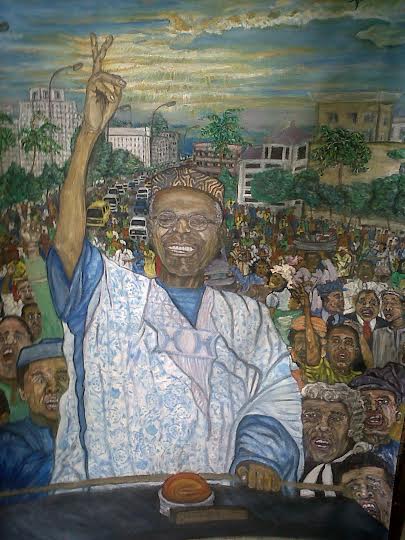
Education was only the beginning. Awolowo’s government introduced a free health programme aimed especially at children, building clinics and maternity centres to bring care within reach of ordinary families. It modernised agriculture and built the infrastructure of a developing economy: roads, water schemes, farm settlements and industrial estates. In 1959 his government launched the Western Nigeria Television service, the first television station anywhere in Africa, a striking symbol of how far ahead the region was running. He oversaw the construction of Cocoa House in Ibadan, for a time the tallest building in tropical Africa, financed by the cocoa wealth of the western farmers. That cocoa economy was the engine of it all. Awolowo’s genius lay in capturing the proceeds of the region’s great export crop through marketing boards and channelling them, methodically and with careful planning, into schools, hospitals, roads and industries that would outlast the boom. He governed not by improvisation but by plan, and the Western Region under his hand became the most advanced and best administered part of Nigeria.
Federal Politics and Opposition
As independence approached, Awolowo’s ambitions, and his party’s, were national. He stepped down from the premiership of the Western Region in 1959 to contest the federal elections that would determine who governed Nigeria at independence in 1960. The Action Group did not win a majority, and in the new federal parliament Awolowo became Leader of the Opposition, a role he filled with characteristic vigour and rigour. From the opposition benches he subjected the government to detailed, fact-driven scrutiny, and he used the platform to articulate a vision of Nigeria’s future that differed sharply from that of the ruling coalition.
At the heart of that vision was his conception of federalism. Awolowo had argued since the 1940s that Nigeria’s diversity was a fact to be accommodated, not suppressed, and that strong, autonomous regions were the only safe foundation for a multi-ethnic state. He pressed for the creation of more states to give Nigeria’s minority peoples a measure of self-government, and he warned against the over-concentration of power at the centre. His federalism was not a slogan but a worked-out theory, set down in books and speeches, of how power and resources should be distributed in a country of many nations.
Alongside federalism stood his economic creed. Awolowo described himself openly as a democratic socialist, and he meant by it a politics organised around the welfare of the common man. He believed that the state had an active duty to provide education, health and social security, to harness national wealth for the public good and to lift the poorest citizens out of want. He was no doctrinaire revolutionary; he believed in elections, in the rule of law and in constitutional government. But he insisted, again and again, that freedom from colonial rule meant little if it did not bring freedom from hunger, ignorance and disease.
“After peace, freedom and justice are the most cherished possessions of the human soul.”
Imprisonment and the Civil War
The early 1960s brought Nigeria’s first great political crisis, and Awolowo was at its centre. A bitter split tore through the Action Group, pitting Awolowo against his former deputy and the premier of the Western Region, Samuel Ladoke Akintola, in a struggle that spilled into violence on the floor of the regional assembly and out into the streets. The crisis in the west destabilised the whole federation. In 1962 the federal government declared a state of emergency in the region, and the political temperature soared.
In 1963 Awolowo and a number of associates were arrested and charged with treasonable felony, accused of plotting to overthrow the federal government by force. The trial that followed was deeply contentious, regarded by his supporters then and by many historians since as a political prosecution intended to remove the most formidable opposition figure in the country. He was convicted and sentenced to imprisonment, and he spent the years that followed in Calabar prison. Even in confinement he kept reading and writing, producing works of political and economic analysis, and his imprisonment only deepened his standing as a martyr in the eyes of his vast following in the west.
His release came in 1966, in the turbulent aftermath of the military coups that overthrew the First Republic and brought the country to the edge of disintegration. As the eastern region moved toward secession and Nigeria slid into civil war in 1967, the federal military government under General Yakubu Gowon turned to Awolowo to lend the regime credibility and economic competence. He was appointed Federal Commissioner for Finance and Vice-Chairman of the Federal Executive Council, in effect the second most powerful figure in the wartime government and the man chiefly responsible for keeping the economy alive while the country fought for its survival from 1967 to 1970.
His management of the war economy was a masterclass in prudence. Faced with the colossal cost of a civil war, Awolowo financed it largely without ruinous foreign borrowing, keeping Nigeria solvent and its currency stable through tight fiscal discipline, careful control of expenditure and shrewd monetary management. He famously changed the currency during the war, a move that neutralised the secessionist side’s holdings of the old notes. His stewardship meant that, almost uniquely among nations that have fought a major civil war, Nigeria emerged from the conflict in 1970 without a crushing burden of debt. Whatever judgements history passes on the politics of that era, his record as a wartime finance minister remains a benchmark of competent economic management.
Presidential Bids and Later Years
When military rule gave way to a return to civilian government and the Second Republic in 1979, Awolowo, by then in his seventies, sought the highest office in the land. He led a new party, the Unity Party of Nigeria, built around the familiar Awoist programme of free education at all levels, free health care, full employment and rural integration. His campaign was perhaps the most programmatic and detailed in the field, grounded in costed plans rather than mere promises. He commanded passionate loyalty across the south west and pockets of support elsewhere, but the national electoral arithmetic, and the controversies surrounding the result, denied him the presidency. He lost the 1979 election to Shehu Shagari of the National Party of Nigeria in a contest whose outcome was disputed all the way to the Supreme Court.
He tried again in 1983, once more under the Unity Party of Nigeria banner, and once more he fell short in elections widely regarded as deeply flawed. The Second Republic itself was soon swept away by the military at the end of 1983, ending Awolowo’s last realistic chance of winning the office he had sought across three campaigns. He never became president of Nigeria. Yet defeat at the polls did nothing to diminish his moral and intellectual authority. He remained, even out of power, a towering presence in national life, a figure whose endorsement was courted, whose criticism was feared and whose ideas continued to set the terms of debate.
In these later years Awolowo turned increasingly to the pen. He had always been a prolific author, and his bookshelf of works, including “Path to Nigerian Freedom,” “Awo: The Autobiography of Chief Obafemi Awolowo,” “Thoughts on Nigerian Constitution,” “The People’s Republic” and “The Strategy and Tactics of the People’s Republic of Nigeria,” amounted to one of the most substantial bodies of political writing produced by any African leader of his generation. Through them he refined his theories of federalism, economic planning and the welfare state, leaving a written legacy that students and politicians study to this day. He retired largely to his home town of Ikenne, where he had built his life and to which he remained devoted, and from there he continued to comment on the affairs of the nation he had served for so long.
Legacy
Chief Obafemi Awolowo died at Ikenne on 9 May 1987, at the age of 78. His passing was mourned across Nigeria, even by those who had opposed him, as the loss of one of the architects of the modern state. The phrase most often attached to his memory, “the best president Nigeria never had,” captures the peculiar shape of his legacy: a man whose influence on his country far exceeded the offices he actually held.
That influence is everywhere in modern Nigeria. The free education he pioneered in the Western Region became the template that every subsequent government has had to answer to, and the generations educated under his schemes carried his ideals into every corner of national life. His insistence on federalism, on regional autonomy and on the creation of states to protect minority peoples shaped the constitutional structure under which Nigeria still operates, and the unending national argument about resource control, devolution and restructuring is in large part an argument about ideas he set down decades ago. His portrait appears on the 100 naira note, a daily reminder of his place in the national story. The largest university in the country, formerly the University of Ife and now Obafemi Awolowo University in Ile-Ife, bears his name, as do roads, institutions and public buildings across the south west and beyond.
More than any monument, though, his legacy lives in a standard of governance. Awolowo demonstrated that a developing African government could plan, build and deliver concrete improvements in the lives of ordinary people, that free schooling and health care were not impossible dreams but achievable policies, and that public office was a trust to be discharged for the benefit of the common man. In an era when Nigerians still debate the gap between the promise and the reality of their leaders, the figure of Awo stands as both an inspiration and a reproach, the measure of what their politics might yet become.
Key Facts
- Obafemi Awolowo was born on 6 March 1909 in Ikenne and rose from severe childhood poverty, after his father’s early death, to qualify as a barrister at the Inner Temple in London in 1946.
- As Premier of the Western Region, he launched free Universal Primary Education in January 1955 and oversaw the creation of Western Nigeria Television in 1959, the first television station in Africa.
- He founded the Action Group in 1951 and the cultural organisation Egbe Omo Oduduwa in 1945, and authored influential books including “Path to Nigerian Freedom” (1947) and his autobiography “Awo.”
- Convicted of treasonable felony and imprisoned in 1963, he was released in 1966 and served as Federal Commissioner for Finance during the Nigerian Civil War from 1967 to 1970, managing the war economy without crippling debt.
- He contested the presidency in 1979 and 1983 under the Unity Party of Nigeria without winning, died at Ikenne on 9 May 1987, and is honoured today on the 100 naira note and through Obafemi Awolowo University.