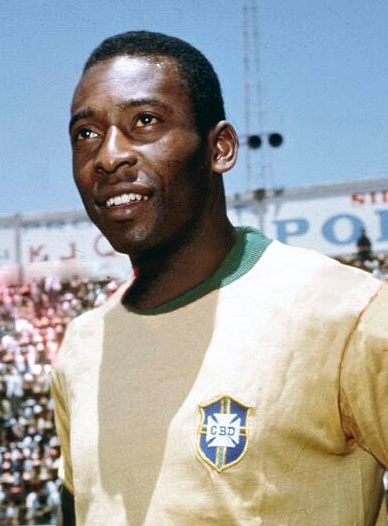
The numbers attached to Edson Arantes do Nascimento, the footballer the world came to know as Pele, are so extravagant that they require a moment of deliberate consideration before they register fully. More than 1,000 career goals. Three FIFA World Cup titles. The youngest player to score in a World Cup final. The youngest World Cup winner in history, at seventeen years and 249 days. A hundred and twenty-nine goals in 92 international appearances for Brazil. To look at that list is to wonder whether it describes a single human being or an aggregated mythology. It describes a single human being, one who grew up in such poverty that he kicked a stuffed sock around dusty streets because a real ball was beyond his family’s means, and who became, in the considered judgment of FIFA itself, the Player of the Century.
Quick Facts
- Full name
- Edson Arantes do Nascimento
- Born
- 23 October 1940, Três Corações, Minas Gerais, Brazil
- Sport
- Football (soccer)
- Known for
- Three FIFA World Cup titles, over 1,000 career goals, FIFA Player of the Century
- Career highlight
- 1958 FIFA World Cup, becoming the youngest World Cup winner in history at 17
Early Life and Background
Edson Arantes do Nascimento was born on 23 October 1940 in Três Corações (which translates as “Three Hearts”), a small city in the Brazilian state of Minas Gerais. His father, João Ramos do Nascimento, known as Dondinho, was a footballer of genuine ability who played for local clubs throughout his career but never broke through to the highest level, partly because a serious knee injury cut short his progress. His mother, Celeste Arantes, was a domestic worker. The family was poor in the specific and grinding way that poverty operates in rural Brazil: insufficient food, inadequate housing, no margin for any unexpected expense.
When Edson was still a young child, the family moved to Bauru, a city in São Paulo state, where Dondinho had found a position playing for the local club. Bauru is where Pele grew up, where he absorbed football from watching his father and from playing constantly in the streets with friends using whatever makeshift ball they could construct. The nickname “Pele” was bestowed upon him by schoolmates, apparently a corruption of the name of a local goalkeeper he admired; he initially disliked the name and has no idea what it means, but it followed him for the rest of his life.
His formal education ended early, as it did for most children in his circumstances. What he had instead of academic opportunity was football, and football in sufficient quantities and of sufficient quality to develop gifts that were, from early adolescence, visibly beyond what anyone around him possessed. His first coach of significance was Waldemar de Brito, a former Brazilian international who discovered him playing for a youth team in Bauru and immediately recognised that what he was seeing was not merely precocious talent but something qualitatively different.
The Path to Santos
Waldemar de Brito did something that shaped the entire history of football: he arranged for the fifteen-year-old Pele to trial with Santos FC, a club based in the port city of Santos, São Paulo. Santos was not then the dominant club it would become, but it was a professional organisation with ambition and the resources to develop young talent. When Pele arrived for his trial in 1956, de Brito told the Santos president that this boy would one day become the greatest footballer in the world. The Santos president was sceptical. Within months he was a believer.
Pele signed his first professional contract with Santos in 1956, at fifteen. He scored his first professional goal in his first game, on 7 September 1956. By the time he was sixteen, he was the league’s top scorer. The velocity of his development was startling even to those who had seen young talent arrive and flourish before. He had a combination of physical attributes that the game had rarely assembled in a single player: quick acceleration over short distances, balance that allowed him to maintain control while being challenged physically, a powerful shot with both feet, exceptional heading ability for a player of his height (he stood around 5 feet 8 inches) and an awareness of space and movement that allowed him to find positions and passes that seemed invisible until the moment he executed them.
He was also, for a fifteen-year-old playing among adult professionals, remarkably composed. The psychological aspect of elite sport breaks many talented young players before they can realise their ability. Pele seemed to inhabit the football pitch with a comfort and certainty that belonged to a much older, more experienced player. His teammates at Santos, men a decade his senior, recognised quickly that whatever this teenager had, it was different from what they had, and they adjusted to incorporate him.
The 1958 World Cup: The World Discovers Pele
In 1958, the FIFA World Cup was held in Sweden. Brazil, a country that had come agonisingly close to winning the tournament on two previous occasions (losing the 1950 final to Uruguay on home soil in what became known as the Maracanazo, a national trauma of enormous proportions), arrived in Sweden with a squad that featured Garrincha, Didi and Nilton Santos alongside a seventeen-year-old making his World Cup debut. Pele had been added to the squad despite carrying a knee injury, included against the judgment of some team officials because the coaching staff believed, correctly, that he was worth the risk.
He played his first match in the tournament’s knock-out phase, against Wales in the quarter-final, on 19 June 1958. He was seventeen years and 239 days old. He scored the only goal of the match, becoming the youngest player to score in the World Cup at that time. Against France in the semi-final, he scored three goals in a 5 to 2 victory. In the final against the host nation Sweden, he scored twice: first a chest-and-volley that was technically the most beautiful goal scored at any World Cup to that point, and then a header to complete a 5 to 2 victory for Brazil.
At the final whistle he collapsed in tears, held up by teammates who were also weeping. The images of this teenager, too overwhelmed by joy and relief to stand on his own, circled the world and introduced a global audience to the footballer who would come to define the sport. At seventeen years and 249 days old, he became, and remains, the youngest player to win the FIFA World Cup.
Santos FC and Club Dominance
While the World Cups provided the stage on which Pele became a global figure, his sustained brilliance was demonstrated across fifteen years at Santos FC. Under coach Lula and later other managers, Santos became the dominant club in South American football and one of the most celebrated in the world, largely because of Pele. Between 1958 and 1974, he won six Campeonato Brasileiro titles (the Brazilian top division) with Santos, and the club won the Copa Libertadores, South America’s premier club competition, in both 1962 and 1963.
The 1962 Intercontinental Cup, the predecessor to the Club World Cup, saw Santos defeat Benfica over two legs to claim the title of world club champions. The following year they did it again, defeating AC Milan. These victories were understood internationally as Pele victories, and they cemented Santos FC’s unusual status as a club that was simultaneously a Brazilian institution and a global touring act. Santos undertook regular exhibition tours throughout South America, Europe, Africa and Asia, and the tours were commercial and diplomatic events as much as football matches. Governments scheduled state occasions around Santos’s visits. Crowds of 100,000 attended their games in Nigeria and other African nations.
Pele’s goal-scoring records at club level are, like all his records, almost impossible to contextualise properly because football in the 1960s was played in a different statistical ecosystem from the modern game. Different sources count his goals differently, but the commonly cited figure is that he scored over 650 official goals for Santos across all competitions. FIFA, in their official statistical work, counts his total across all competitions and representative matches at over 1,000 career goals.
The 1962 World Cup: Injury and Glory
The 1962 World Cup in Chile began for Pele as a continuation of his 1958 dominance. He scored once against Mexico in the group stage, then injured a groin muscle against Czechoslovakia and missed the remainder of the tournament. Brazil won the tournament without him, which demonstrated both the extraordinary depth of talent in that Brazilian squad and the peculiar cruelty of football, which can remove its most important figure from the decisive stages and still produce a champion.
Pele was listed as a World Cup winner for the second time regardless, though the personal sting of not contributing after the early injury was real. He would return to the tournament in 1966 and 1970 under very different circumstances.
The 1966 World Cup: Brutality and Elimination
The 1966 World Cup in England was, for Pele and for football, a troubling and sometimes ugly event. He arrived as the world’s most famous footballer and departed early, the victim of a sustained campaign of physical intimidation that the tournament’s referee structure utterly failed to address. In Brazil’s second group game against Bulgaria, he was kicked continuously throughout the match, exiting with injuries. He was declared unfit for the next match against Hungary, which Brazil lost. In the decisive group game against Portugal, he returned but was again subjected to brutal foul play from João Morais, who tackled him with sufficient force to leave him unable to continue. Pele was carried from the pitch.
Brazil were eliminated at the group stage. Pele declared publicly afterward that he would not play at another World Cup, a statement made in the immediate aftermath of the physical pain and frustration of the tournament but one that, had he kept to it, would have denied the world one of the greatest performances any footballer ever produced.
The 1970 World Cup: The Finest Hour
He changed his mind. The 1970 World Cup in Mexico is widely regarded as the greatest football tournament ever staged, and the Brazilian team that won it is regarded as the greatest national team in the sport’s history. Pele was central to both the squad’s composition and its aesthetic identity: he was thirty years old, the oldest and most experienced player in a team full of attacking talent, and he played with a freedom and intelligence that went beyond the simple scoring he had done at eighteen.
Brazil swept through the tournament. They won every game they played, scoring 19 goals while conceding only 7. Pele scored four goals and provided six assists. His performance in the group stage game against Italy, a goalless draw by the time it concluded (Brazil won the later final against them), included one of the most frequently discussed non-goals in football history: a dummy over a low cross that left Italian goalkeeper Enrico Albertosi sprawling, with the ball running wide of the far post. Pele had attempted to let the ball run through his legs and into the net; he had misjudged the ball’s trajectory by inches.
In the final against Italy, he headed Brazil’s first goal, a powerful downward header that gave Italy no chance, and created the fourth goal, playing a perfect lay-off for Carlos Alberto Torres to strike on the run from 25 yards. The goal is frequently voted the best team goal in the history of football, a cascading combination of eleven players in motion, and it ended with the captain of Brazil hitting a right-footed volley into the corner of the net. The 4 to 1 victory gave Brazil a third World Cup title and, under FIFA rules at the time, permanent possession of the Jules Rimet Trophy.
Pele lifted the trophy and wept, as he had in 1958. But where the 1958 tears had been those of an astonished boy overwhelmed by unexpected greatness, the 1970 tears were those of a man who had navigated every obstacle the sport and the world could place in front of him and arrived at the summit of his game one final, perfect time.
Success is no accident. It is hard work, perseverance, learning, studying, sacrifice and most of all, love of what you are doing.
New York Cosmos and the American Experiment
Pele retired from Santos FC in 1974, but in 1975 he was persuaded to come out of retirement to join the New York Cosmos of the newly formed North American Soccer League. The financial terms, reportedly 4.7 million dollars over three years, made him the highest-paid team athlete in the world at the time. But the reasoning behind his decision went beyond the contract. He believed genuinely that he could help grow football in the United States, a country where the sport remained a curiosity compared to American football, baseball and basketball.
He succeeded in a way that was not immediately visible in television ratings or stadium attendance but was ultimately felt in the generation of young American players who were introduced to the sport during the Cosmos years. Pele played alongside Giorgio Chinaglia and Franz Beckenbauer, and the team’s matches drew crowds that the American game had not previously seen. His three seasons in New York (1975 to 1977) planted seeds that took decades to flower: American football’s growth in the 1990s and the successful hosting of the 1994 World Cup owed something, traceable through coaching trees and grassroots programmes, to the Cosmos years.
His final professional match was a specially arranged exhibition on 1 October 1977, in which the Cosmos played Santos FC. He played one half for each team and scored a direct free kick for the Cosmos. After the final whistle, he took a microphone and addressed a crowd of 75,646 at Giants Stadium, asking them to use the word “love” more. He was thirty-six years old.
The Ambassador Years
After retirement from playing, Pele served as a global ambassador for football, for Brazil and for various humanitarian causes. He was appointed Brazil’s Extraordinary Minister for Sport from 1995 to 1998 and used the role to push through legislation, known as the Pele Law, that regulated club contracts and gave players more rights over their own labour. The law was controversial with club owners and genuinely significant for the players it protected.
He collaborated with the United Nations and with UNICEF on campaigns related to child poverty, education and anti-drug initiatives. He worked with FIFA on promotional campaigns and served as the organisation’s ambassador in various capacities. Whatever complexities surrounded the institution of FIFA itself, Pele’s genuine commitment to the game’s global growth was not in doubt.
His later years were marked by health challenges. He underwent hip replacement surgery and suffered from kidney problems that required regular treatment. He died on 29 December 2022, at the age of eighty-two, in São Paulo, Brazil, following a progression of colorectal cancer diagnosed in September 2021 that had spread to other organs. His death was mourned around the world with an intensity reserved for figures who have become genuinely irreplaceable: heads of state issued statements, football clubs around the world held minutes of silence, and the tributes from players and coaches of every era and every country testified to the breadth of his influence.
Legacy
Pele’s legacy operates on several registers simultaneously. He is the most statistically dominant footballer in history by most measures that can be applied across the eras. He won the World Cup three times, which no other player has done. He scored goals with a variety that no one has matched: volleys, headers, dribbled efforts, free kicks, penalties, chips, backheel finishes. He played in an era before sports science, before the elaborate nutritional and physical conditioning frameworks that extend modern players’ careers, and he sustained his output across fifteen years of professional football at the highest level.
His cultural significance extends beyond the statistics. He was, for much of the 1960s and 1970s, the most recognised person on earth in certain parts of the world. His blackness, in a country and a sport both marked by racial complexity, was significant: he carried the pride of a community as well as a nation. The Brazilian football that he represented was a style as much as a result, a commitment to artistry and improvisation and joy that became the country’s most globally understood cultural export.
Key Facts
- Pele is the youngest player to win the FIFA World Cup, achieving the feat at 17 years and 249 days in 1958, a record that still stands.
- He won three FIFA World Cup titles (1958, 1962 and 1970), the only player in history to accomplish this feat.
- His career goal tally, variously counted between 650 official club and international goals and over 1,000 total across all competitions, remains the subject of statistical debate but represents the highest output of any footballer in history.
- FIFA named him the Player of the Century in 1999, sharing the honour jointly with Argentine Diego Maradona.
- The Pele Law, enacted during his tenure as Brazil’s Minister for Sport from 1995 to 1998, transformed the employment rights of professional footballers in Brazil and influenced football labour law internationally.