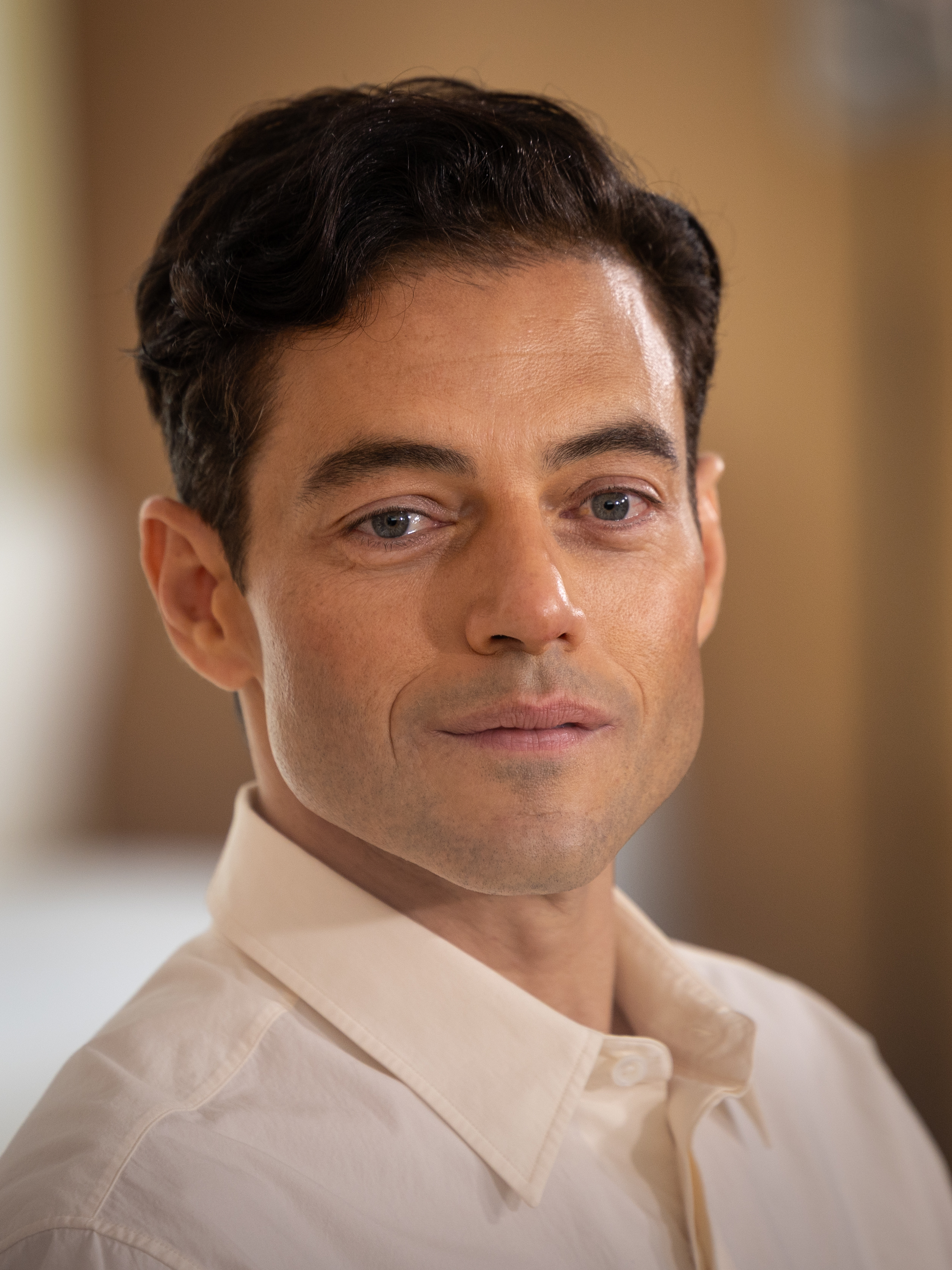
When Rami Malek stepped onto the stage at the Dolby Theatre in February 2019 to accept the Academy Award for Best Actor, he paused, gripped the golden statuette, and told the audience that he was the son of immigrants from Egypt. It was a sentence that carried an enormous weight. In a single moment, a quiet, watchful actor who had spent more than a decade collecting small parts and near-misses had become one of the most recognizable faces in the world. He had done it not through the usual channels of Hollywood glamour but through something rarer: a willingness to disappear completely into other people, to make himself unrecognizable in the service of a character.
Malek is an actor defined by intensity. His large, expressive eyes have become his trademark, capable of communicating fear, defiance, wonder, and menace often within the same scene. He does not coast on charm. Instead, he burrows into the interior lives of the people he plays, whether a paranoid hacker fighting a corporate conspiracy, a rock icon at the height of his powers, or a disfigured terrorist plotting global chaos. This is the story of how a shy boy from Los Angeles, the child of Egyptian immigrants and the twin brother of a schoolteacher, transformed himself into an Oscar winner and a leading man of genuine distinction.
Quick Facts
- Full name
- Rami Said Malek
- Born
- 12 May 1981, Los Angeles, California, USA
- Heritage
- Egyptian-American
- Known for
- Mr. Robot; Bohemian Rhapsody; No Time to Die
- Awards
- Academy Award for Best Actor (2019)
Early Life
Rami Said Malek was born on 12 May 1981 in Los Angeles, California, the son of Egyptian immigrants who had settled in the United States a few years before his birth. His parents were Coptic Christians, members of one of the oldest Christian communities in the world, and they raised their children within that tradition. His father, Said Malek, worked as a travel agent and later sold insurance, while his mother, Nelly Abdel-Malek, worked as an accountant. The family belonged to a close-knit Egyptian community in the San Fernando Valley, and Malek grew up bilingual, speaking Arabic at home and English at school.
He was not an only child, and one detail of his upbringing has fascinated audiences ever since he became famous: Malek is an identical twin. His brother, Sami, was born roughly four minutes after him. Growing up, the two were so alike that they occasionally traded places, and Malek has recalled sitting in for his brother during a class presentation on one memorable occasion. He also has an older sister, Yasmine, who became a doctor. The Malek household prized education and hard work, values common to many immigrant families building a life in a new country.
By his own account, Malek was a shy and often anxious child. He has spoken about feeling self-conscious, about struggling with his sense of identity as the American-born son of immigrants, and about not always knowing where he fit in. Acting became an unexpected refuge. The stage offered him a place where his sensitivity, rather than being a liability, could become a strength. He attended Notre Dame High School in Sherman Oaks, a Catholic school whose alumni include several other actors, and it was there that his interest in performance took shape.
After high school, Malek enrolled at the University of Evansville in Indiana, a considerable distance from the familiar comfort of Los Angeles. He studied theatre and earned a Bachelor of Fine Arts degree in 2003. The years in Evansville were formative. Away from home, immersed in classical training and stage work, he sharpened the discipline and technique that would later allow him to undergo the dramatic physical and vocal transformations his best-known roles demanded. He graduated with a conviction that acting was not merely a hobby but a vocation, and he returned to Los Angeles determined to make a living at it.
Early Career
The road out of drama school and into steady work was not smooth. Like most young actors, Malek took whatever jobs he could find while auditioning relentlessly. He has spoken candidly about the lean early years, about waiting tables and delivering food to pay rent, and about the particular difficulty he faced as an actor of Middle Eastern heritage in an industry that, in the early 2000s, offered performers of his background a narrow and frequently stereotyped range of roles.
His first significant television break came with a small recurring part on the Fox comedy series “The War at Home”, which aired from 2005 to 2007. He played Kenny, the teenage friend of the family’s son, in a role that gave him valuable on-camera experience even if it hardly announced a future star. The exposure helped him land larger opportunities on the big screen.
In 2006 he appeared in “Night at the Museum”, the hugely successful Ben Stiller comedy directed by Shawn Levy. Malek played Ahkmenrah, the ancient Egyptian pharaoh whose golden tablet brings the museum’s exhibits to life each night. It was a fitting early role for an actor of Egyptian descent, and he reprised the character in the two sequels, “Night at the Museum: Battle of the Smithsonian” in 2009 and “Night at the Museum: Secret of the Tomb” in 2014. The films introduced him to a wide family audience and demonstrated that he could hold his own alongside major comic talents.
A turning point of a more serious kind came in 2010, when Malek was cast in the HBO miniseries “The Pacific”, produced by Steven Spielberg and Tom Hanks as a companion to “Band of Brothers”. He played Corporal Merriell Shelton, nicknamed Snafu, a Louisiana Marine whose haunted, unpredictable presence gave the series some of its most unsettling moments. Critics took notice. The role showed that Malek was capable of far more than comic sidekicks and exotic bit parts. He could carry darkness, ambiguity, and psychological damage on screen.
Throughout this period he continued to accumulate credits in a wide range of projects. He appeared in the vampire film “The Twilight Saga: Breaking Dawn, Part 2” in 2012, in Paul Thomas Anderson’s acclaimed drama “The Master” in 2012 alongside Joaquin Phoenix and Philip Seymour Hoffman, and in Spike Lee’s remake of “Oldboy” in 2013. He also lent his voice and presence to video games and independent films. Yet despite this steady work, mainstream stardom remained elusive. Malek was a respected working actor, admired by directors, but not yet a name the public knew. That was about to change.
Mr. Robot and Breakthrough
In 2015, the USA Network premiered a drama series unlike anything else on television, and it made Rami Malek a star. “Mr. Robot”, created by Sam Esmail, cast Malek as Elliot Alderson, a cybersecurity engineer and vigilante hacker suffering from severe social anxiety, depression, and dissociative episodes. Elliot is recruited by a mysterious anarchist figure to bring down a monolithic corporation the show calls E Corp, and the series unfolds as a paranoid, visually daring exploration of technology, mental illness, capitalism, and identity.
Malek was the beating heart of the show. His performance was extraordinarily internal, built on hushed voice-over narration, long silences, and those unblinking eyes that seemed to look straight through the camera at the viewer. Elliot addresses the audience directly, treating us as an imaginary friend, and Malek made this unusual device feel intimate and unnerving rather than gimmicky. He portrayed mental illness with a rare seriousness and empathy, never reducing Elliot to a collection of symptoms.
Critics responded immediately. The series was praised for its ambition, its style, and above all its lead performance. In September 2016, Malek won the Primetime Emmy Award for Outstanding Lead Actor in a Drama Series, becoming the first actor of Egyptian heritage to win in that category and one of the few non-white actors ever to take the prize. In his acceptance speech he spoke about the character’s struggles with connection and mental health, using the platform to raise awareness rather than simply celebrate himself.
“Mr. Robot” ran for four seasons, concluding in December 2019, and it remained a critical favorite throughout its run. The role established the template for everything that followed in Malek’s career: a preference for complex, troubled, interior characters, and a commitment to full immersion. He had finally arrived, and Hollywood had noticed the intensity he could bring to a leading part.
“I always felt like an outsider, and I think that’s why I’m attracted to characters who feel that way too.”
Bohemian Rhapsody and the Oscar
If “Mr. Robot” made Malek a respected television star, “Bohemian Rhapsody” made him a global film icon. The 2018 biographical drama chronicled the rise of the British rock band Queen and its charismatic front man, Freddie Mercury, from the band’s formation through their legendary performance at the Live Aid concert in 1985. Malek was cast in the central role of Mercury, and the challenge was immense. Mercury was one of the most flamboyant, physically dynamic, and beloved performers in the history of popular music, a figure whose every gesture on stage was etched into cultural memory.
Malek threw himself into the transformation with characteristic thoroughness. He worked with a movement coach to master Mercury’s distinctive stage presence, studied hours of concert footage, took singing lessons, and wore prosthetic teeth to replicate Mercury’s famous overbite, which the singer believed contributed to his vocal range. The finished performance blended Malek’s acting with Mercury’s original vocals and other sources, and the recreation of the Live Aid set became the film’s centerpiece and its most celebrated sequence.

The film’s production was troubled. Its original director, Bryan Singer, was dismissed before shooting was complete, and Dexter Fletcher took over to finish the project, though Singer retained the sole directing credit under industry rules. Despite the chaos behind the scenes, “Bohemian Rhapsody” became an enormous commercial success, grossing more than 900 million dollars worldwide and ranking among the highest-earning music biopics ever made. Audiences embraced it, and much of the acclaim centered on Malek’s committed, energetic portrayal of Mercury.
The awards followed in a remarkable sweep. Malek won the Golden Globe Award for Best Actor in a Motion Picture Drama, the Screen Actors Guild Award, the BAFTA Award, and finally, on 24 February 2019, the Academy Award for Best Actor. His Oscar victory carried a significance beyond the individual achievement. He became one of the very few actors of Arab heritage ever to win the category, and the first of Egyptian descent. In his acceptance speech, standing before the world, he spoke of being the son of immigrants and of playing a gay man, an immigrant from Zanzibar of Parsi Indian descent, who had lived his life unapologetically. It was a moment of representation that resonated far beyond the room.
After the Oscar
An Academy Award can be both a blessing and a burden. Some actors follow it with a rush of high-profile projects; others struggle to find roles worthy of the honor. Malek chose a path of deliberate selectivity, taking his time and choosing projects that interested him rather than simply chasing scale.
His first major role after the Oscar came in the James Bond franchise. In “No Time to Die”, released in 2021 after pandemic-related delays, Malek played Lyutsifer Safin, the scarred and softly menacing villain who confronts Daniel Craig’s 007 in what would be Craig’s final outing as the spy. Directed by Cary Joji Fukunaga, the film brought the Craig era of Bond to an emotional and dramatic close. Malek’s antagonist was quiet and unsettling rather than bombastic, a choice consistent with his taste for restraint and interiority even in a blockbuster.
He continued to seek out interesting collaborators. In 2023 he appeared in Christopher Nolan’s “Oppenheimer”, the sweeping historical drama about the making of the atomic bomb that went on to win the Academy Award for Best Picture. Malek played David Hill, a physicist whose testimony proves pivotal late in the story, and his appearance in an ensemble packed with major stars reflected his standing among the industry’s most sought-after actors. He also took on the lead in the spy thriller “The Amateur” in 2025, playing a CIA cryptographer who sets out to avenge his wife’s death, a role that returned him to the kind of intense, obsessive character that suits his gifts.
Away from the screen, Malek expanded into other creative territory, including stage work. He appeared in a West End production, testing himself before live audiences and returning to the theatrical roots of his training. His choices after the Oscar have been characterized by patience and a refusal to be typecast, a strategy that has kept his work varied and his reputation intact.
This approach stands in deliberate contrast to the way many newly minted stars behave. Rather than accepting the biggest paycheck or the most obvious franchise vehicle, Malek has tended to gravitate toward filmmakers with strong, singular visions, from Christopher Nolan to Cary Joji Fukunaga. He has spoken in interviews about wanting his career to be a collection of characters he can be proud of rather than a simple accumulation of hits. That discipline reflects a self-awareness rare in an industry that often rewards volume over care, and it has allowed him to remain a genuine actor’s actor even as his fame grew to global proportions.
Personal Life and Persona
For an actor of his fame, Malek guards his private life closely. He rarely discusses his relationships in detail and has expressed discomfort with the intrusions of celebrity. He was in a relationship with his “Bohemian Rhapsody” co-star Lucy Boynton, who played Mary Austin in the film, and the two were together for several years after meeting on set. He is known among colleagues for his seriousness, his thoughtfulness, and a certain reserve that mirrors the watchful quality of many of his characters.
His Egyptian heritage and Coptic Christian background remain central to his identity, and he has spoken with evident pride about being the son of immigrants. He has used his platform to advocate for greater representation of Middle Eastern and North African performers in an industry that has long underserved them, and his very success has expanded the sense of what is possible for actors of his background. He has also been outspoken about mental health, informed by his years of playing Elliot Alderson, and about the importance of empathy in storytelling.
Malek’s persona, both on screen and off, is one of quiet intensity. He is not a tabloid figure or a social media personality. He lets the work speak, and the work is consistently ambitious. In interviews he comes across as measured and reflective, more interested in craft than in celebrity, a temperament that has helped him navigate sudden fame without losing his footing.
Career Timeline
- 2003: Graduates from the University of Evansville with a Bachelor of Fine Arts in theatre.
- 2005 to 2007: Appears as Kenny in the Fox sitcom “The War at Home”, his first recurring television role.
- 2006: Plays the pharaoh Ahkmenrah in “Night at the Museum”, later reprising the role in two sequels.
- 2010: Stars as Corporal Snafu Shelton in the HBO miniseries “The Pacific”, earning critical attention.
- 2015: Debuts as Elliot Alderson in the USA Network series “Mr. Robot”.
- 2016: Wins the Primetime Emmy Award for Outstanding Lead Actor in a Drama Series.
- 2018: Portrays Freddie Mercury in “Bohemian Rhapsody”.
- 2019: Wins the Academy Award for Best Actor, along with the Golden Globe, SAG, and BAFTA awards.
- 2021 to 2023: Plays the villain Safin in “No Time to Die” and appears in Christopher Nolan’s “Oppenheimer”.
Lesser-Known Facts
- Malek is an identical twin. His brother, Sami, was born about four minutes after him and works as a teacher, and the two occasionally swapped places when they were young.
- He comes from a Coptic Christian family, one of the oldest Christian communities in the world, and grew up speaking Arabic at home in Los Angeles.
- Before finding acting success, he waited tables and worked delivery jobs to support himself during the lean early years of his career.
- His Emmy win in 2016 made him the first actor of Egyptian heritage to win Outstanding Lead Actor in a Drama Series.
- For “Bohemian Rhapsody”, he wore custom prosthetic teeth to recreate Freddie Mercury’s distinctive overbite and studied the singer’s movements for months.
- He appeared in Paul Thomas Anderson’s “The Master” alongside Philip Seymour Hoffman and Joaquin Phoenix years before his own breakout, quietly building his craft in prestigious company.
Frequently Asked Questions
What is Rami Malek’s heritage? Rami Malek is Egyptian-American. He was born in Los Angeles to Egyptian immigrant parents who are Coptic Christians, and he grew up speaking both Arabic and English.
What did Rami Malek win an Oscar for? He won the Academy Award for Best Actor at the 2019 ceremony for his portrayal of Queen front man Freddie Mercury in the 2018 biographical film “Bohemian Rhapsody”.
Does Rami Malek have a twin? Yes. He has an identical twin brother named Sami, who was born roughly four minutes after him and works as a teacher.
What is Mr. Robot? “Mr. Robot” is a USA Network drama series created by Sam Esmail that ran from 2015 to 2019. Malek starred as Elliot Alderson, a hacker with severe anxiety and dissociative episodes, a role that won him a Primetime Emmy Award.
Was Rami Malek in a James Bond film? Yes. He played the villain Lyutsifer Safin in “No Time to Die”, released in 2021, which was Daniel Craig’s final film as James Bond.
Legacy
Rami Malek’s legacy is still being written, but its shape is already clear. He is one of the most distinctive actors of his generation, a performer who reached the summit of his profession not by conforming to Hollywood’s traditional idea of a leading man but by insisting on complexity, transformation, and emotional truth. His Emmy and his Oscar are not merely personal trophies; they are milestones in the slow, ongoing expansion of who gets to be a star.
For countless young people of Middle Eastern and North African descent, and for the children of immigrants everywhere, Malek offered proof that the industry’s highest honors were within reach. His speeches, in which he consistently invoked his parents, his heritage, and the outsiders he loved to play, turned each award into a statement about belonging. He widened the door.
Beyond representation, his legacy rests on the sheer quality and range of his work. From the paranoid stillness of Elliot Alderson to the exuberant showmanship of Freddie Mercury to the icy menace of a Bond villain, he has demonstrated a versatility that few actors can match. He remains selective, patient, and serious about his craft, qualities that suggest his most memorable roles may still lie ahead. Whatever comes next, Rami Malek has already earned a permanent place in the story of modern cinema: the shy son of immigrants who refused to be ignored and, in the end, conquered Hollywood on his own terms.