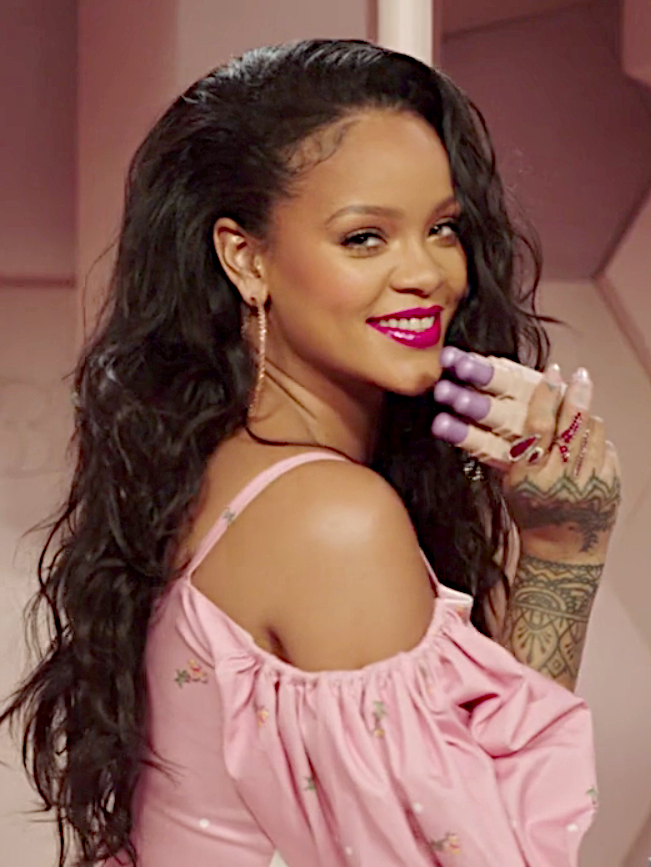
On the evening of February 12, 2023, the lights inside State Farm Stadium in Glendale, Arizona, cut to black. A single spotlight illuminated a figure descending slowly from above, dressed in a crimson bodysuit, suspended on a platform sixty feet above the stadium floor. The crowd of sixty-seven thousand people inside the venue, and the one hundred eighteen million people watching on television across the United States, knew what they were about to see. What they could not have anticipated was the announcement that accompanied it. Halfway through one of the most watched halftime performances in Super Bowl history, Rihanna paused, placed her hands on her stomach, and revealed to the world that she was pregnant with her second child. The stadium exploded. The internet did too. In a single gesture she had taken the largest entertainment stage on the American calendar and made it simultaneously a concert, a comeback and a piece of personal news that no publicist could have scripted. That is Rihanna’s particular genius: the collision of the personal and the spectacular, delivered without explanation or apology.
Quick Facts
- Full name
- Robyn Rihanna Fenty
- Born
- 20 February 1988, Saint Michael, Barbados
- Nationality
- Barbadian
- Known for
- Fenty Beauty, nine Grammy nominations, Fenty x Savage lingerie brand, Super Bowl LVII halftime show
- Career highlight
- Founding Fenty Beauty in 2017 with 40 foundation shades, transforming the beauty industry
- Estimated net worth
- $1.4 billion (Forbes, 2023): wealthiest female musician in history
A Childhood in Bridgetown
Robyn Rihanna Fenty was born on February 20, 1988, in the parish of Saint Michael, Barbados, the first of three children born to Ronald Fenty and Monica Braithwaite. She grew up in a modest house in Bridgetown, the island’s capital, in a neighbourhood that was working-class and tight-knit in the way that small-island communities tend to be. Barbados is a country of roughly 280,000 people, an island of twenty-one miles by fourteen, where the sugarcane fields that once defined the economy have given way to tourism and finance, but where the culture remains stubbornly, beautifully specific to itself.
Her early childhood was complicated by her father’s addiction to crack cocaine and alcohol, a struggle that cast a shadow over the household and created an environment of instability and tension. She has spoken in later interviews about the severity of the headaches she suffered as a young child, headaches so bad that her mother took her for medical testing to rule out serious causes, and about the general atmosphere of a home shaped by addiction. Ronald Fenty and Monica Braithwaite divorced when Rihanna was fourteen, a separation that brought a measure of relief alongside the disruption of an already difficult family situation.
What sustained her through those years was music. From early childhood she had been drawn to it in the particular way of someone for whom it serves as more than entertainment: as shelter. She sang around the neighbourhood, in school talent shows, and in informal settings with friends, developing a voice that was unusual from the outset, not the smooth, technically perfect instrument that the industry tended to reward in pop music, but something more individual. Husky, textured, capable of warmth and of cool remove in the same phrase. It was a voice that sounded lived-in even at fifteen.
She has spoken about growing up feeling caught between two worlds: too Caribbean for the international pop market that she sensed she was moving toward, and too driven by that ambition to fully belong in the rhythms of Bridgetown. The island was home in a profound sense, but it was also a starting point. She was always going to leave; she just needed a mechanism.
The Audition That Changed Everything
In 2003, when Rihanna was fifteen, an American music producer named Evan Rogers visited Barbados on holiday with his wife, who had grown up on the island. Through a mutual acquaintance, a small group of local girls was brought to an informal meeting. Rihanna stood out so immediately that Rogers arranged a proper audition. She recorded demo tracks, including early versions of songs that would later become her first singles, and Rogers took the recordings back to the United States to share with major label contacts.
The demo reached the desk of Jay-Z, the rapper and co-founder of Def Jam Recordings who was by 2003 one of the most commercially astute figures in the American music industry. He arranged an audition in New York, and the story of what happened in that room has become one of the music industry’s favourite anecdotes. Rihanna arrived and was nervous, by her own account, for the first and possibly only time in her professional life. She sang. Jay-Z, alongside then-Def Jam president L.A. Reid, was so impressed that he made a decision on the spot: she was not leaving the building without signing a contract. The meeting that was meant to be an audition became a negotiation and then a signing.
Rihanna was sixteen. She packed her life in Barbados into a suitcase, said goodbye to her mother and her brothers Rorrey and Rajad, and moved to New York to record her first album. She would never live in Barbados full-time again, though the island would remain the emotional and cultural anchor of everything she built.
”Pon de Replay” and the Pop Arrival
Her debut single, “Pon de Replay,” was released in May 2005 and reached the top of charts across the Caribbean immediately. In the United States it peaked at number two on the Billboard Hot 100. In the United Kingdom it reached number two as well. For a sixteen-year-old from a small Caribbean island making her first commercial release, the numbers were extraordinary. The song’s production drew heavily on the dancehall and soca rhythms of the Caribbean while packaging them in a pop-radio format that made them accessible to audiences far beyond the region.
Her debut album, “Music of the Sun,” followed in August 2005, debuting at number ten on the Billboard 200. A second album, “A Girl Like Me,” arrived in April 2006, this time debuting at number five. Its lead single, “SOS,” reached number one on the Billboard Hot 100 in March 2006, becoming her first US chart-topper. She was seventeen years old. The speed of her commercial ascent was remarkable, but the music press noticed something more interesting: between the two albums, her voice had gained confidence and her stage persona had started to develop an edge that the early material had only hinted at.
Then came “Umbrella."
"Umbrella,” “Good Girl Gone Bad,” and a Reinvention
In April 2007, Jay-Z appeared on the intro of “Umbrella,” a song initially written for Britney Spears before landing with Rihanna’s team. The song spent ten consecutive weeks at number one in the United Kingdom, the longest-running chart-topper by any artist in the UK in nearly a decade. It reached number one in the United States, Canada, Australia, Ireland, New Zealand and numerous European markets. It sold millions of copies worldwide and became the song that defined the popular understanding of Rihanna as a pop artist.
More importantly, “Umbrella” was the centrepiece of an aesthetic reinvention. The album it headlined, “Good Girl Gone Bad,” presented a sharper, darker, more fashion-conscious Rihanna who had shed the fresh-faced Caribbean teenager of the first two records and replaced her with someone who wore her ambiguity as armour. The short haircut she adopted during this period became one of the most widely copied styles in popular fashion that year. The visual language of the album, in videos, photo shoots and live performances, drew from the aesthetics of fashion editorials rather than pop music convention.
The critical establishment, which had treated the first two albums as pleasant commercial pop, noticed the shift. The music was still radio-ready and produced with the precision required to compete at the top of the charts, but it had a harder core, a willingness to dwell in darker emotional registers. Rihanna was not simply a pop singer executing the product of her label’s songwriting team; she was beginning to shape a public persona with genuine complexity.
“Good Girl Gone Bad” sold over seven million copies worldwide. It earned Rihanna her first Grammy nomination for Best Rap/Sung Collaboration for “Umbrella.” At the Grammy Awards ceremony in February 2008, she performed the song in a spectacular production that announced her arrival as a live performer capable of matching the scale of her commercial success.
February 2009: The Night That Changed the Conversation
On the night of February 8, 2009, the night before the Grammy Awards ceremony in Los Angeles, Rihanna and her then-boyfriend Chris Brown were involved in an incident in a car that resulted in Brown facing criminal charges for assault. The details, which became public through a Los Angeles Police Department report, described injuries that were serious and visible. Brown ultimately pleaded guilty to felony assault and was sentenced to five years of probation and community service. He was twenty years old. Rihanna was twenty.
The public response was enormous and complicated. Millions of people followed the story, and the coverage often prioritised the impact on Brown’s career over the experience of the victim, a pattern that drew considerable criticism from advocates for survivors of domestic violence. Rihanna was praised by many for speaking openly about the experience in interviews and for using her platform to encourage young women in abusive relationships to seek help. She was also, in some quarters, criticised for briefly reconciling with Brown months after the incident, a decision she later discussed in interviews as consistent with the documented psychological patterns of abuse survivors, not as an endorsement of what had happened.
The incident changed the public conversation about intimate partner violence in ways that its scale could not have avoided. For Rihanna personally, the recovery was played out under the most intense media scrutiny of her career. What she did with that scrutiny was refuse to let it define her. Within months she was back in the studio.
The Comeback: “Rated R,” “Loud,” and Sustained Excellence
Her fourth studio album, “Rated R,” was released in November 2009, nine months after the assault. Dark in its production and emotional in its content without being explicitly autobiographical, it was her most artistically ambitious record to date. Critics responded positively. The commercial performance was softer than her previous albums, but the critical rehabilitation was important: it established that she was a serious artist working through something real, not merely a pop product to be managed and protected.
“Loud” followed in November 2011 and was a deliberate counterbalance: big, colourful, party-oriented production placed alongside moments of genuine emotional openness. The single “We Found Love,” produced by Scottish DJ Calvin Harris, became one of the most significant chart events of 2012, spending ten weeks at number one in the United States and twenty-one weeks at number one in the United Kingdom. It became the longest-running UK number one single by an act from outside the UK in the history of the chart. Globally it sold over twelve million copies, making it one of the best-selling singles of the decade.
The follow-up album, “Talk That Talk,” arrived the same year, and its lead single “You da One” performed strongly, confirming that Rihanna could maintain commercial output at a pace that most artists could not. She was releasing a major album a year, scoring multiple international hits from each one, and touring globally between releases. The schedule would have broken many artists. She seemed to feed off it.
”Unapologetic,” the Grammy Win, and Anti
Her sixth studio album, “Unapologetic,” released in November 2012, became her first album to debut at number one on the Billboard 200. The achievement was commercially and symbolically significant: she had wanted a number-one album for years, and it arrived at the same time as her profile as a fashion and cultural icon was reaching new heights. The album earned her a Grammy for Best Urban Contemporary Album at the 2014 Grammy Awards.
The song “Diamonds,” the lead single from “Unapologetic,” reached number one in twenty-three countries and became one of the best-selling singles in her catalogue. Produced by Sia, it showed a softer, more vulnerable vocal register that demonstrated Rihanna’s range as an interpreter of songs rather than simply as a product of chart-pop machinery.
Then came a pause. After the rapid-release strategy of the first six albums, she took four years to deliver her seventh studio record. “Anti” was released in January 2016, and the gap, unusual for a pop artist at the peak of her commercial powers, allowed expectations to build to an unusual degree. The album more than met them. “Anti” is widely regarded by critics as her best work: a record that abandoned the formula of radio-optimised hits in favour of a looser, more soulful, deliberately imperfect sound that drew from R&B, soul and dancehall in ways that felt personal rather than calculated.
The album’s lead single, “Work,” a feature collaboration with Drake, became a global hit, reaching number one in the United States and the United Kingdom and spending nine weeks at the top of the Billboard Hot 100. On streaming platforms, “Anti” broke records at the time of its release: it became the first album ever to accumulate over one billion streams on TIDAL in its first week. Across streaming services it generated over three billion streams in its first year of release.
“I’ve been making music since I was a teenager, and I’ve never been afraid to change. Change is how you stay honest.” Rihanna
Fenty Beauty: A Revolution in 40 Shades
In September 2017, Rihanna launched Fenty Beauty, a cosmetics brand created in partnership with the luxury conglomerate LVMH. The launch was built around a single foundational principle: inclusivity. The initial Fenty Beauty foundation range launched with forty shades, covering skin tones from the very palest to the very deepest, including the deeper dark shades that most established cosmetics brands had historically failed to offer in adequate variety.
The impact was immediate and seismic. In its first forty days of trading, Fenty Beauty generated one hundred million dollars in sales. Within its first year the brand had generated an estimated five hundred million dollars in revenue. Beauty editors and consumers alike described the launch as a “Fenty effect” that put pressure on every other major cosmetics brand to expand their own shade ranges: within months of Fenty Beauty’s launch, multiple established competitors announced extensions to their own foundation lines.
The deeper cultural significance was noted widely. For decades, women with darker skin tones had struggled to find cosmetics that matched them, a practical exclusion that communicated something unmistakable about whose tastes and needs the beauty industry was designed to serve. Fenty Beauty’s deliberate expansion of the range was not a marketing decision dressed as an ethical one; it was an ethical decision that turned out to be commercially brilliant. The women who had been excluded from mainstream beauty for decades spent their money with a brand that had seen them from the start.
By 2023 Fenty Beauty was valued at over 2.8 billion dollars. The brand has expanded its product range far beyond foundation to include highlighters, lip colours, skin care, and fragrance, all built around the same principle of radical inclusivity. Rihanna serves as creative director and remains the face and guiding intelligence of the brand, not merely a celebrity whose name is licensed to a product but an active participant in every product decision.
Savage X Fenty: Redefining Lingerie
The launch of Savage X Fenty in May 2018 extended Rihanna’s business thinking to the lingerie market. The brand was built around the same principles as Fenty Beauty: a genuine commitment to inclusivity in sizing, in the bodies used to model the products, and in the celebration of customers who had historically been marginalised by the dominant aesthetic of high-profile lingerie brands.
The brand’s annual fashion shows, streamed on Amazon Prime Video beginning in 2019, became some of the most discussed events in fashion, featuring models of every size, age, gender expression and ethnicity, set to live musical performances and produced with the aesthetic ambition of a high-budget film rather than a conventional retail presentation. The shows drew enormous audiences and critical praise for making inclusivity feel genuinely glamorous rather than compensatory.
In 2021, LVMH, the conglomerate that had partnered with Rihanna on Fenty Beauty, invested in Savage X Fenty, valuing the company at one billion dollars at the time of the investment round. The brand expanded into physical retail, opening stores in multiple US cities. By 2023 it had served millions of customers across more than sixty countries and was widely regarded as having applied permanent pressure to the conventional lingerie market to reckon with the inadequacy of its historical size range and model diversity.
Together, Fenty Beauty and Savage X Fenty transformed Rihanna from a musician with a merchandise side-business into one of the most significant entrepreneurs in the global fashion and beauty industry.
The Billion Dollar Artist: Wealthiest Female Musician in History
In August 2021, Forbes magazine confirmed what had been building for several years: Rihanna had crossed the billion-dollar threshold in net worth, with a total estimated at 1.7 billion dollars at the time, subsequently revised to approximately 1.4 billion dollars in subsequent assessments as the valuations of private companies fluctuated. The figures placed her ahead of every other female musician in history in terms of personal wealth, and ahead of most male musicians as well. For context, the overwhelming majority of her wealth derived not from her music career but from Fenty Beauty, which accounts for the largest proportion of her net worth.
The achievement was significant beyond the individual number. It demonstrated that a Black woman from a small Caribbean island could build, through her own creative intelligence and commercial acumen, one of the most valuable beauty brands on the planet in under a decade. It demonstrated that celebrity brands, long dismissed as licensing deals in which a famous name is rented to a product that someone else makes, could be transformed into genuine businesses when the celebrity in question brought real knowledge, real taste and real insistence on quality rather than simply lending their image.
The music industry had made Rihanna famous. The beauty industry made her rich. And the combination of both, the fame that gave her a platform and the business intelligence that turned that platform into something durable, made her one of the defining figures of the early twenty-first century in ways that neither music nor business alone would have.
Barbados, National Identity, and the Republic Honours
Rihanna’s relationship with Barbados is, and has always been, the deepest current running through her public persona. She has never pretended otherwise. In interviews across her career she has returned repeatedly to the island as the source of her musical vocabulary, her attitude, her aesthetic sensibility, and her sense of what is worth fighting for. The accents of Caribbean music, from reggae to dancehall to soca, run through her work even when the production is fully American in its orientation.
In 2018, Barbados formally named her an honorary cultural ambassador, a recognition of the role she had played in raising the island’s profile globally. The honour came with expectations, and she has met them: she has represented Barbados in formal diplomatic and cultural contexts, she has spoken about the island in every major interview she has given, and she has used her platforms to promote Barbadian artists, businesses and cultural initiatives.
In November 2021, when Barbados made history by becoming a republic and removing the British monarch as head of state, Rihanna was present at the ceremonies marking the transition. The country’s new president, Dame Sandra Mason, declared Rihanna a National Hero of Barbados during the ceremony, citing her contribution to the nation’s global standing. She was the eleventh person in Barbadian history to receive the honour. The moment was extraordinary: a thirty-three-year-old woman from Bridgetown, standing in the ceremony that transformed her nation’s constitutional identity, recognised as one of its greatest citizens.
The honour was both personal and symbolic. Barbados, an island nation of 280,000 people, had produced in Rihanna someone who had become genuinely known to most of the world’s eight billion people, and who had done so while remaining, in every meaningful sense, a product of where she came from.
Relationship, Family, and Public Life
Rihanna’s private life has been scrutinised as intensely as her professional one, a consequence of her level of fame that she has managed with a mixture of strategic openness and firm privacy around the things that matter most to her. After the Chris Brown episode and several subsequent relationships that were well documented in the press, she began a relationship with the American rapper and creative director Rakim Athelaston Mayers, better known as A$AP Rocky, in 2020.
The relationship became public knowledge in early 2021, and the couple were photographed together in a way that suggested genuine ease with the public nature of their connection. In May 2022, they welcomed their first child, a son named RZA Athelston Mayers. The birth was not publicly announced in advance; like most things Rihanna does, it happened on her terms and her timeline. In August 2023, their second son, Riot Rose Mayers, was born. The Super Bowl performance in February 2023, at which she revealed she was pregnant with her second child, sat between those two births.
A$AP Rocky is a figure of genuine creative standing in his own right, known as one of the most visually sophisticated artists in hip-hop and as a fashion and design collaborator sought after by houses including Dior and Calvin Klein. The pairing attracted attention not merely because of who each of them was individually but because of what they represent collectively: a union of two people from the Caribbean diaspora and the Black American creative tradition, both operating at the absolute top of their respective industries.
Rihanna has spoken in interviews about motherhood in characteristically direct terms: she did not romanticise it into something other than what it is, a demanding, joyful, life-altering experience, and she did not perform the kind of performative maternal contentment that public figures are often expected to demonstrate. She is, by the accounts of those around her, a hands-on mother who has reorganised her working life around her children while refusing to define herself exclusively through them.
The Music She Owes the World
By 2024, it had been eight years since “Anti,” and the discussion of Rihanna’s long-awaited ninth studio album had become a running thread of popular culture in itself. References to the unfinished album had become a cultural shorthand for delayed creative ambition; it was discussed at awards ceremonies, in social media posts, in journalism, and in conversations between fans who had grown from teenagers to adults in the years since her last record. She had offered periodic reassurances that the album was coming, with no delivery dates attached.
The anticipation itself was a kind of cultural event. No other active artist had created so much interest in music they had not yet released. The interest reflected several things simultaneously: the genuine quality of her recorded catalogue, the sense that someone with her creative intelligence operating at full commitment could produce something remarkable, and the simple arithmetic of time, the idea that years of gathered experience must eventually find its way into songs.
Whether and when the ninth album arrives, its reception will be one of the defining music events of the decade. The bar set by “Anti” is high, and the weight of expectation adds further weight to it. Rihanna, who has never been overwhelmed by expectation before, will probably be fine.
Cultural Impact: Fashion, Body Image and Caribbean Representation
The scope of Rihanna’s cultural influence extends well beyond any single category. In fashion she has collaborated with Puma as creative director, launched a line with LVMH that was the first new house the conglomerate had created since 1987, appeared on the covers of every major fashion magazine, and been the subject of a museum exhibition at the Brooklyn Museum in New York in 2019 that examined her impact on fashion across her career. She has been dressed by designers including Alexander McQueen, Maison Margiela and Giambattista Valli and has worn their clothes in ways that have generated as much cultural conversation as the garments themselves.
Her impact on beauty standards and body image has been direct and sustained. Through Fenty Beauty and Savage X Fenty she has consistently and deliberately centred bodies and skin tones that the mainstream fashion and beauty industries had marginalised, and she has done so not as a corrective gesture but as a commercial proposition built on the premise that the people being excluded were a market worth serving. The commercial success of both enterprises has made the argument for inclusivity in the language of capitalism, which is the only language that tends to change corporate behaviour quickly.
For the Caribbean diaspora worldwide, her significance is profound in a specific way. She is not a Caribbean artist who became internationally successful by shedding her origins; she is a Caribbean artist whose origins are inseparable from her success. The accent, the musical references, the specific pride in Barbados, the presence at Barbadian national events: she carried the island into a global conversation that it would not otherwise have entered, and she did so without the apology that the global entertainment industry often silently expects from artists who arrive from places that are not Los Angeles or New York or London.
Legacy
Rihanna’s legacy is already being written, and it spans categories that rarely overlap in the biography of a single person. She is the most commercially successful female musician in history, measured by wealth accumulated. She is the founder of one of the most significant beauty brands of the twenty-first century. She is a fashion icon whose influence has reshaped how the industry thinks about the bodies its products are designed for. She is a national hero of Barbados, a fact that has no parallel in popular music history. And she is, at thirty-seven years old as of 2025, still at the peak of her influence in every field she has entered.
Her music career alone, set aside from the business achievements, would constitute an extraordinary legacy: fourteen studio Grammy nominations, nine wins, six number-one albums, thirty number-one singles across the world, more than two hundred fifty million records sold globally across all formats. The collaborators who worked with her, from Jay-Z to Calvin Harris to Drake to Eminem, speak consistently of someone who brought more to the recording process than her voice, who had opinions about production, arrangement and the emotional register of a song that went beyond what most artists at her commercial level are expected to contribute.
What makes her unusual, among the short list of genuinely iconic popular musicians, is the decision she made after “Anti” to redirect a significant portion of her creative energy away from music and toward building businesses. That decision, made at the peak of her musical commercial power, transformed her from a rich musician into a billionaire entrepreneur, and it did so in a way that served the communities her music had always spoken to. The millions of women with darker skin tones who can now find their foundation shade at a mainstream counter, who can buy lingerie designed for their bodies, are part of Rihanna’s legacy as surely as any chart position.
A few details capture the scale and character of her career:
- She was signed to Def Jam Records at the age of 16, following an audition with Jay-Z in New York in 2003.
- “We Found Love” spent ten weeks at number one in the United States in 2012, and was the longest-running UK number one by an act from outside the UK in chart history at the time.
- Fenty Beauty launched in September 2017 with 40 foundation shades and generated over $100 million in sales in its first 40 days.
- She was declared a National Hero of Barbados in November 2021 during the island’s ceremonies marking its transition to a republic.
- Her Super Bowl LVII halftime show on February 12, 2023, was watched by 118 million viewers, making it one of the most-watched halftime performances in history.
From the house in Bridgetown where the headaches came and went and the music played through the difficulty, to the platform above a stadium in Arizona where one hundred eighteen million people watched her hold her stomach and smile, the arc of Robyn Rihanna Fenty’s life is one of the most extraordinary in contemporary culture. She came from a small island with a large talent and a specific vision of the world she wanted to inhabit, and she built that world from scratch, on her own terms, in the full view of everyone watching. That is not a story about music, or beauty, or fashion, or business. It is a story about what becomes possible when a person refuses to accept the limits of where they started.