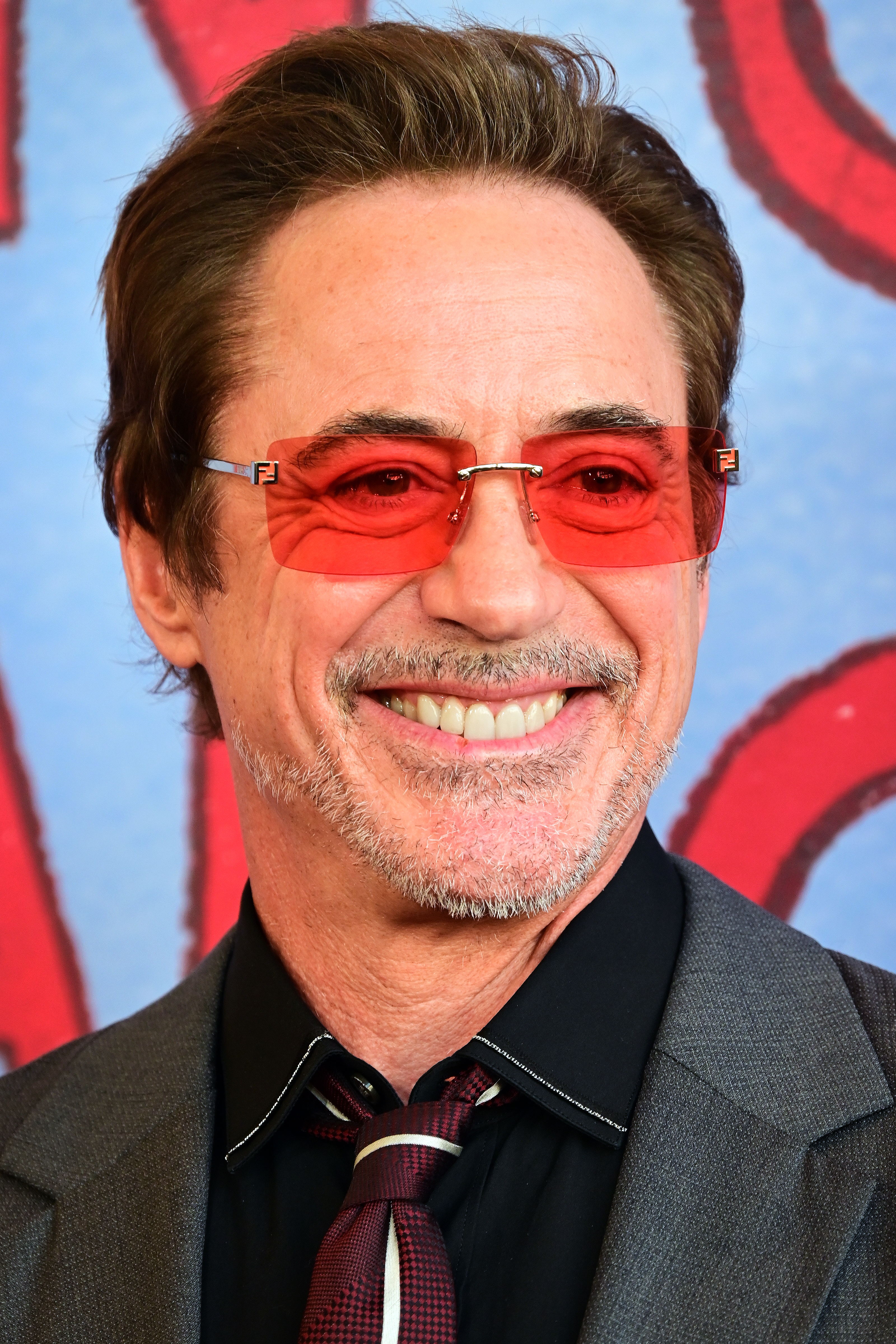
There is a moment in the modern history of American cinema when a studio executive looks at an actor and sees only liability. Robert Downey Jr. lived that moment more than once. By the turn of the millennium he was one of the most gifted performers of his generation and also one of the least employable, a man so consumed by drug addiction that the people who controlled budgets and bond insurance regarded him as a financial impossibility. He had been arrested repeatedly, sentenced to prison, fired from a hit television series, and written off in print as a talent the industry had finally given up on. Then he did something almost no one in his position had ever managed. He came back, and he did not come back quietly. He returned as Tony Stark, anchored the most commercially dominant franchise in film history, became for several years the highest-paid actor in the world, and eventually stood on a stage in 2024 holding an Academy Award. This is the story of that long arc, the fall and the climb, the inheritance and the reinvention.
Quick Facts
- Full name
- Robert John Downey Jr.
- Born
- 4 April 1965, Manhattan, New York, USA
- Nationality
- American
- Known for
- Iron Man / the Marvel Cinematic Universe, Chaplin, Oppenheimer, Sherlock Holmes
- Awards
- Academy Award for Best Supporting Actor (2024, Oppenheimer)
Early Life
Robert John Downey Jr. was born on 4 April 1965 in Manhattan, New York, into a household where the boundary between life and filmmaking barely existed. His father, Robert Downey Sr., was a fixture of the American underground cinema of the 1960s and 1970s, an experimental writer and director whose satirical work, most famously the 1969 advertising-industry sendup “Putney Swope,” made him a counterculture figure. His mother, Elsie Ann Ford, was an actress who appeared in several of her husband’s films. The younger Downey grew up surrounded by artists, eccentrics, and the unstructured creative chaos of independent moviemaking in lower Manhattan and later in California.
That world had a darker side, and Downey has never hidden it. Drugs were present in the home from his earliest years. He has spoken openly about being given marijuana by his father when he was just six years old, an act his father later described as a misguided attempt to share something rather than withhold it. The exposure normalized substances at an age when most children have no concept of them. Downey would later reflect that the habit of using drugs as a way of bonding with the adults around him was woven into his childhood, and that it would take decades and enormous suffering to unwind.
His acting began almost as a byproduct of his surroundings. He made his screen debut as a child in one of his father’s films, “Pound” (1970), playing a small role at the age of five. He appeared in other Downey Sr. projects through his youth, absorbing the rhythms of a set before he had any formal training. When his parents separated and later divorced, Downey moved with his father, spending part of his adolescence in California. He attended Santa Monica High School but never graduated, dropping out in his teens to pursue acting full time. By the time he was a young adult he had relocated back to New York to chase a professional career, carrying with him both an unusual familiarity with the camera and an early, dangerous comfort with the substances that would nearly destroy him.
Early Career
Downey arrived in the entertainment industry of the early 1980s as part of a generation of young actors who would soon be labeled, often dismissively, the Brat Pack. He worked steadily in films aimed at teenagers and twenty-somethings, building credits and visibility. A significant career marker came in 1985, when he joined the cast of “Saturday Night Live” as a featured player for a single season. The fit was awkward and short-lived, and he was not retained beyond that year, but the exposure confirmed that he was a young performer to watch.
It was on the big screen that his talent became undeniable. He appeared in films such as “Weird Science” (1985) and “Back to School” (1986), but the role that announced his dramatic range arrived in 1987 with “Less Than Zero,” an adaptation of Bret Easton Ellis’s novel about disaffected, wealthy young people in Los Angeles. Downey played Julian, a charming but doomed young man sinking into drug addiction. His portrayal was raw and frighteningly convincing, and critics singled it out as the standout of the film. The irony was not lost on observers later: the performance that proved his ability to inhabit addiction would foreshadow his own life with disturbing precision. Downey himself has said the role hit uncomfortably close to home.
Through the late 1980s and early 1990s he continued to accumulate credits in films like “Chances Are” (1989) and “Air America” (1990) opposite Mel Gibson. Then came the role that transformed his standing among serious filmmakers. In 1992, director Richard Attenborough cast him as the lead in “Chaplin,” a sweeping biographical film about the legendary silent-era comedian Charlie Chaplin. The part demanded that Downey age across decades, master physical comedy, perform Chaplin’s iconic Little Tramp routines, and carry a prestige production on his shoulders. He trained relentlessly, studying Chaplin’s movements until he could replicate them, and the result was a tour de force.
For “Chaplin,” Downey received his first Academy Award nomination, for Best Actor, at the 1993 ceremony. He also earned a BAFTA Award for Best Actor in a Leading Role from the British Academy. Though he lost the Oscar to Al Pacino for “Scent of a Woman,” the nomination cemented his reputation as one of the most capable actors of his age. He seemed poised for the kind of distinguished career his early promise had predicted. Instead, the foundation beneath him was already cracking.
The Years of Addiction
The same decade that brought Downey critical acclaim brought the slow public collapse of his life. His drug use, never fully arrested since childhood, escalated through the 1990s into a full crisis involving cocaine, heroin, and other substances. What had once been hidden became, by the end of the decade, a matter of court records and tabloid headlines.
The legal troubles accumulated with grim regularity. In 1996 he was arrested multiple times in a span of months, including an incident in which he was found driving with controlled substances and a handgun, and another in which he was discovered, disoriented, having wandered into a neighbor’s home and fallen asleep in a child’s bed. The courts placed him on probation and ordered treatment, but he repeatedly failed drug tests and violated the terms of his release. Judges grew less forgiving with each appearance. In one widely quoted remark to the court, Downey compared his addiction to having a loaded weapon in his mouth and a finger on the trigger that liked the taste of gunmetal, a stark image that captured how little control he felt.
By 1999 the patience of the legal system ran out. Downey was sentenced to a term in California state prison for violating probation, and he served time at the California Substance Abuse Treatment Facility and State Prison in Corcoran. He spent roughly a year incarcerated before being released. The experience did not immediately cure him. Within a year he was arrested again, found under the influence in a hotel, and later detained in another incident.
Professionally, the consequences were severe. He had joined the cast of the popular television legal dramedy “Ally McBeal” in 2000, and his work on the show, playing a love interest for the title character, was warmly received, earning him a Golden Globe Award and a Screen Actors Guild Award. But after his renewed arrests in late 2000 and early 2001, the producers wrote him out and he was effectively fired from the series. The message rippling through Hollywood was unmistakable. Studios and, crucially, the completion-bond companies that insure film productions against the loss of a key performer concluded that Downey was simply too great a risk to cover. An actor who cannot be insured cannot be cast, and for a period he became nearly uninsurable, his prodigious gifts rendered commercially useless by the chaos of his addiction.
The Comeback
The turning point came in the early 2000s, and like most real recoveries it was less a single dramatic event than a slow, deliberate rebuilding. Downey has credited several forces with helping him achieve lasting sobriety: a final arrest and court-mandated treatment around 2001, the steadying influence of people who refused to give up on him, and his own exhausted decision that he no longer wanted to live the way he had been living. He got clean and, remarkably given his history, stayed clean. He has spoken of the support of those close to him and of practices, including martial arts, that gave structure to his days. By his own account, the recovery that finally held began around 2003.
Sobriety did not instantly restore his career. The industry’s trust had to be earned back piece by piece, and the people willing to take the risk did so cautiously. Mel Gibson, an old friend and colleague, reportedly paid Downey’s insurance bond out of his own pocket so that Downey could be cast in the 2003 film “The Singing Detective.” Director Joel Silver withheld part of Downey’s salary on another project as a guarantee against relapse. These were the humbling terms of a man rebuilding from the bottom.
He took the work that came and made the most of it. He delivered strong supporting and ensemble performances in films across the mid-2000s, gradually demonstrating that he was reliable, present, and as talented as ever. The film that crystallized his renaissance was “Kiss Kiss Bang Bang” (2005), a sharp, self-aware crime comedy written and directed by Shane Black. Downey played Harry Lockhart, a small-time thief who stumbles into a Hollywood murder mystery, and his fast, witty, self-deprecating performance reminded audiences and executives alike of exactly what they had been missing. The film was a critical favorite, and it reintroduced Downey as a leading man with a distinctive comic intelligence. His relationship with Shane Black, forged on that film, would pay off again a few years later. The comeback was no longer a hope. It was happening.
Iron Man and Global Superstardom
In 2007, the newly formed Marvel Studios was preparing to launch its own slate of films based on its comic-book characters, beginning with a relatively second-tier hero named Iron Man. Director Jon Favreau wanted Robert Downey Jr. for the lead role of Tony Stark, the brilliant, arrogant, self-destructive billionaire arms manufacturer who builds a high-tech armored suit and reinvents himself as a hero. The choice was, on paper, a gamble. Downey’s history made the studio’s financiers nervous, and casting a recovering addict as the face of an expensive new franchise required conviction. Favreau argued, persuasively, that Downey’s own life of brilliance, excess, and redemption made him uniquely suited to a character defined by exactly those qualities.
“Iron Man” was released in 2008 and became a phenomenon. Downey’s Tony Stark was funny, charismatic, and unexpectedly human, a wisecracking genius wrestling with conscience and consequence. The film earned more than 580 million dollars at the global box office and launched what became the Marvel Cinematic Universe, the most successful interconnected film franchise ever assembled. Downey’s casting is widely regarded as the single most important creative decision in that universe’s history. He had quite literally bet his career on a comeback, and the bet returned beyond anyone’s projection.
He reprised the role across more than a decade, appearing as Tony Stark in “Iron Man 2” (2010), “Iron Man 3” (2013, again directed by Shane Black), and across the team-up films that became cultural events in their own right. He led the ensemble of “The Avengers” (2012), directed by Joss Whedon, which grossed more than 1.5 billion dollars worldwide, and returned for “Avengers: Age of Ultron” (2015), “Avengers: Infinity War” (2018), and the culminating “Avengers: Endgame” (2019). “Endgame,” in which Stark sacrifices himself to defeat the villain Thanos, became at the time the highest-grossing film in history, taking in nearly 2.8 billion dollars globally. His central role in this run of blockbusters, combined with backend deals tied to the films’ staggering profits, made Downey for several years the highest-paid actor in the world, with reported earnings from individual films and the franchise overall reaching tens of millions of dollars.
Alongside the Marvel work, Downey built a second franchise. He starred as the title detective in Guy Ritchie’s “Sherlock Holmes” (2009), a stylish, action-driven reinterpretation of Arthur Conan Doyle’s character opposite Jude Law as Dr. Watson. The film was a major commercial success and earned Downey a Golden Globe Award for Best Actor in a Musical or Comedy. He returned for “Sherlock Holmes: A Game of Shadows” (2011). For a stretch of years he was effectively the most bankable star on the planet, a status that would have seemed delusional to predict a decade earlier when he sat in a prison cell.
The Mature Artist
The end of his run as Iron Man, marked by his character’s death in “Avengers: Endgame,” opened a new chapter. Freed from the franchise that had defined his middle years, Downey turned back toward the kind of serious, character-driven work that had first earned him acclaim with “Chaplin.” After a misstep with the poorly received fantasy “Dolittle” (2020), he reset and chose his projects with care.
The pivotal collaboration came with director Christopher Nolan. In Nolan’s 2023 historical epic “Oppenheimer,” about the physicist J. Robert Oppenheimer and the creation of the atomic bomb, Downey played Lewis Strauss, the embittered, calculating chairman of the Atomic Energy Commission whose quiet vendetta against Oppenheimer drives much of the film’s tension. It was a role almost entirely stripped of charm, demanding restraint, menace, and psychological precision rather than charisma. Downey vanished into the part, often unrecognizable beneath the character’s age and demeanor.
The performance was hailed as the finest of his mature career and swept the supporting-actor awards of the season. Downey won the Golden Globe Award, the BAFTA Award, the Screen Actors Guild Award, and finally, at the ceremony held in March 2024, the Academy Award for Best Supporting Actor. It was his first Oscar, arriving more than thirty years after his first nomination for “Chaplin,” and it served as the official, industry-sanctioned confirmation of a comeback that had already become legend.
Downey has also expanded into producing and stage work. Through his production company, Team Downey, founded with his wife, he has developed film and television projects. In 2024 he made his Broadway debut in the play “McNeal” at the Vivian Beaumont Theater, taking on the live stage for the first time in his career and drawing strong notices. He announced a return to the Marvel universe as well, this time cast in a new role as the villain Doctor Doom in upcoming Avengers films, a striking choice that closes one loop and opens another. The actor once deemed uninsurable had become, in his later years, a figure of remarkable creative freedom.
Personal Life and Legacy
Central to Downey’s recovery and stability has been his marriage to producer Susan Levin, whom he met on the set of the 2003 film “Gothika,” where she worked as an executive. They married in 2005, the same year his career turned the corner with “Kiss Kiss Bang Bang,” and she became Susan Downey. The two formed a deep personal and professional partnership, founding Team Downey together. Friends and the actor himself have credited Susan with providing the steadiness and accountability that helped sustain his sobriety through the pressures of renewed fame. The couple have two children together, a son and a daughter. Downey also has an older son, Indio, from his first marriage to actress and singer Deborah Falconer, to whom he was married from 1992 to 2004.
“The thing I would say to anybody who’s struggling is, the worst things in your life can become the best things if you let them.”
Downey has rarely lectured publicly about recovery, preferring to demonstrate it through the simple fact of a life rebuilt, but he has become, almost inevitably, a symbol of the possibility of change. His story is cited in conversations about addiction, second chances, and the difference between condemnation and rehabilitation. He has channeled some of his attention toward environmental causes, launching an initiative aimed at using advanced technology to address climate and ecological problems, and he has supported various charitable efforts over the years.
His legacy in film is now secure on multiple fronts. He is the actor who gave the modern superhero blockbuster its template and its heart, the performer whose Tony Stark turned a niche comic-book property into the most lucrative franchise in cinema. He is also a serious dramatic artist whose work in “Chaplin,” “Kiss Kiss Bang Bang,” and “Oppenheimer” stands on its own merits entirely apart from any cape or armor. And underlying all of it is the human story, the most resonant of his many roles: a child raised amid drugs who fell as far as the industry allowed, then climbed back to its very summit. Hollywood has produced countless cautionary tales. Robert Downey Jr. is one of the rare ones who rewrote the ending himself.
Key Facts
- Robert Downey Jr. was born on 4 April 1965 in Manhattan, the son of underground filmmaker Robert Downey Sr., and was exposed to drugs as a young child, making his film debut at age five.
- He earned his first Academy Award nomination for playing Charlie Chaplin in Richard Attenborough’s “Chaplin” (1992), winning a BAFTA for the role.
- His addiction led to multiple arrests, roughly a year in California state prison, his firing from “Ally McBeal,” and a period when he was considered nearly uninsurable in Hollywood.
- After achieving sobriety around 2003, he rebuilt his career and became, through his role as Tony Stark in “Iron Man” (2008) and the Marvel films, the highest-paid actor in the world.
- He won the Academy Award for Best Supporting Actor in 2024 for playing Lewis Strauss in Christopher Nolan’s “Oppenheimer,” more than three decades after his first nomination.