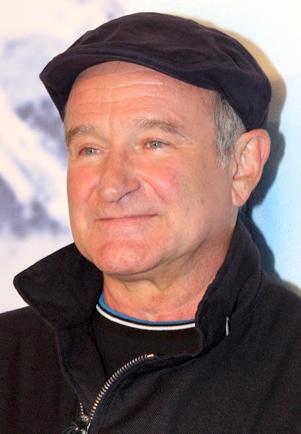
There are performers who tell jokes, and there are performers who become a kind of weather system. Robin Williams belonged to the second group. When he walked onto a stage or stepped in front of a camera, the air in the room seemed to change pressure. Ideas came spilling out of him in torrents, voices layered on voices, accents collapsing into characters, references piling up faster than any audience could fully absorb. He could be a Russian defector, a fussy British matron, a televangelist, and a Brooklyn cab driver inside the span of thirty seconds, and somehow the whole improvised cascade would land on a punchline that felt inevitable. Yet the strangest thing about Robin Williams was not the speed. It was the tenderness underneath it. The same man who could make a packed comedy club gasp for breath could also sit quietly across from a wounded young man on screen and say, with total stillness, that none of it was his fault. He made the world laugh, and then he made the world cry, and he made both feel like acts of generosity.
Quick Facts
- Full name
- Robin McLaurin Williams
- Born
- 21 July 1951, Chicago, Illinois, USA
- Died
- 11 August 2014, Paradise Cay, California (aged 63)
- Known for
- Mork & Mindy, Good Morning Vietnam, Dead Poets Society, Good Will Hunting, Mrs Doubtfire
- Awards
- Academy Award for Best Supporting Actor (1998); 6 Golden Globes
Early Life
Robin McLaurin Williams was born on 21 July 1951 in Chicago, Illinois. His father, Robert Fitzgerald Williams, was a senior executive at the Ford Motor Company, a formal and somewhat distant man who carried himself with old-fashioned dignity. His mother, Laurie McLaurin, was a former model from a wealthy Mississippi family, a warm and theatrical woman with a love of mischief and a quick laugh. Robin was the only child of their marriage, though he had two older half-brothers from his parents’ earlier relationships, and for long stretches of his boyhood he lived something close to the life of an only child.
The family home was large, and Robin often felt small inside it. His father traveled for work, his mother kept a busy social calendar, and the boy was frequently left to his own devices in the company of the household staff. He filled the silence by inventing it. Alone in the vast attic of the house, surrounded by a small army of toy soldiers, he staged elaborate battles and gave each figure its own voice. That early habit of populating loneliness with characters would later become the engine of his entire career. He was, by his own description, a shy and chubby child who learned that making people laugh was the surest way to be noticed and the surest way to be safe.
When his father took a new position, the family moved west to Marin County, California, a change of scenery that opened up the boy considerably. At Redwood High School he discovered a talent for performance and a knack for winning people over with humor rather than force. He initially considered a serious and respectable path, even briefly studying political science, before the pull of acting became impossible to ignore. He enrolled at Claremont McKenna College and later studied at the College of Marin, where his gift for the stage began to take obvious shape.
The decisive step came when he won a full scholarship to the Juilliard School in New York City, one of the most demanding training grounds for performers in the world. There he studied in the prestigious drama program under the formidable John Houseman, a teacher and actor of imposing standards who reportedly told the young Williams that he was wasting his talent and ought to pursue comedy. At Juilliard he formed a close and lasting friendship with another rising student, Christopher Reeve, the future Superman. The two could hardly have looked more different, the tall and stately Reeve beside the restless and electric Williams, but they became devoted friends, and that bond would endure through the rest of their lives, including the years after Reeve’s catastrophic riding accident. Juilliard gave Williams a classical foundation, a respect for craft, and a discipline that would always sit, somewhat improbably, beneath the chaos of his comedy.
Stand-Up and Stardom
Williams left the rigor of Juilliard for the rawer education of the stand-up stage. He returned to California and threw himself into the booming comedy scene of the mid-1970s, working the clubs of San Francisco and Los Angeles. This was the world of The Comedy Store and The Improv, smoky rooms full of hungry young comics, and Williams quickly became the one other performers came to watch. His style was unlike almost anything that had come before it. Rather than delivering a polished set of memorized jokes, he improvised at a furious pace, ricocheting between voices and characters, riffing on whatever flew through his mind or floated up from the crowd. A heckler became raw material. A stray sound from the back of the room became a five-minute detour. Audiences left exhilarated and a little dazed, as though they had witnessed a controlled explosion.
That explosive style caught the attention of television producers. After appearances on the revived version of the variety show Laugh-In and other programs, Williams got the break that would change everything. He was cast as Mork, a guileless alien from the planet Ork, in an episode of the hit sitcom Happy Days. The character was a one-off novelty, a visitor who tried to abduct Richie Cunningham, but Williams seized the role with such manic invention that audiences and executives took immediate notice. The reaction was strong enough that the network built an entire series around him.
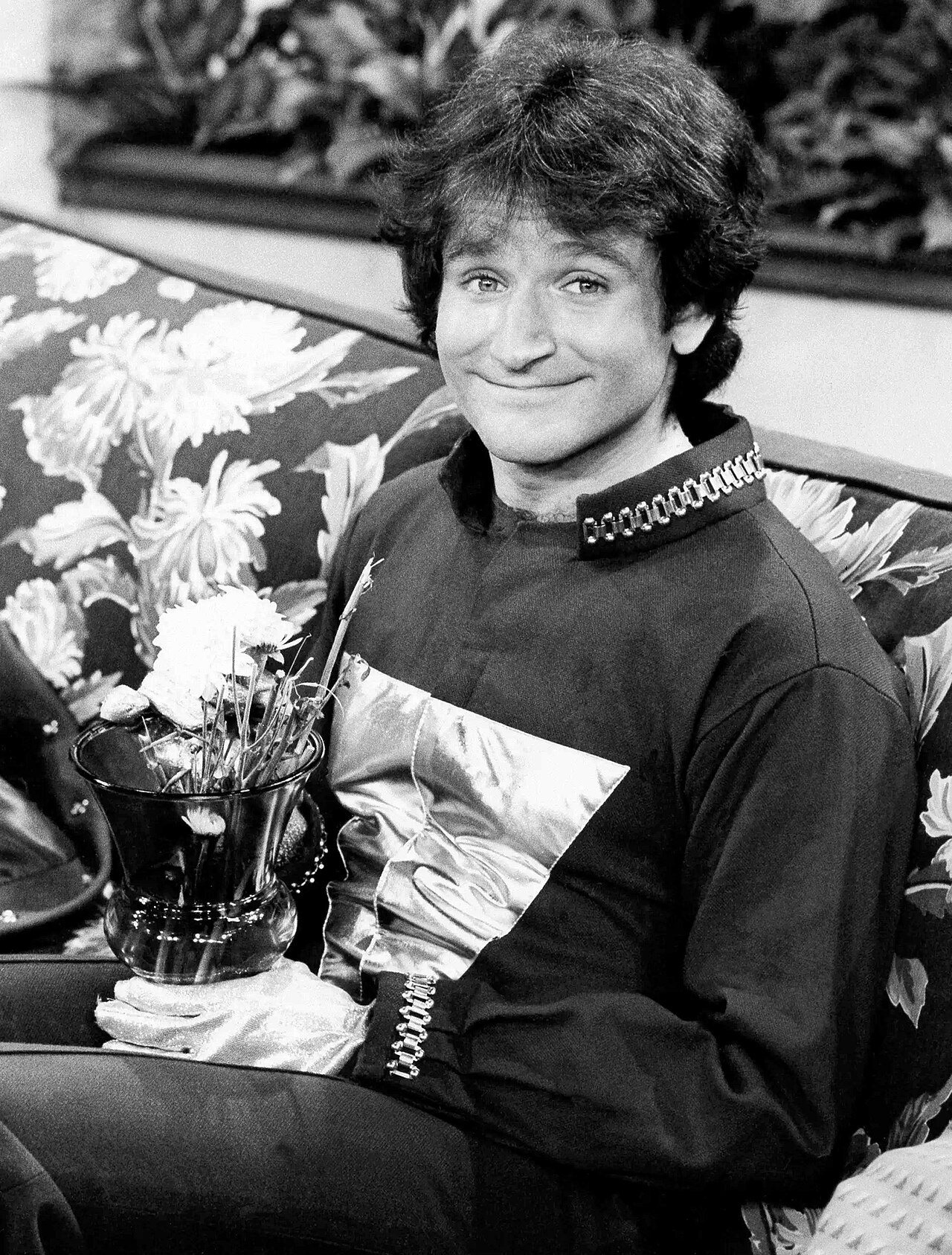
Mork & Mindy premiered in 1978 and ran until 1982, and it made Robin Williams a household name almost overnight. As Mork, the innocent extraterrestrial trying to understand human life while rooming with the kindly Mindy McConnell, played by Pam Dawber, Williams was given license to do exactly what he did best. The scripts left deliberate gaps marked simply as places for him to improvise, and he filled them with rubber-limbed physical comedy, lightning-fast wordplay, and a stream of voices that no writer could have scripted. The show’s catchphrases entered the culture, the rainbow suspenders became an emblem, and Williams, still in his twenties, became one of the most talked-about performers in America. The role earned him a Golden Globe and confirmed that the strange energy honed in attic battles and comedy clubs could conquer a national audience.
Film Stardom and Range
Television fame is one thing, and a durable film career is another. Williams’s first major attempt at the movies, a 1980 adaptation of the comic strip Popeye directed by Robert Altman, was an ambitious oddity that did not become the hit everyone hoped for. For several years he searched for the right vehicle, appearing in films of mixed fortune while continuing to refine his craft. The turning point arrived in 1987 with Good Morning, Vietnam, directed by Barry Levinson. Williams played Adrian Cronauer, an irreverent military radio disc jockey broadcasting to American troops during the Vietnam War. The role let him pour his improvisational genius into the broadcast booth sequences, which crackled with invented bits, while also asking him to carry real dramatic weight as the comedy gave way to the grim realities of the conflict. The performance earned him his first Academy Award nomination, for Best Actor, and announced that he was far more than a manic clown.
He confirmed it almost immediately. In 1989 he starred in Dead Poets Society, directed by Peter Weir, as John Keating, an unconventional English teacher at a strict New England boarding school who urges his students to seize the day and think for themselves. It was a restrained, deeply felt performance, full of warmth and quiet conviction, and it earned Williams a second Best Actor nomination. The film became a cultural touchstone, its rallying cry of “O Captain! My Captain!” and its insistence on living a passionate, examined life resonating with generations of viewers.
The dramatic roles kept coming. In Awakenings (1990), directed by Penny Marshall and based on the writings of the neurologist Oliver Sacks, Williams played a gentle, introverted doctor opposite Robert De Niro, trading his usual fireworks for careful, observant stillness. In Terry Gilliam’s The Fisher King (1991) he gave one of his most moving performances as Parry, a traumatized homeless man on a quixotic search for the Holy Grail in modern New York, a role that earned him yet another Oscar nomination.
Then came a piece of casting that would define him for an entire generation of children. In Disney’s animated Aladdin (1992), Williams voiced the Genie, and the result was a landmark of voice acting. He recorded hours of improvisation, leaping through dozens of impersonations and characters, and the animators raced to keep up with him. The Genie moved and morphed at the speed of his patter, and the performance was so beloved that it helped reshape how studios thought about casting stars in animated films.
His range in this period seemed boundless. In 1993 he starred in Mrs. Doubtfire, directed once again by Chris Columbus, as a divorced father who disguises himself as a prim elderly Scottish housekeeper in order to spend time with his children. The film blended slapstick, heavy prosthetics, and genuine emotional ache about a fractured family, and it became one of the biggest hits of his career. In 1995 he stood at the center of Jumanji, a special-effects adventure about a man freed from a magical board game after decades trapped inside it. Across these years Williams moved between broad family comedy, animated spectacle, and serious drama with a fluidity that few performers of any era have matched.
Dramatic Mastery
For all his nominations and acclaim, the Academy Award itself eluded Williams until 1997. That year he appeared in Good Will Hunting, directed by Gus Van Sant and written by its young stars Matt Damon and Ben Affleck. Williams played Sean Maguire, a grieving widower and community-college psychologist who takes on a defiant, brilliant, wounded young janitor named Will Hunting, played by Damon. The role asked Williams to set aside spectacle almost entirely. His finest moment in the film is a quiet conversation on a park bench, and later a scene in which he repeats a single phrase to the young man until its truth finally breaks through. The performance was tender, weathered, and wise, the work of an actor who understood pain from the inside. At the 70th Academy Awards in 1998, Robin Williams won the Oscar for Best Supporting Actor. After years of being celebrated for everything except a statuette, the recognition felt both overdue and exactly right.
You’re only given a little spark of madness. You mustn’t lose it.
That spark never deserted his comedy, but in the years after his Oscar he showed a willingness to follow his talent into much darker territory. In 2002 he delivered two of the most chilling performances of his career, both of which inverted his cuddly public image. In One Hour Photo, directed by Mark Romanek, he played Sy Parrish, a lonely, meticulous photo-lab technician whose obsession with a seemingly perfect family curdles into something menacing. The performance was unsettling precisely because Williams played Sy not as a monster but as a hollowed-out, aching human being. That same year, in Christopher Nolan’s Insomnia, he played a calculating crime writer turned killer matching wits with a sleep-deprived detective portrayed by Al Pacino. The two roles proved that the empathy which made his heroes so warm could also be turned inside out to make his villains genuinely disturbing.
The Man Behind the Laughter
The energy that audiences loved came at a cost that Williams rarely hid and never fully escaped. From his earliest years of fame he struggled with addiction, falling into heavy use of alcohol and cocaine during the boom years of the late 1970s and early 1980s. The death of his friend John Belushi in 1982, after a night the two had spent together, frightened Williams badly and contributed to his decision to get sober. He stayed clean for two decades before a relapse into alcoholism during a film shoot in Alaska led him back into treatment in the mid-2000s. He spoke about these battles with disarming honesty, turning even his own demons into material in his stand-up specials while never pretending they were anything other than serious.
Beneath the manic public persona ran a current of depression that those closest to him understood. The very intensity that fueled his comedy seemed bound up with a restlessness and a sadness he could not always outrun. Yet the people who worked with him almost universally describe a man of extraordinary kindness. He was famous on film sets for his generosity, quietly arranging help for crew members in difficulty and lifting the spirits of anyone having a hard day. He visited hospitals and performed for sick children without publicity. He insisted that companies he worked with hire homeless people, and he gave freely of his time to causes he believed in.
Chief among those causes was Comic Relief USA, the charity benefit he co-hosted for years alongside Whoopi Goldberg and Billy Crystal to raise money and awareness for people experiencing homelessness. He also performed tirelessly for American troops stationed overseas, bringing his comedy to bases around the world in the tradition of the great wartime entertainers. The contrast at the heart of him, the depressive who devoted himself to lifting others, was not a contradiction so much as the whole point. He knew what darkness felt like, and so he spent his life trying to push it back for other people.
Final Years and Death
In his final years Williams continued to work prolifically, returning to television with the series The Crazy Ones and appearing in films, even as friends noticed he was struggling. In the months before his death he was troubled by anxiety, by physical symptoms he could not explain, and by a creeping sense that something was wrong with his mind. He had recently been given a diagnosis of Parkinson’s disease, though he confided to those near him that he did not feel the explanation fit what he was experiencing.
On 11 August 2014, at his home in Paradise Cay, California, Robin Williams died by suicide. He was 63 years old. The news broke across the world within hours and triggered an outpouring of grief on a scale rarely seen for an entertainer. Fans gathered at sites associated with his films, tributes poured in from presidents and fellow performers, and millions of people shared what his work had meant to them, often citing the very films, like Dead Poets Society and Good Will Hunting, in which he had urged others to live fully and to ask for help.
It was only after his death that the fuller picture emerged. An autopsy revealed that Williams had been suffering not primarily from Parkinson’s disease but from diffuse Lewy body dementia, one of the most aggressive forms of the condition. The disease attacks the brain in ways that can cause severe anxiety, paranoia, hallucinations, confusion, and a devastating loss of control, and his had been unusually severe. His widow, Susan Schneider Williams, later wrote movingly about the illness, describing it as the terrorist inside her husband’s brain and arguing that he had been fighting a disease no one had correctly identified while he was alive. The revelation reframed his final months as a medical tragedy, a brilliant mind under assault by a condition that could not yet be diagnosed in life.
Legacy
The grief that followed Robin Williams’s death was so vast because his work had reached so deeply into so many lives. For children of the 1990s he was the Genie and Mrs. Doubtfire and the man who survived Jumanji. For students he was John Keating, urging them to make their lives extraordinary. For anyone who had ever sat with their own pain he was Sean Maguire on a park bench, saying the thing they needed to hear. Few performers have managed to be both the funniest person in any room and one of the most emotionally truthful actors of their time, and fewer still have done it with such evident warmth.
His influence on comedy is enormous. Generations of stand-up performers absorbed his improvisational fearlessness and his willingness to risk everything for a moment of genuine surprise. His approach to voice acting reshaped the animated film. And his openness about addiction and depression, deepened by the circumstances of his death, helped push conversations about mental health further into the open, encouraging fans and even strangers to speak honestly about their own struggles and to seek help.
The dam in Marin County where he lived, and tribute murals around the world, carry his image, but his truest memorial is the body of work itself, endlessly rewatched and quoted. He remains proof that comedy and compassion are not opposites but neighbors, and that a single performer, armed with nothing but a little spark of madness, could make the whole world feel, all at once, like laughing and crying together.
Key Facts
- Robin McLaurin Williams was born on 21 July 1951 in Chicago and trained at the Juilliard School under John Houseman, alongside his lifelong friend Christopher Reeve.
- He rose to national fame as the alien Mork in the sitcom Mork & Mindy, which ran from 1978 to 1982.
- He received three Academy Award nominations for Best Actor, for Good Morning, Vietnam, Dead Poets Society, and The Fisher King, before winning Best Supporting Actor for Good Will Hunting in 1998.
- He co-hosted the Comic Relief USA benefits for years to support people experiencing homelessness and was widely known for his off-screen generosity.
- He died on 11 August 2014 at the age of 63, and an autopsy later revealed he had been suffering from diffuse Lewy body dementia.