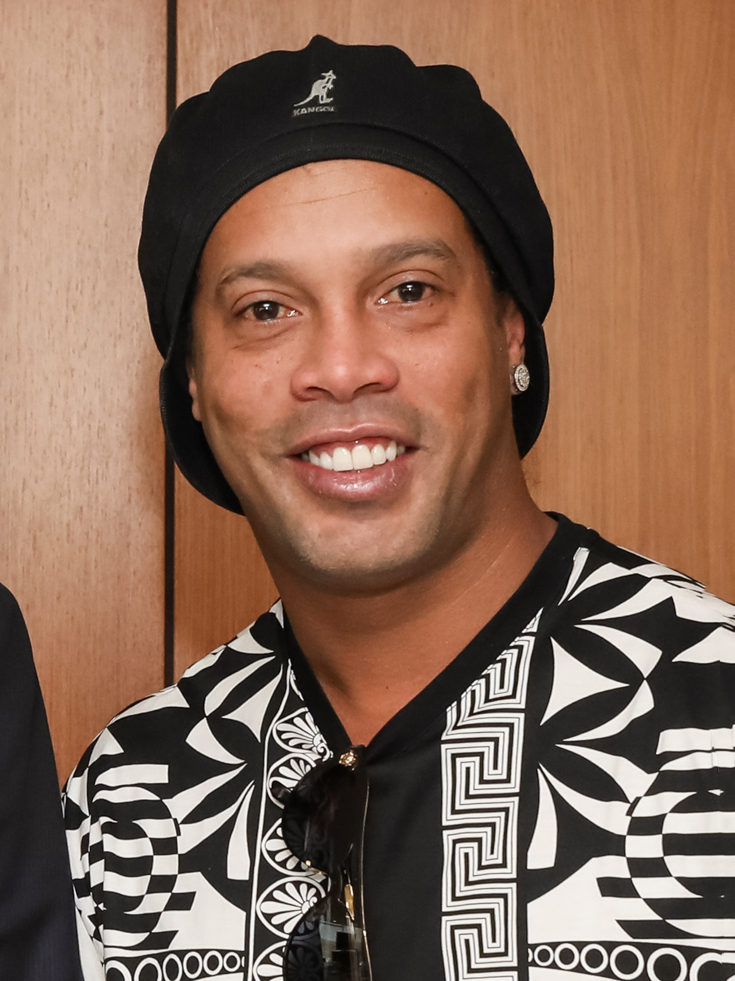
There is a particular sound that a football crowd makes when it sees something it cannot explain. It is not quite a cheer and not quite a gasp. It is closer to a collective laugh, the noise of tens of thousands of people deciding at the same instant that what just happened in front of them should not have been possible. For most of the early 2000s, that sound followed one man around the stadiums of Europe and South America. He had buck teeth, a permanent grin, and a body that seemed to move to music nobody else could hear. His name was Ronaldinho, and for a few golden seasons he made football feel like play again.
Plenty of footballers have been faster, or stronger, or more relentlessly efficient. A few have won more. But almost nobody made the game look like such unfiltered fun. Ronaldinho dribbled past defenders with a smile, scored absurd goals as though they were jokes he was sharing with the crowd, and treated the most pressured stages in world sport like a beach kickabout among friends. He was a serious winner, a World Cup champion and twice the best player on earth, yet what people remember most is the feeling: the sense that for a while one player had reminded everyone why they fell in love with the sport in the first place.
Quick Facts
- Full name
- Ronaldo de Assis Moreira
- Born
- 21 March 1980, Porto Alegre, Brazil
- Sport
- Football (attacking midfielder / forward)
- Known for
- FIFA World Player of the Year 2004 and 2005; 2002 World Cup winner
- Major clubs
- Grêmio, Paris Saint-Germain, Barcelona, AC Milan
Early Life
Ronaldo de Assis Moreira was born on 21 March 1980 in Porto Alegre, the capital of Rio Grande do Sul in the far south of Brazil. The nickname came later and came naturally. In a country where almost everyone called Ronaldo answers to some affectionate variation, the small, grinning boy with the round cheeks became Ronaldinho, a diminutive that means little Ronaldo. The name stuck so completely that the world would forget he had ever been called anything else.
He grew up in a household where football was not a hobby but a language. His father, João de Assis Moreira, worked at a shipyard and played the game himself in his spare time. His mother, Miguelina, raised the family with the kind of steadiness that anchors a house full of ambition. The most important figure in Ronaldinho’s early football education, though, was his older brother Roberto, a genuinely promising forward who signed for Grêmio, the great club of Porto Alegre, and looked for a time as though he might become a star in his own right. Roberto’s career was eventually undone by injuries, but the family’s investment in football never wavered. The money Roberto earned helped move the family to a better home, and that home had a small swimming pool and a five a side pitch where the youngest child sharpened his gifts.
Tragedy arrived early. When Ronaldinho was eight years old, his father suffered a heart attack and drowned in that family pool. It was a wound that the family carried quietly for the rest of their lives, and it bound them tighter. Roberto and his sister Deisi, who would later manage parts of Ronaldinho’s career and commercial affairs, became guardians of his talent as much as his siblings.
The football itself was learned the way so much Brazilian football is learned, away from manicured academy pitches. Ronaldinho grew up playing futsal, the fast indoor five a side game played on hard courts with a small, heavy ball that barely bounces. Futsal rewards close control, quick feet, imagination in tight spaces, and the confidence to try outrageous things because there is no room for anything ordinary. It is no accident that so many of Brazil’s most inventive players came through it. He also played beach football and street football, games with no referees and no tactics, where the only currency was whether you could beat the boy in front of you and make the watching crowd laugh while you did it.
And the smile was there from the beginning. People who knew him as a child describe the same thing again and again: a boy who simply enjoyed the ball, who treated training as recreation and matches as a stage, whose joy was infectious long before it became famous. That temperament would become his signature. Other prodigies played with fear or fury. Ronaldinho played with delight.
Rise in Brazil
He joined the youth system at Grêmio, following in his brother’s footsteps, and his reputation began to spread through the junior ranks of Brazilian football. One of the legends that trailed him into adulthood was a youth match in which he reportedly scored all of his team’s goals in a 23 to nil rout. Whether the exact number is folklore or fact, the point of the story was clear enough: this was a teenager operating on a different plane from everyone around him.
The wider world got its first real look at him at the 1997 Under 17 World Championship, where Brazil reached the latter stages and Ronaldinho announced himself as a special talent. He made his professional debut for Grêmio not long after and began the slow, then suddenly rapid, business of becoming a senior star. By 1999 he was a regular contributor, scoring goals that mixed teenage cheek with genuine technique, and the bigger clubs of Europe were beginning to take notice.
His true international breakthrough came at the 1999 Copa América, staged in Paraguay. Still only nineteen, Ronaldinho was part of a Brazil squad that swept to the title, and he played a meaningful role in a forward line bristling with talent. Brazil beat Uruguay 3 to nil in the final, and the tournament served notice that the next great Brazilian attacker had arrived. That same year he was also part of the Brazil side that won the Confederations Cup, and he picked up individual recognition as one of the brightest young players in the world game.
There were complications too. A contractual dispute over his future created a tug of war between clubs and left his immediate path uncertain. It was the first taste of the off field tangles that would periodically shadow his career. But the football kept answering every question. He was too good, too watchable, and too obviously destined for a bigger stage to remain in southern Brazil for long. In 2001 he made the leap to Europe.
Europe and PSG
The destination was Paris Saint-Germain. France in 2001 was the reigning champion of the world and of Europe, and Ligue 1 was a serious, physically demanding division. PSG, then a club of ambition rather than dominance, paid to bring the young Brazilian to the French capital, and for a while it looked like an inspired piece of business.
The flashes were extraordinary. Ronaldinho produced moments in Paris that hinted at everything he would later become: the rolling stepovers, the elastico flick that became one of his trademarks, the no look passes, the free kicks bent into impossible corners. Anyone who watched him closely could see a generational talent finding his feet in European football. He scored important goals, including memorable strikes in the Paris derby and in European competition, and on his best nights he was simply unplayable.
But France was also where Ronaldinho learned that talent alone was not enough. His relationship with the club’s management grew strained. There were complaints about his appetite for the Paris nightlife, about his fitness, about a young man enjoying his fame perhaps more than his profession at times. The manager Luis Fernández publicly questioned his discipline, and the partnership soured. PSG never quite became the force its supporters dreamed of during his time there, and Ronaldinho never quite delivered the sustained brilliance the move had promised.
In two seasons in France he showed flashes that lit up the league without ever fully detonating. The frustration cut both ways. For Ronaldinho, Paris was a finishing school in the hard lessons of European football. For the watching giants of the continent, his obvious gifts meant that even an imperfect spell could not dim his appeal. When his form dipped at club level, it was his country that kept his global stock high. By the spring of 2002 he had a World Cup to play, and it would change everything.
The 2002 World Cup
Brazil arrived at the 2002 World Cup in Korea and Japan having scraped through a turbulent qualifying campaign. The team that took the field, though, was a thing of beauty up front. The coach Luiz Felipe Scolari built his side around a forward trio that became known as the three Rs: Ronaldo, the great striker rebuilt after years of knee injuries; Rivaldo, the elegant left footed playmaker; and Ronaldinho, the youngest and most mischievous of the three. Together they tore through the tournament.
Ronaldinho’s defining moment came in the quarter final against England. Brazil had fallen behind to a Michael Owen goal but equalised before half time through a flowing move that Ronaldinho started and finished with a pass for Rivaldo to score. Then, early in the second half, came the goal that lives forever in the World Cup highlight reels. Brazil won a free kick about forty yards from the England goal, wide and seemingly too far out to be a serious threat. Ronaldinho stood over it, and rather than crossing into the box he curled an audacious, dipping shot over the head of the England goalkeeper David Seaman and into the far top corner.
The debate about that goal has never fully ended. Some insist it was a cross that floated in by happy accident. Ronaldinho has always maintained, with the same grin, that he meant every inch of it, having noticed Seaman straying off his line. Intentional or not, the result was the same: Brazil 2, England 1, and a place in the semi finals. Ronaldinho was sent off late in that match for a foul, which forced him to miss the semi final against Turkey, but Brazil won through, and he returned for the final.
In the final against Germany in Yokohama, Brazil were too much for a stubborn German side. Ronaldo scored both goals in a 2 to nil win to claim Brazil’s fifth World Cup, and Ronaldinho, still only twenty two, was a world champion. He had not been the headline act, that honour belonged to Ronaldo, but he had delivered one of the tournament’s signature moments and confirmed that the future of Brazilian football would run through his magical left and right feet alike. The World Cup transformed him from a gifted prospect with a difficult club situation into a global commodity. The biggest clubs in the world now wanted him, and one in particular was about to make the move that would define his life.
Barcelona and the Golden Years
In the summer of 2003, Ronaldinho signed for FC Barcelona. It is easy now, knowing how the story ended, to forget how uncertain a move it was at the time. Barcelona were not the colossus they would later become. The club had gone several years without a league title, was in a period of financial and sporting drift, and had just elected a new president, Joan Laporta, partly on the promise of a glamorous signing. Laporta had chased David Beckham and missed. Ronaldinho was, in the eyes of some sceptics, a consolation prize.
He turned out to be the foundation of an empire. From almost his first touch in a Barcelona shirt, Ronaldinho transformed the mood of the club and the city. The football he played was joyous and fearless. He scored a famous late winner against Sevilla in his debut season, a long solo run finished with a shot that sent the Camp Nou into delirium and signalled that something had shifted. Barcelona finished second in his first season and then, in 2004 to 2005, they were champions of Spain for the first time in six years, with Ronaldinho the unquestioned heart of the team.
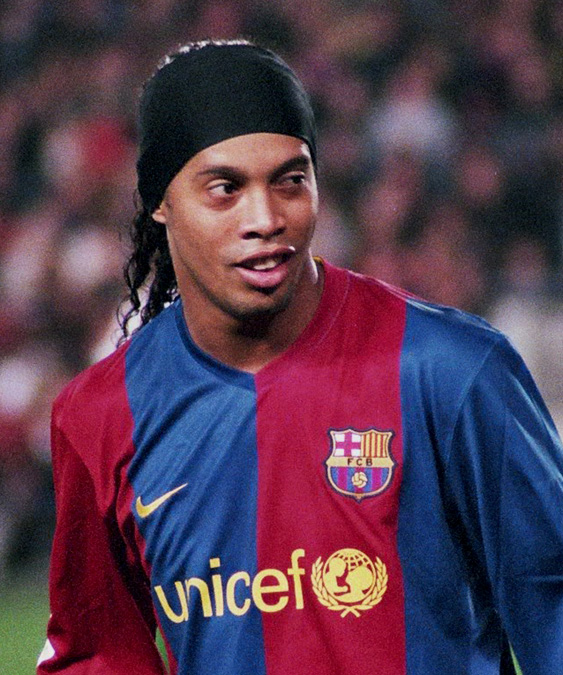
That same year, 2004, he was named FIFA World Player of the Year, and he won it again in 2005, becoming the brightest star in world football by a clear distance. He was also awarded the Ballon d’Or in 2005 for the best player in Europe. His game in those seasons was a complete expression of attacking football: the dribbling, the vision, the long passing, the free kicks, the penalties, the sheer unpredictability. Defenders did not know whether he would beat them with a trick, slip a teammate in with a flick of the outside of his boot, or simply shoot from an impossible angle. Often he seemed not to know himself until the last instant, which made him impossible to defend against.
The 2005 to 2006 season was the peak. Barcelona retained the La Liga title, and they conquered Europe. In the Champions League final of May 2006, played in Paris, Barcelona came from behind to beat Arsenal 2 to 1, with Ronaldinho providing the spark for the winning goals after Arsenal had been reduced to ten men. It was the club’s first European Cup in fourteen years, and it cemented Ronaldinho’s status not just as an entertainer but as a champion at the very highest level. He had taken a sleeping giant and made it the best team in the world, and he had done it while smiling.
The single performance that captured his standing better than any trophy came on 19 November 2005, at the Santiago Bernabéu, the home of Barcelona’s eternal rivals Real Madrid. Barcelona won 3 to nil, and Ronaldinho scored twice, the second a slaloming run through the Madrid defence finished with composure. What happened next was extraordinary. The Real Madrid supporters, the most demanding and partisan crowd in Spanish football, rose to their feet and applauded a Barcelona player off the pitch. It is one of the rarest sights in the sport, an away player so transcendent that the home fans set aside a century of rivalry to acknowledge greatness. For Ronaldinho it was perhaps the ultimate compliment, a tribute paid by the people least inclined to give it.
“I learned all about life with a ball at my feet.”
For those few seasons, Ronaldinho was football. Children around the world copied his tricks in the street. His advertising campaigns, including one in which he reportedly hit the crossbar four times in succession, racked up millions of views in the early days of online video. He made the game look like the most fun anyone could possibly have, and he did it on the biggest stage against the best opposition. It could not last forever, and it did not.
AC Milan and Decline
The decline, when it came, was gradual but unmistakable. By the 2007 to 2008 season, the discipline issues that had shadowed Ronaldinho in Paris resurfaced in Barcelona. There were questions about his fitness, his focus, and his commitment, and a new young talent at the club, a teenager named Lionel Messi, was beginning to take on the responsibility of carrying the team. Injuries interrupted his rhythm, and the magic that had seemed effortless now required effort he was not always willing to give. Barcelona decided it was time to move on.
In the summer of 2008 he joined AC Milan, the storied Italian club, for a fee that reflected both his fame and the reality that he was no longer at his absolute peak. Serie A was a tough, tactically rigorous league, and Ronaldinho was now in his late twenties with plenty of football behind him. There were good moments at Milan. He could still produce passages of brilliance, still bend a free kick or thread a pass that nobody else could see, and in his first full season he was among the more productive attacking players in the squad. But the relentless, week in week out dominance of his Barcelona years was gone. He was a wonderful player having flashes of his old self rather than a force of nature bending matches to his will.
In 2011 he returned home to Brazil, signing for Flamengo, one of the country’s most popular clubs. The homecoming reconnected him with the joyful football of his roots and reminded Brazilian supporters of what they had been missing. After a spell at Flamengo he moved to Atlético Mineiro, and there he produced the last great triumph of his career. In 2013, Atlético Mineiro won the Copa Libertadores, South America’s equivalent of the Champions League, for the first time in the club’s history, beating Olimpia of Paraguay in a dramatic final decided on penalties. Ronaldinho was the creative engine of that side and was named the best player of the tournament. It was a fitting late chapter: a continental title won on home soil, with the smile still flickering even as the legs slowed.
There were further moves after that, including spells in Mexico and elsewhere, but the Libertadores triumph was the true final act of his competitive greatness. He drifted toward retirement over the following years, his career formally ending in the mid 2010s, though by then he had long since passed into legend.
Life After Football
Retirement did not dim Ronaldinho’s fame. If anything, it preserved it. He became a global ambassador for the sport, appearing at exhibition matches, charity events, and football festivals around the world, where crowds turned out simply to watch him juggle and grin one more time. His iconic status was secure. To a generation that had grown up watching him in the early 2000s, he was not merely a great player but a feeling, a reminder of football’s capacity for pure joy.
Off the field, his life was not without trouble. The casual approach that had occasionally frustrated his managers translated into a chaotic relationship with money and administration in retirement. The most serious episode came in March 2020, when Ronaldinho and his brother Roberto travelled to Paraguay and were detained by authorities over the use of allegedly falsified passports. The pair spent time in custody in Paraguay, including a period in a prison, before being moved to house arrest in a hotel as the legal process unfolded. The image of one of the most beloved footballers in history caught up in such a saga was jarring, and it underlined how loosely he had sometimes managed the practical side of his affairs. He was eventually released and the matter resolved, but it was a sobering interlude in an otherwise charmed public life.
Through all of it, his popularity barely wavered. There is a forgiving quality to the affection people feel for Ronaldinho, rooted in the genuine happiness he gave them. His social media following ran into the tens of millions. He remained one of the most recognisable faces in the sport, summoned for tributes, anniversaries, and celebrations, an evergreen symbol of an era. His influence on the players who came after him became one of the most talked about strands of his legacy, and it was a strand that ran directly through the two best players of the next generation.
Legacy
To understand Ronaldinho’s place in football history, you have to separate two things: what he won and what he meant. What he won is a serious record by any measure. A World Cup in 2002. A Copa América in 1999. Two La Liga titles and a Champions League with Barcelona. A Copa Libertadores with Atlético Mineiro. Two FIFA World Player of the Year awards and a Ballon d’Or. That alone would secure him a place among the greats of his era.
But what he meant goes beyond the trophy cabinet. Ronaldinho arrived at a moment when elite football was becoming ever more organised, more athletic, more tactically rigid, and he played as though none of that applied to him. He reintroduced spontaneity at the highest level and proved that imagination could still beat structure. He made the sport feel generous and human, a game played by a man who clearly loved it rather than a machine engineered to win it.
His most concrete legacy lives in the players he inspired. At Barcelona, the young Lionel Messi grew up training alongside him, learning from him, and inheriting the number that Ronaldinho’s brilliance helped make sacred at the Camp Nou. Messi has spoken warmly of what the older man meant to him, both as a player to watch and as a generous teammate who helped a nervous teenager settle. The other great heir was Neymar, the Brazilian who idolised Ronaldinho as a boy and built his own game on the same foundation of trickery, joy, and fearless attacking. When Neymar wears the Brazil shirt and tries the outrageous, he is playing in a tradition that Ronaldinho carried and passed on.
Perhaps the truest measure of Ronaldinho is the standing ovation at the Bernabéu. It takes a once in a generation talent to make your fiercest rivals applaud you out of love for the game. He had that quality. Other players were more consistent, more durable, more decorated over a full career. Few, if any, made a billion people smile the way he did. In the long argument about football’s greatest entertainers, Ronaldinho’s name will always be near the front, the smiling magician who, for a few unforgettable years, made the impossible look easy and the game look like fun again.
Key Facts
- Born Ronaldo de Assis Moreira on 21 March 1980 in Porto Alegre, Brazil, he learned the game through futsal, beach football, and street matches before breaking through at his home club Grêmio.
- He won the 1999 Copa América with Brazil and the 2002 World Cup in Korea and Japan, where his long range free kick beat England goalkeeper David Seaman in the quarter final.
- At Barcelona from 2003 he won two La Liga titles (2005 and 2006) and the 2006 Champions League, and was named FIFA World Player of the Year in both 2004 and 2005, plus the 2005 Ballon d’Or.
- On 19 November 2005 he scored twice in a 3 to nil win at Real Madrid’s Bernabéu and received a standing ovation from the home crowd, one of the rarest tributes in the sport.
- After spells at AC Milan and Flamengo, he won the 2013 Copa Libertadores with Atlético Mineiro, and his joyful style directly influenced later stars including Lionel Messi and Neymar.