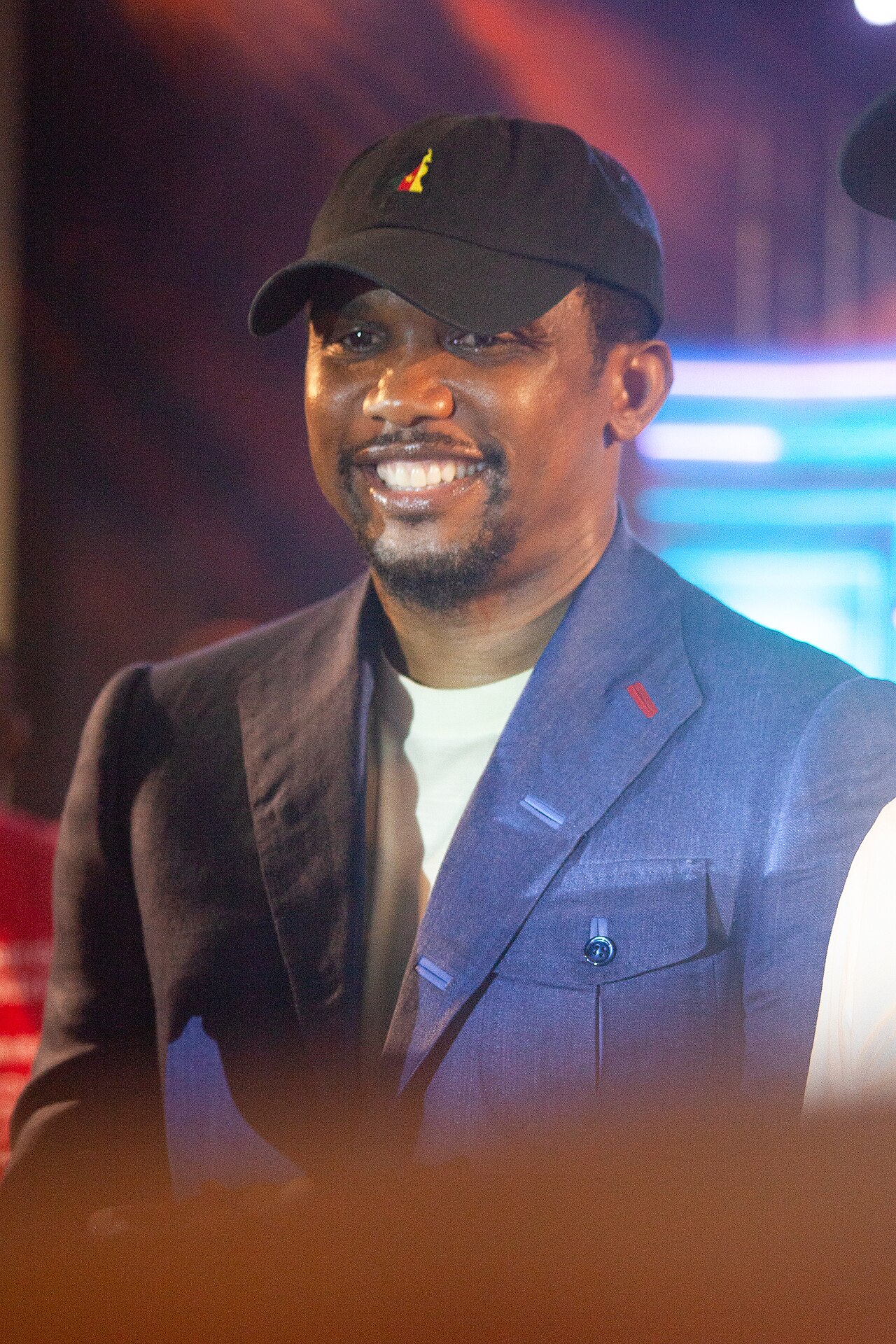
On a warm May night in Rome in 2010, Samuel Eto’o chased down loose balls, tracked back toward his own penalty area, and defended with the hunger of a man playing the first final of his life. In fact, he was playing one of his last great European finals, and he already owned a cabinet full of medals. Inter Milan beat Bayern Munich 2 to 0 that evening to win the UEFA Champions League, and when the final whistle blew, Eto’o had completed something almost no footballer in history had managed. He had won the treble of league, cup, and Champions League for a second year running, each time with a different club in a different country. One season earlier he had done it with Barcelona in Spain. Now he had done it with Inter in Italy.
That image, a world-class striker sprinting back to help his defenders in a Champions League final, captures the essence of Samuel Eto’o. He had everything a forward could want: blistering pace, a predator’s instinct in front of goal, and the nerve to score on the biggest occasions. Yet he also carried a fierce work ethic and an even fiercer pride, the pride of a boy from Cameroon who grew up being told that African players were not quite good enough for the very top, and who spent an entire career proving that judgement wrong. This is the story of the Cameroonian lion who became one of the greatest footballers Africa has ever produced.
Quick Facts
- Full name
- Samuel Eto'o Fils
- Born
- 10 March 1981, Nkon, Cameroon
- Sport
- Football (striker)
- Known for
- Record 4-time African Footballer of the Year; Champions League winner
- Major clubs
- Real Madrid, Mallorca, Barcelona, Inter Milan
Early Life
Samuel Eto’o Fils was born on 10 March 1981 in Nkon, a community near the bustling port city of Douala in Cameroon. Douala is the commercial heart of the country, a crowded and energetic place where football is a constant presence, spilling out onto dusty streets and patches of open ground wherever children can find room to play. Eto’o grew up in a large family of modest means, and like so many boys in his part of the world, he fell in love with the game almost as soon as he could kick a ball.
His childhood was not one of comfort or privilege. The young Eto’o knew what it meant to want for things, and he understood early that football might be his way to a better life. He has often spoken about the determination that drove him as a boy, the sense that he was not simply playing for fun but working toward something real. While other children drifted in and out of the game, Eto’o trained with a seriousness that set him apart. He wanted to be the best, and he said so openly even when he was very young.
That ambition found a home at the Kadji Sports Academy in Douala, one of the most important football development centres in Cameroon. There, Eto’o sharpened the raw gifts that nature had given him: his acceleration, his balance, and his almost ruthless appetite for goals. Coaches quickly recognised that they were dealing with an exceptional prospect, a forward who combined speed with composure and who seemed to thrive on pressure rather than wilt under it.
By his mid-teens, Eto’o was already being watched by scouts from Europe, where the richest and most powerful clubs hunt constantly for the next great talent. The idea of a Cameroonian teenager moving to one of the giants of European football was thrilling and daunting in equal measure. For Eto’o, though, it was simply the next step on a path he had mapped out in his own head years earlier. In 1997, at just sixteen years of age, he left Cameroon for Spain, carrying the hopes of his family and the quiet confidence of a boy who had always believed he belonged at the top.
Early Career in Spain
Eto’o arrived in Spain as a teenager attached to Real Madrid, one of the most famous and demanding clubs on the planet. For a player so young and so far from home, breaking into the first team of a club loaded with international stars was an almost impossible task. Real Madrid’s forward line was crowded with established names, and the club’s ruthless win-now culture left little room for patient development of a raw teenager, no matter how gifted.
Rather than waste away on the sidelines, Eto’o was sent out on a series of loan spells to gain experience and playing time. He spent periods at clubs including Leganés and Espanyol, learning the rhythms of Spanish football and testing himself against seasoned professionals. These moves were part education and part proving ground. Each loan gave him minutes, goals, and the chance to show that he could handle the physical and tactical demands of the Spanish game. The experience toughened him and taught him to adapt, qualities that would serve him for the rest of his career.
The turning point came when Eto’o joined Mallorca, first on loan and then on a permanent basis in 2000 after Real Madrid chose to cash in on a player they could not fit into their plans. In hindsight, letting him go would prove to be a significant miscalculation, but at the island club Eto’o finally found a stage on which he could shine without restriction. Freed from the suffocating competition at Madrid, he flourished.
At Mallorca, Eto’o became a genuine star. Over several seasons he scored freely, terrorising La Liga defences with his pace and his clinical finishing. He was fast, direct, and fearless, the kind of forward who could turn a half chance into a goal in an instant. His performances helped Mallorca punch well above their weight, and in 2003 he played a central role as the club won the Copa del Rey, the Spanish cup, one of the greatest achievements in Mallorca’s history. By then, Eto’o was no longer a promising youngster. He was one of the most feared strikers in Spain, and the biggest clubs in Europe were watching closely. In 2003 he also received his first African Footballer of the Year award, confirming his status as the finest player on his continent.
Barcelona Glory
In 2004, Eto’o made the move that would define his career. Barcelona, one of the grandest institutions in world football, signed him as the centrepiece of a project designed to restore the club to the summit of Spanish and European football. The transfer was a statement of intent, and Eto’o repaid the faith immediately. He arrived at a club brimming with talent, including the Brazilian magician Ronaldinho, and the combination proved irresistible.
Eto’o was sensational at Barcelona. Playing as the spearhead of a thrilling attacking side, he scored goals in bunches, season after season, and quickly established himself as one of the very best strikers in the world. His movement was intelligent, his finishing was lethal, and his engine never stopped. In his first two seasons he helped Barcelona win back to back La Liga titles in 2005 and 2006, ending a long wait for the Spanish championship and announcing the club’s return to dominance.
The crowning moment of that era came in 2006. Barcelona reached the final of the UEFA Champions League, the most prestigious trophy in club football, and faced Arsenal in Paris. In a tense and dramatic final, Eto’o scored the equalising goal that turned the match in Barcelona’s favour, and the Catalan club went on to win 2 to 1 to lift the European Cup. For Eto’o, scoring in a Champions League final and winning the trophy placed him firmly among the elite of the global game. He was also named African Footballer of the Year in both 2004 and 2005, a run of individual honours that underlined his sustained excellence.
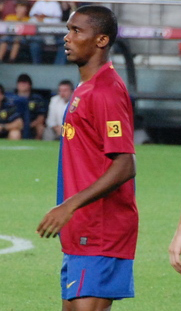
The best was still to come. In the 2008 to 2009 season, under the new management of Pep Guardiola, Barcelona produced one of the greatest campaigns in the history of the sport. Eto’o was a vital part of a forward line that also featured a young Lionel Messi and the Frenchman Thierry Henry. Together they tore opponents apart. Barcelona won La Liga, lifted the Copa del Rey, and reached the Champions League final once again, this time against Manchester United in Rome. Eto’o opened the scoring in a 2 to 0 victory, and Barcelona completed the treble, the first Spanish club ever to win all three major trophies in a single season. Eto’o had now won two Champions League titles with the same club and cemented a legacy as one of Barcelona’s finest ever strikers.
Inter and the Historic Treble
Few players walk away from a club at the peak of their powers, but in the summer of 2009 Eto’o did exactly that. Barcelona arranged a high-profile transfer that sent him to Inter Milan of Italy, with the Swedish striker Zlatan Ibrahimovic moving in the opposite direction. The deal stunned many observers, who could not understand why Barcelona would part with a forward who had just scored in a Champions League final. For Eto’o, it was a fresh challenge in a new country, and he embraced it with characteristic hunger.
At Inter, Eto’o came under the management of Jose Mourinho, one of the most successful and demanding coaches in the game. Mourinho asked Eto’o to play a very different role from the one he had enjoyed at Barcelona. Instead of operating purely as a goal-scoring spearhead, Eto’o was often deployed in a wide and defensive-minded position, tasked with tracking back, closing down space, and sacrificing himself for the good of the team. Many star forwards would have bristled at such a demand, but Eto’o accepted it for the greater cause, and the results spoke for themselves.
The 2009 to 2010 season became the finest in Inter Milan’s modern history. The club won Serie A, the Italian league, lifted the Coppa Italia, and marched all the way to the Champions League final. In Madrid, Inter defeated Bayern Munich 2 to 0 to claim the European crown, completing the treble. For Samuel Eto’o, it was an achievement almost without precedent. He had won the treble with Barcelona in 2009 and then immediately won it again with Inter in 2010, becoming one of the very few players in the history of football to win back to back trebles with two different clubs in two different countries. That feat alone secures his place among the game’s great winners.
His time in Italy showcased a side of Eto’o that is sometimes overlooked. He was not simply a brilliant finisher but a complete team player, willing to run himself into the ground and adapt his game for the benefit of the collective. The sight of a striker of his calibre defending so diligently in a Champions League final became one of the enduring images of that triumphant Inter side, and it spoke volumes about his character and his will to win.
Cameroon and Africa
For all his success in the club game, Eto’o never lost sight of what it meant to represent Cameroon and the wider African continent. He wore the famous green, red, and yellow of the Indomitable Lions with immense pride, and he became the defining figure of Cameroonian football for a generation. His international career was long and decorated, and it carried a significance that went far beyond individual matches.
Eto’o first announced himself on the global stage as a teenager at the 1998 FIFA World Cup, where he became one of the youngest players ever to appear at the tournament. Two years later, in 2000, he was part of the Cameroon side that won the Olympic football gold medal at the Sydney Games, a landmark achievement for African football. That same period saw Cameroon dominate the Africa Cup of Nations, the continent’s premier international competition, and Eto’o was central to the success. He helped Cameroon win the Africa Cup of Nations in 2000 and again in 2002, back to back triumphs that confirmed the Indomitable Lions as the leading force in African football.
Over the years, Eto’o became Africa’s all-time leading scorer at the Africa Cup of Nations, a record that reflects both his longevity and his remarkable consistency at the highest level of the continental game. He also became Cameroon’s all-time top scorer, representing his country at four separate FIFA World Cups across a career that spanned more than fifteen years of international football. Through good times and difficult ones, including moments of friction with national administrators and painful early exits at major tournaments, Eto’o remained the heartbeat of the Cameroonian side.
His standing in African football is captured most clearly by his record in the African Footballer of the Year award. Eto’o won the honour four times, in 2003, 2004, 2005, and 2010, a record haul that places him at the very top of the game’s African royalty. No player had dominated the award quite like him, and the four trophies reflect a career of sustained brilliance both for club and country. For millions of young Africans, Eto’o was living proof that a boy from the continent could rise to become one of the best players in the world without ever leaving his roots behind.
“I am proud to be African, and everything I have done, I have done for my country and my continent.” (Samuel Eto’o)
Later Career and Administration
As Eto’o entered the later stages of his playing career, he took his talents to new and sometimes unexpected destinations. In 2011 he moved to Russia to join Anzhi Makhachkala, a club backed by enormous wealth and ambition. The transfer made him one of the highest-paid footballers in the world at the time, and it reflected both his enduring quality and his willingness to forge his own path rather than follow convention. He continued to score goals and lead the line with the same intensity that had defined his prime.
After his spell in Russia, Eto’o returned to top European football with Chelsea in England, where he played under Jose Mourinho once again during the 2013 to 2014 season. He later had further stops in England with Everton and in Italy with Sampdoria before heading to Turkey, where he represented clubs including Antalyaspor and Konyaspor. He also spent time in Qatar. Wherever he went, Eto’o brought experience, goals, and a professional example for younger players to follow. He finally brought the curtain down on his long and storied playing career in 2019, retiring as one of the most accomplished footballers of his generation.
Retirement did not mean stepping away from the sport that had given him so much. Eto’o turned his attention to football administration and the governance of the game in his homeland. In December 2021 he was elected president of the Cameroonian Football Federation, known by its French acronym FECAFOOT. The election marked a dramatic new chapter, as one of the country’s greatest ever players took charge of the organisation responsible for the sport’s future at home. In his role as president, Eto’o has sought to reform and strengthen Cameroonian football, bringing the same drive and ambition to the boardroom that he once brought to the pitch. His move into administration has not been without controversy and challenge, but it reflects his deep and lasting commitment to the game in Cameroon and across Africa.
Career Timeline
- 1997: Leaves Cameroon as a teenager and joins the Real Madrid system in Spain at just sixteen years of age.
- 2000: Wins Olympic football gold with Cameroon at the Sydney Games and signs permanently for Mallorca.
- 2002: Helps Cameroon win a second consecutive Africa Cup of Nations title.
- 2003: Lifts the Copa del Rey with Mallorca and wins his first African Footballer of the Year award.
- 2004: Transfers to Barcelona and establishes himself as one of the world’s best strikers.
- 2006: Scores in the Champions League final as Barcelona beat Arsenal to win the European title.
- 2009: Wins the treble with Barcelona under Pep Guardiola, then moves to Inter Milan.
- 2010: Wins a second successive treble with Inter under Jose Mourinho and claims a fourth African Footballer of the Year award.
- 2021: Elected president of the Cameroonian Football Federation (FECAFOOT) after retiring from playing in 2019.
Lesser-Known Facts
- A record four African Footballer of the Year awards. Eto’o won the continent’s top individual honour four times, in 2003, 2004, 2005, and 2010, a record that underlines his sustained dominance of African football.
- Back to back trebles with two different clubs. He won the league, cup, and Champions League treble with Barcelona in 2009 and then repeated the feat with Inter Milan in 2010, a rare achievement across two countries in consecutive seasons.
- Africa’s all-time Cup of Nations top scorer. Eto’o holds the record for the most goals ever scored at the Africa Cup of Nations, a mark built across many years of leading the Cameroon attack.
- Olympic champion. Long before his European trophies, he won Olympic football gold with Cameroon at the Sydney Games in 2000, one of the proudest moments of African sport.
- He defended from the front for Mourinho. At Inter, the celebrated goal-scorer accepted a demanding wide and defensive role, sacrificing personal glory to help the team win the 2010 treble.
- From star player to federation president. In December 2021 he was elected president of FECAFOOT, taking charge of the governance of the game in the country he once lit up as a player.
Frequently Asked Questions
Who is Samuel Eto’o? Samuel Eto’o Fils is a retired Cameroonian footballer, widely regarded as one of the greatest African players in history. A ferocious striker, he starred for Mallorca, Barcelona, and Inter Milan in Europe and led the Cameroon national team for more than a decade. He now serves as president of the Cameroonian Football Federation.
How many Champions Leagues did Eto’o win? Eto’o won the UEFA Champions League three times. He claimed two titles with Barcelona, in 2006 and 2009, scoring in both finals, and a third with Inter Milan in 2010, making him one of the most successful strikers in the history of the competition.
How many times was he African Footballer of the Year? He was named African Footballer of the Year a record four times, in 2003, 2004, 2005, and 2010. No player has matched his total, and the award captures his long reign as the finest footballer on the continent.
What clubs did he play for? Eto’o played for a range of clubs during his career, including Real Madrid, Mallorca, Barcelona, and Inter Milan, as well as Anzhi Makhachkala in Russia, Chelsea, Everton, and Sampdoria, and Antalyaspor and Konyaspor in Turkey, among others. He also spent time playing in Qatar before retiring in 2019.
What does he do now? Since December 2021, Eto’o has served as president of the Cameroonian Football Federation (FECAFOOT). He has moved from playing into football administration, where he works to reform and strengthen the game in his home country while remaining a prominent voice in African football.
Legacy
Samuel Eto’o leaves behind a legacy that few footballers from any continent can rival. On the pitch, he was a complete striker, blessed with pace, power, and an unerring eye for goal, and blessed too with the mentality of a champion who rose to the occasion when the stakes were highest. His medals tell part of the story: multiple La Liga titles, Champions League triumphs, back to back trebles with Barcelona and Inter, an Olympic gold medal, and two Africa Cup of Nations crowns. His four African Footballer of the Year awards tell another part, confirming him as the dominant African player of his era.
Yet the full measure of Eto’o goes beyond trophies. He carried the hopes of Cameroon and of Africa with a pride that never dimmed, and he refused to accept the quiet prejudice that African players sometimes faced in the game. He stood up against racist abuse during his career, and he spoke out at a time when too many stayed silent. In doing so he became more than a footballer. He became a symbol of excellence and dignity for a generation of young Africans who saw in him proof that their dreams were valid and achievable.
For boys and girls across Cameroon, Nigeria, Ghana, Senegal, and the whole of the continent, Samuel Eto’o remains a towering inspiration. His journey from the streets near Douala to the summit of world football, and then to the presidency of his country’s football federation, is a story of talent, hard work, and unbreakable self-belief. The Cameroonian lion did not merely conquer Europe. He showed the world exactly how far an African footballer could go, and in the process he became a giant of the game whose name will be spoken with reverence for generations to come.