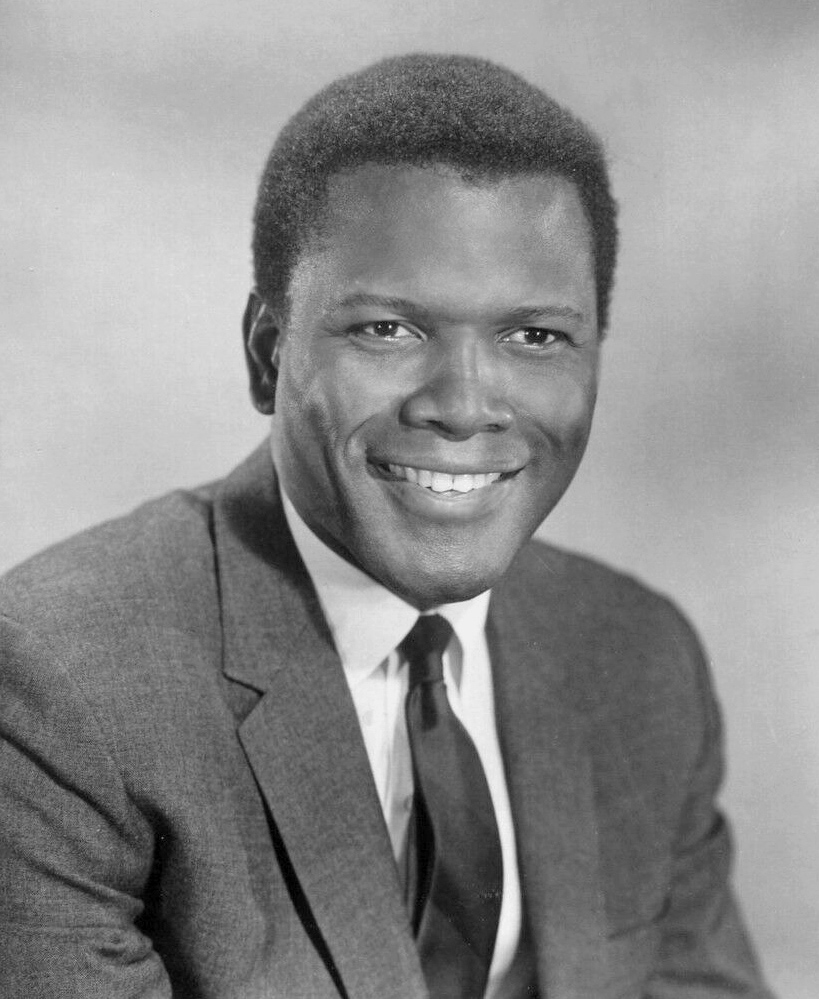
To understand what Sidney Poitier did, you need to understand what existed before him. In the American cinema of the 1940s and 1950s, Black people appeared onscreen in roles that had been designed not to reflect their humanity but to manage white anxiety about it. They were servants, comic relief, criminals or threats. They were rarely heroes. They were almost never the moral centre of a story. They were, in the language of the craft, supporting characters in a narrative that did not fundamentally concern them. Into this landscape walked a young man from the Bahamas who had barely seen a film before he arrived in New York, who spoke with an accent no American casting director had encountered, who was nearly homeless when he first walked through the doors of the American Negro Theatre. What he did in the decades that followed rearranged the furniture of American culture so thoroughly that later generations could look at what he had built and imagine, mistakenly, that it had always been there.
Sidney Poitier was not simply the first Black man to win the Academy Award for Best Actor. He was the argument, sustained across decades of work, that the restriction of Black actors to diminishing roles was a failure of imagination, a lie told by an industry to itself and to the world. He made that argument not with speeches alone, though he was capable of those, but with a series of performances so fully realised, so morally complex and so humanly specific that no serious person watching them could maintain the lie with any intellectual comfort. The argument was won. The winning of it cost him almost everything.
Quick Facts
- Full name
- Sidney Lionel Poitier
- Born
- 20 February 1927, Miami, Florida, USA (raised in the Bahamas)
- Nationality
- Bahamian-American
- Known for
- First Black man to win Academy Award for Best Actor; "In the Heat of the Night," "Guess Who's Coming to Dinner," "Lilies of the Field"
- Awards
- Academy Award for Best Actor (1964); Honorary Academy Award (2002); Presidential Medal of Freedom (2009); BAFTA; Golden Globe
An Improbable Beginning: Cat Island and Nassau
Sidney Poitier arrived in the world under conditions that did not suggest a life of consequence was in prospect. He was born on 20 February 1927 in Miami, Florida, where his Bahamian parents, Reginald James Poitier and Evelyn Outten, had come to sell tomatoes. He was premature, so small that his parents were told he would not survive, and his father was reportedly already making arrangements for his burial. He survived. The family returned to the Bahamas, to Cat Island, a remote settlement in the Out Islands that had no electricity, no running water and no paved roads, where his father farmed tomatoes on land that produced just enough to sustain the family and little more.
Cat Island in the 1930s was as far from Hollywood, geographically and socially, as any point on earth. The population was small, deeply religious and oriented entirely around the rhythms of farming and fishing. Poitier grew up in a world where the physical and spiritual dimensions of life were never clearly separated, where his mother’s religious faith was not a Sunday ceremony but the organising principle of everyday existence. The values instilled in him there, a sense of personal dignity, a belief that honesty was non-negotiable and a conviction that character was the sum of how you behaved when no one was watching, formed the bedrock of everything he did for the rest of his life.
When he was around ten years old, his family moved to Nassau, the capital of the Bahamas, and the encounter with urban life was disorienting and exciting in equal measure. Nassau had electricity, cinemas, automobiles and a social complexity that Cat Island’s farming community had nothing prepared him for. He got into minor trouble, the natural result of a boy from the rural Out Islands encountering a city for the first time, but his parents’ discipline and his own native intelligence kept him from anything serious. He left the Nassau school system early, and the education he received was fragmentary at best. He would spend much of his adult life compensating for the gaps, reading voraciously and teaching himself whatever the formal system had failed to provide.
Arriving in New York: Cold, Confused, and Determined
At fifteen, Sidney Poitier went to Miami to live with his older brother, and the encounter with Jim Crow America was a shock that altered his understanding of himself and of the world. The Bahamas had its own racial hierarchies, shaped by British colonialism, but the American South’s system of legal racial segregation was something categorically different: a structure designed not merely to disadvantage but to humiliate, to insist through law and violence that certain human beings were categorically lesser. Poitier had grown up without absorbing that message as a truth about himself, and the discovery that an entire society was built on the premise that it was true produced in him not submission but fury.
He moved to New York, sleeping in the Port Authority bus terminal, working as a dishwasher, surviving the New York winter in clothes suited for the Caribbean, and beginning, in whatever spare time he could find, to think about what he wanted his life to be. An advertisement for actors in the African-American press caught his eye. He auditioned for the American Negro Theatre and was turned away immediately, partly because of his thick Bahamian accent and partly because, as the director politely suggested, he had no discernible acting ability whatsoever.
The rejection did not deflate him. It gave him a problem to solve. He obtained a radio and spent months listening to American speech patterns, teaching himself to approximate a standard American accent by ear. He returned to the American Negro Theatre months later, auditioned again, and was admitted. The methods by which he had prepared himself, entirely self-directed, without teachers or formal tools, using only the materials available to him in a room with a radio, told the story of how Poitier would approach every significant challenge of his life.
The American Negro Theatre and the First Opportunities
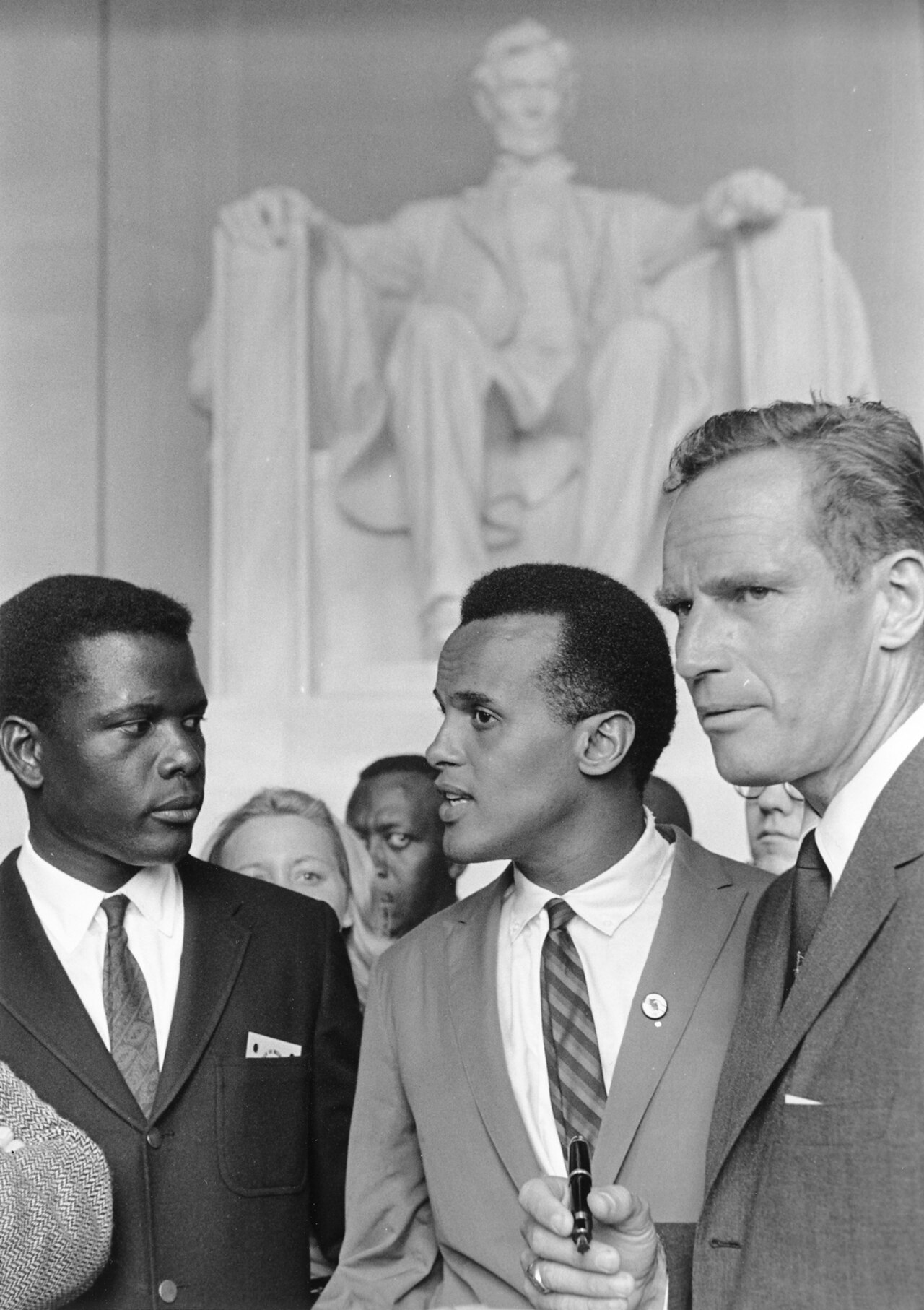
The American Negro Theatre in Harlem was, in the late 1940s, one of the most important institutions in the American theatrical world. It was founded in 1940 by the actor Abram Hill and Frederick O’Neal as a community theatre dedicated to presenting Black life with dignity and complexity, and it functioned as a training ground for a remarkable generation of Black American talent. Harry Belafonte was a fellow student of Poitier’s there, and their friendship, which would last for decades and involve a deep mutual support through the industry’s most hostile periods, began in that Harlem rehearsal room.
Poitier worked hard at the theatre, performing in productions and learning the fundamentals of stage craft. He received a breakthrough when he was cast as an understudy in the Broadway production of “Lysistrata” and then, more significantly, when he was given an opportunity that set the trajectory of his film career in motion.
He was cast in “No Way Out” (1950), a film about a young Black doctor working in a prison ward who becomes the target of a violent racist (played by Richard Widmark) after the racist’s brother dies in his care. The film was ahead of its time in its explicit critique of American racism, and Poitier’s performance was notable for what it refused to do. He did not play the doctor as a saint or a victim. He played him as a competent professional under pressure, as a man navigating a specific set of institutional forces with the same combination of skill and controlled anger that actual Black professionals were navigating every day. The performance established a template that Poitier would develop and refine across the following two decades.
”Blackboard Jungle,” “The Defiant Ones,” and Building Toward Greatness
The 1950s were a period of extraordinary challenge and extraordinary accomplishment. In “Blackboard Jungle” (1955), directed by Richard Brooks, Poitier played Gregory Miller, a rebellious student in a troubled inner-city school who ultimately sides with a dedicated teacher (played by Glenn Ford) against the forces of chaos. The film was controversial, realistic and genuinely provocative, and Poitier’s performance was noticed at the highest levels of the industry. The film became associated in the public mind with the emergence of rock and roll and juvenile delinquency, largely because of Bill Haley’s “Rock Around the Clock” on the soundtrack, but Poitier’s work in it was the most lasting artistic achievement.
“The Defiant Ones” (1958) was the film that transformed him from a respected working actor into a genuine major talent. Directed by Stanley Kramer, the film cast Poitier and Tony Curtis as two escaped prisoners, one Black and one white, who are chained together and who must cooperate to survive while navigating their mutual hostility. The premise was schematic, deliberately so, because Kramer was making an explicit argument about American race relations. But Poitier and Curtis, both at the peak of their powers, gave performances that transcended the argument’s schematism and created two fully realised human beings whose relationship felt genuinely earned.
The film received nine Academy Award nominations and won two. Poitier received his first Academy Award nomination for Best Actor. He did not win, but the nomination placed him, for the first time, in direct competition with the industry’s most celebrated white actors, and the quality of his work made the competition feel entirely legitimate. The cultural impact of the film went beyond the awards: it generated serious discussion about race, cooperation and the American project in a way that mainstream entertainment rarely attempted, and Poitier’s willingness to inhabit the complexity of his character without softening it was central to the film’s power.
“I came into a profession with some very clear points of view about what I would or wouldn’t do. I was not going to represent my race in a demeaning, cruel, negative fashion.”
1963: “Lilies of the Field” and the Oscar That Changed Everything
Sidney Poitier won the Academy Award for Best Actor on 13 April 1964 for his performance in “Lilies of the Field” (1963), becoming the first Black man ever to receive the honour. He played Homer Smith, a wandering handyman who stops at a small Arizona farm run by a group of East German nuns and finds himself coerced, charmed and finally genuinely committed into helping them build a chapel. The role was warm, funny, physically expressive and anchored in a dignity that felt entirely natural because it was entirely Poitier. He had not become a different kind of actor for the role. He had found a story that allowed the full human range he carried to be visible.
The moment when his name was read from the stage of the Santa Monica Civic Auditorium was received with a silence and then an ovation that people who were present described as different from any other ovation the ceremony had produced. Anne Bancroft, who presented the award, was visibly moved. Poitier walked to the stage in a room where the historical weight of what was happening was palpable to everyone present. He received the award for a modest film made on a small budget about a man building a chapel, and the award acknowledged both the film and the fifteen years of work and personal cost that had made it possible.
The acceptance speech he gave was brief, gracious and direct. What he did not say in that speech, and what he carried privately for much of the following decade, was the complexity of what the achievement cost him. To be the first, in a system designed to exclude, is to accept a weight of representation that no single person should have to carry. Every role he played was read as a statement about Black people. Every career choice he made was evaluated against a standard that no white actor was asked to meet. He was both celebrated and constrained by his own historic significance.
The Extraordinary Year of 1967
If the Oscar for “Lilies of the Field” was the peak of a single achievement, 1967 was the peak of an entire career phase. That year Poitier appeared in three films that collectively defined an era of American cinema and permanently altered the conversation about race, representation and the movies.
“To Sir, with Love” cast him as a Guianese teacher at a rough East London school who wins the trust and ultimately the affection of his initially hostile students. The film was a British production, directed by James Clavell, and it was a massive international success. The title song, performed by Lulu, became a number-one hit in America, and the film reached audiences that had no particular interest in racial politics but responded to a story of human connection told with warmth and without sentimentality. Poitier was the film’s engine, and his performance demonstrated that his appeal had no national or racial boundary.
“In the Heat of the Night,” directed by Norman Jewison, was a more complex and more lasting achievement. Poitier played Virgil Tibbs, a Philadelphia homicide detective who is detained in a small Mississippi town on suspicion of murder, cleared by his credentials, and then reluctantly enlisted to help the local sheriff (played by Rod Steiger) solve the actual crime. The film was a police procedural and a civil-rights allegory simultaneously, and it worked equally well on both levels. Poitier’s Tibbs was proud, precise, controlled and capable of an anger that occasionally broke through the control with tremendous force.
The film produced one of the most famous moments in American cinema. When a wealthy white plantation owner slaps Tibbs during an interview, Tibbs slaps him back, immediately and without hesitation. The moment is brief. It lasts perhaps two seconds. Its impact in 1967, in a film that played in cinemas across the American South, was seismic. Black audiences described watching that moment as a physical experience, a gasp and then a release, something being said onscreen that had never been said before in a major American film.
“Guess Who’s Coming to Dinner,” also released in 1967, addressed interracial marriage directly, casting Poitier as a distinguished doctor who brings his white fiancee home to meet her liberal parents (played by Spencer Tracy and Katharine Hepburn). The film was Tracy’s last; he died seventeen days after filming was completed. The casting of Tracy and Hepburn, two of Hollywood’s most beloved and respected figures, alongside Poitier was a deliberate statement about whose company he belonged in, and the film’s argument, that love and human dignity are not racially contingent, was made with the full authority of three extraordinary performances.
The three films of 1967 grossed a combined total that made Poitier the top box-office draw in America for that year. A Black man was the most commercially successful star in Hollywood. The industry could not pretend, after that, that there was any financial logic to the exclusion of Black actors from leading roles.
The Pressure of Representation and the Critics
Success at the scale Poitier achieved carried a burden that would have broken a less resilient person. From the mid-1960s onward, he faced sustained criticism from within the Black community as well as from white liberal critics who felt that the characters he played, dignified, educated, professional, non-threatening, represented a compromise with white comfort rather than a genuine challenge to racism. The sociologist and activist Clifford Mason published a famous article in the New York Times in 1967 titled “Why Does White America Love Sidney Poitier So Much?” that articulated these criticisms with considerable force.
The argument was that Poitier’s screen persona, a man who never expressed anger, never showed sexuality, never existed in any context that was not essentially white, was a fantasy constructed for white reassurance rather than a genuine portrait of Black humanity. The criticism stung, and Poitier engaged with it seriously, acknowledging in interviews that there was truth in it while also defending the strategic necessity of the choices he had made in the specific historical moment in which he had made them. You could not, he argued, demand revolution from an industry before you had demonstrated that inclusion was commercially viable, and demonstrating that required accepting limitations that, in a more just world, he would never have accepted.
The debate has continued among film scholars and cultural critics for more than fifty years, and it has produced a more nuanced understanding of what Poitier was doing than either his advocates or his critics initially offered. He was constrained by the industry. He also constrained himself, by refusing roles that he considered demeaning and by holding to a personal standard of dignity that was, in the context, a form of resistance. The constraints and the resistance were inseparable, because both were responses to the same racism.
Behind the Camera: Director, Diplomat, Elder Statesman
The 1970s brought a new phase. Poitier moved behind the camera, directing several commercially successful films that demonstrated a gift for popular entertainment and a particular skill with comedy. “Buck and the Preacher” (1972) he also starred in alongside Harry Belafonte, a Western that placed Black characters at the centre of a genre from which they had been almost entirely excluded. “Uptown Saturday Night” (1974) and “Let’s Do It Again” (1975) were comedies that paired him with Bill Cosby and made enormous amounts of money, demonstrating that Black-led entertainment could succeed at the highest commercial level.
As an actor, his later film roles were less frequent but carefully chosen. He appeared in “A Piece of the Action” (1977), “Shoot to Kill” (1988) and “Sneakers” (1992), among others. In 1995 he played Nelson Mandela in “Mandela and de Klerk,” a television film about the negotiations that ended apartheid in South Africa. The casting of Poitier as Mandela felt exactly right: these were two men who had endured the specific loneliness of being required to represent an entire people’s struggle while also remaining human beings with private lives, fears and contradictions.
In 1997 President Bill Clinton appointed him Ambassador to Japan, a post he held until 2001. The appointment was recognition of a public stature that extended well beyond the entertainment industry, and Poitier brought to it the same qualities that had distinguished his acting career: intelligence, dignity, a capacity for patient negotiation and an absolute refusal to be diminished by anyone or any circumstance. In 2009 President Barack Obama awarded him the Presidential Medal of Freedom, the nation’s highest civilian honour, at a ceremony that had a particular weight given Obama’s own historic significance.
The Honorary Oscar, the Retrospective and a Life’s Meaning
In 2002, at the 74th Academy Awards ceremony, the Academy of Motion Picture Arts and Sciences presented Sidney Poitier with an Honorary Oscar for his extraordinary performances and unique presence on screen and for representing the industry with dignity, style and intelligence. The award was presented by Denzel Washington, who had won Best Actor the same evening for “Training Day,” becoming only the second Black man to win the award in the sixty-four years since Poitier had first won it.
Washington’s tribute to Poitier was explicit about the debt: he stood before the audience as evidence of what Poitier’s life had made possible. The moment had the quality of a relay race, a baton passed across time, the acknowledgement that the opportunities Washington and every subsequent Black actor had enjoyed were not natural features of the landscape but the product of specific actions taken by specific people at specific moments of history.
Poitier’s memoir “The Measure of a Man: A Spiritual Autobiography,” published in 2000, offered a remarkable account of the private dimensions of a life lived almost entirely in public. He wrote about faith, about the values instilled in him on Cat Island, about the cost of being first, about the marriages (he was married twice, first to Juanita Hardy and then to the actress Joanna Shimkus, who became his partner for life), about fatherhood and about the relationship between the person he was and the person the public believed him to be.
Passing and the Measure of a Legacy
Sidney Poitier died on 6 January 2022 in Nassau, the Bahamas, at the age of ninety-four. The tributes that poured in from every corner of the world described the dimensions of a legacy that a single paragraph cannot contain. Film scholars, fellow actors, politicians, civil-rights leaders and ordinary members of the public who simply remembered watching his films and feeling, for the first time or the thousandth time, that they mattered, were all attempting to describe the same thing: the specific effect of seeing someone who looked like them treated, onscreen, as fully human.
Denzel Washington said: “He is my hero. He showed me that it could be done.” Will Smith, who won the Academy Award for Best Actor in 2022, the year of Poitier’s death, described the moment as inextricably bound to Poitier’s example. President Joe Biden called him “a groundbreaking artist” who had helped America “see its better self.” The Bahamian government declared a national day of mourning.
The numbers are part of the story: first Black man to win Best Actor, top box-office draw of 1967, three of the most important American films of the twentieth century released in a single year. But the numbers, however significant, do not capture the thing itself. The thing itself was a man who walked into a system designed to diminish him and refused, with every performance, every role choice and every public act, to be diminished. He was not always able to change the system on his own terms. He was always able to maintain his own dignity within it, and in doing so he expanded, by the force of specific and irreducible presence, what the system was capable of imagining.
Key Facts
- Sidney Poitier was born prematurely on 20 February 1927 in Miami, Florida, while his Bahamian parents were in the city to sell tomatoes, and grew up on Cat Island in the Bahamas, which had no electricity or running water.
- He taught himself a standard American accent by listening to a radio after being rejected from the American Negro Theatre for his Bahamian accent, then returned months later and was admitted.
- He became the first Black man to win the Academy Award for Best Actor, receiving the honour on 13 April 1964 for “Lilies of the Field” (1963), directed by Ralph Nelson.
- In 1967 he starred in three films released in the same year: “To Sir, with Love,” “In the Heat of the Night” and “Guess Who’s Coming to Dinner,” making him the top box-office draw in Hollywood for that year.
- He served as the Bahamian Ambassador to Japan from 1997 to 2001, appointed by President Bill Clinton, and was awarded the Presidential Medal of Freedom by President Barack Obama in 2009.