There is a photograph taken at the 2016 Rio Olympics in which Simone Biles is captured at the apex of a vault, her body in a position so far beyond what the human frame is supposed to achieve that it looks digitally altered. She is not merely performing gymnastics in that image; she is rewriting the physical possibilities of the sport. By the time that photograph was taken, she was already the most decorated World Championship gymnast in history, the owner of moves that no other competitor had ever attempted in competition and a unanimous consensus choice as the greatest gymnast who had ever lived. She was nineteen years old. What came after, including the courage she showed not only in competition but in choosing to walk away from it at the most watched sporting event on earth, made her story richer and more important than any medal count could convey.
Quick Facts
- Full name
- Simone Arianne Biles
- Born
- 14 March 1997, Columbus, Ohio, USA
- Sport
- Artistic gymnastics
- Known for
- 37 World and Olympic medals (combined), 4 skills named after her, 2021 withdrawal at Tokyo Olympics
- Career highlight
- 2016 Rio Olympics, winning four gold medals and one bronze
Early Life and Background
Simone Arianne Biles was born on 14 March 1997 in Columbus, Ohio, the third of four children born to Shanon Biles, whose struggles with drug and alcohol addiction made stable parenting impossible in Simone’s earliest years. When Simone was three years old, she and her siblings were placed in foster care. Their father, Kelvin Clemons, was largely absent. For several years the children moved between the foster care system and temporary arrangements with relatives, a period that Simone has described in interviews as one of confusion, instability and, in the language children use for these things, simply not understanding where she belonged.
The transformation of her circumstances came through her maternal grandfather, Ron Biles, and his wife Nellie. Ron Biles had retired from his career as an air traffic controller and was living in Spring, Texas, a suburb north of Houston. He and Nellie visited the children in foster care in 2003 and immediately recognised that the situation was unsustainable. They took in Simone and her younger sister Adria, formally adopting them in 2003. Simone has referred to Ron and Nellie as “Mom and Dad” in every public context throughout her career. Two older siblings went to live with Nellie’s sister in Cleveland.
The environment Ron and Nellie provided was structured, loving and deeply faith-based. Simone was raised Catholic and has spoken consistently about the importance of her faith in her mental framework, her ability to approach competition with a sense of perspective that transcended the immediate result. She attended World Champions Centre, a private gymnastics facility in Spring, Texas, coached by Aimee Boorman, who would remain her primary coach through her first Olympic cycle.
Discovering Gymnastics
The origin story of Simone Biles in gymnastics is simultaneously charming and entirely on-brand for someone who would go on to do things in the sport that no one had done before. At six years old, she visited a gymnastics facility on a day care field trip. While the other children watched, Simone began imitating the gymnasts on the floor, mimicking their moves with an accuracy that stunned the instructors present. A letter was sent home to her parents suggesting she enrol in formal gymnastics classes. It was a letter that would eventually lead to the greatest individual gymnastic career in the sport’s history.
She began training seriously, and her natural talent was evident almost immediately. She was small, powerfully built, with an extraordinarily low centre of gravity and an unusual capacity for what gymnasts call “air awareness”: the ability to know, while the body is rotating in space, precisely where it is and where it needs to be. This quality cannot be taught. It is a neurological gift, and Simone possessed it to a degree that her coaches found genuinely unusual even among the very best gymnasts they had encountered.
By her early teens, she was already doing skills in training that coaches elsewhere would not have considered asking of their athletes. Her Yurchenko double pike vault, a move of such extreme difficulty that most women’s gymnastics coaches regarded it as theoretical rather than practical, was something she had been working on in training for years before she first competed it. When she did compete it, at the 2021 US Classic, the gymnastics world simply stopped. The degree of difficulty was higher than anything previously seen in women’s gymnastics on vault.
Rising Through the Ranks
Simone Biles debuted at the senior level of USA Gymnastics in 2013 at the age of sixteen. The gymnastics community was accustomed to young prodigies who showed promise; what they were not accustomed to was a sixteen-year-old who immediately dominated the entire senior field. At her first World Championships in Antwerp, Belgium, in October 2013, she won the all-around gold medal and placed first on floor exercise. She was the first Black woman to win the World all-around title.
She did not stop there. She returned to defend her World all-around title in 2014 at Nanning, China, and won again. She won a third consecutive World all-around title in 2015 at Glasgow, Scotland, something no woman had done since Svetlana Khorkina of Russia won three in a row between 2001 and 2003. By the time she arrived at the 2016 Olympic year, she had 10 World Championship gold medals and a total of 14 World medals across three years of senior competition. She was unbeaten in the all-around at major competitions since her senior debut.
What distinguished her from other dominant gymnasts was not just the consistency of her winning but the margin by which she won and the skills she was performing. The Code of Points, the document that governs gymnastics judging and assigns numerical difficulty values to skills, had never been calibrated for an athlete of Biles’s capability. Judges and technical committees were in the strange position of having to assess skills they had never seen competed before, and in some cases they intentionally rated her skills below their objective difficulty in order to encourage other gymnasts to attempt them and to prevent one athlete from distorting the sport’s competitive landscape. Biles noted this publicly in 2021 and it generated substantial controversy.
I’m not the next Usain Bolt or Michael Phelps. I’m the first Simone Biles.
The 2016 Rio Olympics
The 2016 Summer Olympics in Rio de Janeiro, Brazil were, by every statistical and observational measure, the greatest single performance at a gymnastics Olympics in the history of the sport. Simone Biles won four gold medals: in the team competition, the individual all-around, the vault and the floor exercise. She added a bronze medal on the balance beam, performing with a kidney stone that had caused her significant pain and required medical attention during the competition.
Her margin of victory in the all-around was 2.1 points over her nearest competitor, Aly Raisman of the United States. In a sport where winning margins are typically measured in tenths of points, a 2.1-point gap is essentially a different classification of performance. Her execution scores, which reflect the technical precision of the performance rather than the difficulty of the skills attempted, were also the highest in the field, meaning she was not merely doing harder things than anyone else. She was doing them better.
She became the first American woman to win four gold medals at a single Olympics since the apparatus was changed following the 1984 Games. She appeared on the covers of magazines worldwide, was invited to the White House and received the Presidential Medal of Freedom from President Barack Obama in September 2016. President Obama joked in his remarks that there had been some discussion about who was the greater athlete present, him or Simone Biles, and he had decided to concede the point.
The Abuse by Larry Nassar
In 2016 and 2017, a series of investigative reports, eventually confirmed by hundreds of sworn statements and a criminal prosecution, revealed that Lawrence “Larry” Nassar, the longtime team physician for USA Gymnastics and Michigan State University’s gymnastics programme, had been sexually abusing gymnasts for decades under the guise of medical treatment. More than 265 women and girls ultimately identified themselves as his victims, including the majority of the 2016 US Olympic gymnastics team. Simone Biles was among them.
She disclosed this publicly on 19 January 2018, in a statement released through her social media channels, saying: “I, too, am one of the many survivors that was abused by Larry Nassar. I want to first and foremost say how sorry I am to anyone who wasn’t able to receive the support that they needed and deserved.” She was twenty years old when she published that statement, describing abuse she had endured as a minor. In a subsequent statement, she expressed anger at USA Gymnastics and the US Olympic and Paralympic Committee for what she described as institutional failures that had enabled Nassar’s crimes. Nassar was sentenced in January 2018 to 40 to 175 years in prison.
Biles later told reporters and in her Netflix documentary that she had returned to gymnastics and competed at the 2016 Olympics in part because she felt it was important to bear witness and not allow the abuse to erase what she had worked for. She also said that the experience left her with trauma whose effects continued for years and contributed to the mental health challenges she would later describe publicly.
Preparing for Tokyo
After Rio, Biles took a gap year, stepping away from competition in 2017 for the first time in her senior career. She spent time on Dancing with the Stars (a US television programme), participated in a gymnastics tour and began working through some of the emotional material from the Nassar revelations. She returned to competition in 2018 with a new coaching setup at World Champions Centre, working with Laurent and Cecile Landi alongside her existing support staff.
Her first World Championships back, in 2018 at Doha, Qatar, produced four gold medals and one silver. In 2019 at Stuttgart, Germany, she went four for four in gold medals and won her fifth World all-around title, making her the most decorated World Championship gymnast in history (men’s or women’s) with 25 World medals total. She unveiled two new skills at those championships: the Biles II on floor exercise, a triple-twisting double layout that is the most difficult skill in women’s floor exercise history, and the Yurchenko double pike on vault, which she had been working toward for years.
The 2020 Tokyo Olympics were delayed by one year due to the global pandemic, and when they finally took place in July and August 2021, Biles arrived as the sport’s unquestioned greatest and the heavy favourite for five gold medals.
The Tokyo Decision and Its Meaning
On 27 July 2021, in the gymnastics team final at the Tokyo Olympics, Simone Biles withdrew from the competition after one vault. She had experienced what gymnasts call “the twisties,” a sudden and extremely dangerous disconnection between the mind’s intentions and the body’s execution during aerial skills. A gymnast experiencing the twisties loses the ability to track where she is in the air, which at the height Biles was flying and with the skills she was performing could easily result in a catastrophic landing and life-altering injury. She knew this. She made the decision to stop.
The reaction around the world was divided along lines that revealed a great deal about cultural attitudes toward mental health, athletic sacrifice and the obligations of elite performers. A vocal minority, primarily in certain media and political contexts, accused her of cowardice or weakness. A larger majority, and virtually the entire community of mental health professionals and sport psychologists who commented publicly, praised her for prioritising her safety and wellbeing over a gold medal. Her teammates, who won silver without her, were unequivocal in their support.
Biles withdrew from three more individual finals before returning to compete on balance beam, winning bronze. She gave extensive interviews during those competition days, explaining the twisties with specificity and patience, discussing her mental health openly and declining to apologise for her decision. The impact of her transparency on global conversations about athlete mental health is impossible to quantify precisely but was clearly substantial. It opened space for athletes in every sport to discuss mental health in ways that had previously been suppressed by the culture of elite sport.
She would later describe the Tokyo experience in her documentary as among the most difficult of her life and also among the most clarifying. She had chosen herself. The sky had not fallen.
The 2023 Return and the Paris Olympics
Simone Biles did not retire after Tokyo. After a period away from competition, she announced her return, and at the 2023 World Championships in Antwerp (the same city where she had debuted a decade earlier), she won the all-around gold medal, her sixth World all-around title. She also won gold on vault, floor and beam, and added a fifth all-around title to become, statistically, the most decorated gymnast in the history of the World Championships.
At the 2024 Paris Olympics, Biles led the United States gymnastics team to gold in the team competition, then won the individual all-around gold, her second Olympic all-around title. She also won gold on floor and silver on beam. She performed the Yurchenko double pike vault in the vault final and won gold. The reception in Paris was extraordinary, with the gymnastics venue effectively becoming a stadium dedicated to watching one person redefine what the sport could look like.
She was 27 years old at the Paris Games and competing skills that 16-year-olds with freshly developing bodies would typically decline to attempt. Her longevity was a function of the same forensic approach to preparation and physical management that had sustained her from the beginning, combined with a mental relationship with the sport that she had rebuilt, consciously and carefully, from the ground up.
Technical Greatness
For those unfamiliar with gymnastics scoring, a brief explanation of why Biles’s difficulty is genuinely unprecedented is useful. Gymnastics skills are rated on an A to I scale, with A being the simplest and I being the most complex. The vast majority of skills in high-level competition cluster in the B to D range. Biles competes skills in the E, F and G range routinely. The four skills that bear her name are the Biles (a double layout half-out on floor, a G skill), the Biles II (a triple-twisting double layout on floor, an H skill), the Biles on beam (a full twisting double somersault dismount, an H skill) and the Biles vault (a Yurchenko double pike, a J skill, the highest-rated vault in the Code of Points).
She also has a greater quantity of skills in the highest difficulty bands than any other gymnast in history, meaning that even if she performs with slightly lower execution scores than her absolute best on a given day, her start value (the base score before deductions) is so far above the competition that she is virtually impossible to catch.
Legacy
Simone Biles is the greatest gymnast in the history of the sport, a claim supported by every available statistical measure and almost universally held among the sport’s coaches, judges and former champions. She has 37 combined World Championship and Olympic medals. She has six World all-around titles. She has four skills named after her, each representing a frontier that other gymnasts had not reached. She changed the sport’s relationship with mental health by demonstrating, in the most public way imaginable, that an athlete’s mind is as important as their body.
Her story is also a story about family, about the grandparents who chose her and gave her the stability from which everything else grew, about the coaches who built a framework around extraordinary gifts, and about the personal courage to be honest about struggle even when the entire watching world was waiting for you to be invulnerable.
Key Facts
- Simone Biles has 37 combined World Championship and Olympic medals, the most of any gymnast in history (men’s or women’s).
- She has four skills named after her in the gymnastics Code of Points, each representing the highest level of difficulty in its category.
- Her 2016 Rio Olympics performance, four gold medals and one bronze, was the greatest individual gymnastics performance at a single Olympics in the sport’s history.
- She won her sixth World all-around title at the 2023 World Championships in Antwerp, more than any other gymnast in history.
- Her decision to withdraw from the 2021 Tokyo Olympics team final, prioritising her mental health over competition, is widely credited with changing the global conversation about mental health in elite sport.
The Larger Meaning
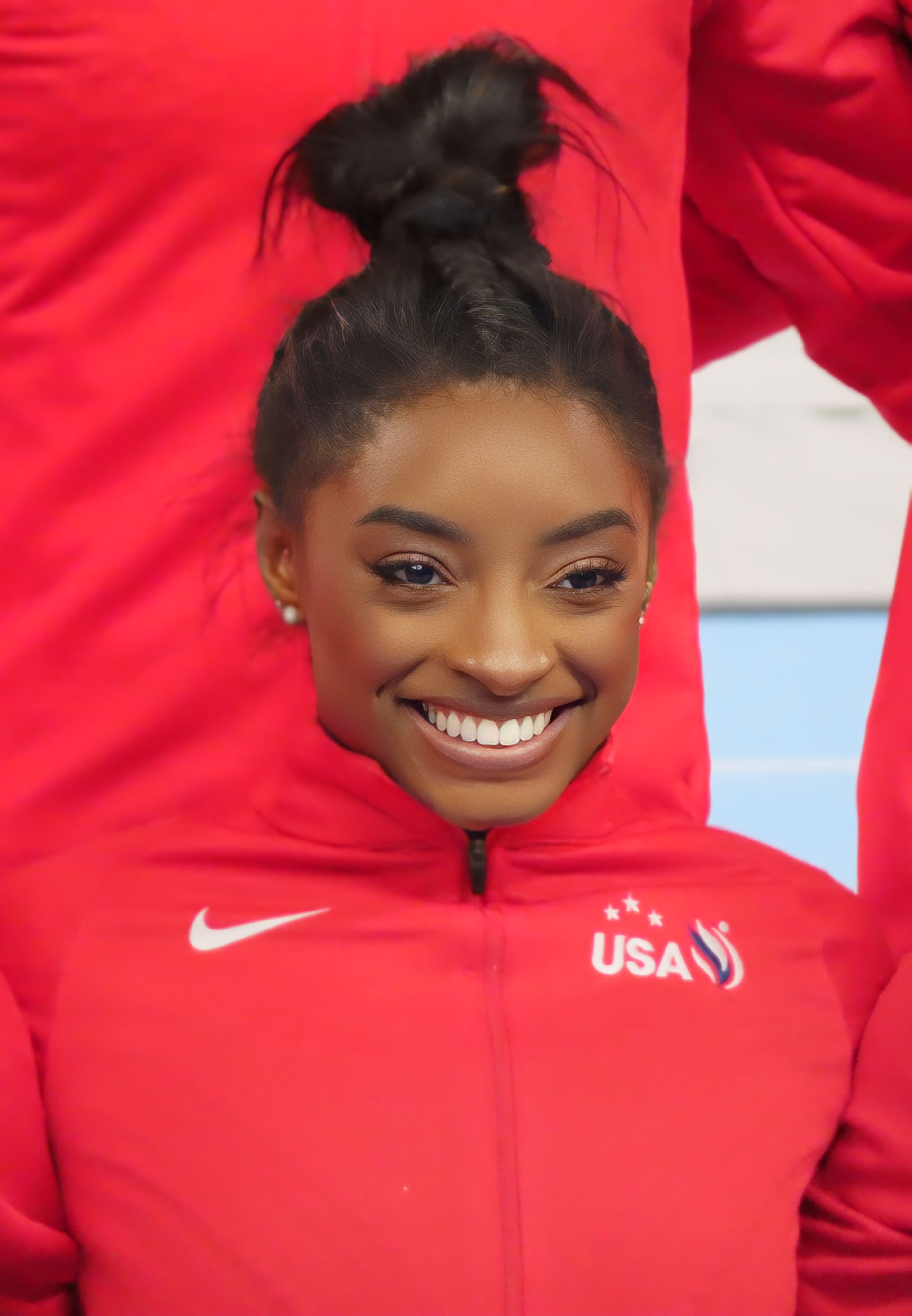
Simone Biles is the greatest gymnast in the history of competitive gymnastics. The statistical case is unimpeachable: 37 World Championship medals, 6 Olympic medals, skills named after her that were previously deemed impossible or too dangerous to attempt. But the case for her significance extends beyond the scorecard.
She competes in a sport with a long and troubling history of abuse, physical and psychological, and she has been both a victim of that history and, through her testimony against Larry Nassar and her refusal to be silent, one of its most important critics. She competes with a body that does not conform to the aesthetic ideal the sport historically favoured, and she has made that body a subject of celebration rather than apology. She withdrew from the Tokyo Olympics when her mental and physical safety required it, and she returned to win gold in Paris at an age when gymnasts are typically years into retirement. Each of those facts is a form of argument, and together they constitute a case for what sport can be when an athlete refuses to be defined by anyone’s expectations but their own.