
There is a particular hush that falls over a crowd when Tems opens her mouth to sing. The voice arrives low, smoky and unhurried, and it seems to come from somewhere deeper than the chest. For millions of listeners around the world, that voice was the gateway into a new era of African music, one where the polish of Afrobeats met the ache of alternative R&B and the honesty of a woman who built her career largely on her own terms. The remarkable thing is that the woman behind the voice spent her early years uploading her own songs to the internet, producing her own records in a bedroom, and refusing to wait for permission from an industry that had no obvious box to place her in.
Temilade Openiyi, known to the world simply as Tems, did not follow the conventional path to stardom. She did not win a televised talent contest, and she did not break through on the strength of a label’s marketing budget. Instead she grew her audience one song at a time, trusted her instincts about a sound that did not fit neatly into any single genre, and then found herself at the center of one of the biggest songs the African continent has ever produced. Within a few short years she went from an independent artist in Lagos to a Grammy winner, an Academy Award nominee, and a name mentioned alongside the biggest stars in global pop. This is the story of how she did it.
Quick Facts
- Full name
- Temilade Openiyi (known as Tems)
- Born
- 11 June 1995, Lagos, Nigeria
- Nationality
- Nigerian
- Known for
- Afrobeats, alternative R&B, singing, songwriting, production
- Notable work
- Essence (with Wizkid), Wait for U (with Future), Born in the Wild
Early Life in Lagos
Temilade Openiyi was born on 11 June 1995 in Lagos, Nigeria, into a family that carried both Nigerian and British heritage. Her early childhood was split between two worlds. For a time she lived in the United Kingdom, and then her family returned to Nigeria, where she was raised partly in Lagos and partly in the Ilupeju area. That early movement between countries and cultures shaped the way she heard music. She grew up exposed to the rhythms of Lagos street life as well as the pop and R&B that travelled across borders, and she absorbed both without feeling obliged to choose one over the other.
Her parents separated when she was young, and she was raised largely by her mother, a single parent who worked hard to keep the household steady. Tems has spoken warmly about her mother’s influence, crediting her with instilling discipline and a quiet strength that would later serve her well in a demanding industry. Growing up in a single-parent home taught her early lessons about resilience, self-reliance and the value of not depending on anyone to hand her an opportunity.
Music was present in her life from the beginning, though it took her time to recognize it as a calling. As a child she was drawn to melody and to the feeling that a song could carry. She taught herself to play the piano, picking out chords and following her ear rather than formal lessons, and this self-directed curiosity became a defining trait. She was not content simply to sing other people’s songs. She wanted to understand how a record was built from the inside, how the drums and keys and vocals fit together to create a mood.
That instinct pushed her toward production. Long before she had a record deal or an audience, Tems began experimenting with making beats and arranging her own music. She watched tutorials, studied the software, and learned through trial and error how to turn the sounds in her head into finished recordings. This technical grounding set her apart. Many singers rely entirely on outside producers to shape their sound, but Tems was able to sit at the controls herself and craft exactly the atmosphere she wanted. The dark, textured, slightly hazy quality that would later define her records was not an accident of studio chance. It was the product of a young woman who had taught herself how to make it.
Before she fully committed to music, Tems followed a more conventional route for a while. She pursued education and, for a period, stepped into the working world, taking on a job as many young Nigerians do while weighing their options. The experience of ordinary employment gave her perspective, but it also sharpened her certainty that music was where she belonged. At a certain point she made the decision that would change everything. She chose to walk away from a steady path and bet on herself, pouring her energy into songwriting, production and the slow, unglamorous work of building a catalogue.
Breakthrough as an Independent Artist
Tems began releasing music independently, and from the start she did things her own way. In 2018 she put out her debut single “Mr Rebel,” a song that introduced the world to her unusual voice and her refusal to sound like anyone else. The track carried a certain defiance in its very title, a fitting calling card for an artist who was quietly rejecting the expectations placed on young female singers in the Nigerian scene.
The following year she released “Try Me,” and this was the song that truly announced her. “Try Me” was built on a message of self-worth and resistance, a warning to anyone who underestimated her, and it struck a chord with listeners who had grown tired of formulaic pop. The record showcased everything that made Tems distinctive. Her deep, resonant vocal tone sat in a register that few of her peers occupied, and the production had a moody, alternative edge that felt closer to the wider world of R&B than to the bright, dance-driven Afrobeats dominating the airwaves. Crucially, she had a hand in creating that sound herself, producing and shaping her own material rather than outsourcing her identity.
What made her rise so striking was how independent it was. She was not the product of a hit factory. She uploaded her songs, grew her following organically, and let the music do the persuading. Listeners discovered her and shared her, and her reputation spread through word of mouth and the internet rather than through saturation radio play. In an industry where many artists chase trends, Tems trusted that there was an audience hungry for something more introspective and more emotionally raw.
In 2020 she released her debut extended play, titled “For Broken Ears.” The project was a statement of intent. Across its songs Tems explored vulnerability, heartbreak, strength and self-definition, wrapping difficult emotions in her signature smoky delivery. “For Broken Ears” proved that she was not a one-song novelty but a complete artist with a clear vision, capable of sustaining a mood across a body of work. The EP deepened her connection with fans and established her as one of the most interesting new voices to emerge from Nigeria, an artist whose appeal crossed genre lines and whose honesty gave her music unusual weight.
By this point the wider industry was paying attention. Her name was circulating among the biggest figures in Nigerian music, and it was only a matter of time before one of them reached out.
Global Stardom with Essence
The turning point arrived through a collaboration that would become historic. In 2020, Wizkid, one of the most influential figures in Afrobeats, included a song called “Essence” on his album “Made in Lagos.” The track featured Tems, and from the moment it appeared it carried something special. Over a warm, gently swaying beat, Wizkid and Tems traded lines about desire and devotion, and Tems’s contribution gave the song its emotional center. Her verse and hook were tender and magnetic, and they lifted “Essence” from a pleasant album cut into something that listeners could not stop replaying.
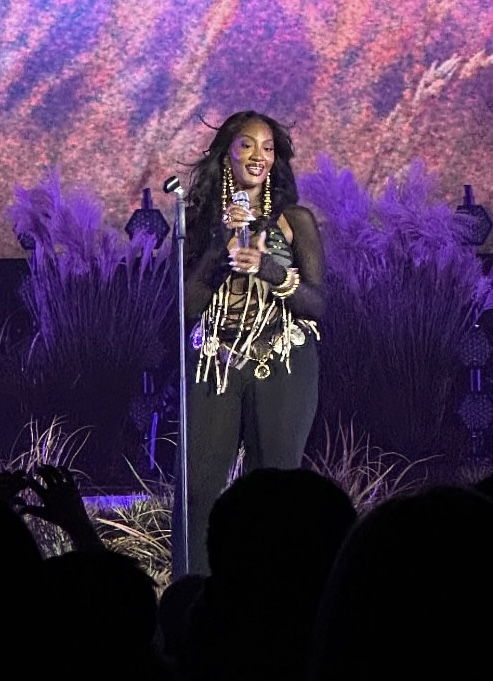
At first the song was a favorite among fans of the album, but over the following months it grew into a phenomenon. Through 2021, “Essence” spread far beyond Nigeria and across the globe, becoming a defining sound of the year. It earned praise from international stars, found its way onto radio and playlists worldwide, and built a momentum that was impossible to ignore. The song went on to chart on the Billboard Hot 100 in the United States, a milestone that marked a breakthrough moment for the mainstream crossover of modern Afrobeats, and it helped prove that a song born in Lagos could capture audiences everywhere without changing its character to do so.
The success of “Essence” was amplified further when a remix was released featuring the Canadian pop superstar Justin Bieber. Bieber added a verse to the track, and his involvement introduced the song to an even larger global audience. Rather than overshadow the original, the remix underscored just how strong the foundation was, with Tems’s performance remaining the heart of the record. For Tems personally, “Essence” was transformative. Almost overnight she went from a respected independent artist known mainly within the African music community to a globally recognized voice whose sound the biggest names in pop wanted to be near.
What made the achievement so meaningful was that she had not compromised to get there. The qualities that made “Essence” irresistible, the depth of her voice and the understated emotion of her delivery, were the same qualities she had developed on her own independent records. The world had come to her sound rather than the other way around.
Grammy Recognition and Global Collaborations
Having captured global attention, Tems quickly became one of the most sought-after collaborators in music, and the recognition that followed cemented her status. In 2022 she was featured on “Wait for U,” a song by the American rapper Future that also featured Drake. The track was built around a sample and interpolation of Tems’s own earlier work, and her voice formed the emotional backbone of the record. “Wait for U” became a major hit in the United States, and it carried Tems to a new level of acclaim.
At the 2023 Grammy Awards, “Wait for U” won the award for Best Melodic Rap Performance. The victory made Tems a Grammy winner, a landmark moment in a career that had moved at remarkable speed, and it placed her among a small group of African artists to receive the industry’s highest honor. Because the song drew so directly on her own material, the award felt like recognition not just of a guest feature but of her songwriting and her distinctive artistic signature.
Her reach extended into film as well. Tems contributed to the soundtrack of the major Hollywood film “Black Panther: Wakanda Forever,” co-writing the song “Lift Me Up,” which was performed by Rihanna. It marked a significant moment on two fronts. It brought Rihanna back to original music after a long absence, and it placed Tems’s writing at the center of one of the most anticipated soundtracks of the year. “Lift Me Up” went on to be nominated for an Academy Award for Best Original Song, earning Tems recognition from the film world and underlining her versatility as a creator who could write for others as powerfully as she performed for herself.
Alongside these headline moments, Tems built an impressive list of collaborations and songwriting credits, working with artists across genres and continents. Her writing ability, long underappreciated beneath the attention paid to her voice, became one of her most valuable assets. She was not merely a performer handed finished songs. She was a craftswoman who could shape the architecture of a record.
Her ascent was not without difficulty. In December 2022, Tems was briefly detained in Uganda following a concert, caught up in an incident connected to a show she had performed. The matter drew international attention, and she was later released. It was a brief and unsettling episode in an otherwise triumphant period, a reminder of the complications that can accompany a touring career across different countries. Tems moved past it and returned her focus to the music.
Debut Album and Critical Acclaim
For all her success as a featured artist and songwriter, one major milestone remained. A debut studio album. Tems had deliberately taken her time, resisting pressure to rush a full-length project simply to capitalize on her fame. In 2024 she finally delivered it. The album, titled “Born in the Wild,” arrived as a considered, deeply personal statement from an artist who had spent years earning the right to tell her story on her own terms.
“Born in the Wild” allowed Tems to stretch out and show the full range of her artistry. Across the project she moved between tender ballads, rhythmic grooves and introspective meditations, drawing on the same self-produced sensibility that had defined her from the beginning. The album reflected her journey, her growth and her refusal to be confined to a single lane, blending Afrobeats, R&B and soul into a sound that was unmistakably her own. Critics received it warmly, praising its ambition and its emotional honesty, and it confirmed that Tems was no passing feature act but a serious album artist with a vision to sustain.
The album also brought further Grammy recognition. At the 2025 Grammy Awards, held in February of that year, Tems won the award for Best African Music Performance for her song “Love Me JeJe,” a track from “Born in the Wild.” The win was her second Grammy and her first solo Grammy, a significant distinction given that her earlier award had come as a featured collaborator. The song also saw off strong competition from a field of leading African artists. In addition to that victory, “Born in the Wild” was nominated for Best Global Music Album, and another song from the project, “Burning,” was nominated for Best R&B Song, underlining the breadth of her appeal across categories.
Through it all, Tems maintained the independence of spirit that had carried her from the start. She retained a strong hand in her creative direction, continued to produce and write, and guarded the authenticity that fans had come to love. Her artistry rested on a simple principle. She made the music she believed in, and she trusted that the world would follow. Time and again, it did.
“I don’t do music to prove to anyone that I can sing. I do music because that’s who I am, that’s my therapy and that’s my way of communicating.”
Career Timeline
- 1995: Temilade Openiyi is born on 11 June in Lagos, Nigeria, into a family of Nigerian and British heritage.
- 2018: Releases her debut single “Mr Rebel,” introducing her distinctive deep vocal tone as an independent artist.
- 2019: Releases “Try Me,” a breakout single celebrating self-worth and resilience that broadens her following.
- 2020: Releases her debut EP “For Broken Ears” and features on Wizkid’s “Essence” from the album “Made in Lagos.”
- 2021: “Essence” becomes a global hit, charts on the Billboard Hot 100, and gains a remix featuring Justin Bieber.
- 2022: Features on Future’s “Wait for U” (with Drake) and co-writes Rihanna’s “Lift Me Up” for “Black Panther: Wakanda Forever.”
- 2023: “Wait for U” wins Best Melodic Rap Performance at the Grammy Awards, making Tems a Grammy winner, while “Lift Me Up” is nominated for an Academy Award.
- 2024: Releases her debut studio album “Born in the Wild” to critical acclaim.
- 2025: Wins Best African Music Performance at the Grammy Awards for “Love Me JeJe,” her second Grammy and first solo win.
Lesser-Known Facts
- She produces her own music. Tems taught herself production and has long been involved in crafting the beats and arrangements behind her records, giving her a rare degree of control over her signature atmospheric sound.
- She is self-taught across the board. From learning piano by ear as a child to mastering music software on her own, much of her musical knowledge came through independent study rather than formal training.
- “Essence” made Billboard history. Her feature on “Essence” helped the song cross over and chart on the Billboard Hot 100, a landmark moment for the mainstream reach of modern Afrobeats.
- Her first Grammy came as a featured artist. Tems won her first Grammy through “Wait for U” with Future and Drake, which took Best Melodic Rap Performance at the 2023 Grammy Awards.
- She earned an Oscar nomination as a writer. By co-writing “Lift Me Up” for Rihanna, Tems secured a nomination for the Academy Award for Best Original Song, recognition for her songwriting rather than her performing.
- She built her career independently. Before the major collaborations arrived, Tems grew her audience by releasing and uploading her own songs, proving her appeal before any industry machine got behind her.
Frequently Asked Questions
Who is Tems? Tems is a Nigerian singer, songwriter and record producer, born in Lagos in 1995. She rose to global fame through her feature on Wizkid’s “Essence” and has since become one of Africa’s most celebrated musical exports, known for blending Afrobeats with alternative R&B and soul.
What is Tems’s real name? Her real name is Temilade Openiyi. “Tems” is the stage name she performs under, a shortened form drawn from her first name.
Has Tems won a Grammy? Yes. Tems won her first Grammy for Best Melodic Rap Performance in 2023 as a featured artist on Future’s “Wait for U.” She won a second Grammy, her first solo win, for Best African Music Performance in 2025 with her song “Love Me JeJe.”
What is Tems best known for? Tems is best known for her deep, distinctive voice and for her feature on the global hit “Essence” with Wizkid. She is also recognized for “Wait for U” with Future and Drake, for co-writing Rihanna’s “Lift Me Up,” and for her work as a self-producing artist.
What is her debut album? Her debut studio album is “Born in the Wild,” released in 2024. It received critical acclaim and produced the Grammy-winning song “Love Me JeJe.”
Legacy
Tems arrived at a moment when African music was pushing against the boundaries that had long kept it on the margins of the global industry, and she became one of the artists who helped break those boundaries down. Her significance goes beyond the hits and the awards. She expanded the idea of what an African pop star could sound like, proving that a voice rooted in introspection and a sound shaped by alternative R&B could command the same worldwide attention as the brightest, most danceable records.
Her influence is especially meaningful for a generation of young women across Nigeria and the wider continent. Here was an artist who produced her own music, wrote her own songs, and refused to soften her voice or her vision to fit a mold. She built her platform independently before the industry’s biggest names came calling, and in doing so she offered a template for artistic self-determination. The message embedded in her rise is that authenticity is not a weakness to be managed but a strength to be trusted.
As a songwriter, she earned recognition that few performers of her generation can claim, placing her words in the mouths of global superstars and in the credits of major films. As a performer, she gave the world a voice that is instantly recognizable, a low and smoky instrument that carries both vulnerability and power. And as a cultural figure, she stands among the artists who carried the sound of Lagos to the center of global pop without diluting it along the way.
The story of Temilade Openiyi is still being written, and that may be the most exciting part of her legacy. She has already won Grammys, earned an Oscar nomination, topped charts and released a debut album on her own terms, all while remaining true to the independent spirit that defined her from the start. For an artist who once uploaded her own songs and produced her own beats in search of listeners, the journey from the bedroom studios of Lagos to the world’s biggest stages stands as proof of what conviction and originality can achieve. Tems did not wait for the industry to make room for her. She created her own space, and the world moved to meet her there.