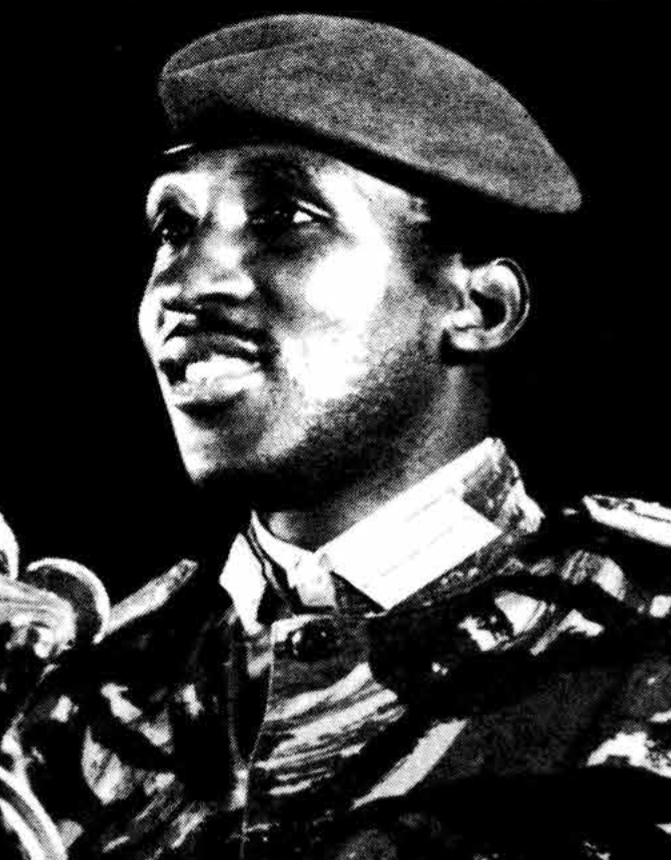
On the morning of 4 August 1984, exactly one year after a small band of soldiers seized power in a landlocked West African country, the President stood before his people and announced that their nation no longer existed. Upper Volta, the name handed down by French colonial administrators who had carved the territory according to rivers and convenience, was gone. In its place rose Burkina Faso, a name stitched together from two of the country’s own languages, Mossi and Dioula, meaning roughly “the land of upright people.” The man who made that declaration was thirty-four years old, played guitar in a band, rode a bicycle, and would be dead within three years. His name was Thomas Sankara, and in the brief window history allowed him, he attempted something almost no leader of a poor country had dared: to make self-respect, rather than foreign approval, the organizing principle of national life.
He has been called Africa’s Che Guevara, a comparison he probably would have found both flattering and limiting. The truth is that Sankara was harder to categorize than any slogan suggests. He was a Marxist who quoted scripture, a soldier who distrusted militarism, an austere leader who could be disarmingly funny, and a Pan-Africanist who spoke to the world’s most powerful institutions in language that still circulates on the internet decades later. To understand why a man who governed for barely four years remains a fixture on T-shirts, in murals, and in the speeches of young activists from Ouagadougou to Johannesburg, one has to follow his life from a small town in the colonial Sahel to the presidential palace, and finally to the bullet-scarred meeting room where it ended.
Quick Facts
- Full name
- Thomas Isidore Noël Sankara
- Born
- 21 December 1949, Yako, French Upper Volta (now Burkina Faso)
- Died
- 15 October 1987, Ouagadougou, Burkina Faso (aged 37)
- Known for
- President of Burkina Faso 1983 to 1987; Pan-Africanist and revolutionary
- Nickname
- "Africa's Che Guevara"
Early Life and Background
Thomas Isidore Noël Sankara was born on 21 December 1949 in Yako, a town in the north of what was then French Upper Volta, a colony folded into the vast administrative bloc of French West Africa. He was the third of ten children. His heritage was itself a small map of the region’s complexity: his father, Joseph Sankara, came from a family of mixed Mossi and Fulani background, the Mossi being the largest ethnic group of the central plateau and the Fulani a historically pastoralist people spread across the Sahel. His mother, Marguerite Kinda, raised a large household on the modest means of a colonial gendarme’s family. Joseph had served in the French colonial forces, which gave the family a measure of stability and a foot inside the institutions of the colonial state.
The Sankaras were Roman Catholic, and faith ran deep in the household. As a bright, devout boy, Thomas seemed destined for the seminary, and his parents nurtured the hope that he would become a priest. He was sent to good schools, first in Gaoua, where his father was posted, and later in the capital, then called Ouagadougou. He was a serious student, fond of mathematics and reading, and the discipline of the church left marks on him that never fully disappeared. Even as an adult revolutionary who embraced Marxism, he retained a moral seriousness, an instinct for self-denial, and a habit of speaking about justice in almost prophetic terms that owed as much to the catechism as to any political tract.
But the priesthood was not to be his path. Sankara was drawn instead to the military, which in the West Africa of his youth was one of the few avenues through which a young man of limited means could earn an education, a salary, and a chance to see the wider world. In 1966, the year Upper Volta experienced its first military coup, the teenage Sankara entered military training. His talent and discipline carried him forward, and in 1969, at the age of nineteen, he was sent abroad for officer training to Madagascar, to the military academy at Antsirabe.
Madagascar proved to be the hinge of his political education. The island was in ferment. In 1971 and 1972, popular uprisings of students, workers, and peasants shook the government and eventually toppled the post-independence order. The young cadet watched ordinary people bring down a regime through mass protest, and he read voraciously, encountering Marxist and Leninist texts that gave him a framework for understanding what he was seeing. He came to view poverty not as a misfortune or an act of God, but as the product of structures that could be analyzed and, in principle, changed. By the time he returned home, the devout boy who might have been a priest had become a young officer with a revolutionary’s conviction that the world’s arrangements were neither natural nor permanent.
The Young Officer
Back in Upper Volta, Sankara built a reputation as a soldier of unusual competence and even more unusual charisma. He completed parachute training, including a course in France, and in 1974 he saw combat in a brief border war between Upper Volta and Mali. The experience left him disillusioned with the conflict, which he later dismissed as useless and unjust, a war between two impoverished peoples who had far more uniting them than dividing them. That distaste for pointless violence, even as he wore the uniform of a paratrooper, became a recurring theme.
What set Sankara apart was not only his military skill but his personality. He played the guitar, rode a motorcycle, and connected easily with ordinary soldiers and civilians alike. He surrounded himself with a circle of like-minded young officers, men who discussed politics, read together, and chafed at the corruption and stagnation of the country’s revolving-door governments. Among them was Blaise Compaoré, a fellow officer who became Sankara’s closest political ally and personal friend, a bond that would later turn into one of the great betrayals of modern African history.
Sankara’s rise accelerated in the late 1970s and early 1980s, a turbulent period in which Upper Volta cycled through coups and constitutional crises. In September 1981 he was appointed Secretary of State for Information in the government of Colonel Saye Zerbo. He approached the post with characteristic flair and integrity, and characteristically refused to play the games of office. In April 1982 he resigned, famously declaring his contempt for those who would muzzle the people, and reportedly walking away with a statement that the country’s leadership had betrayed its principles. His resignation in protest, a rare act in a milieu where ministers clung to power, sharpened his public image as a man who could not be bought.
After another coup in November 1982 brought a new government to power, Sankara was named Prime Minister in January 1983. For a few months he occupied the second-highest office in the land, and he used the platform to speak boldly, including warm words toward radical movements abroad and pointed criticism of imperialism. This alarmed conservative forces at home and, crucially, the watchful government of France and its close ally Côte d’Ivoire. Under foreign pressure, Sankara was dismissed and placed under arrest in May 1983. His detention triggered protests, particularly among students and younger soldiers who saw in him a champion. The stage was set for the decisive move.
Coming to Power
On 4 August 1983, a group of soldiers loyal to Sankara, with Blaise Compaoré playing a central role in organizing the operation, marched on the capital and seized power. Sankara, freed and elevated by the uprising, became head of state at the age of thirty-three. The new government called itself the National Council of the Revolution (Conseil National de la Révolution), and from its first hours it was clear that this would not be another routine reshuffling of elites.
The coup had the texture of a genuine popular movement rather than a mere palace intrigue. Crowds turned out in support, and Sankara’s first broadcasts framed the seizure of power not as the ambition of a strongman but as the opening of a revolution belonging to the masses. He spoke of the peasants, the workers, the women, and the young as the true subjects of history. He warned the corrupt, the lazy, and the comfortable that the days of business as usual were over. Where many coup leaders promised stability, Sankara promised upheaval, and he meant it.
He was helped immeasurably by the loyalty and organizational skill of his comrades, above all Compaoré, who commanded important military units and whose backing made the takeover possible. In those early days the two men were spoken of almost as brothers, the public face and the quiet engine of the revolution. Few could have guessed that the partnership would curdle into the rivalry that defined Sankara’s death.
The Revolution
The transformation began immediately, and it was breathtaking in both ambition and pace. On the first anniversary of the coup, 4 August 1984, Sankara announced that Upper Volta would be renamed Burkina Faso. The new name combined words from two of the country’s main languages: “Burkina” from Mossi, meaning honest or upright, and “Faso” from Dioula, meaning fatherland or homeland. Together they declared the country to be the land of upright and honest people. Citizens would be called Burkinabè, with the suffix drawn from yet a third language, Fula, so that the very name of the nation embodied the diversity Sankara wanted to honor. A new flag, a new anthem (which Sankara himself helped compose), and a new sense of identity accompanied the change.
But names were the least of it. Sankara’s government launched a program of social transformation aimed squarely at the conditions that kept the country among the poorest on earth. Health was a first priority. In November 1984, in a campaign called “Vaccination Commando,” Burkina Faso mobilized to immunize children against measles, meningitis, and yellow fever. In a matter of weeks, with help from international health workers but driven by the government’s own urgency, around two and a half million children were vaccinated, a feat that drew praise even from organizations skeptical of the regime’s politics. Infant mortality, which had been staggeringly high, began to fall.
The fight against the encroaching desert became another signature cause. Burkina Faso sits in the Sahel, where the Sahara’s southern edge advances and farmland turns to dust. Sankara framed tree-planting as a patriotic and ecological duty, and his government oversaw the planting of millions of trees to slow desertification and protect the soil. He spoke about the environment with a clarity decades ahead of his time, linking the destruction of forests in Africa to the appetites of the wealthy world and insisting that the struggle to protect nature was inseparable from the struggle against poverty and injustice.
Education and health infrastructure expanded rapidly. The government built schools, health clinics, and housing through campaigns of voluntary and communal labor, often using local materials and local hands rather than expensive foreign contractors. A nationwide literacy drive sought to teach reading and writing in indigenous languages, reaching adults in the countryside who had never seen the inside of a classroom. Wells were dug to bring water closer to villages and to ease the burden, borne mostly by women, of walking long distances each day.
Land reform struck at the old order. Sankara’s government nationalized land and mineral wealth, abolishing the feudal dues and tribute that traditional chiefs had long extracted from peasants. The idea was to free farmers from rent and obligation so that the food they grew was their own. Combined with investment in agriculture, these measures helped the country move toward feeding itself, and within a few years Burkina Faso achieved a striking degree of food self-sufficiency in cereals, a remarkable outcome for a Sahelian nation chronically dependent on imports and aid. Throughout, Sankara waged a relentless campaign against corruption, setting up Popular Revolutionary Tribunals to try officials accused of embezzlement and demanding that public servants account for their wealth.
A Different Kind of Leader
What made Sankara magnetic was not only his policies but the way he embodied them. He governed with a personal austerity that bordered on the ascetic, and he insisted that the country’s leaders share the sacrifices he asked of ordinary citizens. On taking power he ordered the sale of the government’s fleet of Mercedes-Benz cars, the standard luxury of African ministers, and decreed that the official vehicle of ministers would be the humble Renault 5, one of the cheapest cars then available. He cut his own salary to a modest sum, reportedly around four hundred and fifty dollars a month, and declared his personal possessions to be little more than a car, a few guitars, a refrigerator, and a bicycle. He flew economy class and asked his ministers to do the same.
This was not mere theater, though Sankara understood the power of symbols. It flowed from a conviction that a revolution which enriched its leaders was no revolution at all. He famously refused much foreign aid that came tangled in political conditions, arguing that dependence on outside help robbed a nation of dignity and the will to develop its own resources. “He who feeds you, controls you,” he often said, capturing in a phrase his suspicion of the strings attached to charity from the rich world.
Few aspects of his rule were more ahead of their time than his commitment to the rights of women. Sankara declared that the revolution could not succeed while half the population remained oppressed, and he turned that belief into policy. His government banned forced marriages and the practice of paying a bride price, outlawed female genital mutilation, and campaigned against polygamy. He appointed women to senior positions in his cabinet and in the administration, encouraged girls to stay in school, and made a point of speaking about the daily exploitation of women in agriculture and the home. On one occasion he organized a day on which men were encouraged to go to the market and cook for their families, so that they might understand the labor women performed without recognition. His speeches on the emancipation of women remain among the most quoted of his words.
On the world stage, Sankara became famous for his fierce critiques of foreign debt. In July 1987, addressing the summit of the Organisation of African Unity in Addis Ababa, he delivered a speech that would echo for generations. He argued that the debts owed by poor African nations to wealthy creditors were illegitimate, rooted in colonial plunder, and impossible to repay without crushing the poor. He called on African leaders to form a united front and refuse to pay, warning, with grim foresight, that those who spoke out alone would be picked off. “If Burkina Faso alone refuses to pay the debt, I will not be at the next conference,” he told the assembled heads of state, a prophecy that proved tragically accurate.
While revolutionaries as individuals can be murdered, you cannot kill ideas.
Enemies and Assassination
For all that Sankara inspired, his revolution made enemies, and powerful ones. His radicalism unsettled France, the former colonial power that still regarded the region as part of its sphere of influence and viewed his rhetoric and his foreign friendships with deep suspicion. It alarmed neighboring Côte d’Ivoire, whose President, Félix Houphouët-Boigny, was a pillar of the conservative, pro-Western order in West Africa and had little patience for a young firebrand preaching debt refusal next door. Conservative powers, traditional chiefs stripped of their privileges, trade unions that resented the regime’s heavy hand, and elements within the army uneasy with the pace of change all gathered into a constellation of opposition.
Sankara’s methods contributed to his isolation. The Popular Revolutionary Tribunals and the Committees for the Defense of the Revolution, organs meant to mobilize and police society, sometimes acted harshly, and clashes with the powerful trade unions cost him allies on the left. He governed by force of will and personal example, and his impatience with compromise, admirable in many ways, narrowed his base of support as the revolution wore on.
The most fateful rupture was the slow estrangement between Sankara and Blaise Compaoré. The two friends who had made the revolution together drifted apart over policy, over the pace and direction of the revolution, and, many believe, over the influence of foreign powers and regional leaders who found Compaoré a more congenial partner. By 1987 the tension between the two men, and between the factions around them, had become dangerous and public.
On 15 October 1987, the rupture turned to bloodshed. As Sankara met with colleagues at the headquarters of the National Council of the Revolution in Ouagadougou, a group of soldiers stormed the building and opened fire. Sankara and twelve others were killed. He was thirty-seven years old. His body was hastily buried, and the country awoke to find that the revolution’s leader was dead and that Blaise Compaoré had taken power. Compaoré would rule Burkina Faso for twenty-seven years, until a popular uprising forced him from office in 2014.
Legacy
Death did not silence Thomas Sankara. If anything, it amplified him. The man who governed for barely more than four years became, in the decades after his murder, one of the most enduring icons of African liberation, integrity, and self-reliance. His image appears on murals, posters, and clothing across the continent and beyond. To millions he is simply “le président intègre,” the man of integrity, a leader who refused to grow rich, who asked his country to believe in its own hands, and who paid for his convictions with his life.
His influence runs through Pan-Africanism and through the youth movements that have swept Africa in recent years. When young people in capital after capital have risen against corruption, foreign domination, and the indignities of dependence, they have often done so beneath his face and in his name. His speeches on debt, on women, on the environment, and on dignity circulate widely, read by new generations who find in them a vocabulary for their own frustrations and hopes. That a leader speaking in the 1980s could sound so current on questions of ecology and economic justice is part of his lasting power.
Justice for his killing was a long time coming. After Compaoré fell from power in 2014, investigations that had been impossible for decades finally moved forward. A military trial opened in Ouagadougou in 2021, and in April 2022 a court convicted Blaise Compaoré in absentia, along with others, for complicity in the assassination, sentencing him to life imprisonment. Compaoré, living in exile in Côte d’Ivoire, denied wrongdoing and did not appear, but the verdict gave Sankara’s family and admirers a measure of vindication after thirty-five years. A mausoleum and memorial have since risen on the site of his killing, a place of pilgrimage for those who keep his memory alive.
Thomas Sankara remains, in the end, a figure of inspiration and argument. Admirers celebrate his honesty, his vision, and his refusal to bow to the powerful; critics point to the authoritarian features of his rule and the costs of his impatience. Both readings can be true. What is beyond dispute is that for four extraordinary years, a poor and overlooked country in the heart of West Africa became a laboratory of audacious ideas, led by a man who believed that even the smallest nation had the right to stand upright. He proved that belief could move a country, and though his enemies killed the man, they could not, as he warned, kill the idea.
Key Facts
- Thomas Sankara seized power in Upper Volta on 4 August 1983 at the age of thirty-three, and on 4 August 1984 renamed the country Burkina Faso, meaning the land of upright people.
- His government immunized roughly two and a half million children in a single rapid campaign in 1984 and oversaw the planting of millions of trees to combat the spread of the desert.
- He advanced women’s rights far ahead of his era, banning forced marriage and female genital mutilation, opposing the bride price and polygamy, and appointing women to senior government posts.
- He practiced radical personal austerity, selling the government’s Mercedes fleet in favor of the Renault 5 and cutting his own salary, while condemning foreign debt in a landmark 1987 speech at the Organisation of African Unity.
- He was assassinated on 15 October 1987 in a coup led by his former ally Blaise Compaoré, who was convicted in absentia of complicity in the killing by a Burkinabè court in April 2022.