There have been golfers who won more majors than most, golfers who dominated their eras and golfers whose names became shorthand for excellence. There has been only one golfer who changed the sport so completely that the game played before his arrival seems like a different activity from the one played after it. Eldrick Tont Woods, known to the entire world as Tiger, rewired professional golf’s economics, its demographics, its broadcast appeal and its athletic standards. He also lived one of the most turbulent public lives in the history of sport: the miraculous rise, the devastating fall, the painful reconstruction and the improbable return. All of it played out under the most intense media scrutiny imaginable, with a level of attention that would have consumed almost anyone else.
Quick Facts
- Full name
- Eldrick Tont Woods
- Born
- 30 December 1975, Cypress, California, USA
- Sport
- Golf (PGA Tour)
- Known for
- 15 major championships, 82 PGA Tour wins, transforming golf globally
- Career highlight
- 2019 Masters victory, his 15th major, after years of injuries and scandal
Early Life and Background
Eldrick Tont Woods was born on 30 December 1975 in Cypress, California, to Earl Woods and Kultida Punsawad. His father Earl had served as a Green Beret in the United States Army and had taken up golf in his forties, becoming a genuinely capable amateur player. His mother Kultida was from Thailand, and she brought with her a Buddhist faith and a fierce, exacting approach to excellence that would shape her son in ways that were not always immediately visible to observers focused on Earl’s more outward role as instructor and promoter.
Earl placed a golf club in Tiger’s hands almost from infancy. At ten months old, according to the family’s account, Tiger sat in a high chair in the garage and watched his father hit balls into a net, mesmerised. At two, he appeared on The Mike Douglas Show and putted a ball alongside comedian Bob Hope. At three, he shot 48 for nine holes on the Navy Golf Course in Cypress. These are not the exaggerations of a proud parent looking back; they are documented facts, recorded in photographs and television footage, and they point toward a natural talent so extreme that it requires a different kind of explanation than simply hard work and dedication.
Earl Woods was a complicated man whose influence on his son was both essential and, in retrospect, problematic. He drilled Tiger relentlessly, physically and psychologically. He deliberately distracted Tiger during swings to build concentration. He toughened him to the point where Tiger, by his own description, learned to enter a competitive state that was close to emotionlessness, a detachment from the immediate environment that made him almost impossible to unsettle on the course. It was a remarkable achievement of parental engineering, and it produced a champion. It also produced a man who found emotional intimacy exceptionally difficult, a fact that would contribute to the personal crisis that eventually engulfed him.
Junior and Amateur Career
Tiger Woods was not merely a child prodigy who faded. He became the most dominant junior golfer in American history. He won the US Junior Amateur Championship three consecutive times, from 1991 to 1993, becoming the first player ever to accomplish that feat. He then won the US Amateur Championship three consecutive times, from 1994 to 1996, again the only player ever to do so. He was also the youngest player to win the US Junior Amateur, doing so at fifteen in 1991. His amateur record represented a level of sustained excellence against competitive fields that had no precedent.
He attended Stanford University on a golf scholarship in 1994, studying economics and maintaining a 3.0 grade point average while continuing to compete at the highest amateur level. He was already a celebrity on campus, already trailing press attention wherever he went. In 1996, after his third US Amateur title, he turned professional. His turning-pro announcement came with an advertisement in Golf World that showed a photograph of a young Tiger with the line “Hello, world.” Nike had signed him. The deal, reportedly worth 40 million dollars over five years, was the largest initial endorsement deal in golf history and reflected how thoroughly the sport’s commercial establishment had come to believe that this particular twenty-year-old was genuinely different from everything that had come before.
The 1997 Masters and the Arrival of an Era
In April 1997, in just his fifth major championship as a professional, Tiger Woods won the Masters Tournament at Augusta National Golf Club. He won it by 12 strokes, the largest winning margin in the tournament’s history. He finished at 18 under par, also a Masters record. He was 21 years old. He became the youngest Masters champion in history.
The performance was so overwhelming that it seemed to demand a different vocabulary. His drives were routinely 30 to 40 yards longer than those of his competitors, reducing holes that veteran Tour players treated with respect to simple exercises of wedge precision. His iron play was accurate under pressure in a way that defied statistical norms. His putting was ruthless. He did not make mistakes at critical moments. He simply played a level of golf that the course, designed partly as a defence against exactly that kind of sustained precision, had never encountered before.
The cultural significance of the victory was enormous. Augusta National Golf Club, situated in Georgia and founded in 1933, had not admitted a Black member until 1990. Its history was inseparable from the history of segregation in American sport. Tiger Woods, whose father was part African American and his mother Thai, making Tiger, in his own phrase, “Cablinasian” (Caucasian, Black, American Indian and Asian), winning the Masters in such spectacular fashion was a moment that resonated far beyond the boundaries of golf. Television ratings for the final round of the 1997 Masters were more than double those of the previous year.
Dominance at the Turn of the Century
What followed the 1997 Masters was a period during which Tiger Woods played golf at a level that remains, by virtually every serious analytical measure, the greatest stretch of sustained excellence in the sport’s history. Between 1999 and 2002, he won six of the eleven major championships he entered. He held all four major trophies simultaneously from the 2000 US Open through the 2001 Masters, a feat since called the “Tiger Slam.” This was not the calendar Grand Slam, which would require winning all four in one calendar year, but it was extraordinary nonetheless.
The 2000 US Open at Pebble Beach saw him win by 15 strokes, the largest margin of victory in major championship history. He finished at 12 under par in a course and conditions that caused the field average to come in at 16 over par. His closest competitor was Ernie Els, at 3 under. The gap between Tiger and the rest of the field was simply not in any way connected to what professional golf was supposed to look like. Statisticians calculated that the probability of winning a major by 15 strokes against a typical Tour field was approximately one in 182 million.
The 2000 Open Championship at St Andrews, one of golf’s most sacred venues, saw him win at 19 under par, again a record. The 2000 PGA Championship at Valhalla followed. In the span of three major championships, he had broken three course or tournament records. He added the 2001 Masters to complete his “Tiger Slam.” In the process, he became the first player in the professional era to hold all four major titles at the same time.
Rebuilding and More Major Victories
The remarkable thing about Tiger’s career statistics is that they include not one but two distinct periods of dominance separated by a deliberate reconstruction. After his initial burst of success, he made a decision that shocked the golf world: he fired swing coach Butch Harmon and rebuilt his technique from scratch, working with Hank Haney. He did this at a moment when he was the undisputed number-one player in the world, which seemed to many observers both baffling and foolhardy. His reasoning was that he wanted to build a swing that would last, that would not put excessive strain on his body and that would remain reliable under the most extreme pressure.
During the reconstruction period of 2002 to 2004, he won fewer events but kept finding ways to win majors, adding the 2002 Masters, the 2002 US Open and the 2005 Masters and Open Championship to his total. By 2006, with his father Earl dying of prostate cancer in May of that year, he appeared briefly vulnerable. He missed the 2006 US Open cut, his first missed cut at a major as a professional. Then he produced, at the 2006 Open Championship at Royal Liverpool, one of the most focused performances in major history, winning by two strokes as a tribute to his father. He wept as he signed his scorecard.
The 2008 US Open at Torrey Pines remains one of the most physically extraordinary performances in golf history. Woods played the entire tournament on a left leg containing a torn anterior cruciate ligament and two stress fractures in his left tibia. He had known about the injuries before the tournament and chosen to compete anyway. He won in an 18-hole playoff against Rocco Mediate, birdieing the last hole of regulation to force the playoff, then winning on the first sudden-death hole of the extended playoff. He then announced he would miss the remainder of the season for surgery and rehabilitation. It was his 14th major championship. He would not win another for eleven years.
The Fall
In November 2009, a single car accident outside Tiger Woods’s home in Florida set in motion a catastrophe that would redefine public understanding of him. The National Enquirer had been preparing to publish a story about an extramarital affair. In the early hours of 27 November 2009, he drove his SUV into a fire hydrant and then a tree outside his home. His wife Elin Nordegren used a golf club to break a rear window and help pull him out. He was treated for minor injuries.
What followed was a cascading public revelation of multiple extramarital affairs. Dozens of women came forward. Tiger issued a statement confessing to infidelity. Sponsorship deals began to fall away: Accenture, AT&T and Tag Heuer all ended their relationships with him. Nike stayed. EA Sports stayed. He checked himself into a rehabilitation facility in Mississippi for treatment related to what his representatives described as personal issues. He returned to golf at the 2010 Masters in April, finishing fourth. He and Elin divorced in August 2010 after reaching an agreement widely reported to be worth 100 million dollars.
The professional impact was severe. Between 2010 and 2018, he battled a series of back injuries that required multiple surgeries, including a discectomy in March 2014, another discectomy in September 2015 and a fusion surgery in April 2017. The fusion surgery, which permanently connected two vertebrae in his lower back, was described by his surgeon as a procedure that would allow him to have a functional life but whose impact on his ability to play competitive golf at the highest level was genuinely uncertain. He spent months learning to walk again without pain.
The 2019 Masters
When Tiger Woods walked up the 18th fairway at Augusta National Golf Club on 14 April 2019, the roar from the crowd was of a kind that golf courses had never heard before and may never hear again. He was 43 years old. He had not won a major since the 2008 US Open, an interval of nearly eleven years. He had undergone four back surgeries. He had been photographed in 2017 by police in Florida, barely coherent at the wheel of his car, having mixed prescription medications. He had rebuilt his life, his body and his game in ways that most people who followed the story had concluded were simply not possible.
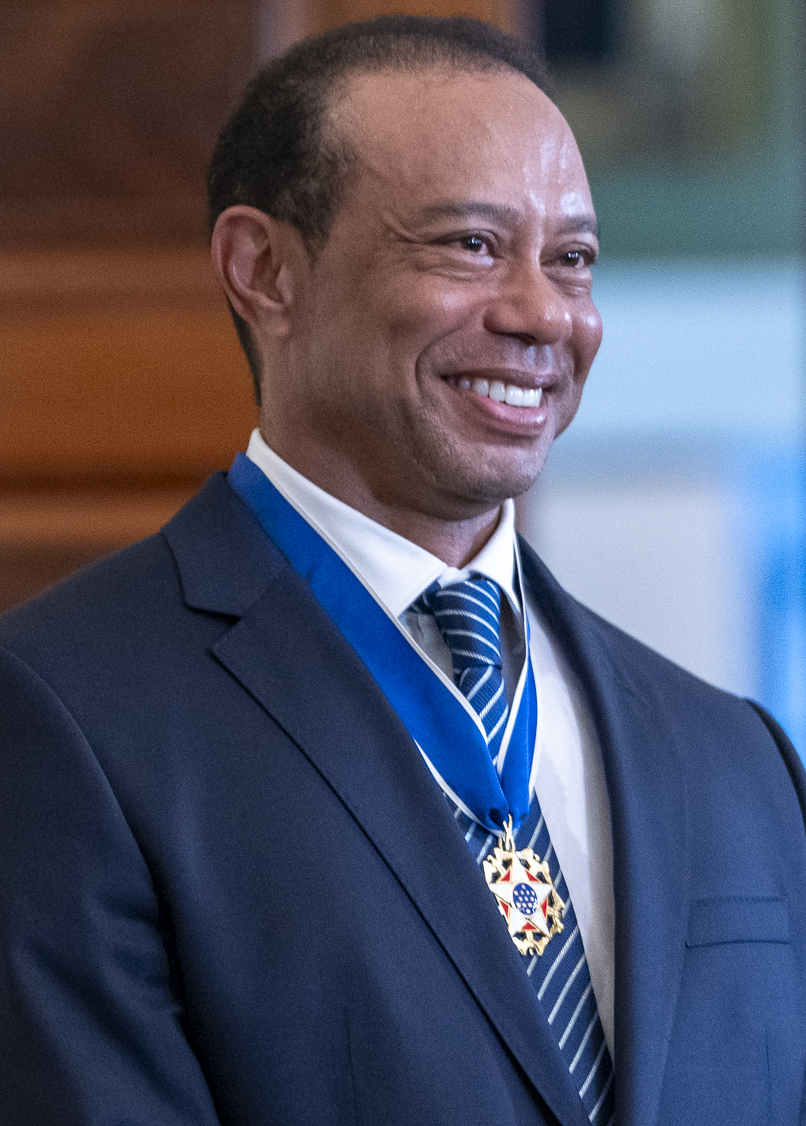
He won the 2019 Masters at 13 under par, his fifth Masters title and his 15th major championship overall, placing him two behind Jack Nicklaus’s record of 18 and reigniting a debate about whether he could still pass it. The reception on the 18th green, where his son Charlie and daughter Sam ran to embrace him, was an emotional moment that reduced most of the watching sporting world to tears. The president of the United States awarded him the Presidential Medal of Freedom.
The comeback is, objectively, the most remarkable in the history of professional sport. No other athlete has returned from the physical damage he sustained and the personal devastation he experienced to compete at the absolute summit of their profession.
The 2021 Car Accident and Ongoing Resilience
In February 2021, Tiger Woods was seriously injured in a single-vehicle rollover accident in California. His vehicle crossed a median, went off the road and rolled over several times. First responders used an axe and crowbar to remove him from the vehicle. He sustained comminuted open fractures in his right tibia and fibula, injuries to his foot and ankle, and damage to muscle and tissue requiring extensive repair. Doctors told him they had considered amputation. He was in hospital for weeks and then underwent a long rehabilitation process at home.
In December 2021, he played a nine-hole exhibition with his son Charlie, walking the course with a noticeable but manageable limp. In April 2022, he competed at the Masters, finishing 47th, the significance of the result entirely overshadowed by the astonishment that he could compete at all. He continued to make occasional competitive appearances, each one a reminder that the body he had reconstructed was not what it had been but was more than most people had believed possible.
Impact on the Sport
The measurable impact of Tiger Woods on professional golf’s economics is without parallel in the history of the sport. PGA Tour total prize money for 1996, the year he turned professional, was 65.5 million dollars. By 2009, it had grown to 278 million dollars, a figure that golf administrators attributed substantially to the Tiger Effect: the dramatically increased television ratings his presence generated, the sponsorships that followed those ratings and the attendance records he set at virtually every tournament he entered.
Courses he played routinely sold out of spectator tickets within hours of his entry confirmation. Television networks structured their broadcast schedules around which day he was playing. Entire generations of golfers in countries where the sport had previously had minimal following grew up watching him and were inspired to take up the game. In Asia particularly, his mother’s Thai heritage making him a figure of genuine pride in Southeast Asia, his influence on golf participation rates was documented and dramatic.
He also changed the sport’s physical culture. Before Tiger, professional golfers were not particularly regarded as athletes in the conventional sense. Tour players ate what they wanted, drank regularly and did not follow structured fitness programmes with any consistency. Tiger’s arrival with a Navy SEAL trainer, a strict dietary regime and a gym-built physique that was visibly different from any previous Tour player’s body changed expectations for the entire profession. Within a decade of his arrival, the PGA Tour had fitness trailers at every event and virtually every player under forty followed a structured conditioning programme.
Legacy
Tiger Woods is 15 times a major champion, 82 times a PGA Tour winner (the joint record alongside Sam Snead), a three-time PGA Tour Player of the Year, an 11-time PGA Tour money leader and the recipient of virtually every honour the sport can bestow. His World Golf Ranking number-one position was held for a cumulative total of 683 weeks.
But the statistics, even those extraordinary ones, do not fully account for his legacy. His legacy is the game he transformed, the players he inspired and the standard of mental and physical commitment he established for professional golf. It is also the narrative of resilience: the proof that a person can fall from greater heights than almost anyone alive and still find a way back.
Key Facts
- Tiger Woods has won 15 major championships, second only to Jack Nicklaus’s record of 18, and 82 PGA Tour events, tied with Sam Snead for the all-time record.
- His 2000 US Open victory at Pebble Beach, by 15 strokes, remains the largest winning margin in major championship history.
- He held the World Golf Ranking number-one position for a cumulative total of 683 weeks, more than any other player in the sport’s history.
- The “Tiger Effect” on PGA Tour prize money saw the total grow from 65.5 million dollars in 1996 to 278 million dollars in 2009.
- His 2019 Masters victory, his 15th major, came nearly eleven years after his previous major win and following four back surgeries and a personal crisis that had threatened to end his career permanently.
The Measure of the Achievement
Any honest assessment of Tiger Woods must grapple with what he overcame as well as what he won. He changed golf’s demographics, its prize structures and its global audience. He survived the public destruction of his personal reputation and the physical destruction of his athletic body, and he found a way back from both. The 2019 Masters victory, won on a course where he had won his first major in 1997 as a 21-year-old who looked like no one who had ever played the game before, closed a circle that most observers had concluded could never be closed.
The story is not finished. He continues to compete when his body allows it, and the question of whether he can win again at the highest level remains genuinely open. But even if he never wins another tournament, the legacy is already complete. He is, alongside Muhammad Ali and Michael Jordan, one of the three or four athletes who most profoundly changed what sport looks like, who watches it, and what watching it means. That is not something that tournament results can diminish.